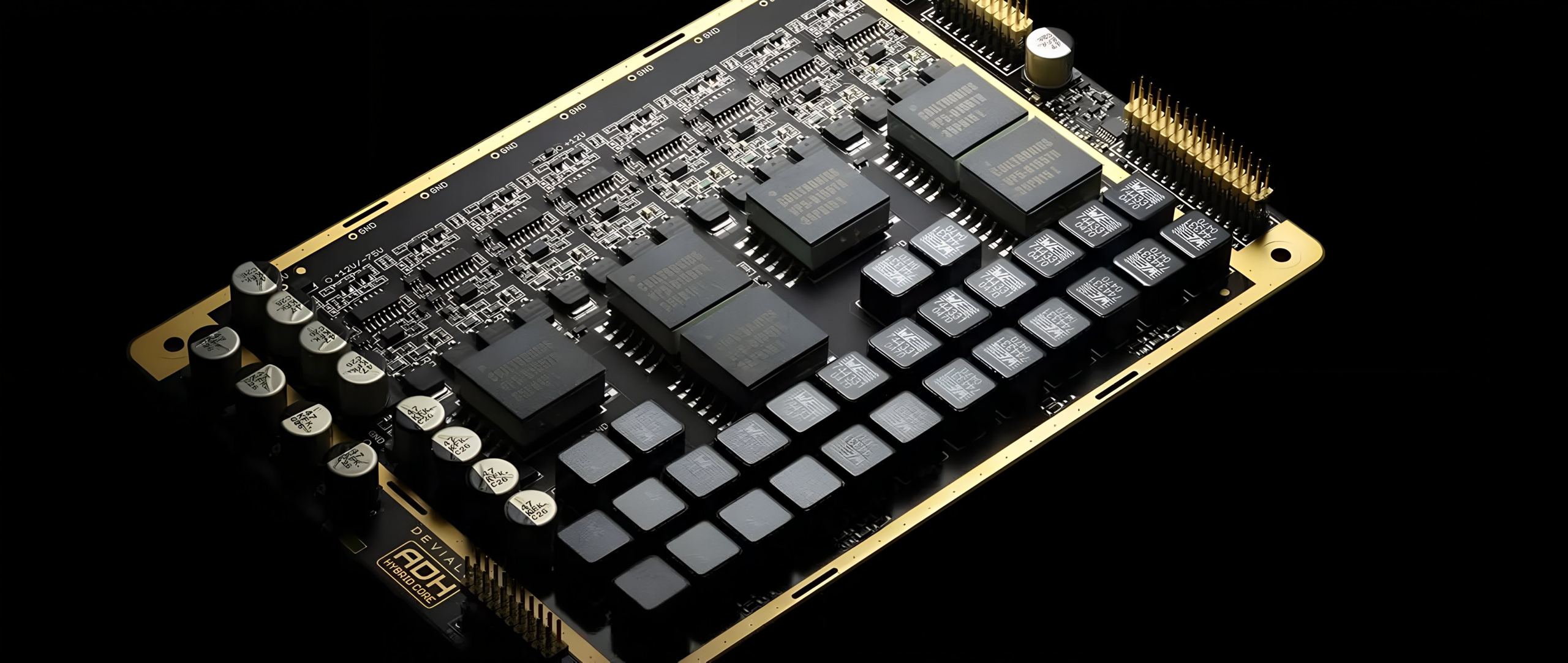
The Phantom Ultimate 98 dB embodies the new generation of connected speakers from Devialet, combining 400 watts of power and a frequency response ranging from 18 Hz to 25 kHz in a surprisingly compact form factor. This single-channel speaker, designed and manufactured in France, represents ten years of technological evolution since the first Phantom launched in 2015, integrating the latest advances in digital signal processing and hybrid amplification. With its quad-core NXP i.MX 8M Nano processor clocked at 1.5 GHz and its new DOS 3 operating system, it offers extended connectivity including Tidal Connect and Google Cast, two protocols absent from previous generations.
Mechanical construction in the service of acoustic purity
The structure of the Phantom Ultimate 98 dB reflects an approach where every element contributes to controlling parasitic vibrations. The speaker uses a bi-injected composite design pairing an internal layer of glass fiber–reinforced polycarbonate with an external ABS shell. This construction is anchored by a central core of die-cast aluminum, a true backbone capable of withstanding the considerable forces generated by the side-firing drivers during their excursions.
The speaker’s dimensions (157 × 219 × 168 mm for 4.3 kg) remain identical to those of the Phantom II it replaces, but several substantial changes have been made. The full-range driver grille now features a 13% higher aperture ratio, enabling better propagation of high frequencies. The aluminum side woofers, visible for the first time without protective covers, provide a striking visual display when in motion, with excursions that can reach several centimeters on the deepest notes.
The user interface has been redesigned with four capacitive touch controls on the top: volume, play/pause, and Bluetooth activation. An LED indicator communicates operating status via simple visual codes (off, flashing on startup, solid white in operation). Two finishes are offered: Deep Forest, a deep green with black chrome reflections, and Light Pearl, a matte pearlescent white reminiscent of biscuit porcelain. A special Opéra de Paris edition, the result of a partnership initiated in 2017, features contours gilded with gold leaf applied by hand at Ateliers Gohard, requiring eight hours of artisanal work per unit.
Next-generation ADH: the perfect synthesis of analog and digital
At the heart of the Phantom Ultimate 98 dB beats ADH (Analog Digital Hybrid), Devialet’s foundational technology perfected since 2004. This hybrid approach runs an analog Class A amplifier, renowned for its linearity and musicality, in parallel with digital Class D amplifiers, valued for their efficiency and compactness. The principle is akin to automotive power steering: the analog amplifier generates the output voltage and defines signal quality, while the digital amplifiers supply the current needed to drive the speakers.
This new generation of ADH benefits from refined control algorithms that allow perfect synchronization between the two amplification types, even at the highest frequencies. The analog amplifier maintains a natural bandwidth extending from DC up to 5 MHz, ensuring flawless transient reproduction and zero phase shift within the audio band. The digital amplifier, free of an output capacitor, achieves an effective efficiency of 90% with a constant output impedance below one milliohm across the spectrum.
SAM (Speaker Active Matching) technology analyzes the electromechanical characteristics of the drivers in real time using laser interferometry measurements carried out in the lab. More than sixty parameters are modeled for each transducer: displacement, deformation, velocity, acceleration, resonances. This algorithmic processing corrects timing offsets between different drivers, particularly noticeable in the bass where diaphragms respond more slowly. The result is exceptional temporal coherence and bass extension well beyond usual physical limits.
Acoustic performance that defies the laws of physics
The HBI (Heart Bass Implosion) system is one of Devialet’s acoustic hallmarks. This suite of multiphysics innovations enables the two 2 × 75 mm side woofers to reach down to 18 Hz despite an internal volume of just 3.5 liters. The drivers operate in a push-push configuration, their diaphragms moving symmetrically inward and outward in perfect sync. This arrangement cancels the reaction forces that, in a conventional speaker, would generate cabinet-borne vibrations.
The maximum sound pressure of 98 dB SPL at 1 meter may seem modest compared with the 108 dB of the higher model, but it remains more than sufficient to fill rooms up to 40 m². Signal processing is performed internally at 32-bit/96 kHz, preserving the resolution of high-definition files. Inputs accept signals up to 24-bit/192 kHz, although streaming via certain protocols like AirPlay is limited to 16-bit/44.1 kHz.
AVL (Adaptive Volume Level) technology, inherited from the Dione soundbar, dynamically adjusts equalization based on the content being played. This intelligent processing maintains tonal balance at all listening levels, compensating for the limitations of human hearing at low volumes while preserving dialogue clarity in audiovisual content. Background noise, measured at 0 dB SPL at 1 meter, attests to the electronics’ exceptionally silent operation.
Wireless connectivity designed for the modern ecosystem
The new DOS 3 operating system, powered by the NXP i.MX 8M Nano processor, marks a major evolution in the Phantom’s streaming capabilities. Native integration of Tidal Connect now allows subscribers to stream directly from the mobile app without using Devialet’s interface. Google Cast offers similar functionality within the Android ecosystem, simplifying multiroom playback and voice control via Google Assistant.
AirPlay and Spotify Connect, already present in previous generations, benefit from optimizations that reduce latency and improve connection stability. Roon Ready (RAAT) compatibility will appeal to audiophiles with large music libraries, offering advanced metadata management and automatic upsampling. The UPnP protocol enables playback of files stored on a NAS or computer on the local network, with a maximum resolution of 24-bit/96 kHz.
Physical connectivity is deliberately limited to a mini-TOSLINK optical input and an RJ45 Ethernet port. This apparent simplicity reflects real-world use: the optical input, compatible with 3.5 mm jack adapters, allows connection of an analog source via an external converter or direct hookup to a TV. Ethernet ensures a stable link for multiroom setups comprising multiple speakers, with Devialet’s proprietary protocol enabling perfect synchronization of up to 16 units.
Wi‑Fi 5 (802.11 a/b/g/n/ac) in a 2×2 MIMO configuration operates on the 2.4 and 5 GHz bands, automatically adapting to network conditions. Bluetooth 5.2, limited to SBC and AAC codecs, is more of a fallback solution than a preferred listening mode, with the absence of high-definition codecs like aptX HD or LDAC confirming this orientation.
The Devialet app: control and personalization hub
The Devialet mobile app, completely redesigned for this new generation, goes beyond the role of a simple remote. The initial setup, required even for Bluetooth-only use, guides the user through network configuration and firmware updates. The stereo pairing process automatically detects the presence of two Phantom Ultimate 98 dB units on the same network and offers to link them.
The six-band parametric equalizer lets you tailor the sound signature to the room’s acoustic characteristics or personal preferences. Three preset listening modes optimize processing for different content: Music Mode for faithful reproduction of the original recording, Cinema Mode with widened spatialization and enhanced dynamics, and Podcast Mode prioritizing vocal intelligibility. Night Mode automatically reduces the amplitude of low frequencies to preserve neighborly peace without sacrificing listening quality.
Advanced settings include latency adjustment for audio/video sync, particularly useful when watching content on a TV connected via optical. Auto power-off scheduling, configurable from 30 minutes to 12 hours of inactivity, optimizes energy consumption. In standby, the speaker consumes only 2 watts while remaining instantly accessible over the network.
Wi‑Fi: Wi‑Fi 5 (802.11 a/b/g/n/ac) – 2×2 MIMO (2.4 and 5 GHz)
Ethernet: RJ45 (100 / 1000 Mbps)
Inter-speaker connection: Devialet DOS 3 protocol (96 kHz / 24-bit)
Optical input: 1 × mini‑TOSLINK
Streaming services
AirPlay
Google Cast
Spotify Connect
Tidal Connect
UPnP
Roon Ready (RAAT)
Bluetooth 5.2 (A2DP and AVRCP profiles, SBC and AAC codecs)
Power
Voltage: 100–240 V ~ 50 / 60 Hz
Power consumption
Off: < 0.5 W
Standby: < 2 W
Dimensions and weight
Speaker: 157 × 219 × 168 mm (W × D × H)
Weight: 4.3 kg
Packaging: 210 × 285 × 250 mm – 5 kg
Box contents
Devialet Phantom Ultimate 98 dB
Power cable
Documentation
Frequently Asked Questions
Can two Phantom Ultimate 98 dB units be used in a stereo setup?
+
Yes, the Devialet app makes it easy to pair two identical speakers to create a true stereo image. Synchronization occurs automatically via Wi‑Fi or Ethernet, with imperceptible latency between the two channels. The soundstage gains significantly in width and depth, with instruments precisely placed in space. For optimal results, space the speakers 1.5 to 2.5 meters apart and toe them in by 25 to 30 degrees toward the listening position.
What is the main difference between the Phantom Ultimate 98 dB and the 108 dB model?
+
Beyond the difference in maximum sound pressure (a 10 dB increase is perceived as roughly twice as loud), the 108 dB model uses a three-way configuration with separate tweeter and midrange in a coaxial arrangement, versus a two-way configuration for the 98 dB. The woofers in the higher model use ABS diaphragms rather than aluminum, allowing greater excursion and extension down to 14 Hz. The 108 dB also includes Wi‑Fi 6 and Bluetooth 5.3, versus Wi‑Fi 5 and Bluetooth 5.2 for the compact version.
Does the Phantom Ultimate 98 dB require an app to operate?
+
The Devialet app is essential for initial setup, even if you plan to use Bluetooth only. Once configured, the speaker can be controlled via the integrated touch controls or directly from compatible streaming apps (Spotify, Tidal, etc.). The app is still recommended to access advanced settings, firmware updates, and the customizable equalizer.
Can SAM technology damage the drivers?
+
On the contrary, SAM incorporates sophisticated protection mechanisms based on precise modeling of each transducer’s physical limits. The system continuously monitors diaphragm excursion and dissipated power, automatically limiting the signal before reaching critical thresholds. This dynamic protection paradoxically allows the drivers’ capabilities to be exploited more fully than with a conventional amplifier, while ensuring their integrity even during prolonged high-volume listening.
User reviews
Farid
A real disaster for an audiophile. My wife wanted one and, listening to it in the showroom, I found it not bad. But after a few hours of listening at home I started to find it very mediocre. Good for going boom boom, but for musicality you can give it a miss. It’s going to end up on leboncoin.
Comment from May 13, 2026 — Experience from March 10, 2026
Automatically translated — Show original (French)
Un vrai désastre pour audiophile. Ma femme
en voulait une et a l’écoute au showroom, je l’ai trouvé pas mal. Mais après qq heures d’écoute chez moi j’ai commencé à la trouver très moyenne. Bien’pour faire boum boum mais pour la musicalité on peut passer son tour. Elle va finir sur le boncoin.
To better understand our visitors, measure marketing effectiveness and personalise ads, we and our partners use cookies and mobile advertising identifiers on your device. This data makes it possible to display personalised and non-personalised ads and measure their performance. Some cookies, which are technically necessary, are exempt from consent. You can accept those that require your consent, refuse them by clicking "Refuse", or customise your choices via the settings screen.
To find out how Google uses the data collected once you have given your consent, see Google’s Business Data Responsibility site.
You can change or withdraw your consent at any time via the "Consent and cookies" link. Your choices will apply on our site for 12 months.