

Screen'up MO4790III
Overview
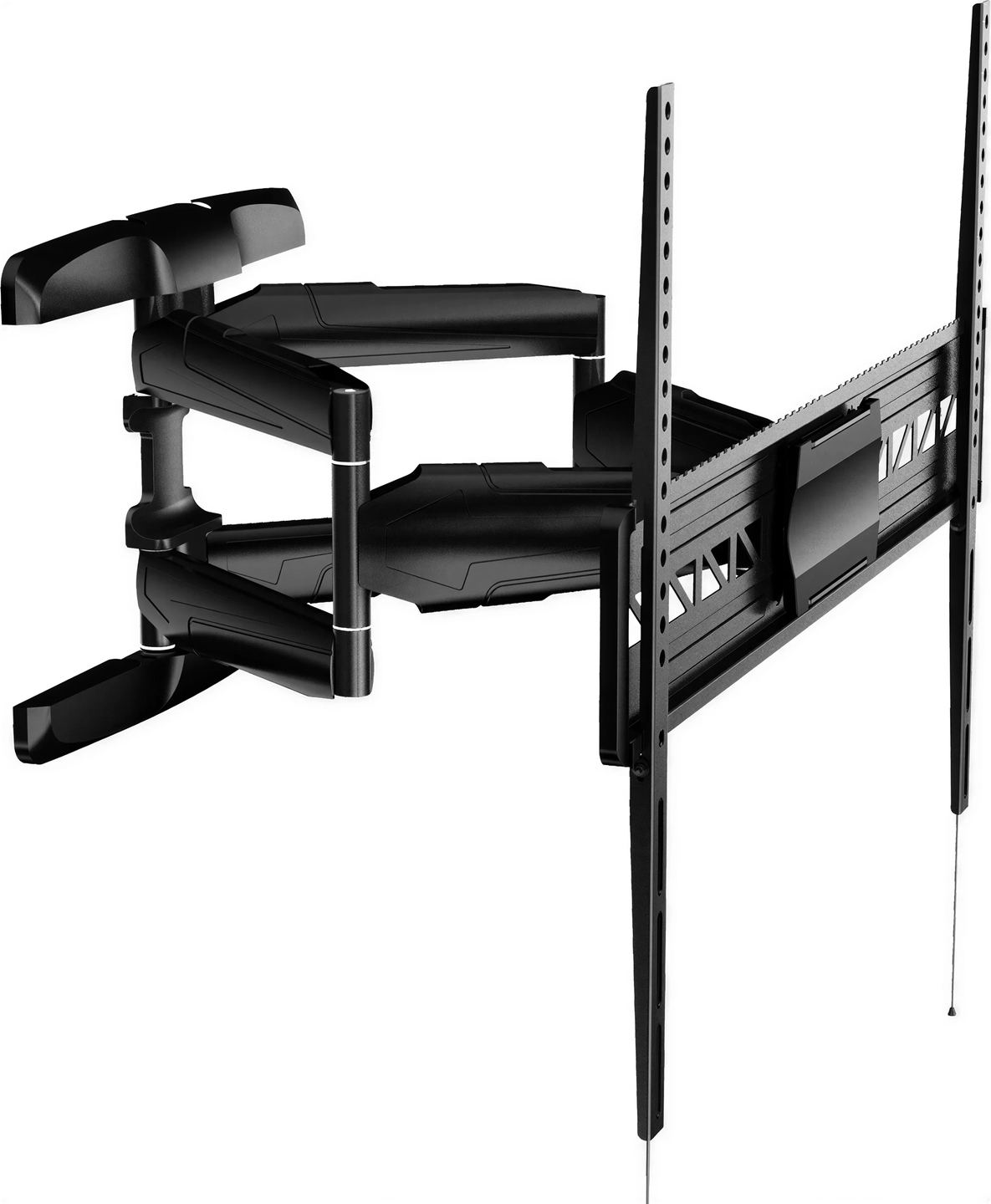
A large TV mounted flat against the wall stays fixed in a single position, facing the sofa and nowhere else. This wall arm from Screen’up pulls it away from the wall, turns it towards the dining table or reading corner, then brings it back to within a few centimetres of the wall once the film is over. It accommodates screens from 47 to 90 inches weighing up to 60 kg, which also covers very large screen sizes.
An arm that extends the screen up to 45 cm from the wall
When folded, the mount leaves 5.5 cm between the wall and the back of the TV, a distance close to that of a conventional fixed mount. When extended, it positions the screen 45 cm from the wall. This range of movement is primarily useful for adjusting the viewing direction: the screen can swivel through 90° to follow a change of seating position in the room or face a room opening onto the living room. The further the arm is extended, the more freely the screen can turn, as an 85-inch TV sitting flat against the wall can barely swivel without its edge touching the wall.
The clearance also has a very practical benefit. To connect a new console, replace an HDMI cable or reach a USB port on the back of the panel, simply pull the screen towards you rather than take it off the mount.
Useful tilt adjustment for mounting high up
The tilt range is −2° to +10°. Most of this range is used to tilt the screen downwards, which is helpful when the TV is mounted above a fireplace, a tall cabinet or a centre speaker: the picture aligns with your line of sight rather than forcing you to lift your head. These few degrees also allow you to move a distracting reflection from a window or ceiling light out of the viewing area.
VESA compatibility and load capacity
The attachment on the back of the TV uses the VESA standard, a standardised mounting hole pattern expressed in millimetres (horizontal spacing × vertical spacing of the four threaded holes). This mount accepts hole spacings up to 800 × 600 mm, a format found on large TVs. The VESA hole spacing and screen weight are listed in the TV’s manual or specification sheet: these two values, more than the screen diagonal, confirm compatibility. A 90-inch screen weighing more than 60 kg exceeds the arm’s capacity, even if its size falls within the stated range.
An installation that requires a solid wall
The mount alone weighs 9.06 kg, and the supplied fixings cover attachment to the screen and to a solid wall (concrete, solid brick, stone). With a 50 or 60 kg TV extended to 45 cm, the arm exerts considerable leverage on its anchor points: the quality of the wall matters just as much as that of the mount. On a plasterboard, hollow brick or plaster block partition, you will need fixings suited to the material, or even structural reinforcement, and seeking an installer’s advice is the sensible approach. Fitting the TV onto the arm is a two-person job, with the 10.6 kg box (93 × 44.5 × 8 cm) already giving an idea of the overall size of the assembly.
Technical Specifications
Dimensions and Compatibility
- Compatible with screens from 119 to 229 cm
- VESA compatibility up to 800 × 600 mm
- Distance from the wall: 55 to 450 mm
Capabilities
- Maximum supported weight: 60 kg
- Tilt: −2° to +10°
- Rotation: 90°
Product Information
- Screws included for screen and solid wall mounting
- Weight:
- Product: 9.06 kg
- Packaging: 10.6 kg
- Packaging dimensions (W × H × D): 931 × 445 × 80 mm
Frequently asked questions
Can this bracket be mounted on a plasterboard partition?
Not with the supplied screws, which are intended for solid walls. On plasterboard, the mount must be secured to reinforced framing (doubled metal studs, a wooden panel built into the partition) or with specialist wall plugs whose load capacity has been verified for the total load. Given the weight of a large television and the leverage exerted by the extended arm, a lightweight partition without reinforcement must not be used.
At what height should the TV be placed?
For seated viewing, the usual guideline is to position the centre of the screen at eye level, approximately 1 m to 1.10 m above the floor, depending on the sofa’s seat depth and height. If the television needs to be positioned higher, tilting the mount downwards compensates for some of the difference.
How do you manage cables with an articulating arm?
Allow for cables long enough to follow the TV up to 45 cm from the wall and as it swivels, without pulling on the connectors. A flexible sleeve or cable ties secured along the arm keep everything tidy, while cable trunking or a recessed channel in the wall conceals the cable run down to the cabinet.
Can the TV remain unfolded permanently?
Yes, as long as the screen’s weight is within the 60 kg capacity. The folded position puts less strain on the anchors and offers a more discreet appearance, making it the most sensible resting position for everyday use. Periodically checking that the screws are tight remains a good habit for an arm that moves frequently.
What equipment is needed for installation?
A drill with a drill bit suitable for the wall (concrete or masonry), a spirit level to align the wall plate, a tape measure, a pencil and a screwdriver or spanner for the fixings. A cable and pipe detector prevents drilling in the wrong place.
Is this mount suitable for a 43-inch TV?
The advertised range starts at 47 inches (119 cm). For a smaller screen, the VESA mounting hole spacing may not match the mounting arms, and a mount designed for lighter screens will be more suitable.
- Eco-contribution included in the sale price.
- GTIN / EAN: 3700432030725


