Audiovisual Racks
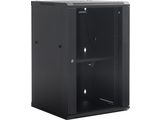
An AV rack is a 19-inch standardized technical cabinet designed to organize and protect your home theater equipment. It brings together amplifiers, audio-video processors, players, and other devices in a stable structure that optimizes their performance. Available in different heights (measured in rack units, U), these racks simplify cable management, ensure proper ventilation, and make maintenance of your setup easier. Learn more
Why choose an AV rack?
Beyond simple storage, an AV rack addresses several essential technical needs for a high-quality home theater installation. It centralizes all your gear in a structured space, preventing haphazard stacking of devices and reducing the risk of overheating or malfunction.
Cable management is one of the main advantages of a rack. The numerous connections (HDMI, analog audio, power, network) can quickly become unmanageable. A rack allows you to separate signal cables from power cables, which reduces electromagnetic interference and improves audio and video quality. Integrated cable routing and mounting systems greatly simplify installation and future interventions.
The 19-inch format: a universal standard
The 19-inch format (483 mm wide) has become the benchmark in the AV industry. Compatible equipment mounts on standardized rails, and height is measured in rack units (1U = 44 mm). This standardization ensures compatibility across brands and makes it easier to upgrade your setup over time.
Racks come in several configurations: caster-mounted models for increased mobility, wall-mounted versions to save space, or larger freestanding structures. Depths generally range from 450 to 600 mm to suit your equipment dimensions and your room.
Thermal management and equipment protection
Amplifiers and processors generate heat during operation. A well-designed rack ensures natural airflow through perforated panels or active ventilation systems. Proper thermal management extends the lifespan of your gear and maintains optimal performance.
A rack’s robust structure also protects your equipment from accidental impacts, dust, and improper handling. Models with solid or glass doors and locks provide added security—especially useful in shared spaces or professional installations.
Optimizing audio and video performance
A quality rack directly contributes to your system’s performance. The rigidity of the structure minimizes vibrations that can degrade the signal, particularly for sensitive audio sources. Some models include decoupling systems or adjustable feet to effectively isolate your entire setup.
The systematic organization provided by a rack also enables better grounding of your devices, reducing ground loops and noise that impair sound quality.
Selection criteria
To choose the right rack for your needs, first assess the number and size of your current equipment, while planning for future upgrades. Count in rack units (U): an amplifier typically takes up 2 to 3U, a player or processor 1 to 2U.
Depth is just as important as height. Make sure your rack can accommodate your deepest devices, and allow extra space for rear cable routing.
The type of door affects both aesthetics and functionality. A glass door lets you see LED indicators without opening it, while a solid or perforated door can improve acoustic isolation or ventilation.
Installation and integration
An AV rack can be installed directly in your home theater room or in an adjacent equipment closet if you have the space. The latter option completely isolates equipment fan noise but requires longer cables and sometimes active solutions for HDMI signals beyond 10 meters.
Caster-mounted models simplify servicing and let you move the entire rack to access rear connections. Fixed or wall-mounted versions are better suited to permanent installations where floor space is limited.
Accessories and scalability
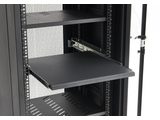
Racks support numerous accessories: sliding shelves for non-rackable devices, storage drawers for remotes and cables, blanking panels to fill empty spaces, and rack-mount power distribution units to centralize electrical distribution.
This modularity lets you tailor your rack precisely to your current configuration and easily scale it as you add new equipment or replace existing components.