High-Fidelity Vinyl
The Vinyl category brings together all the accessories and essential equipment to get the most out of your turntables. Phono cartridges and styli, RIAA preamplifiers, tonearms, specialized cables, record clamps, cleaning products: each element contributes to playback quality and the preservation of your records. From simply replacing a worn stylus to completely upgrading an audiophile setup. Learn more




Must-haves
Best sellers

Phono cartridges and styli: the heart of playback
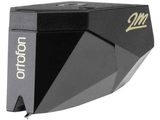
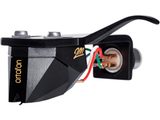
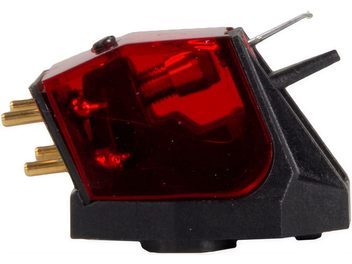
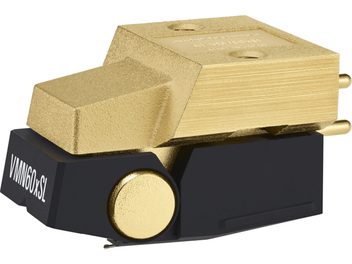
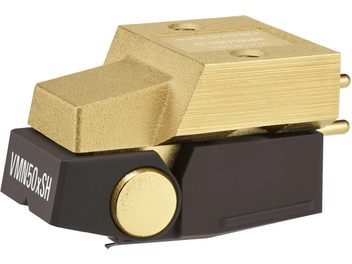
The phono cartridge is the most critical component of a turntable. Its role is to extract the information engraved in a record’s grooves and convert it into an electrical signal. The quality of this conversion directly determines the fidelity of the sound reproduction.
Cartridge types
Two main technologies coexist: moving magnet (MM) and moving coil (MC) cartridges. MM cartridges are the most widespread standard, offering good value for money and universal compatibility. Their output level of around 4 mV makes amplification easier and ensures compatibility with most phono preamplifiers.
MC cartridges deliver a much lower signal, sometimes below 0.2 mV, but generally offer better resolution and a wider frequency response. They require a specifically designed phono preamplifier or a step-up transformer to compensate for their low output level.
Cartridge mounting
Three mounting systems exist depending on the tonearm type. The P-Mount (or T4P) system, now discontinued, equipped entry-level turntables up until the mid-1980s. The 1/2-inch standard is now the most common, requiring precise alignment and tracking force adjustment. The Ortofon/SME system is mainly used with high-end arms and certain specific cartridges.
Styli and needles
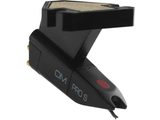
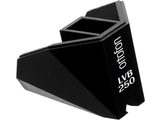
The diamond, or stylus, attaches to the cartridge and directly contacts the record groove. Its shape greatly influences playback quality. Spherical (or conical) tips are found on entry-level turntables and DJ cartridges, offering appreciated robustness but limited resolution.
Elliptical tips are the hi-fi standard, providing an optimized contact surface with the groove walls. They are the ideal choice for mid-range turntables and can significantly improve playback quality on a reasonable budget.
Advanced profile tips (Contact Line, Micro Linear, Shibata) equip high-end cartridges. Their sophisticated geometry maximizes contact area while minimizing record wear. These profiles deliver outstanding audio performance, revealing the most subtle nuances of recordings.
A stylus’s lifespan varies depending on build quality and usage conditions. Manufacturers like Ortofon state a minimum of 1000 hours of listening under normal conditions. A worn stylus gradually degrades the sound and can irreversibly damage record grooves. Regular replacement is therefore essential.
Phono preamplifiers: the necessary amplification
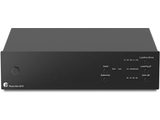
The phono preamplifier performs two essential functions for operating a turntable. First, it amplifies the very low-level signal produced by the cartridge to standard line level (around 2 V) compatible with modern amplifiers. A CD player outputs a line-level signal directly, but a phono cartridge produces a signal 500 to 10,000 times weaker.
Second, the preamp applies the RIAA equalization curve. In the 1950s, the Recording Industry Association of America standardized a pre-emphasis curve to address the physical constraints of microgroove records. High frequencies are boosted and lows attenuated during cutting. The preamplifier applies the inverse correction to restore the natural balance of the sound spectrum.
Built-in or external preamps
Many modern turntables include a built-in phono preamplifier, greatly simplifying setup by allowing direct connection to an amplifier’s auxiliary input. This practical solution is perfectly suited to entry- and mid-range systems.
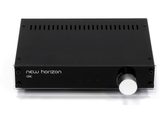
For demanding audiophile systems, a dedicated external phono preamplifier generally outperforms built-in phono stages. These units benefit from dedicated power supplies, higher-quality components, and optimized design. The audible difference manifests as a wider soundstage, better instrument separation, and increased resolution.
MM/MC compatibility
Choosing a phono preamplifier must take into account the cartridge type. An MM preamp suits moving magnet cartridges, offering about 40 dB of gain and a standard 47,000-ohm load. MC preamps require a minimum of 58 dB of gain and typically provide adjustable resistive loads between 50 and 1000 ohms to accommodate different MC cartridges.
Many models offer switchable MM/MC compatibility, providing valuable flexibility for future upgrades. This option makes it easy to switch from an MM to an MC cartridge without replacing the preamplifier.
Tonearms: mechanical precision
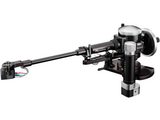
The tonearm supports the cartridge and guides its movement across the record. Its design directly influences playback quality. A rigid arm minimizes unwanted resonances, while a well-balanced design ensures consistent tracking force across the entire record.
Sophisticated arms allow multiple adjustments: height to set vertical tracking angle (VTA), azimuth for cartridge level, tracking force adjustable to the gram, anti-skate to counter centripetal force. These parameters require precise adjustment to optimize playback and preserve records.
Three tonearm geometries coexist: traditional pivoted arms (the most common), tangential arms that follow a path parallel to the grooves (eliminating tracking error), and unipivot arms resting on a single point (favoring freedom of movement).
Cables and connectivity
Phono cables
Phono cables connect the turntable to the preamplifier or amplifier. Their specific design takes into account the very low signal level and its sensitivity to electromagnetic interference. Effective shielding and controlled capacitance are essential to preserve signal integrity.
The total capacitance of the phono cable (including cartridge and preamp capacitances) influences the frequency response of MM cartridges. Excessive capacitance attenuates high frequencies, while too low a value can create undesirable resonance. Typical values range from 100 to 200 picofarads per meter.
Ground cables
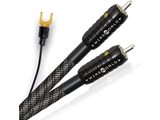
The ground cable connects the turntable chassis to the ground of the amplifier or preamplifier. This connection eliminates ground loops responsible for hum. A quality ground cable with optimal contact ensures quiet operation of the system.
Headshell leads
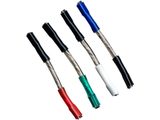
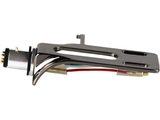
Headshell leads provide the electrical connection between the cartridge pins and the tonearm contacts. These thin, short wires require careful handling during installation. Some enthusiasts replace the original leads with aftermarket copper OFC or silver models to optimize signal transmission.
Installation and setup accessories
Record clamps
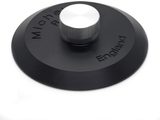
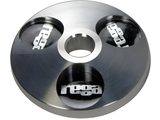
The record clamp sits at the center of the record to press it firmly against the platter. This device improves mechanical coupling between the record and the platter, reducing resonances and stabilizing rotation. Clamps come in various materials (steel, brass, acrylic) and weights, each subtly influencing sound reproduction.
Setup kits
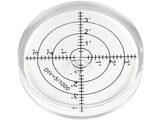
Setup kits bring together essential tools to properly adjust a turntable: precision scale to check tracking force, alignment protractor to position the cartridge, bubble level for platter horizontality, VTA gauge to set tonearm height. These accessories enable optimal adjustments, a sine qua non for quality playback.
Disc centerers
Disc centerers compensate for off-center pressings. An off-center record generates audible speed variations (wow) on sustained notes. Placed on the platter spindle, the centerer allows you to adjust the record’s position for perfect centering.
Maintenance and cleaning
Record brushes
Carbon fiber brushes remove surface dust before and after each play. Their anti-static action neutralizes static electricity responsible for attracting dust. Systematic brushing before playback prolongs the life of records and the stylus.
Cleaning fluids
Specialized cleaning fluids dissolve embedded grime in the grooves. Applied with a microfiber cloth or dedicated brush, they restore record cleanliness and significantly improve playback quality. Modern formulations are vinyl-safe and dry quickly without leaving residue.
Record cleaning machines
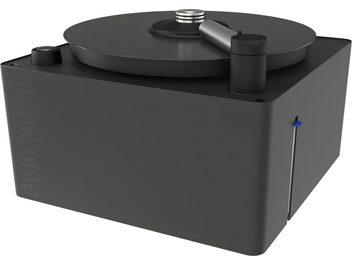
Automatic or semi-automatic cleaning machines offer deep cleaning impossible to achieve manually. Combining mechanical action, cleaning solution, and vacuum, they remove all impurities lodged in the grooves. Ultrasonic machines represent the pinnacle of cleaning, using ultrasonic waves to dislodge the tiniest particles.
Stylus cleaning
The stylus quickly accumulates deposits (dust, vinyl residue) that degrade sound and accelerate wear. Cleaning before and after each play with a specific anti-static brush preserves performance. Stylus cleaning fluids dissolve stubborn residues without damaging the cantilever or the cartridge generator.
Mechanical accessories
Turntable dust covers
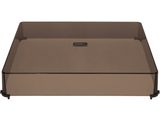
Dust covers protect the turntable when not in use. Hinged models allow convenient opening, while removable covers offer greater rigidity, eliminating unwanted vibrations. Some audiophiles prefer to remove the cover entirely during listening to avoid any sonic coloration.
Platter mats
Platter mats sit between the platter and the record. Their material (felt, cork, leather, rubber, acrylic) influences mechanical coupling and acoustic characteristics. Each material offers a different balance between vibration damping and dynamic response.
Belts
Belt-drive turntables require periodic replacement of this wear part. An aged belt loses elasticity, causing speed variations and degrading speed stability. Aftermarket belts in neoprene or specialized synthetic materials promise better torque transmission and increased longevity.
Power and electronics
External power supplies
Some turntables accept upgraded external power supplies, replacing the original power supply. These regulated power blocks deliver perfectly stable current, eliminating mains fluctuations. The benefit translates into improved speed stability and a lower noise floor.
Transformers
Step-up transformers allow a very low-output MC cartridge to be matched to an MM preamplifier. This passive solution, with no power supply, preserves the character of the signal while providing the necessary gain.
Racks and storage
The support for the turntable influences its performance. A rigid, massive rack absorbs unwanted vibrations, while effective decoupling isolates the turntable from floor-borne vibrations. Specialized supports use damping materials or suspension systems to optimize vibration isolation.
Dedicated storage for accessories (spare cartridges, cleaning products, setup tools) helps organize and preserve equipment. Proper storage protects sensitive items such as spare styli and delicate cables.
Complete vinyl systems
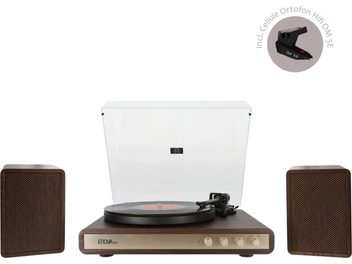
For newcomers or those seeking a turnkey solution, complete vinyl systems combine turntable, amplification, and speakers in a coherent, harmonious setup. These pre-assembled configurations ensure optimal component compatibility and greatly simplify installation.