Speaker jumpers
On a speaker with dual binding posts, two short links connect the bass section to the treble section when only one cable comes from the amplifier. Manufacturers supply straps, metal plates that are rarely on par with the rest of the speaker. Jumper cables replace them over the last few centimeters of the signal path, with a copper conductor and proper connectors. Learn more
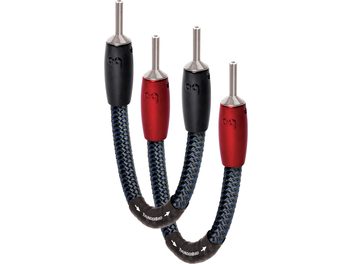
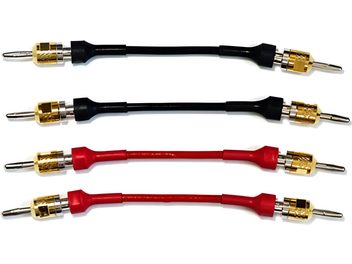
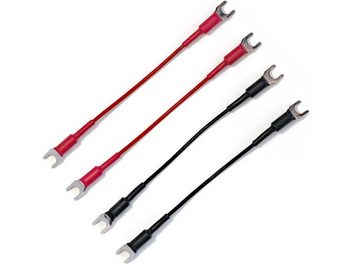
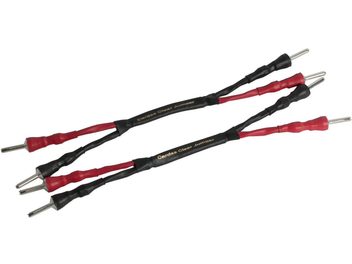
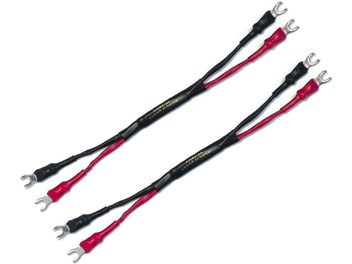
The exact role of a jumper
A two-way speaker contains a passive crossover that splits the signal between the woofer and the tweeter. When the manufacturer brings out the inputs of these two branches separately, the terminal panel has four posts instead of two. The speaker cable feeds only one pair. The jumper provides electrical continuity to the other pair. Without it, half of the spectrum remains silent.
These links measure between five and twenty centimeters. Yet they sit on the path of the amplified signal, where current reaches its maximum intensity in the audio chain. Contact resistance and the nature of the metal used factor into the electrical performance of the system, just like the meters of cable coming from the amplifier.
Stock straps and their limits
The bridge supplied with the speaker is most often a stamped brass plate, sometimes nickel-plated, sometimes gold-plated with just a few microns. Its manufacturing cost is counted in cents. Two criticisms are commonly made of this strap. Brass conducts about four times less well than pure copper. And the plate establishes only a flat contact, crushed under the washer, on a surface that oxidizes and loosens over thermal cycles.
A wired jumper substitutes this strap with a copper conductor terminated with crimped or soldered connectors. The benefit comes down to series resistance and the quality of the metal-to-metal contact. Nothing spectacular in listening terms, but one less anomaly in a link nobody looks at.
Some users cut a leftover piece of their speaker cable and strip it to connect the two pairs. The approach is consistent, since the metal remains the same over the entire length, and it costs almost nothing. It simply requires keeping an eye on tightening: a bare copper strand oxidizes faster than a treated spade.
Copper, silver, and surface treatments
Oxygen-free copper, designated by the acronym OFC, serves as the reference for most audio jumpers. Its low impurity content limits the formation of internal oxide. The most ambitious brands use single-crystal copper (OCC), whose grains are drawn in the direction of the current, reducing the number of intergranular boundaries crossed by the signal.
Pure silver has the best conductivity of all metals, ahead of copper by a few percent. Over a length of ten centimeters, the difference in resistance remains tiny. Silver plating on copper is mainly about long-term stability: silver oxide conducts, unlike copper oxide, which stabilizes the contact over several years.
Connectors get their own treatment. Gold plating protects against corrosion and suits humid environments. Rhodium, being harder, resists repeated insertions better and is found on high-end jumpers. Nickel, economical, has poor conductivity and a magnetic layer that many manufacturers do without today.
Spades, bananas, and binding post compatibility
Two terminations dominate. The copper spade lug slips under the washer and is locked by tightening. The contact surface is large and mechanical hold is excellent, provided it is retightened periodically. The 4 mm banana plug inserts along the axis of the post. It is quick to handle and does not cope well with lateral pulling.
The choice depends on the binding posts. Models with a nut accept both formats. Lever- or spring-clamp terminals, found on compact speakers, often require banana plugs or bare wire. Some speakers keep a 19 mm spacing, a standard derived from power connectors, which allows the use of twin banana blocks. A poorly sized jumper puts stress on the cable and wears out the binding post.
Spade-to-banana jumpers exist for terminals where the lower post is recessed into the base. Checking accessibility before purchase avoids a return.
Single wiring or bi-wiring
Dual binding posts allow three uses. In single wiring, a single cable feeds the speaker and the jumpers close the circuit to the second pair of posts. In bi-wiring, two separate cables leave the same amplifier outputs, the straps are removed, and each crossover branch gets its own line. In bi-amplification, two separate power stages each drive one branch.
The debate over the real benefit of bi-wiring has lasted forty years and will not be settled here. One point is widely agreed on: a quality cable in single wiring, completed with jumpers made of the same metal, gives better results than two mediocre cables in bi-wiring. The budget argument therefore favors the well-chosen single cable.
If the jumpers remain in place, they might as well share the design of the main cable. Mixing single-crystal copper over three meters with a brass plate over eight centimeters is like putting a spare tire on a sports car.
Choosing your jumpers for your system
The first need to identify concerns the binding posts: post spacing, termination format, accessibility. Next comes consistency with the speaker cable already in place, since the point of a jumper is to extend the same conductor all the way to the crossover. A high-end accessory installed behind an entry-level cable makes up for nothing.
On a hi-fi audio system built around revealing speakers, switching to wired jumpers brings an improvement that most listeners notice after a few hours of listening. In home theater, where bass and side channels dominate, the advantage is felt less clearly. So the budget question comes before the brand question. Before buying audio jumpers, advice in-store or online is better than buying blind.
Audio jumpers are sold in sets of four, two per speaker. Check that the quantity offered does indeed cover one complete pair of speakers.
How to install jumpers on speakers
Turn off the amplifier before any work. Remove the stock straps by fully unscrewing the posts. Position the jumpers while observing polarity: red connects the two positive posts, black the two negative posts. Reversing them puts the tweeter out of phase with the woofer and hollows out the upper part of the spectrum.
The speaker cable is then connected to one of the two pairs. Connection to the bass section is considered the most common, while connection to the treble section sometimes appears in manufacturers’ instructions. Cross wiring, positive on the treble and negative on the bass, also has its advocates. The differences are small and depend on the crossover: test both configurations on a track you know well.
Retighten the posts after a few days. Copper flows slightly under pressure and tightening torque drops. This simple step recovers more sound quality than many accessory changes.
Audible differences, to be kept in perspective
The improvement brought by a wired jumper falls into the category of small things: slightly clearer articulation in the lower midrange, a tweeter that breathes better on transients. Many audiophiles see it as the best ratio between the price paid and the performance gained on an already coherent system. On an entry-level system, the investment is less justified than in speaker stands or room acoustic treatment.
The relationship between the price of jumpers and their length often comes as a shock. The connectors and the labor for termination account for most of the cost, regardless of the cable’s centimeters. A ten-centimeter jumper uses as many connectors as a five-meter cable.
Maintenance and longevity
Contact points oxidize, slowly in a dry atmosphere, faster near the coast or in an unheated room. Annual cleaning of spades and binding posts with contact cleaner, followed by retightening, keeps the link in good condition. Silver- or rhodium-plated jumpers handle these conditions better than bare brass.
A properly installed jumper lasts as long as the speaker. It can be moved from one system to another, provided you check the post spacing and termination format of the new binding posts.
Frequently asked questions
Should jumpers be removed in bi-wiring
Yes, systematically. Leaving them in place short-circuits the two crossover branches and defeats the entire point of bi-wiring. There is no electrical risk, but the setup loses all interest.
What are the advantages of high-end jumpers
A single-crystal copper conductor, silver- or rhodium-plated connectors, and carefully made contact points. These audio jumpers improve signal conduction and maintain their performance over time, where a brass strap degrades.
Can a jumper improve the sound
On a revealing hi-fi system, yes, in modest proportions. Replacing a brass strap with a copper conductor improves conduction and contact stability. On an entry-level setup, the need is less pronounced.
Can a jumper damage a speaker
No, except in the event of polarity reversal between the two pairs of posts. A reversal destroys nothing but severely degrades the response in the crossover overlap region.
How to choose the length
Measure the spacing between the posts on your speaker, generally between 20 and 60 mm. Commercial jumpers provide enough margin for these spacings. A model that is too long creates an unsightly loop with no sonic consequence.
Can bare wire replace a jumper
Technically, yes. A stripped segment of speaker cable inserted into both posts creates a good-quality link. You must accept the oxidation of bare copper and retighten the posts regularly.