

Dedicated Home Theater Speakers
Dedicated home theater speakers are specifically designed for private screening rooms equipped with a projector. Unlike conventional living-room home theater speakers, they integrate behind an acoustically transparent screen and meet rigorous technical requirements. These LCR (Left-Center-Right) speakers deliver high efficiency, controlled dispersion, and exceptional power handling to recreate the commercial cinema experience. Learn more
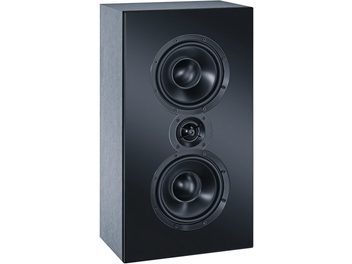


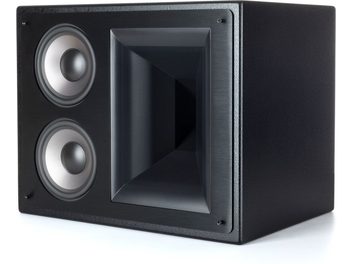


What is a dedicated home theater speaker?
Dedicated speakers differ from Hi-Fi speakers and versatile home theater systems by focusing on a single goal: total cinematic immersion in a purpose-built room. Their shallow depth (typically a maximum of 30 cm) allows optimal placement behind an acoustically transparent projection screen, whether micro-perforated or woven. This configuration ensures the sound seems to come directly from the image, exactly like in a professional movie theater.
Technologies and performance
These speakers incorporate specific technologies: compression drivers, waveguides (horns), and high-efficiency drivers capable of handling high sound pressure levels without distortion. Sensitivity generally exceeds 90 dB, enabling realistic acoustic levels even with moderately powered amplifiers. The passive crossovers are meticulously engineered to ensure perfect phase coherence between the different drivers.
THX certification and standards
THX certification (Select, Select2, Ultra, Ultra 2) is a benchmark for this category. A THX-certified speaker has passed hundreds of tests guaranteeing linear frequency response, low distortion, and optimized dispersion. THX Ultra 2 requirements notably mandate the ability to reproduce sound levels up to 117 dB without dynamic compression. Other certifications such as HAA (Home Acoustics Alliance) ensure compatibility with the acoustic standards of dedicated rooms.
LCR configuration and tonal consistency
The LCR configuration is fundamental in a dedicated setup. The three front speakers (left, center, right) must share an identical sonic signature to avoid any acoustic discontinuity when sound pans from one channel to another. This is why many manufacturers offer symmetrical LCR models that can be used interchangeably in horizontal or vertical orientation. The center speaker, ideally placed behind the center of the screen at ear height, ensures clear and precise dialogue reproduction.
Room integration
Physical integration is a crucial aspect. Dedicated speakers are designed to be on-wall, in-wall, or mounted behind the acoustically transparent screen. This visual discretion goes hand in hand with acoustic optimization: positioning at a distance from the screen material (at least 30 cm for a micro-perforated screen) prevents interference. Mounting brackets, often compliant with VESA standards, make precise positioning easier. To complete the installation, bipolar or dipolar surround speakers provide enveloping spatialization, while ceiling Atmos modules add the vertical dimension.
Compatibility and scalability
These speakers operate in configurations ranging from classic 5.1 to immersive systems such as 7.1.4, 9.2.4, or even 11.2.6 with Dolby Atmos and DTS:X. The AV receiver must provide sufficient power (minimum 50W per channel, 100W recommended) and support modern multichannel formats. Subwoofers—often multiple in larger rooms—complete the system by handling very low frequencies with authority. The result is a coherent sound experience in which every explosion, every line of dialogue, and every musical note finds its place within the three-dimensional space.
Who are they for?
Dedicated home theater speakers are aimed at enthusiasts with a room devoted to cinema, equipped with acoustic treatment and a projector with an acoustically transparent screen. They are suited to permanent installations where acoustic performance takes precedence over versatility. If your goal is to faithfully reproduce the filmmakers’ artistic intent with maximum dynamics and immersion, these speakers are the logical choice. They generally require installation by a certified professional to fully realize their potential in your specific environment.


