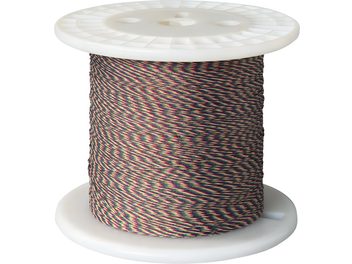

Tonearm cables
The tonearm cable carries the cartridge signal along the most critical path in the entire vinyl chain: from the stylus tip to the turntable output, before any amplification. This signal is tiny, a few millivolts for a moving-magnet cartridge, sometimes less than one-tenth of a millivolt for a moving-coil cartridge, making it extremely sensitive to noise and loss. Two realities are covered by this term. Inside the tonearm runs a very fine, flexible wire connecting the cartridge pins to the base, chosen to be lightweight so as not to hinder tonearm movement. At the output, a phono cable, fitted with a ground wire, then leads to the preamplifier. Rewiring a tonearm involves replacing this internal wire, a delicate soldering operation on fine strands and tiny pins, carried out to repair a worn conductor or upgrade a turntable. Quality is assessed according to precise criteria: low capacitance, which preserves high frequencies, especially with an MM cartridge, good shielding against interference, and in certain setups a continuous connection from the headshell to the plugs, with no intermediate connection. The length of the phono cable also matters, preferably short, without exceeding around one and a half metres. This cable extends the tonearm, connects to the preamp via a low-capacitance phono cable, before reaching the phono preamp.