

In-Wall Speakers
Save floor space and spread sound without visible furniture or cables: in-wall speakers fit into a partition or suspended ceiling and disappear behind a paint-ready grille. They are suitable for background music, stereo hi-fi listening, and home theater, all the way to Dolby Atmos height effects in the ceiling. The only requirement: a hollow wall or ceiling cavity to house them. Learn more
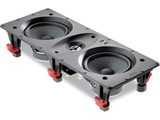
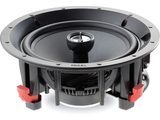
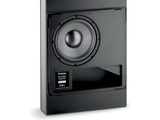
Best sellers
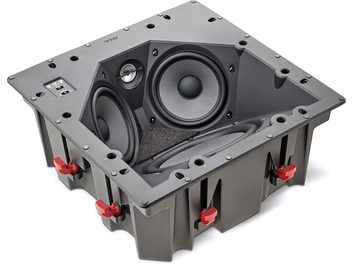
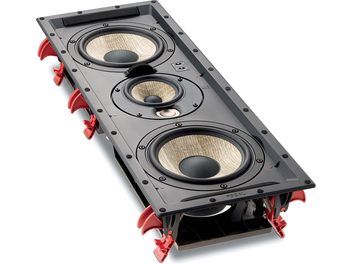
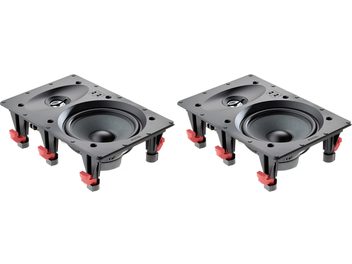
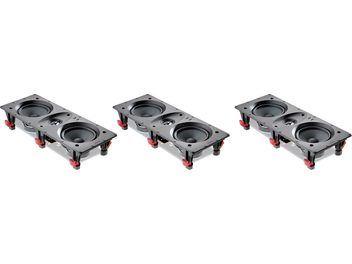
In-wall and in-ceiling speakers
There are two main families. In-wall speakers, often rectangular in shape, are mounted on the wall (on-wall) or recessed into the partition (in-wall), at ear level. Directional like bookshelf or floorstanding speakers, they create a precise stereo image and handle the front, center, and surround channels of a home theater system.
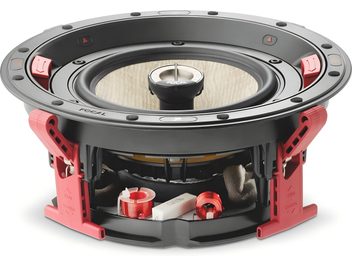
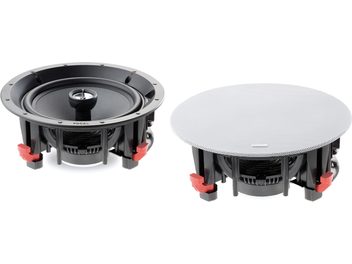
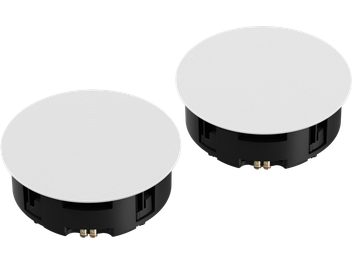
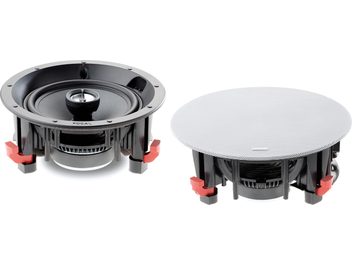
In-ceiling speakers are most often round and disperse sound over 360 degrees. This wide dispersion covers a large area with few listening points, which explains their use for background music in shops and restaurants, but also in a living room ceiling for Atmos and DTS:X height effects. A pivoting tweeter, when the model includes one, directs the treble toward the sofa rather than the floor.
Placement in home theater and hi-fi
In home theater, the two front speakers are placed on either side of the television, with the center speaker just below. With a video projector, the center speaker can go behind an acoustically transparent screen, a micro-perforated screen that lets sound pass through. Surround speakers belong on the side walls in line with the sofa or on the rear wall. For Dolby Atmos, ceiling speakers are installed slightly in front of the listening position, and wide dispersion helps cover all seated positions.
For stereo hi-fi listening, two in-wall speakers are enough, aligned on the same horizontal plane, with the tweeter at ear level when seated. Some speakers include a dual tweeter and reproduce a stereo signal on their own, which is handy in a hallway or bathroom where a pair makes little sense.
The role of the back box
An open-back in-wall speaker uses the wall cavity as its enclosure, a volume that varies depending on wall thickness, the insulation present, and the materials. From one location to another, the bass changes. The back box, built-in or added, closes off this volume: bass reproduction becomes consistent, and the sound energy transmitted to adjacent rooms drops noticeably. Useful when a bedroom is next to the living room.
One physical limitation remains: a driver housed in a thin wall rarely goes very low. For home theater or listening that calls for bass, a subwoofer, also available as an in-wall model, takes over below 80 hertz.
Choosing according to the room and the use
The driver diameter determines output level and bass foundation: a 13 cm driver is enough to fill a kitchen, while a 20 cm driver can handle a living room or dedicated theater room. Check the available depth behind the partition before choosing, especially in the ceiling where the service void is sometimes limited. In terms of coverage, allow roughly one listening point for every 25 to 30 m² and ceiling spacing of about twice the ceiling height.
In a wet room, bathroom, laundry room, or around a swimming pool, choose a tropicalized model, resistant to humidity, or even waterproof with a high IP rating. To stream without a separate amplifier, Bluetooth in-wall speakers include their own electronics and receive sound from a phone or tablet. And if you are equipping several rooms in a multiroom setup, keeping the same brand, and if possible the same series, preserves tonal consistency from one zone to another.
Cutting, wiring, and finishing
The principle remains accessible to a careful DIYer. The manufacturer provides a template to mark the cutout, made with a hole saw or a jigsaw. Before cutting, a stud finder locates the framing and above all the electrical cables or pipes to avoid. The speaker cable is run beforehand, with a cross-section of 1.5 to 2.5 mm² depending on the length, while observing polarity to preserve phase.
On an open-back speaker, lining the rear of the partition with glass wool limits reflected waves and vibrations. The swivel tabs clamp the speaker against the wall, then the magnetic grille clips on. Usually supplied in white, it can be painted to match the wall or ceiling, and the speaker fades from view. On a finished ceiling or for a complex multizone installation, calling in a specialist installer avoids many cable-routing mistakes.




