

Speaker Accessories
Protective grilles, spike shoes, carrying covers, charging stations, banana plugs and cables: speaker accessories take care of everything around the speaker driver. They protect floors and cones, ensure a reliable connection to the amplifier and make life easier for hi-fi, home theater or portable speakers, whether they stay in the living room or head off for the weekend. Learn more
Best sellers

Accessories with very distinct roles
The word “accessory” here covers items that have almost nothing in common. A grille and a cover physically protect the speaker, a spike shoe manages its contact with the floor or stand, a charging station supports the everyday use of a battery-powered model, while cables and connectors carry the signal from the amplifier to the speaker drivers. What they share is the need to match the equipment: most of these items depend on the speaker model, the type of terminal or the nature of the floor, and this is what should be checked before anything else.
This selection covers both living-room hi-fi speakers and PA speakers transported from one venue to another. Weight and handling requirements differ, but the same questions about compatibility with the model apply, whether the speaker is used for home audio listening or to provide sound in a venue.
Speaker grilles and driver protection
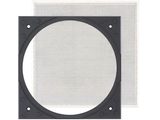
A grille is a frame covered with acoustic fabric, or a micro-perforated metal sheet, placed in front of the drivers. It protects the cones from dust, curious fingers and the cat’s claws, and gives the speaker a more understated appearance in a living space. It is usually attached by plastic pegs that fit into the front panel or by magnets concealed in the cabinet. The most common finishes remain black, gray or white acoustic fabric, matched to the cabinet’s color, whether it is black lacquered wood, veneer or a white finish.
A replacement grille must match the model exactly: dimensions, peg or magnet positions, and cutouts around the drivers. In-ceiling speakers and in-wall speakers have their own round or square grilles, often paintable to blend in with the wall color. On PA speakers, the grille is generally a thick steel sheet backed with foam, a more rigid construction that withstands knocks during transport and also protects the high-frequency horn. This horn, a kind of rigid funnel placed in front of the tweeter, directs the sound and remains vulnerable if left uncovered.
In terms of sound, no acoustic protection is completely neutral. The frame creates slight diffraction and the fabric slightly attenuates the highest treble, with an effect that varies from one design to another. Some manufacturers tune their speakers with the protection in place, others without: the manual indicates which configuration was used to develop the speaker. In practice, keeping it on for everyday use and removing it for attentive listening remains a reasonable compromise.
Spike shoes, decoupling and floor protection
Many floorstanding speakers, speaker stands and hi-fi racks rest on metal spikes. Concentrating the weight on a few square millimeters stabilizes the assembly on a slightly uneven floor and limits cabinet rocking when the drivers are working hard in the bass. The downside is that these sharp tips mark wood floors, scratch tiles or sink into soft flooring whenever they touch the surface directly.
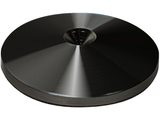
A spike shoe is a small disc, generally made of metal, with a central recess to receive the tip. It distributes the load and protects the flooring. Models fitted with an adhesive felt or velvet pad underneath even allow the speaker to slide so its placement can be adjusted without lifting it, making it easier to try different positions relative to the walls.
Before ordering, check the diameter and angle of the recess, which must accommodate the tip without allowing it to tilt, the maximum load supported by a set of four, and the number of support points on the speaker, three or four depending on the model. On thick carpet, the tip is designed to pass through the covering and rest on the slab; a disc would cancel out this effect. On a lightweight floor or a resonant floating wood floor, elastomer or dense foam damping pads do a better job of filtering vibrations transmitted to the floor.
The terminology can be confusing: people commonly talk about decoupling, whereas a metal support couples the speaker to its base rather than isolating it. Both approaches exist and address different situations, and the nature of the floor guides the choice. On a heavy, rigid floor (concrete slab, tiles), this coupling provides firm support and a structure that does not move. On a lightweight structure that vibrates, acoustic damping with a flexible material prevents the floor from resonating along with the bass. The same reasoning applies to a subwoofer, the component most susceptible to this phenomenon, whose vibrations spread easily through a wood floor: anti-vibration feet or a damping base limit these unwanted resonances.
Carrying covers and speaker protection
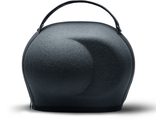
A Bluetooth speaker or a battery-powered speaker travels in a bag, a car trunk or a suitcase, and that is where it takes knocks. A padded protective cover, most often black, cushions impacts, protects the finish from scratches and keeps the front panel safe from sand or dust.
Covers tailored to a specific model, often offered by the speaker manufacturer itself, follow its shape, leave the handle accessible through a dedicated opening and sometimes include a pocket for the charging cable. Some even allow listening without taking the speaker out. A hard case offers more substantial protection against crushing, at the cost of greater bulk. The choice depends on how the speaker is transported: a soft cover made of thick, foam-lined fabric is sufficient for a shoulder bag, while a rigid shell provides greater reassurance at the bottom of a suitcase.
For a pair of PA speakers, the requirements are on a different scale. The carrying bag must support several dozen kilograms, with reinforced handles, an abrasion-resistant base and sometimes wheels. A set of straps helps secure everything in a vehicle, and a second bag tailored to the subwoofer often completes the equipment. When not traveling, a cover also allows a speaker to be stored away from dust during the months when it is not used, whether it is a living-room model or a live sound system.
Charging stations for wireless speakers
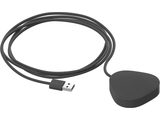
Plugging in a USB cable for every recharge eventually wears out the connector and means having to find the charger. A charging station, or charging dock, solves this problem: the speaker is placed on it and recharges through contacts or induction, then can be picked up and taken away without any fiddling.
These docks are specific to a speaker or a family of speakers from the same manufacturer, because contact positions, magnetic alignment and charging power vary from one model to another. Before buying, check exact compatibility and whether the mains power adapter is included, as some docks come with only their cable. Left permanently on a piece of furniture, the dock gives a portable speaker a fixed place in the home, with a battery that is always full when it is time to leave. The charge level is usually displayed by an indicator light on the speaker or in its app, and the battery then recharges without intervention. The same principle exists for wireless earbuds, with a charging case that also serves as a storage case, but these accessories belong to a different category.
Banana plugs and spade connectors for a neat connection
Connecting bare speaker cable works, but twisted copper strands oxidize over time, loosen in the terminal and, if poorly trimmed, can cause a short circuit between the two poles. Banana plugs and spade connectors, fitted to the cable ends, provide firm, lasting contact and make disconnection much easier.
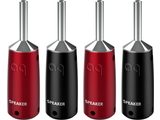
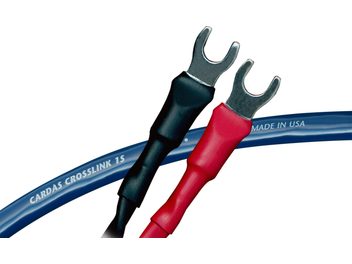
A banana plug inserts into the central hole in the terminal. Many amplifiers sold in Europe come with small plastic caps in this opening, which must be removed with a small screwdriver before first use. The U-shaped spade connector slips under the terminal nut, which is then tightened by hand: it is suitable for screw terminals without a hole and provides a large contact area once tightened. Both are available as male connectors ready to fit, in sets of four for a pair of speakers or eight for bi-wiring.
The choice depends first on the cable cross-section accepted, 4 mm² for common models, 6 mm² or more for larger ones, then on the attachment method. Screw-clamp connections can be assembled with a simple screwdriver, crimping requires suitable pliers but ensures a very stable connection, and some high-end connectors use soldering for a permanent joint. Every part of the audio connector’s construction matters: plug body, contact, clamping screws and sleeve that protects the cable against pullout. The contacts are generally plated with gold, which resists corrosion, silver, a very good conductor, or rhodium, which is harder and therefore better able to withstand repeated connections.
Speaker cable by the meter or pre-terminated cable
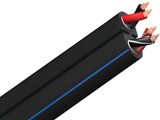
Speaker cable by the meter is sold cut to length: you order the required length, divide it in two, then strip the ends to screw them into the terminals or fit them with plugs. This solution fits the installation precisely, lends itself to routing through trunking or behind a baseboard and remains the most economical option for a home theater system with five, seven or more speakers.
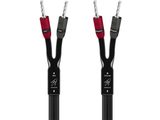
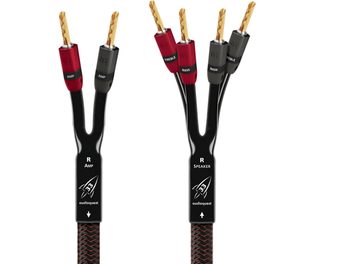
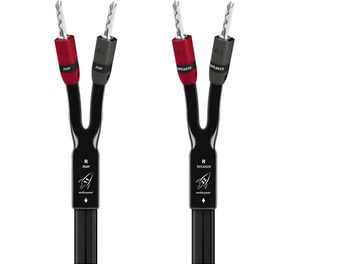
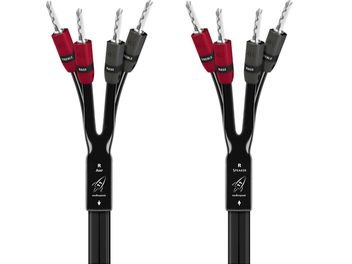
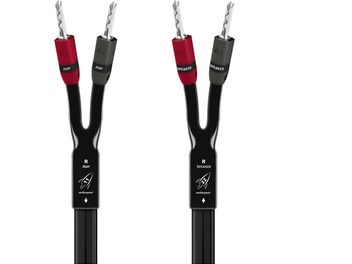
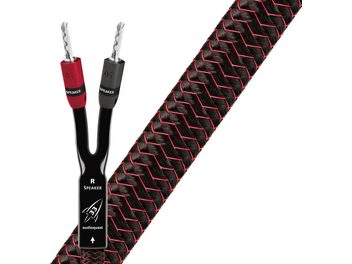
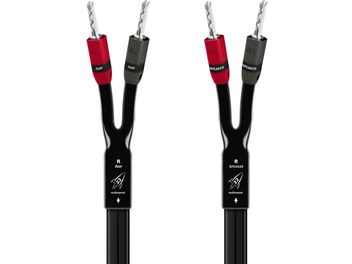
Pre-terminated speaker cable arrives ready to connect, with its connectors fitted in the workshop. It eliminates stripping and plug assembly, and ensures a neat, identical termination at both ends. It is also available in a bi-wiring version, with one pair of plugs at the amplifier end and two pairs at the speaker end, or a bi-amping version, with two pairs at each end, for speakers fitted with dual terminals. In both cases, the jumpers linking the original terminals are removed, because each section of the passive crossover (the part that distributes the signal between bass and treble) then receives its own connection. Its limitation lies in the lengths available, either fixed or made to order.
Choosing cable cross-section and length
The cross-section, expressed in mm², determines the electrical resistance of the conductor. The longer the connection and the lower the speaker impedance, the larger the cross-section needs to be. A simple rule is to keep total resistance below 5% of the speaker’s nominal impedance. For a 4-ohm speaker, this means 0.2 ohm, counting both the outward and return signal paths.
In copper, a 1.5 mm² conductor has a resistance of around 0.012 ohm per meter, a 2.5 mm² conductor around 0.007 ohm and a 4 mm² conductor around 0.004 ohm. An 8-meter run of 2.5 mm² cable therefore represents 16 meters of conductor and just over 0.1 ohm: there is a comfortable margin. In practice, 1.5 mm² is suitable for small speakers and short runs, 2.5 mm² covers most hi-fi and home theater installations, and 4 mm² is justified over long distances or with 4-ohm speakers that demand a lot of current.
The conductor material also matters. OFC (oxygen-free) copper conducts better than copper-clad aluminum, known as CCA, which is lighter and cheaper but has significantly higher resistance for the same cross-section. Polarity markings, a ribbed sheath, a colored wire or lettering along one conductor prevent the positive and negative connections of a speaker from being reversed, a mistake that weakens the bass and blurs the stereo image. Identical cable lengths for both speakers in a pair are not an electrical requirement, but they simplify identification and provide a perfectly symmetrical connection.


