Accuphase E-3000
Complementary products
Overview
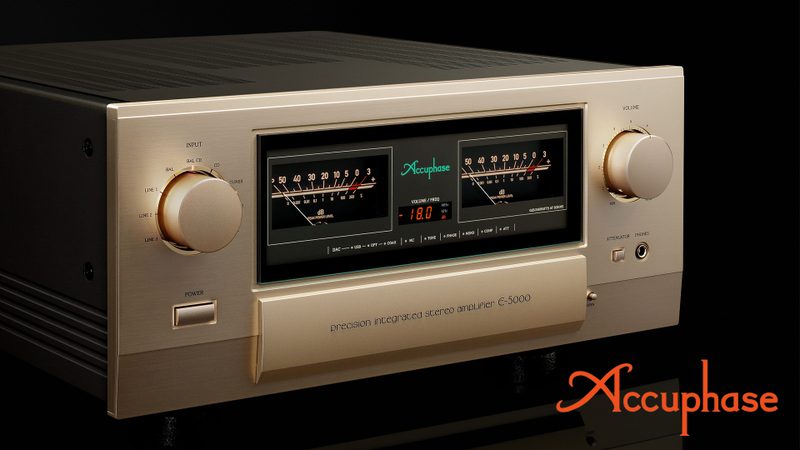
The Accuphase E-3000 represents the new benchmark in the range of integrated amplifiers from the prestigious Japanese manufacturer. Succeeding the E-280 and E-380 models, this new device concentrates Accuphase’s expertise in a chassis with carefully controlled dimensions. Equipped with technologies derived from the brand’s flagship models, the E-3000 delivers a generous output of 100 watts into 8 ohms and 150 watts into 4 ohms, all while maintaining a remarkably low distortion level. Its meticulous design, AAVA volume circuit with ANCC technology, and exceptional damping factor of 600 make it a top choice for audiophiles.
Heritage and Positioning in the Range
The E-3000 follows in the tradition of Accuphase’s integrated amplifiers, a Japanese brand renowned for decades for its excellence in high-end audio. This new model merges the qualities of the E-280 and E-380, creating an intermediate device that capitalizes on the strengths of its predecessors. With dimensions of 465 mm width, 161 mm height, and 420 mm depth, the E-3000 adopts a compact yet robust format, weighing 23.1 kg—a notable fact, as it is heavier than the E-380 despite a more compact chassis.
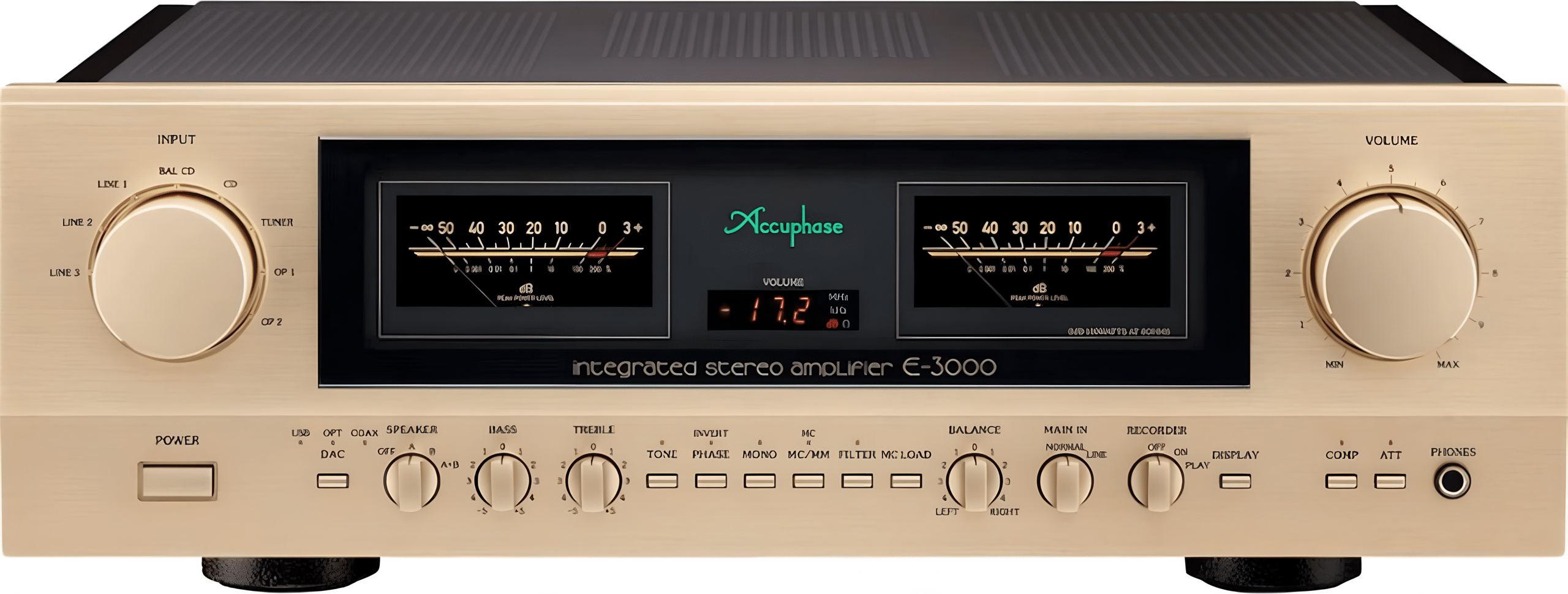
The design remains true to Accuphase’s classic aesthetic, with its signature gold front panel and large analog VU meters. This conservative approach reflects the brand’s philosophy: favoring longevity and timelessness over fleeting trends. The E-3000 positions itself as an accessible high-end integrated amplifier, representing the entry point into Accuphase’s flagship product universe.
Exclusive AAVA and ANCC Technologies
At the heart of the E-3000 is the AAVA (Accuphase Analog Vari-gain Amplifier) circuit, a proprietary technology that revolutionizes volume control. Unlike traditional potentiometers that attenuate the signal and can introduce noise, AAVA generates multiple signals from the input and adjusts the volume by modifying the combination of these signals. This innovative approach ensures minimal noise at all volume levels, with no signal degradation.
The E-3000 also incorporates ANCC (Accuphase Noise and distortion Canceling Circuit) technology, which uses a secondary amplifier to cancel out noise and distortion from the main amplifier. This system significantly improves performance, especially during transitions between low and medium volume settings. In practical terms, the ANCC circuit reduces background noise by 20% compared to the E-380 model, ensuring exceptional sound clarity even at low volume.
This AAVA-ANCC combination is one of the E-3000’s main assets, offering a level of precision and sonic transparency rarely achieved in this category of integrated amplifiers.
Amplification Architecture and Performance
The E-3000 features a rigorous dual-mono architecture, with completely separate left and right amplification modules for optimal channel isolation. The power stage uses three pairs of push-pull transistors per channel, operating in class AB. This configuration allows for a generous output of 100 watts per channel into 8 ohms and up to 150 watts into 4 ohms.
One of the amplifier’s strengths is its exceptionally high damping factor of 600. This value, 20% higher than previous models, reflects the amplifier’s ability to precisely control speaker movement, especially in the low frequencies. This increased control results in more precise and articulate bass reproduction, as well as better overall sound definition.
The amplification stage is configured according to the instrumentation amplifier principle, producing balanced signals and benefiting from excellent suppression of external noise. This design, combined with current feedback technology, ensures remarkable stability at high frequencies and low distortion across the entire audio spectrum.
Power Supply and Construction
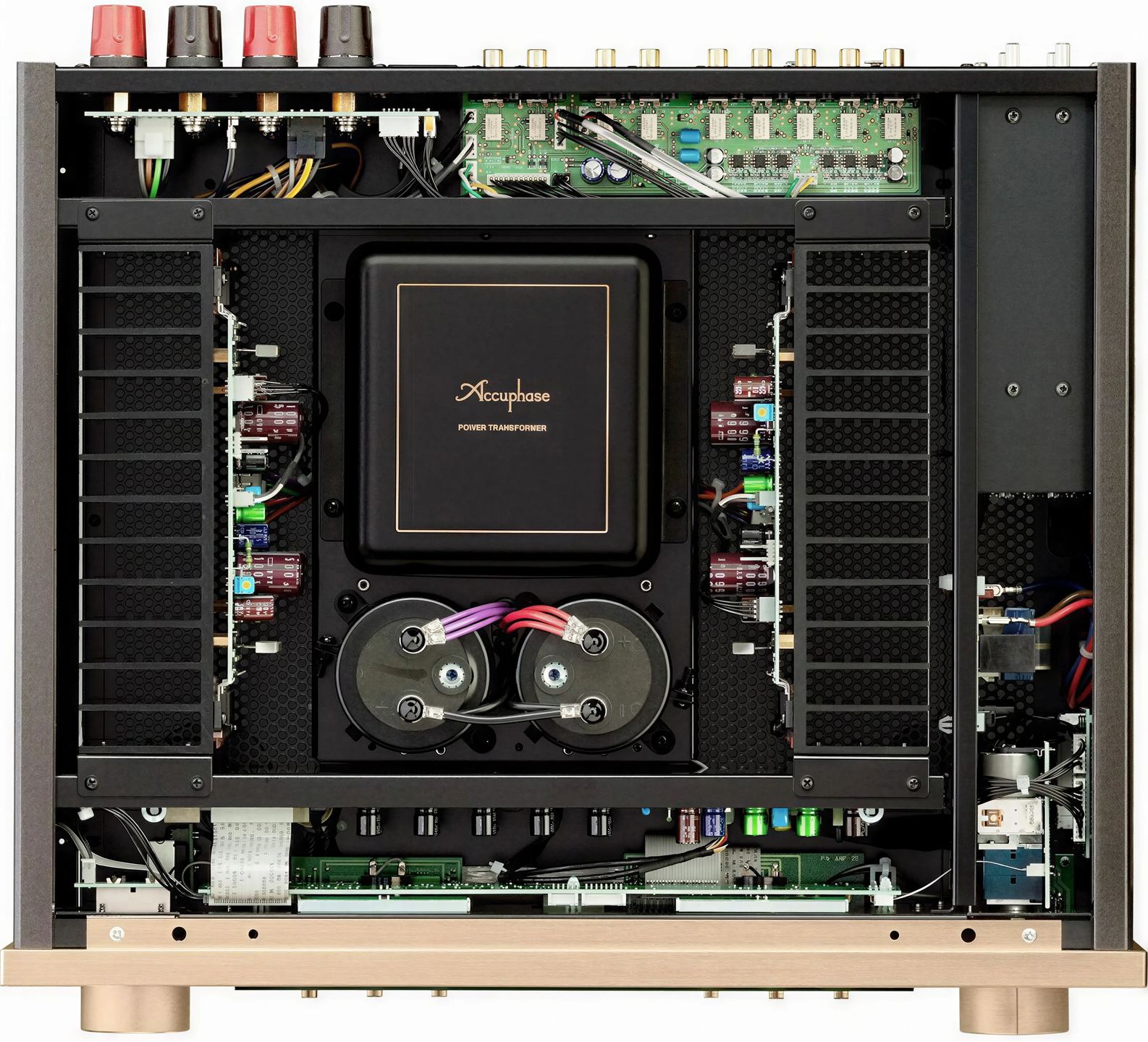
The sound quality of an amplifier largely depends on its power supply, and Accuphase has made no compromises in this regard. The E-3000 is equipped with a massive toroidal transformer and two 33,000 μF filter capacitors. This oversized power supply guarantees exemplary stability, even during the most demanding dynamic musical passages.
The device’s internal construction demonstrates exemplary rigor. The E-3000 is organized into separate compartments for the power supply, preamplifier, and power stages, all within an aluminum chassis. The heat sinks are thermally isolated from the rest of the chassis by an aluminum bar, ensuring optimal thermal stability.
The components used are carefully selected, the printed circuit boards are metalized, and the internal wiring uses low-resistance copper. The device’s feet are made of high-carbon cast iron, providing excellent vibration isolation. This meticulous attention to construction details significantly contributes to the amplifier’s overall sound quality.
Modularity and Connectivity
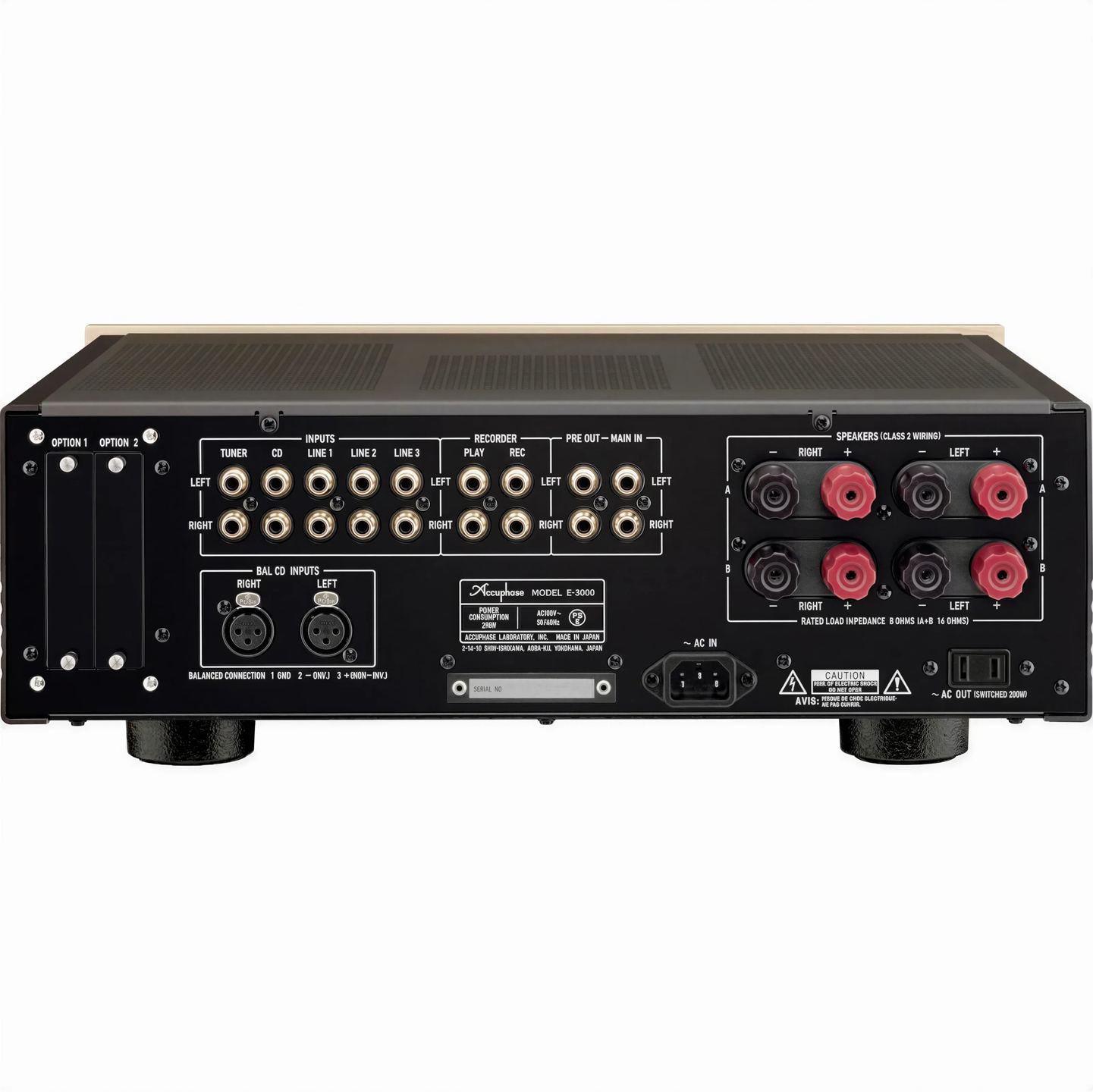
The E-3000 stands out for its modularity, thanks to two slots for optional cards located at the rear of the device. These slots can accommodate various types of cards, including:
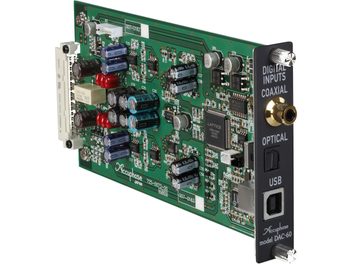
- The DAC-60 card, a high-performance digital-to-analog converter using two ESS Technology ES9016K2M chips in parallel, capable of processing PCM signals up to 384 kHz/32 bits and DSD up to 11.2 MHz.
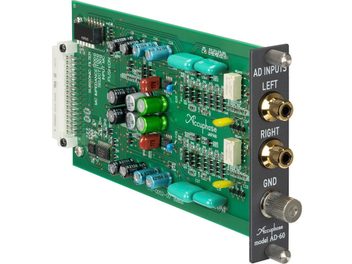
- The AD-60 card, a phono preamplifier for turntables, compatible with MM and MC cartridges, with selectable load impedance for MC cartridges (30, 100, 200, or 300 ohms).
- The LINE-10 card, which adds an extra pair of line inputs.
This modular approach allows the amplifier to be tailored to each user’s specific needs and to evolve over time without having to replace the entire device.
Standard connectivity includes five RCA line inputs, one balanced XLR line input, one preamplified input, a REC input/output pair in RCA, a preamplified RCA output, and a front-panel headphone output (6.35 mm jack). The speaker terminals are doubled, allowing connection of two pairs of speakers or use of the amplifier in bi-wiring or bi-amplification mode.
Documentation
Technical Specifications
Audio Performance
- Output power:
- 100 W / channel at 8 Ω
- 150 W / channel at 4 Ω
- Class AB operation
- Exceptional damping factor: 600 (20% improvement over previous models)
- Active tone controls via summing filters
Amplification Technologies
- AAVA volume control with ANCC noise reduction (20% less noise compared to the E-380 model)
- Triple parallel push-pull power stages with bipolar transistors
- Instrumentation amplifier for balanced signals
- Balanced remote sensing for precise speaker control
- Current feedback topology ensuring high-frequency stability
Design and Power Supply
- Dual mono construction:
- Separate left/right amplification modules
- Improved channel separation
- Robust power supply:
- Oversized massive transformer
- 33,000 μF × 2 capacitors
- Chassis isolated by high-carbon cast iron feet
- Advanced protection:
- Low-resistance MOS-FET switches (1.6 mΩ)
- Photocouplers
- Temperature sensors
Connectivity and Options
- Inputs and outputs:
- Mains power supply
- Line inputs: tuner / CD / line 1, 2, 3
- Recorder: playback / recording
- Preamplifier output (PRE OUT)
- Power amplifier input (MAIN IN)
- Balanced inputs (BAL CD)
- Speaker terminals A / B
- 2 slots for optional cards:
- Compatible with DAC-60 card
- Compatible with AD-60 card
- 2 pairs of gold-plated speaker terminals
Physical Characteristics
- Power consumption:
- 185 watts in operation
- 0.3 watt in standby
- Dimensions:
- Width: 465 mm
- Height: 161 mm
- Depth: 420 mm
- Weight: 23.1 kg
Frequently asked questions
What is the main difference between the E-3000 and the previous E-280 and E-380 models?
The E-3000 merges and improves upon the features of the two previous models. It is slightly larger than the E-280 but more compact than the E-380, while being heavier than both. Technically, it incorporates the new ANCC system, which reduces background noise by 20% compared to the E-380 and offers a higher damping factor of 600 versus about 500 for the previous models. The internal architecture has also been optimized for better channel separation and a reinforced power supply.
How exactly does the AAVA system work and what are its advantages?
Unlike traditional potentiometers that attenuate the input signal (potentially creating noise and imbalances), the AAVA system breaks the signal down into several components of different amplitudes, then recombines them according to the desired volume level. This approach eliminates contact issues, channel imbalance, and degradation of the signal-to-noise ratio at low volume. With the addition of the ANCC circuit, the system further reduces noise and distortion, especially during transitions between different volume levels.
What optional cards are available and what do they offer?
Three types of optional cards are available: the DAC-60 (digital-to-analog converter supporting PCM up to 384kHz/32bits and DSD up to 11.2MHz), the AD-60 (phono preamplifier for MM and MC cartridges with selectable impedance), and the LINE-10 (additional line inputs). These cards fit into the two slots at the rear of the amplifier and allow the device to be tailored to each user’s specific needs without requiring additional external equipment.
How can I use the E-3000’s bi-amplification function?
To use the E-3000 in bi-amplification mode, your speakers must have separate inputs for the bass and treble sections. You then connect the amplifier’s A outputs to the bass terminals and the B outputs to the treble terminals (or vice versa, according to your preferences). This configuration allows you to power the different sections of the speakers separately with the same gain, improving sound definition and reducing interactions between the drivers. Note that this function differs from bridged mode, which is not available on the E-3000.
Is the lack of built-in streaming a major drawback?
The E-3000 prioritizes pure sound quality over a multitude of features. This approach allows resources to be focused on amplification excellence without compromise. To add streaming capabilities, several options are available: add a quality external streamer connected to the analog inputs, use the optional DAC-60 card with a network transport, or connect a computer via the USB input on the same card. This modularity offers the advantage of being able to upgrade the digital section independently of the amplifier, whose longevity far exceeds that of ever-evolving streaming technologies.
- Eco-contribution of €5 included in the sale price.