
Jerome
Great product, I highly recommend it!
Comment from 20 April 2022 — Experience from 9 April 2022
Automatically translated — Show original (French)
Produit nickel, je recommande ! !
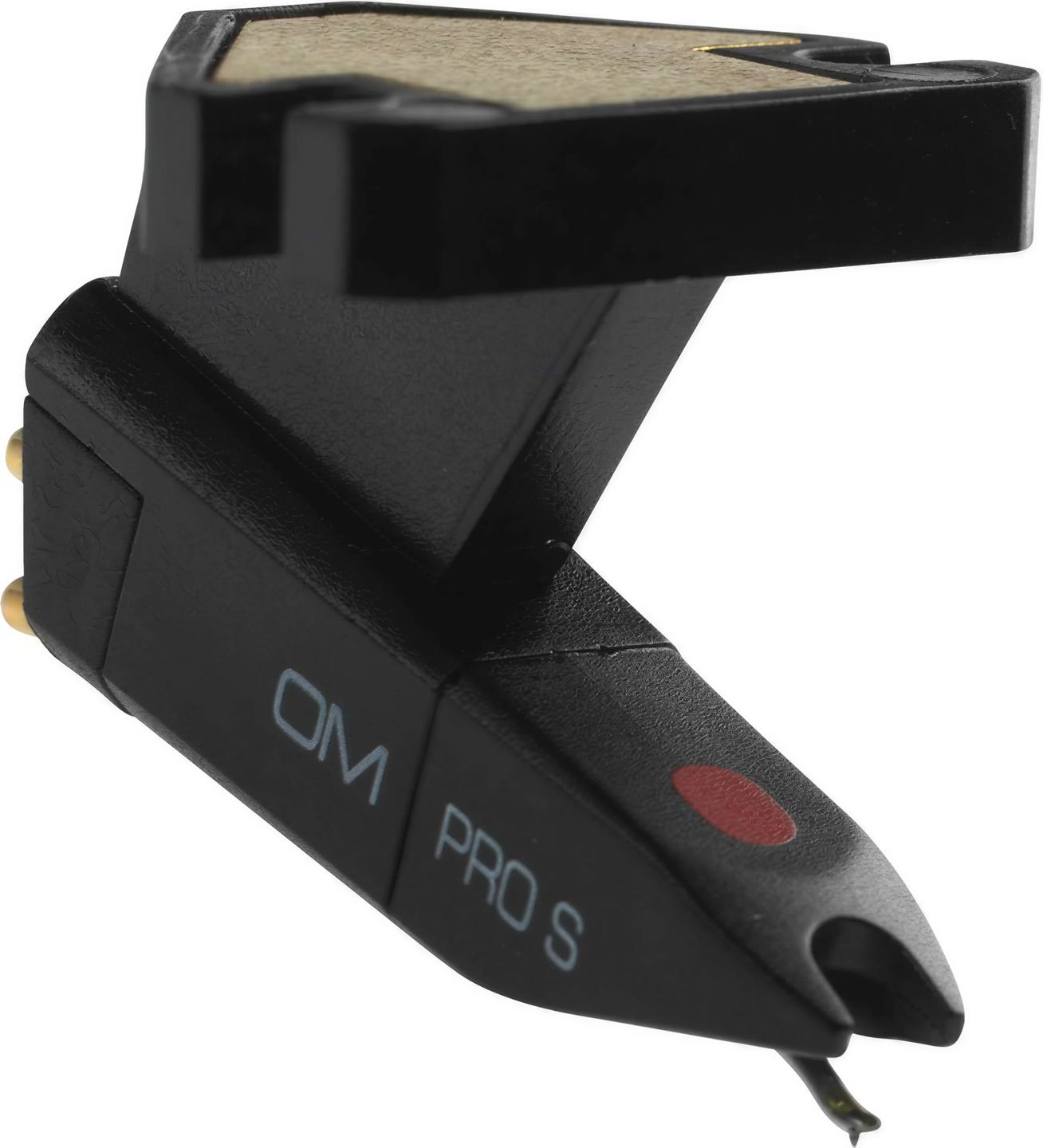
A DJ cartridge is judged first by how it handles everyday movements: lowering the tonearm mid-track, pulling the record back to cue a start, holding the vinyl under your fingers. The OM PRO S meets these demands with a spherical stylus, a robust moving assembly and a generous output signal, in the half-inch format that mounts on most headshells. It is the entry-level model in Ortofon’s DJ range.
The stylus tip is ground to a spherical shape, with a radius of 18 µm. This rounded profile rests against the groove walls with a simple, uniform contact area, making it more stable than an elliptical profile when the record is pushed, pulled or stopped abruptly: the stylus stays in its groove instead of skipping. The trade-off is well known: a spherical tip tracks the tightest groove modulations less precisely, and the OM PRO S’s frequency response stops at 18 kHz. For playback in a club or at home, this limit takes a back seat to reliable tracking.
The stylus is supported by an aluminium lever (the cantilever, the fine rod that transmits groove vibrations to the generator) rigid enough to withstand the jolts of energetic handling. The suspension follows the same approach: its compliance, meaning its flexibility, is 7 µm/mN, a low value that corresponds to a firm moving assembly, well suited to the heavy tonearms of DJ turntables and relatively insensitive to shocks and vibrations transmitted by a booth or a moving floor.
The recommended tracking force is 4 g, within a range of 3 to 5 g, roughly twice what typical hi-fi cartridges require. This weight holds the stylus down in the groove and largely explains its secure tracking during back-cueing. It also wears the vinyl and stylus a little faster than a light tracking force, a deliberate compromise for DJ use.
The OM PRO S works on the moving-magnet principle: a small magnet attached to the cantilever moves relative to fixed coils, generating the electrical signal in them. Its output voltage reaches 5 mV, a high level for this family of cartridges. The mixer’s phono preamp needs to provide less gain, hiss remains less noticeable relative to the music, and two turntables fitted with the same cartridge deliver a consistent level, making transitions easier.
The recommended load values (47 kΩ and 200 to 600 pF) are those of any standard MM phono input, whether on a mixer, an amplifier or a separate phono preamp: no special adjustment is required. Channel separation, at 20 dB at 1 kHz and 15 dB at 15 kHz, remains modest and produces a narrower stereo image than a home-listening cartridge, with no consequence when mixing, where the signal often ends up on a front-of-house PA system.
The black, 5 g body attaches with two screws to any standard half-inch headshell, as on turntables with an S-shaped tonearm and a removable headshell such as the Technics SL-1200. The front leaves the tip clearly visible, a detail that helps place the stylus at the exact starting point on the record. The vertical tracking angle is 20°.
Setup simply involves aligning the cartridge on the headshell, balancing the tonearm, then setting the counterweight to 4 g. The replacement stylus, the Stylus PRO S, is removed and refitted from the front without removing the cartridge, allowing the body to remain in place and only the stylus to be replaced when it wears out.
The OM PRO S shares its stylus with the Concorde PRO S, a version of the same cartridge integrated into a one-piece headshell. Both formats use the same replacement Stylus PRO S. Further up, the OM range offers more specialised models, such as the OM Scratch or the OM Q.Bert, whose higher output and stiffer suspension are aimed at intensive turntablism. The OM PRO S remains the family’s versatile cartridge, comfortable with mixing, headphone cueing and occasional scratching.
The OM PRO S can also be fitted to a home turntable, on two conditions: the tonearm must accommodate a tracking force of 4 g, and its mass must remain compatible with a firm suspension. A light tonearm designed for high-compliance cartridges will be a poor match. On a medium- to high-mass tonearm, it tracks without difficulty and is forgiving of worn second-hand records, with the spherical tip resting on a part of the groove less affected by previous playback. In return, treble reproduction and stereo image precision remain below those of hi-fi cartridges with an elliptical profile, making the cartridge better suited to a secondary turntable, family listening or a crate of bargain finds than to a high-resolution system.
OM styli physically clip onto this body, but each model is matched to the magnet and coils of its own body. A stylus from another series changes the output level and tonal balance, and may create an imbalance between the two channels. To restore the original specifications, the Stylus PRO S remains the only suitable replacement.
No, the OM PRO S is the cartridge only, to be mounted on a half-inch headshell. A version premounted on a headshell is available in the Ortofon range under a separate model number.
No. The cartridge’s 5 mV output must pass through a phono stage, which amplifies the signal and applies RIAA equalization (the equalization curve that restores the bass-treble balance recorded on the disc). An MM phono input on a mixer or amplifier, or an external phono preamp, serves this purpose. A phono input set to MC mode is not suitable.
The four headshell wires connect to the four pins on the back of the cartridge according to the standard colour code: red to right channel positive, green to right channel ground, white to left channel positive, blue to left channel ground. The cartridge pins bear the corresponding markings.
Yes. The protective cover slides over the front of the stylus for transport and installation, and is removed before lowering the tonearm onto the record. Refitting it whenever the headshell is removed prevents the cantilever from being bent by an accidental knock.
A fine-bristled brush moved from the back to the front of the cartridge, in the direction of the cantilever, removes dust accumulated on the stylus tip. A sideways or front-to-back movement risks bending the cantilever. With a tracking force of 4 g and frequent handling, regularly checking the stylus tip with a magnifying glass helps detect wear before it damages records.
A high tracking force accelerates groove wear compared with the 2 g commonly used in hi-fi, especially when combined with repeated back-cueing over the same passage. Staying at the recommended value of 4 g, without exceeding the upper limit of 5 g, and keeping the stylus in good condition limits this effect: a worn tip damages a record far more than a correctly adjusted tracking force.
Jerome
Great product, I highly recommend it!
Comment from 20 April 2022 — Experience from 9 April 2022


