Aurender N200 silver


Specifications and features


Overview
Moving from a computer or small network player to a dedicated audio server often comes down to one detail: where the file actually comes from when it is played. With Aurender, the answer lies in an SSD cache drive and a USB output isolated from the rest of the machine. The N200 adopts this approach in a full-width chassis, with a large colour display and two accessible storage bays.
A network transport without a converter
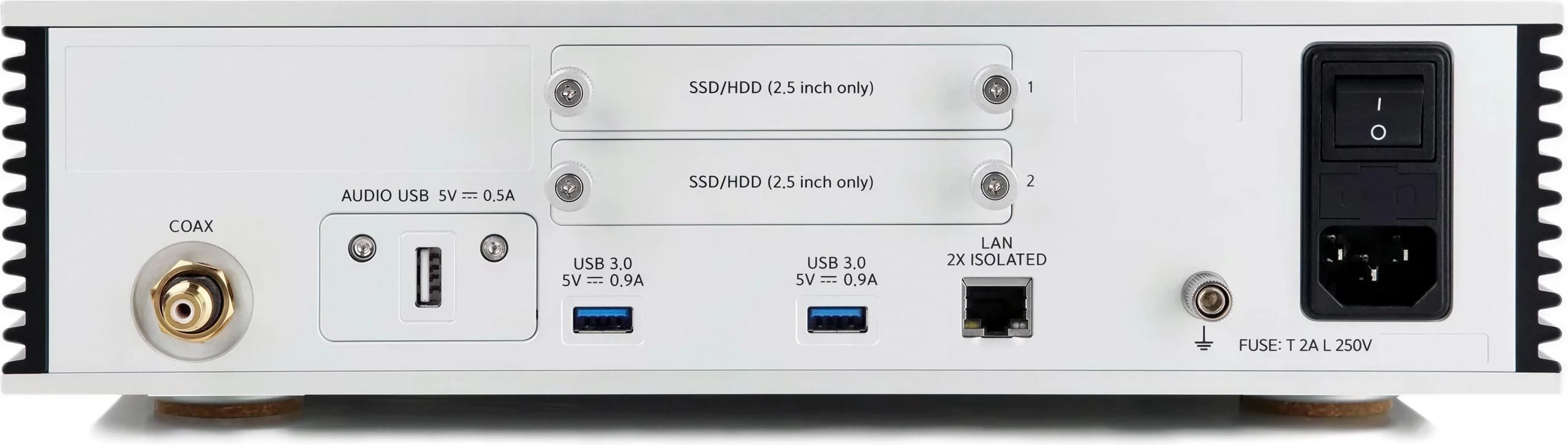
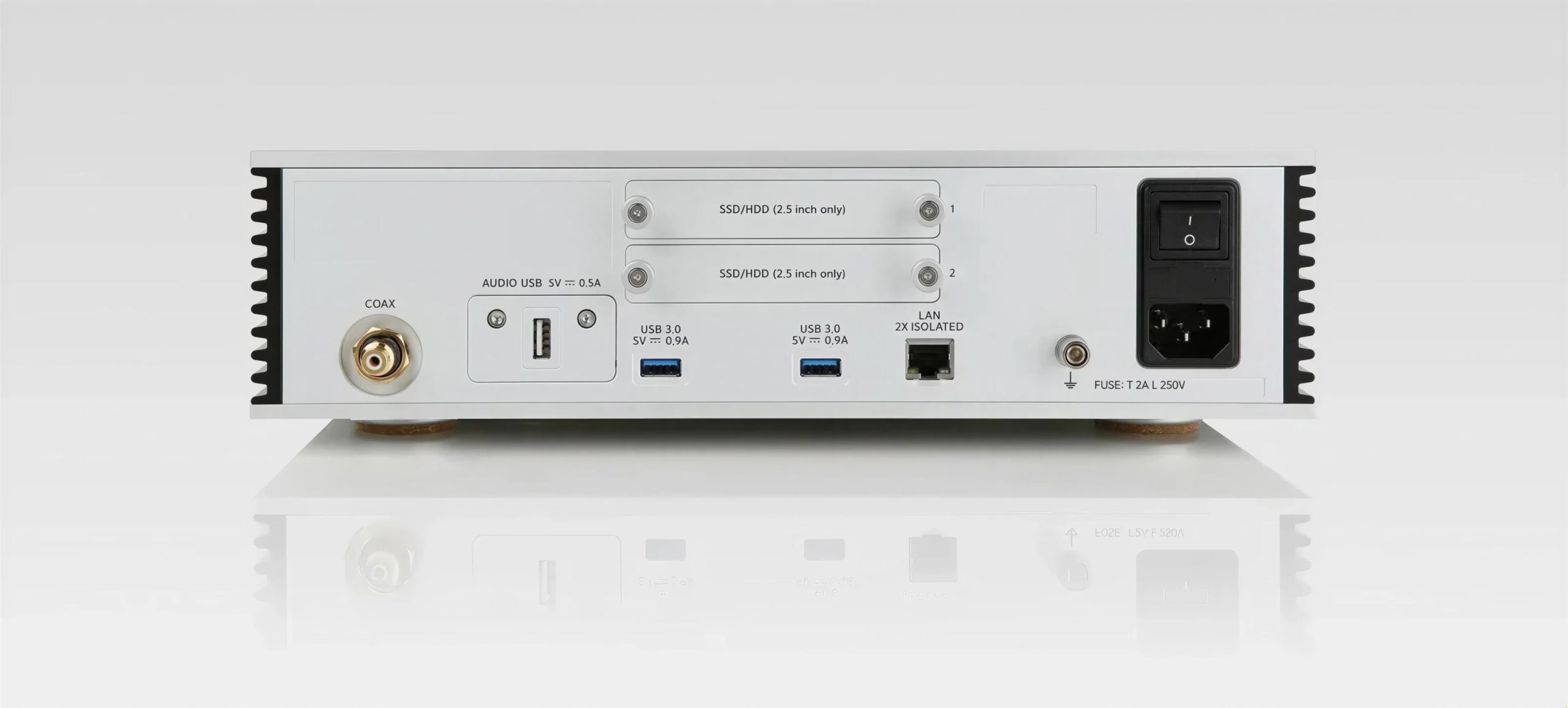
The N200 does not convert anything and does not output any analogue signal. It reads, caches and sends a digital stream to an external converter via its dedicated USB Audio Class 2.0 output or its RCA coaxial S/PDIF output. The USB output supports PCM up to 768 kHz in 32-bit, native DSD512 and DSD256 in DoP. The coaxial output is more modest, with PCM up to 192 kHz in 32-bit and DSD64 in DoP: it serves as a fallback solution for an older converter without a USB input, or for a second system. No DSD-to-PCM conversion is offered; the file is sent as is.
This USB output is physically and electrically separated from the processor board. USB can easily carry noise from one device to another, and this is the area on which Aurender focuses its isolation work. The audio clock is a TCXO, a temperature-compensated quartz oscillator. The brand’s higher-end models use an OCXO clock combined with high-level S/PDIF and AES/EBU outputs: this is precisely the section Aurender removed from the N200 to keep its price in check, concentrating its resources on the USB path alone.
SSD caching changes playback
When a track is started from the application, it is not read directly from the library drive or continuously pulled from the network. It is first copied to an internal 240 GB NVMe SSD, which also serves as the system drive, then played from that SSD. The storage drives are put to rest during listening, and fluctuations from a NAS or home connection no longer affect the stream.
Critical Listening mode takes this approach further by switching off the front display, buttons and background tasks not required for playback. In return, you have to accept losing the display during listening, which remains consistent with tablet control.
Two drive bays to populate yourself
The rear of the N200 houses two slots for 2.5-inch drives, mechanical hard drives or SSDs, to be installed by the user. Aurender announces support for up to two 8 TB SSDs. The drives are not supplied, leaving you free to choose the type and capacity, and allowing the bays to remain empty for online-only listening. The machine’s price therefore does not include storage you may not need.
A library stored on a NAS remains usable via network sharing, and two USB 3.0 ports on the rear are used for transfers from an external drive or USB stick. Aurender nevertheless considers internal storage to be the reference operating mode: browsing remote content is done in folder view, with less convenience.
The 6.9-inch display and control
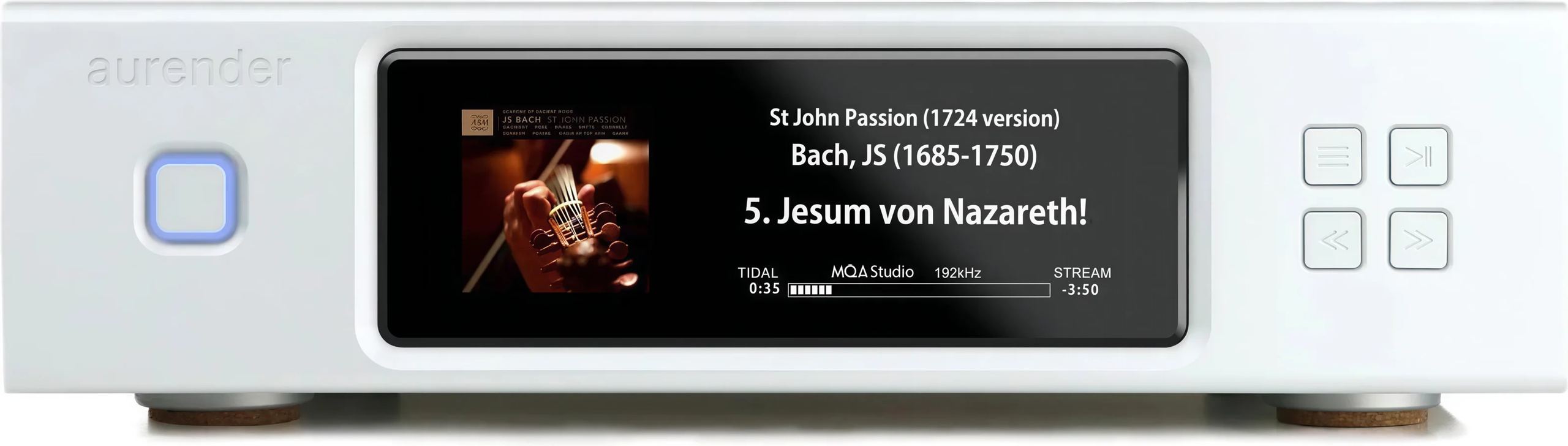
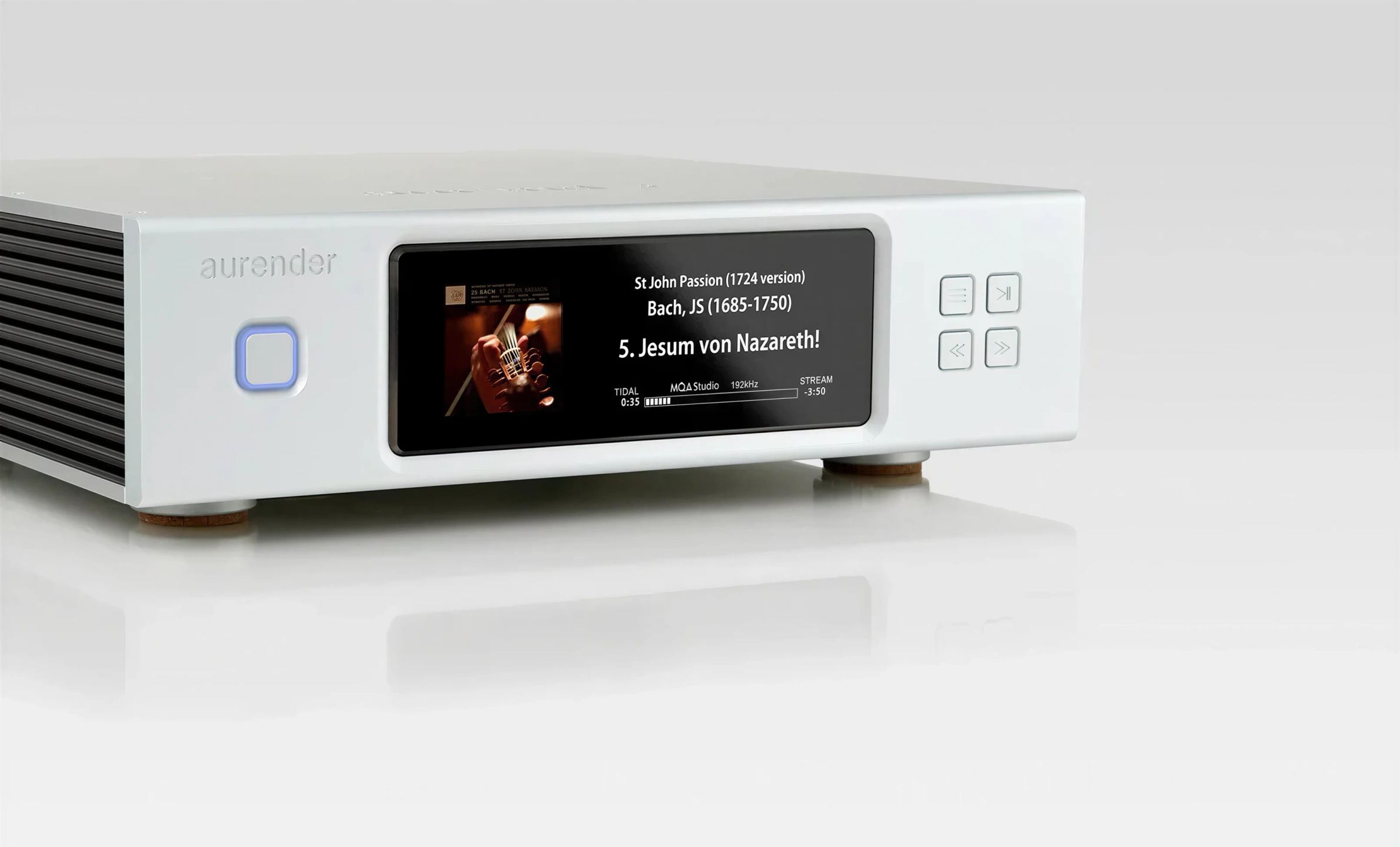
The machined aluminium front panel features a 6.9-inch colour IPS display with 1280 × 480 resolution, showing the cover art, artist and current track. Its dimensions are those of a classic hi-fi component: 33 cm wide, 35.6 cm deep and 9.7 cm high, weighing 8.8 kg. The more compact N150 makes do with a 3-inch monochrome display and a single drive bay.
All control is handled through Aurender’s own Conductor app, on iPhone, iPad and Android devices. There is no web interface or physical remote control: without a compatible tablet or phone, the machine cannot be operated. Tidal, Qobuz and web radio are integrated into the app; Spotify Connect and AirPlay allow streaming from another device, and the N200 works as a Roon Ready playback endpoint on a network equipped with a Roon server. MQA Core decoding is available as a paid option, in the form of a licence purchased through the app.
Linear power supply and network connection
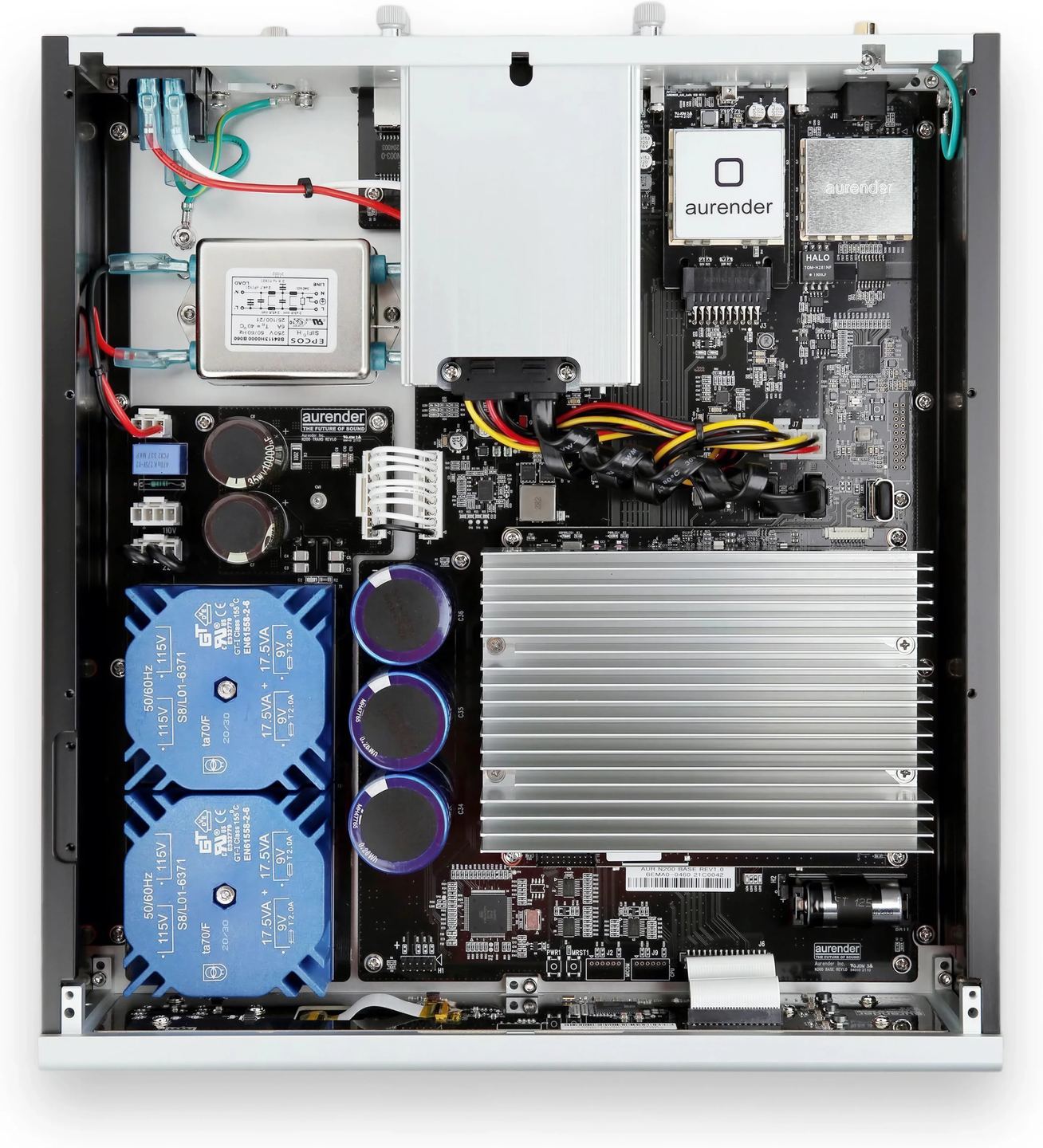
The power supply is entirely linear, in two 35 W sections, a choice intended to deliver a low noise floor where a switching power supply injects high-frequency noise into the ground. An internal supercapacitor UPS takes over in the event of a mains failure, allowing time for the system to shut down properly: there is no chemical battery to replace after a few years. Power consumption remains restrained, at 15 W during playback, 35 W peak and 5.1 W in standby, for a low-power quad-core Intel processor supported by 8 GB of RAM.
The Gigabit Ethernet port is isolated by two transformer stages, protecting against noise coming from the router and the rest of the installation. Network connection is cable-only: no Wi-Fi link is provided, which requires a network socket near the equipment rack or a powerline adapter. Aurender technical support can remotely access the machine over the Internet to diagnose an issue.
Technical Specifications
Overview
- Type: high-fidelity audio network server and transport
- Construction: machined aluminum chassis
Processor and Memory
- Low-power Intel Quad Core processor
- RAM: 8 GB
- System SSD and cache memory: 240 GB NVMe
Storage
- 2 slots for 2.5-inch drives
- Compatible with user-installable HDDs and SSDs
- Recommended capacity: up to 2 × 8 TB SSD
- Can be used without internal drives for streaming-only use
Display
- 6.9-inch color IPS display
- Resolution: 1280 × 480 pixels
- Displays album artwork, artists, and track information
Network Connectivity
- Dual-isolated Gigabit Ethernet port
- Compatible with music libraries stored on NAS
- Connection of external USB hard drives
USB Ports
- 2 × USB 3.0 for data storage
- Dedicated isolated USB audio output
Digital Outputs
- 1 × dedicated USB Audio output
- 1 × RCA coaxial S / PDIF digital output
Supported Formats
- DSD: DSF, DFF
- PCM: WAV, FLAC, AIFF, ALAC, M4A, APE and other compatible formats
Audio Resolutions
- USB output
- PCM up to 768 kHz / 32 bits
- Native DSD512
- DSD256 via DoP
- Coaxial S / PDIF output
- PCM up to 32 bits / 192 kHz
- DSD64 via DoP
Clock
- TCXO audio clock
Power Supply
- Audiophile linear power supply
- Integrated supercapacitor UPS system for safe shutdown in the event of a power outage
Power Consumption
- Playback: 15 W
- Peak: 35 W
- Standby: 5.1 W
Features
- Playback with cache memory
- Critical Listening mode
- Integrated streaming services
- Roon Ready compatible
- Aurender Conductor software suite
- Remote technical support via the Internet
- MQA Core Decoder upgrade available
Dimensions and Weight
- Width: 33.0 cm
- Depth: 35.6 cm
- Height: 9.7 cm
- Height without feet: 8.4 cm
- Weight: 8.8 kg
Frequently asked questions
Is an external converter mandatory?
Yes. The N200 has neither a converter nor an analog output: it connects via USB or coaxial to a converter, an integrated amplifier with a digital input, or a converter preamplifier. Without this link, no sound will come out of it.
What file formats are supported?
DSD files in DSF and DFF format, and PCM in WAV, FLAC, AIFF, ALAC, M4A and APE, among others.
Can CDs be ripped with the N200?
No extraction function is provided, even with an external drive. Aurender reserves this possibility for its content servers, the ACS100 and ACS10.
What happens if two drives with different capacities are installed?
The two bays operate independently. There is no need to pair the drives, and an SSD can coexist with a mechanical hard drive.
Can the screen be turned off outside of Critical Listening mode?
Screen brightness and timeout are adjusted in the Conductor app preferences, without having to use Critical Listening Mode, which also disables background tasks.
Does the N200 support an external clock?
No, it does not have a 10 MHz clock input. This feature starts with the N20 in the range.
How do I get an optical output?
Aurender offers the UC100 and UT100 converters, which convert the USB audio output into a coaxial or optical signal. Since the N200 already has a coaxial output, the UT100 is mainly intended for converters limited to a Toslink input.
- Eco-contribution included in the sale price.