

T+A MP 3100 HV G3 silver


Overview
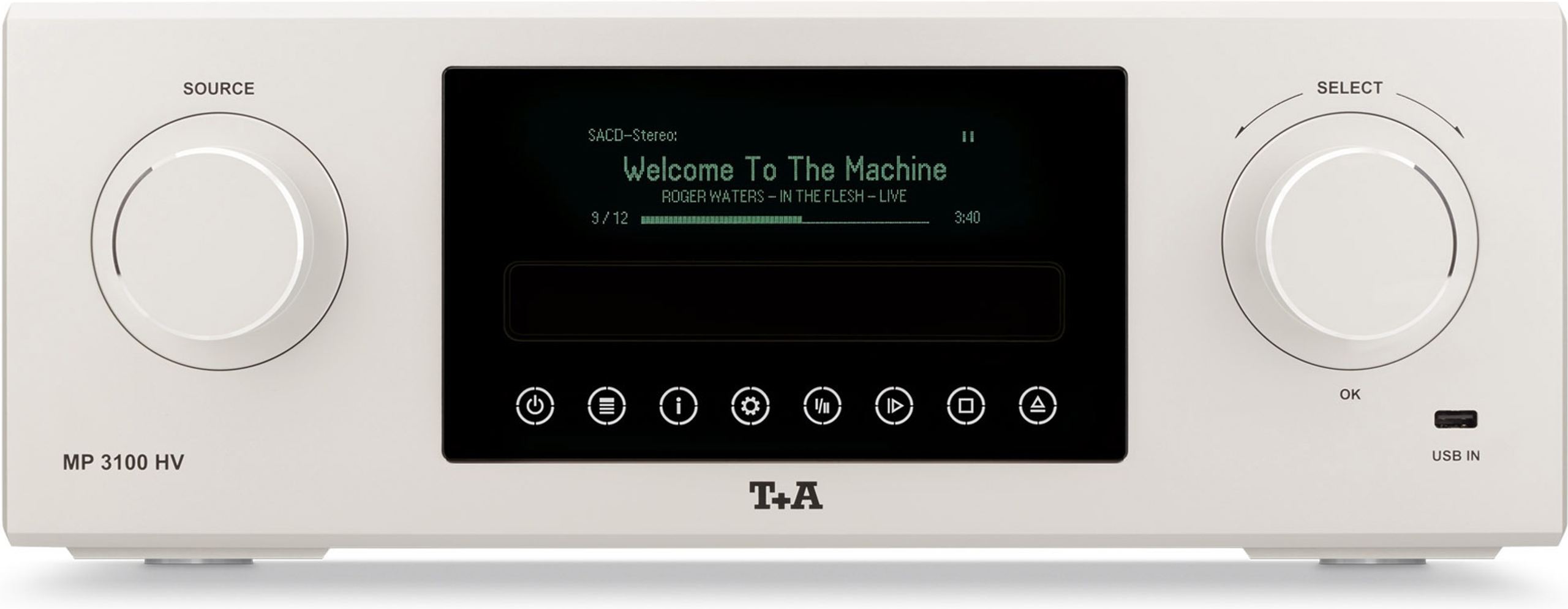
Playing an SACD, a DAB+ station, a high-resolution Qobuz album or a DSD file stored on a network server, then converting each of these signals according to its type: that is the purpose of this source component from the HV series, T+A’s reference range. This third generation retains the transport mechanism and conversion circuitry of the MP 3100 HV and gains a new streaming platform, with support for Connect services and AirPlay 2.
One converter for PCM, another for DSD
Most players turn DSD into PCM before converting it into an analog signal, because a single conversion circuit costs less than two. T+A rejects this shortcut: the player houses two digital sections, two conversion stages and two analog output stages, each dedicated to one format. DSD files and the high-resolution layer of SACDs feed an in-house 1-bit converter, which processes the bitstream exactly as it was recorded, without digital filtering or noise shaping, from DSD64 to DSD512.
PCM passes through a quadruple balanced converter: four 32-bit Burr-Brown chips per channel, eight in total, configured differentially. Their small linearity errors cancel each other out, and the noise floor drops by 6 dB compared with a single-ended configuration. Before conversion, the signal is oversampled to as high as 384 kHz using one of four available algorithms. Two conventional FIR filters, one with a very linear frequency response and the other more precise on attacks, sit alongside two Bézier filters developed by T+A. The latter reconstruct the curve between samples through polynomial interpolation, without the small unwanted oscillations that conventional digital filters add before and after each transient. The first combines Bézier and IIR for a sound close to that of an analog source, while the second applies pure Bézier interpolation.
At the output, a third-order linear-phase analog Bessel filter can be set to 60 kHz, the normal setting that keeps the high-frequency noise inherent in SACD’s DSD64 in check, or to 120 kHz to extend the bandwidth with high-resolution recordings. A setting inverts the signal’s absolute phase in the digital domain, useful for the few discs recorded with inverted phase.
An SACD transport machined from a block of aluminum
A reading error made by the laser can no longer be corrected once the data has been sent to the processing circuit. T+A therefore developed its own transport mechanism, housed in a shielded enclosure machined from a solid block of aluminum rather than assembled from sheet metal. The optical pickup, equipped with two lasers (658 nm for SACD, 790 nm for CD), slides on two aluminum linear bearings mounted on a milled plate, driven along a decoupled precision spindle by a high-torque synchronous motor. Three screws secure the assembly to the chassis while isolating it from vibrations, and an anti-resonance mass stabilizes the mechanism.
The tray, positioned below the display, accepts stereo SACDs, audio CDs, CD-Rs and CD-RWs. On a hybrid disc, you choose which layer takes priority, SACD or CD; the player automatically switches to the other layer if the first is absent. The G3 generation now reads CD Text and uses it to retrieve cover art and detailed album information in the T+A MusicNavigator G3 app, through the Gracenote service.
Third-generation streaming and Connect services
The ASA G3 platform is the main new feature compared with the MP 3100 HV. It connects to the network through a Gigabit Ethernet port, which takes priority as soon as a cable is plugged in, or through a dual-band 2×2 MIMO Wi-Fi 6 (802.11ax) module with an external antenna. Tidal, Qobuz, Deezer, Amazon Music, HIGHRESAUDIO, and airable Internet radio and podcasts are built into the player, while Tidal Connect, Qobuz Connect, Spotify Connect and AirPlay 2 allow playback to be controlled from each service’s app or from an iPhone. The player is recognized as a playback endpoint by Roon and Audirvana and plays libraries shared by a NAS via UPnP/DLNA.
Supported formats include FLAC, WAV, AIFF, ALAC, MP3, AAC and OGG Vorbis, with PCM playback up to 384 kHz and gapless playback for FLAC, WAV and MP3. DSD files (DSD64, DSD128 and DSD256) travel from the network to the 1-bit converter without being converted to PCM, a first for a T+A streamer. Service logins are set up once in the MusicNavigator G3 app, available on iOS and Android.
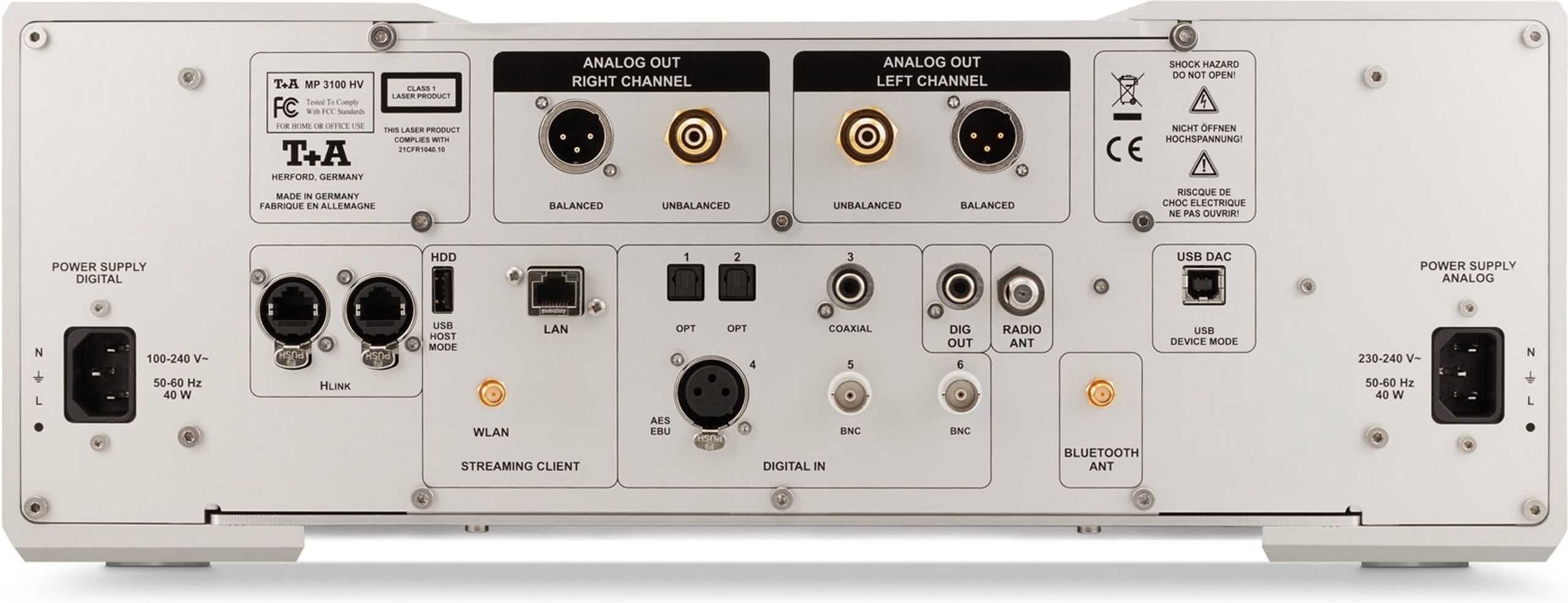
Two USB ports, on the front and rear, read flash drives and hard drives formatted in FAT, NTFS or ext; a standard 2.5-inch drive is powered directly by the port. Bluetooth aptX HD rounds out the features for occasional playback from a phone, with its own antenna on a magnetic base and a range of 3 to 5 meters. The compression inherent in Bluetooth limits it to casual use, with the network and USB remaining the routes to high-resolution playback.
Three radio sources in a single chassis
The FM tuner covers the 87.5–108 MHz band with a sensitivity of 1 µV and displays RDS information (station name, program type, radio text). The DAB+ section receives band III and indicates each station’s bitrate, which provides an indication of its sound quality. Internet radio offers access to more than 11,000 stations and podcasts. Each source has its own list of 99 presets, accessible by number from the remote control, and a stereo/mono switch reduces hiss on a weak or distant FM station.
Six digital inputs and a USB port for a computer
The player also serves as a converter for other devices: a television, network player, CD transport or computer. Its digital input board brings together an AES/EBU socket, one RCA coaxial input and two BNC inputs accepting up to 192 kHz/24-bit, two Toslink optical inputs limited to 96 kHz/24-bit, and an asynchronous USB port supporting up to 384 kHz/32-bit PCM and DSD512. The display shows the format and sampling rate of the incoming signal.
All these inputs pass through a two-stage reclocking system. Jitter, the timing inaccuracies in samples introduced by the source and cable, is first reduced by a phase-locked loop (PLL). A microprocessor then analyzes the recovered clock: if its accuracy and stability are sufficient, the converters switch to an internal quartz clock with very low phase noise, completely isolated from the source. Otherwise, a second PLL takes over and reduces the residual jitter by a further factor of four. A symbol on the display indicates the switch to the internal oscillator.
Two separate power supplies and a 26 kg chassis
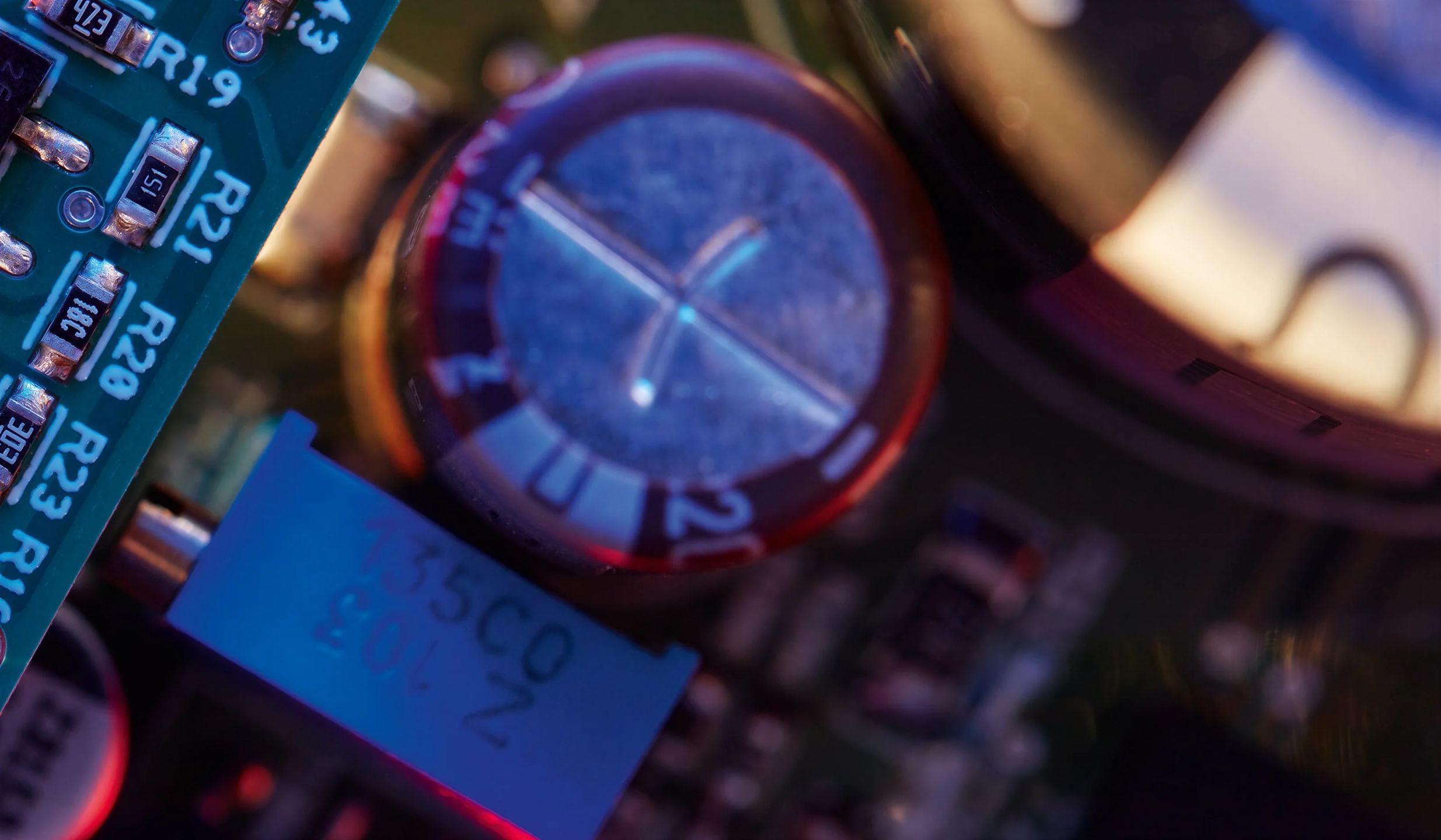
The digital and analog power supplies occupy two shielded compartments, on the left and right of the chassis, each with its own mains socket and power cord: noise from the digital circuits cannot reach the analog stages through a shared power supply. Both cords must be plugged in for the player to operate, requiring two available sockets on the power strip or power distributor.
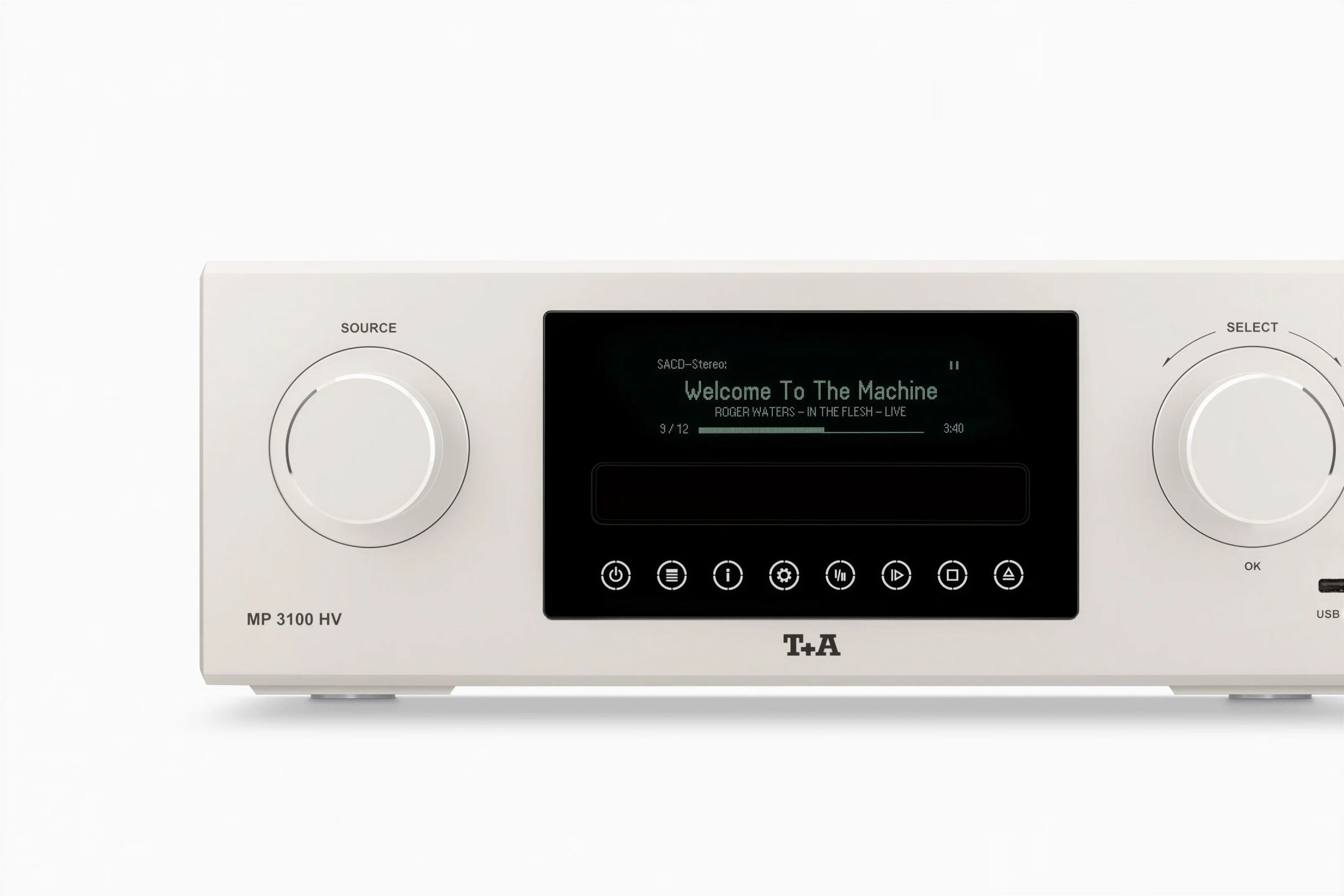
The enclosure, made from solid aluminum and non-magnetic metals, is assembled by hand in Herford, Germany. It measures 17 × 46 × 46 cm and weighs 26 kg: it requires two people to move it, a piece of furniture capable of supporting its weight, and 10 cm of clearance all around for ventilation. Two finishes are available, silver and titanium, with black side heatsinks; the HV-Individual program offers other colors on request. The two large front-panel knobs select the source and scroll through lists, the graphic display switches between a large-character view readable from a distance and a detailed view, and its brightness can be adjusted or switched off. The F 3100 remote control uses a radio link, so there is no need to point it at the device.
Documentation
Technical specifications
Product overview
- Model: T+A MP 3100 HV G3
- Type: multiformat player / audiophile network player
- Built-in functions: SACD / CD player, FM / DAB+ tuner, Internet radio, Bluetooth, digital-to-analog converter
SACD / CD player
- High-precision linear tracking mechanism
- Dual laser system:
- SACD: 658 nm
- CD: 790 nm
- Supported formats: stereo SACD, CD, CD-R, CD-RW, CD Text
- Frequency response and dynamic range:
- CD: 2 Hz – 20 kHz / 100 dB
- SACD: 2 Hz – 44 kHz / 110 dB
Network playback and streaming services
- Audio streaming architecture: Audiophile Streaming Architecture G3
- Network connection:
- Gigabit Ethernet local area network
- Wi-Fi 802.11a / b / g / n / ac / ax, MIMO 2 × 2
- Supported audio formats: MP3, AAC, OGG Vorbis, FLAC, WAV, AIFF, ALAC
- Maximum PCM resolution: 32-bit / 384 kHz
- Supported DSD formats: DSD64, DSD128, DSD256
- Gapless playback between tracks: MP3 (Lame), WAV, FLAC
- Protocol: UPnP AV
- Streaming services: Tidal, Qobuz, Deezer, Amazon Music HD, HIGHRESAUDIO
- Direct connection functions: Tidal Connect, Qobuz Connect, Spotify Connect
- Apple AirPlay 2
- Audirvana compatibility
Radio and tuner
- Internet radio and podcasts via airable:
- More than 11000 radio stations
- FM / FM-HD tuner:
- Frequency range: 87.5 – 108 MHz
- FM sensitivity: 1 µV
- FM signal-to-noise ratio: > 65 dBA
- DAB / DAB+ tuner:
- Frequency range: 168 – 240 MHz, band III
- Sensitivity: 2.0 µV
- Signal-to-noise ratio: > 96 dBA
- RDS / RDBS functions: station name, program type, radio text, clock
Bluetooth
- Profiles: A2DP / AVRCP 1.4
- Codec: aptX HD
- Formats: MP3, SBC
Digital-to-analog conversion
- PCM conversion:
- Double-Differential-Quadruple architecture
- 4 32-bit sigma-delta converters per channel
- Conversion frequency: 352.4 / 384 kHz
- DSD conversion: T+A True 1-Bit DSD in native bitstream
- PCM oversampling with 4 selectable algorithms:
- Short FIR
- Long FIR
- Bézier / IIR
- Bézier
- Analog filter: 3rd-order linear-phase Bessel
- Cutoff frequencies: 60 / 120 kHz
Frequency response
- PCM:
- 44.1 kHz: 2 Hz – 20 kHz
- 48 kHz: 2 Hz – 22 kHz
- 96 kHz: 2 Hz – 40 kHz
- 192 kHz: 2 Hz – 80 kHz
- 384 kHz: 2 Hz – 100 kHz
- DSD:
- DSD64: 2 Hz – 44 kHz
- DSD128: 2 Hz – 60 kHz
- DSD256: 2 Hz – 80 kHz
- DSD512: 2 Hz – 100 kHz
Audio performance
- Total harmonic distortion: < 0.001%
- Signal-to-noise ratio: > 116 dB
- Channel separation: > 110 dB
Analog and digital connectivity
- Analog outputs:
- 1 × coaxial RCA
- 1 × balanced XLR
- Output level:
- RCA: 2.5 Vrms / 50 Ω
- XLR: 5.0 Vrms / 50 Ω
- Digital output: 1 × coaxial S/PDIF
- Digital inputs:
- 1 × AES/EBU
- 1 × coaxial S/PDIF
- 2 × BNC
- 2 × optical TOS-Link
USB connections and functions
- 1 × USB port in device mode:
- PCM up to 384 kHz
- DSD512 compatibility
- Asynchronous transfer
- DSD256 and DSD512 via a Windows PC with the appropriate driver
- 2 × USB ports in host mode for storage media: USB flash drive, hard drive
Remote control and control
- F 3100 remote control:
- Infrared / radio control
- T+A MusicNavigator app for iOS and Android
Power supply and consumption
- Power supply: 2 × 110–120 V or 220–240 V, 50–60 Hz
- Power: 2 × 40 W
- Standby consumption: < 0.5 W
Dimensions and weight
- Dimensions (H × W × D): 17 × 46 × 46 cm
- Weight: 26 kg
Frequently asked questions
Can the MP 3100 HV G3 be connected directly to a power amplifier?
No. The analog outputs deliver a fixed level (2.5 V via RCA, 5 V via XLR), and the player has no volume control. It connects to the line input of a preamplifier or an integrated amplifier. When the amplifier has both types of connectors, the balanced XLR connection is preferable.
Can multichannel SACDs be played?
The player only outputs stereo. On an SACD that contains both a stereo track and a multichannel track, it plays the stereo track; the few multichannel-only discs cannot be played.
Can the player be used as a transport for another converter?
The coaxial S/PDIF digital output transmits PCM from CDs, tuners and network sources up to 192 kHz. The high-resolution layer of SACDs is not available through it due to the format’s copy protection. For DSD sources or those above 192 kHz (Roon, UPnP, HIGHRESAUDIO, USB), the DIG OUT menu option converts DSD to PCM and reduces higher sample rates to a compatible value. When disabled, it ensures fully native internal processing, but the digital output then remains silent for these sources.
Do I need to install a driver for the USB input?
On Windows, yes: the T+A driver, available to download from the brand’s website, supports PCM at 384 kHz and DSD up to DSD512. On macOS, no driver is required, and DSD is limited to DSD128. On Linux, the player works without a driver up to DSD512. It is best to keep the player away from the computer to avoid interference radiated by the latter.
Can a previous-generation MP 3100 HV be upgraded to the G3 platform?
Yes. Since September 2025, T+A has offered MP 3100 HV owners an upgrade to the ASA G3 streaming platform, carried out in the workshop by appointment. The dealer handles the arrangements for the device.
What antenna do I need for the radio?
The 75 Ω antenna input accepts either a rooftop antenna or a cable network outlet. A professionally installed outdoor antenna provides the best reception for both FM and DAB+. The supplied Wi-Fi and Bluetooth antennas sit on their magnetic bases, clear of any metal obstructions.
How does the player integrate into a T+A HV series system?
Two HLink sockets connect the player to a T+A HV series amplifier. The F 3100 remote control then controls the entire system: selecting the player’s sources, adjusting the amplifier’s volume, activating the speaker outputs. The name assigned to the player in its menu automatically appears on the amplifier’s display.
Can the player still be accessed from the app when in standby?
It depends on the mode selected. ECO standby consumes less than 0.5 W; the player can then be turned back on using the remote control or the front panel and turns off automatically after 90 minutes without a signal on certain sources. Comfort standby consumes slightly more but allows the player to be woken from the MusicNavigator app and disables automatic shutdown.
- Eco-contribution included in the sale price.
- GTIN / EAN: 4032872138143


