

Isol-8 SubStation F3 Axis black


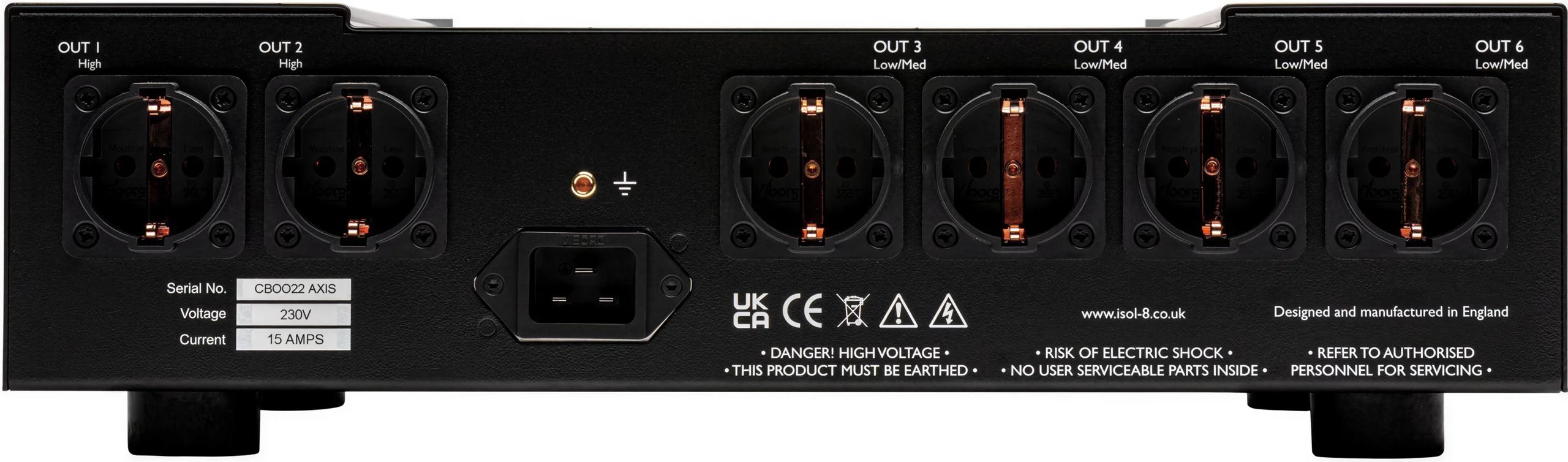
ISOL-8 SubStation F3 Axis: six filtered outlets and DC blocking
A deep, steady hum coming from the amplifier, even with the volume turned down, is rarely caused by interconnect cables. The culprit is often a DC component on the mains, which makes the transformer vibrate. This version of the SubStation F3 blocks this component at the unit’s input, then distributes power to six filtered outlets, with separate circuits for sources and amplifiers. It is hand-assembled in England.
Why a transformer starts to vibrate
A toroidal transformer works properly as long as the voltage it receives is a symmetrical sine wave. Some household appliances, through the way they draw power, add a slight DC voltage to this sine wave. The transformer’s magnetic core then partially saturates, its windings vibrate and the amplifier hums. The noise is mechanical, coming from the chassis rather than the speakers, and it can change depending on which appliances are switched on elsewhere in the house.
ISOL-8’s Axis circuit sits at the input of the SubStation F3 Axis, before the entire distribution stage. It blocks the DC component and lets alternating current pass through. All six outlets benefit, including those for sources: a preamplifier or player with a toroidal transformer is affected just as an amplifier is.
Six outlets and two types of filtering
Once the DC component has been removed, power reaches two groups of outlets. The source outlets pass through a multistage Transmodal filter, and ISOL-8 limits cross-contamination: noise that a DAC or a network player feeds back into the mains does not directly reach the device plugged in next to it. These low- and medium-current outlets support 6 A in total.
The high-current outlets use a variant of the Transmodal filter with very low series resistance. At times, an amplifier demands far more current than its average consumption, during a drum attack or a sustained bass note, and this filtering does not restrict those demands. All the outlets share a continuous 15 A rating.
The Transmodal filter acts on differential-mode interference, between live and neutral, and common-mode interference, between these conductors and earth. The protective earth has its own choke, wound by ISOL-8. Surge protection and a resettable circuit breaker complete the system.
Power inlet and construction
Three inlet options are available when ordering: IEC C14 (10 A), IEC C20 (20 A) or Neutrik powerCON. The C14 is sufficient for a system drawing less than 10 A in total, approximately 2,300 W at 230 V. With a power-hungry amplifier, the C20 or powerCON make the unit’s full 15 A available. ISOL-8 IsoLink Vertex and Vector power cords are available with these terminations.
The 450 × 375 × 132 mm enclosure features a 10 mm machined aluminium front panel, in silver or black. Inside, the chokes are wound by ISOL-8, the capacitors are polypropylene and the wiring is silver-plated copper with PTFE insulation. Assembly is carried out by hand in Worcestershire.
Technical specifications
Type and range
- Type: passive mains conditioner with DC blocking
- Range: SubStation F
Filtering and protection
- DC blocking: integrated Axis ISOL-8 circuit, upstream of the outlets
- Filtering: multistage Transmodal, common-mode and differential-mode
- Cross-contamination control between connected devices
- High-current outlets: Transmodal topology with very low series resistance
- Earth circuit filtering: ISOL-8 wound inductor
- Surge protection
- Protection: resettable circuit breaker
Connections and power supply
- Number of outlets: 6
- Outlets for low / medium-current sources
- High-current outlets for amplifiers
- Choice of mains inlet: IEC C14 (10 A), IEC C20 (20 A), Neutrik powerCON NAC3MPXXA
- Total continuous current: 15 A maximum shared across all outlets
- With C14 inlet: 10 A
- Continuous current for low / medium-current outlets: 6 A maximum in total
- Supply voltage:
- European version: 220–240 V AC
- 120 V version: 100–127 V AC
- Frequency: 50 / 60 Hz
Construction and finishes
- Components: inductors wound by ISOL-8, polypropylene capacitors, silver-plated copper wiring with polytetrafluoroethylene (PTFE) insulation
- Front panel: 10 mm thick machined aluminium
- Finishes: silver or black
- Manufacturing: hand-assembled in Worcestershire (England)
Dimensions and weight
- Dimensions (W × D × H): 450 × 375 × 132 mm
- Depth excluding connectors
- Packaged dimensions: 555 × 500 × 300 mm
- Weight: 10 kg, to be confirmed for the Axis version
- With packaging: 13.2 kg, to be confirmed for the Axis version
Frequently asked questions
What is the difference between the SubStation F3 and the SubStation F3 Axis?
The F3 Axis adds a DC blocking circuit at the input of the unit. The number of outlets, filtering, input options and enclosure are identical. If there is no mechanical hum in the system, the standard F3 is suitable.
Does the Axis circuit eliminate all hum?
It addresses the mechanical hum of a transformer caused by a DC component. Hum coming from the speakers is more likely due to a ground loop or a signal cable issue, which the Axis circuit does not correct.
F3 Axis or F5 Axis: how to choose?
Both feature the same Axis circuit, the same input options, and the same current limits. The F5 Axis offers a seventh outlet, useful with two monoblock amplifiers, a turntable and its phono preamp, or an additional source.
Is an F3 Axis or an F3 paired with an Axis 20 better?
An Axis 20 only protects the device plugged into its single socket. The F3 Axis treats all six sockets at once, including source components, in a single enclosure and without an additional cord.
What total power can be connected?
15 A continuous shared across the six outlets, equivalent to approximately 3,450 W at 230 V with a C20 or powerCON inlet, and 10 A, approximately 2,300 W, with a C14 inlet. The source outlets are limited to 6 A in total.
How much depth should be allowed in the cabinet?
The stated 375 mm excludes connectors. Allow space for plugs and cables at the rear, without bending them at right angles against the wall.
- Eco-contribution included in the sale price.


