

Isol-8 SubStation F5 black


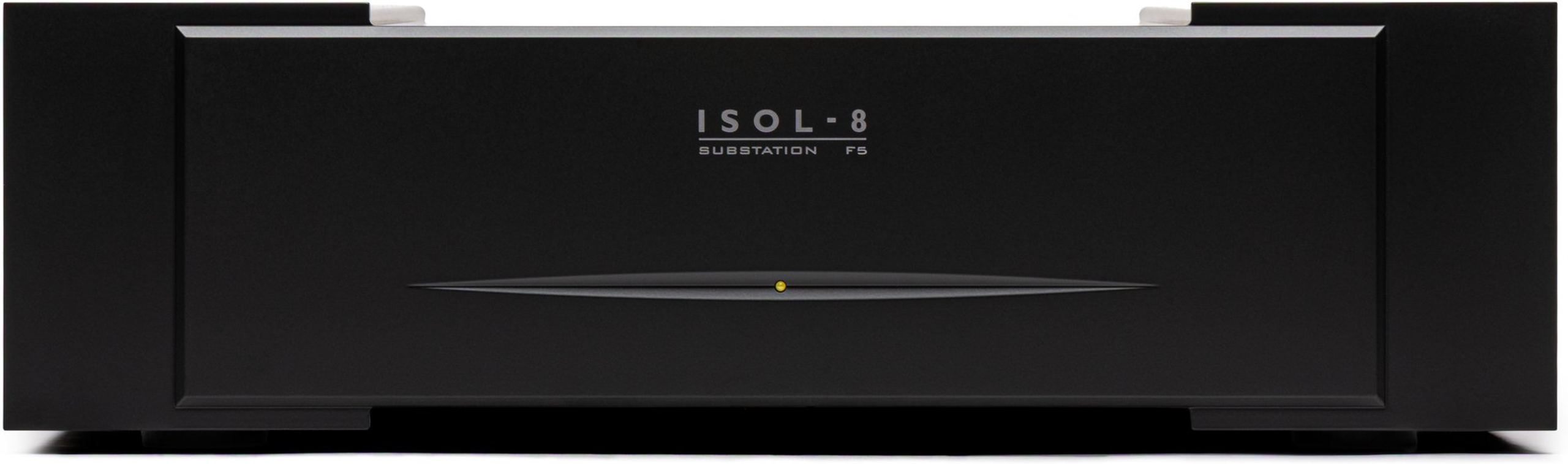
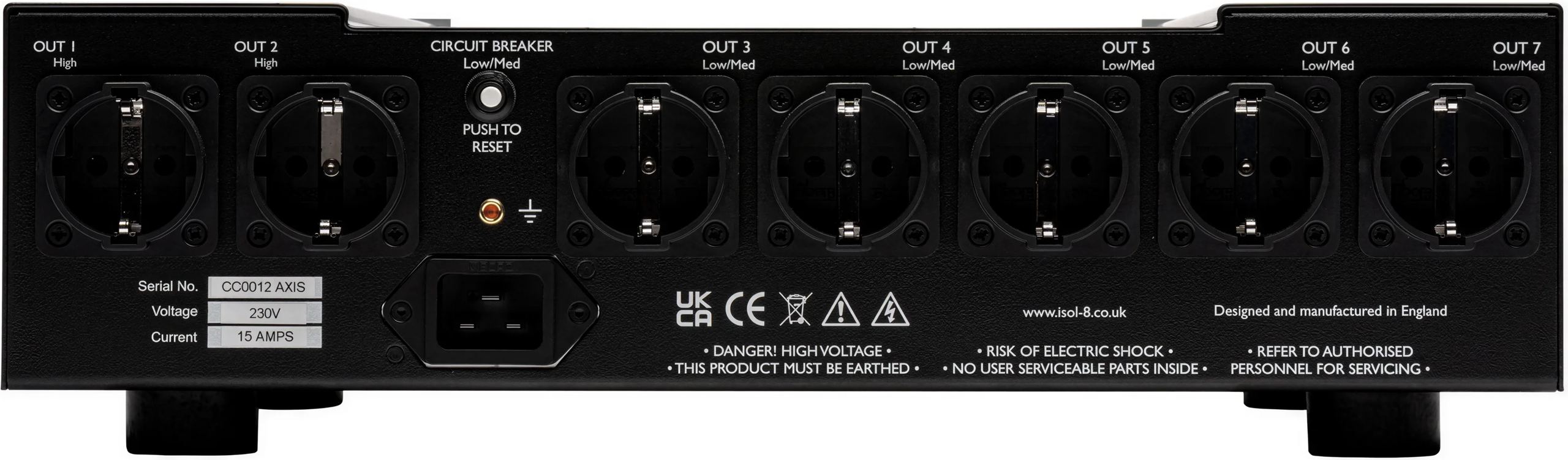
ISOL-8 SubStation F5: seven-outlet mains conditioner
A streamer, a DAC, a preamplifier, two power amplifiers, a turntable with its phono preamp: a complete system quickly exceeds six components. Each feeds interference back into the mains and is affected by interference from the others. In ISOL-8’s F range, the SubStation F5 uses the same enclosure and filtering principle as the F3, with a seventh outlet. Sources and amplifiers have separate circuits with different filtering. Assembly is carried out by hand in England.
Seven outlets and two filtering approaches
Source components draw little current, but even the slightest impurity in their power supply finds its way into the signal. Their outlets pass through a multistage Transmodal filter, and ISOL-8 limits cross-contamination: interference fed back into the mains by a network player does not directly reach the DAC plugged in beside it. Together, these low- and medium-current outlets support 6 A continuously.
Amplifiers have different requirements. A piano attack or a double bass note demands a current far above their average consumption within a few milliseconds, and a filter that restricts this current compresses dynamics. The high-current outputs therefore use a variant of the Transmodal filter with very low series resistance. All seven outlets share a continuous rating of 15 A.
Interference addressed on all three conductors
The Transmodal filter handles differential-mode noise, present between live and neutral, and common-mode noise, which appears on both conductors at once relative to earth. ISOL-8 claims effectiveness extending down to very low frequencies. The third conductor, the protective earth, connects the chassis of all components and also carries interference: a dedicated choke wound by ISOL-8 is provided for it.
Surge protection applies to all outlets. A resettable circuit breaker cuts the power if the current exceeds the limit, and can simply be reset once the cause has been identified.
Inlet, enclosure and construction
The power inlet is selected when ordering from three options: IEC C14 (10 A), IEC C20 (20 A) or Neutrik powerCON. With seven components connected, including amplifiers, the C20 or powerCON is often the right choice, as the C14 limits the total current to 10 A, approximately 2,300 W at 230 V. ISOL-8’s IsoLink Vertex and Vector power cables are available with these terminations.
The machined aluminium front panel is 10 mm thick, with a silver or black finish. Inside, the chokes are wound by ISOL-8, the capacitors are polypropylene and the wiring is PTFE-insulated silver-plated copper. Assembly is carried out by hand in Worcestershire. The enclosure measures 450 × 375 × 132 mm, like that of the F3, and weighs 11.7 kg, an increase of 1.7 kg.
Technical specifications
Type and mains distribution
- Type: passive mains conditioner, SubStation F range
- Number of outlets: 7
- Outlets for low / medium-current source components
- High-current outlets for amplifiers
- Choice of mains inlet: IEC C14 (10 A), IEC C20 (20 A), Neutrik powerCON NAC3MPXXA
- Total continuous current: 15 A maximum shared across all outlets
- With IEC C14 inlet: 10 A
- Continuous current for low / medium-current outlets: 6 A maximum in total
- Supply voltage:
- European version: 220–240 V AC
- 120 V version: 100–127 V AC
- Frequency: 50 / 60 Hz
Filtering and protection
- Multistage Transmodal filtering: common mode, differential mode
- Cross-contamination control between connected devices
- High-current outlets: Transmodal topology with very low series resistance
- Earth circuit filtering: ISOL-8 wound inductor
- Surge protection
- DC blocking: no (see SubStation F5 Axis)
- Protection: resettable circuit breaker
Components and construction
- Components: ISOL-8 wound inductors, polypropylene capacitors, silver-plated copper wiring with polytetrafluoroethylene (PTFE) insulation
- Front panel: 10 mm thick machined aluminium
- Finishes: silver or black
- Construction: hand-assembled in Worcestershire (England)
Dimensions and weight
- Dimensions (W × D × H): 450 × 375 × 132 mm
- Depth excluding connectors
- Packaged dimensions: 555 × 500 × 300 mm
- Weight: 11.7 kg
- Packaged weight: 15 kg
Frequently asked questions
What total power can be connected to the SubStation F5?
15 A continuous, shared across the seven outlets, or approximately 3,450 W at 230 V with a C20 or powerCON inlet. With a C14 inlet, the limit drops to 10 A, approximately 2,300 W. The source component outlets are limited to 6 A in total. With monoblock power amplifiers or a Class A amplifier, add up the power consumption figures specified by their manufacturers before choosing the inlet.
Should you choose the F5 over the F3?
The deciding factor is the number of devices. Both models have the same input options, current limits and enclosure. The F5 adds a seventh outlet: useful for a system with two power amplifiers, a turntable and its phono preamp, or an additional source.
What should I do if an amplifier produces a mechanical hum?
A buzzing noise coming from the amplifier’s casing, rather than the speakers, is most often caused by a DC component on the mains supply. The SubStation F5 does not block it. The SubStation F5 Axis uses the same power conditioner with a built-in blocking circuit. If only one device is affected, ISOL-8’s Axis 10 and Axis 20 address the problem at a single socket.
Can the SubStation F5 be placed on a hi-fi rack shelf?
Yes, its 450 mm width and 132 mm height match a standard hi-fi component. The 375 mm depth does not include the plugs: allow about ten extra centimetres at the rear for seven cables and the power supply, without bending them against the wall. At 11.7 kg, also check the shelf’s load capacity.
Does the SubStation F5 support 60 Hz mains power?
Yes. The European version operates at 220–240 V, at 50 or 60 Hz. A separate 120 V version is available for 100–127 V mains supplies.
- Eco-contribution included in the sale price.


