

What are the differences between EL34, KT88, 300B, etc... tubes?
8 October 2025
Contents
Imagine electronic components invented over a century ago, long since replaced by more modern and efficient alternatives, yet still making the hearts of music enthusiasts beat faster. This is the fascinating story of vacuum tubes in high-fidelity audio. These luminescent glass bulbs, with their incandescent filaments and complex metal structures, remain at the center of passionate debates among audiophiles. Why? Because each type of tube—whether an EL34, a KT88, or the legendary 300B—brings its own sonic signature, its unique character to the reproduced music.

Triodes, Tetrodes and Pentodes: What Are the Differences?
The triode is the simplest tube: just three elements. A heated cathode emits electrons, a grid controls their flow, and a plate collects them. This simplicity produces remarkably pure sound, with primarily second-harmonic distortion—the type of distortion our ears perceive as pleasant, adding warmth and richness to the sound. This is why triodes like the 300B or 2A3 are often described as “magical” for reproducing voices and acoustic instruments.
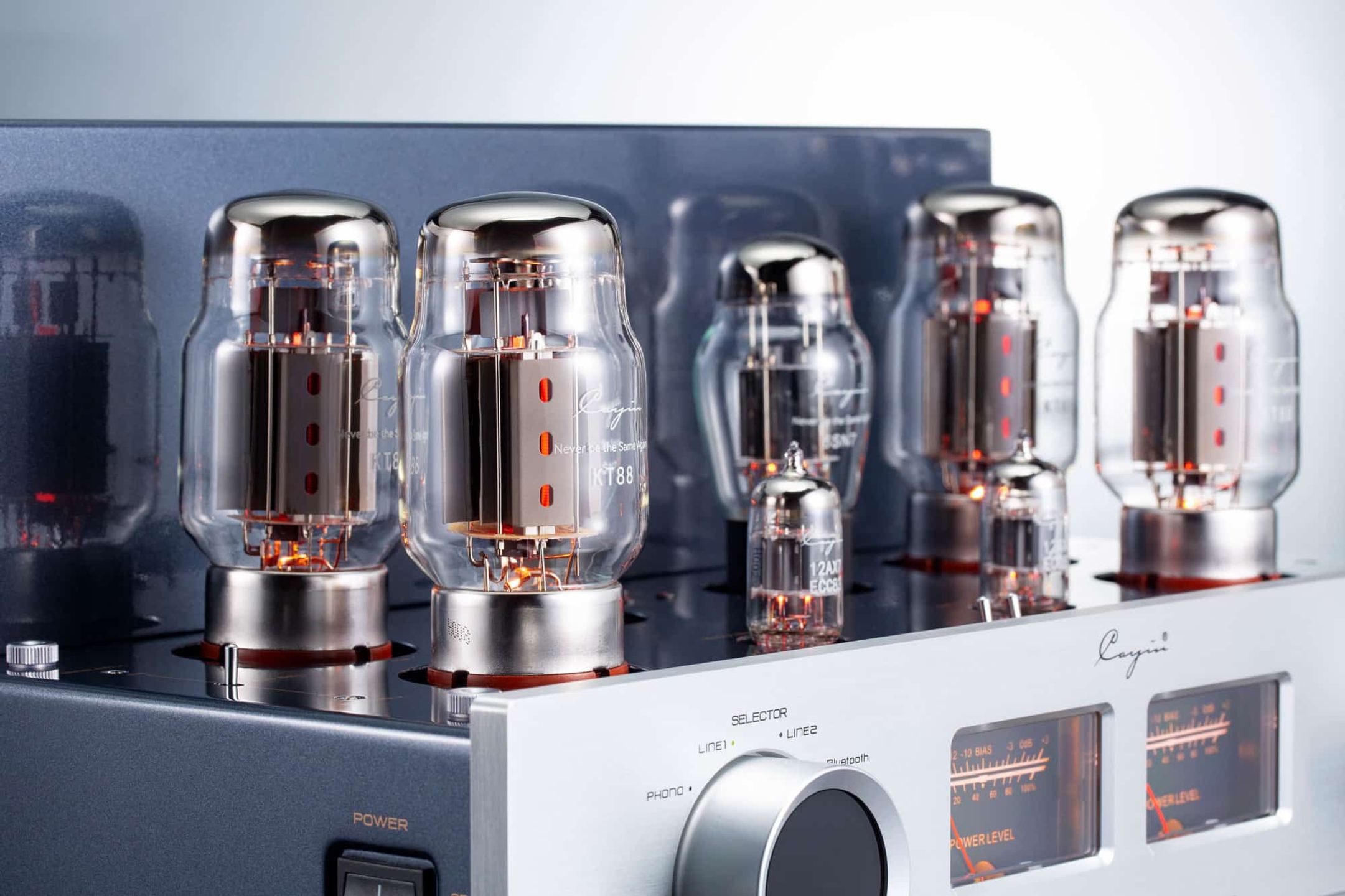
On the other hand, pentodes (like the EL34) and beam tetrodes (like the KT88) add extra grids to increase power and control. The price to pay? Different distortion, with more odd harmonics that can sound less natural. But their advantage in terms of power and versatility makes them indispensable for many applications.
Comparison of Main Audio Tubes
Pentode Tubes
| Tube | Origin | Sonic Signature | Music Style / Ambiance |
|---|---|---|---|
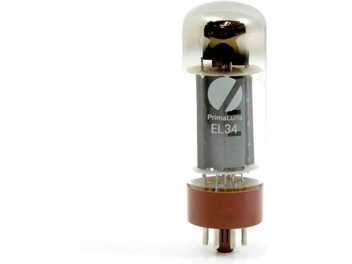
| EL34 | United Kingdom (Mullard) | Warm midrange, smooth highs, firm bass | Classic European rock, overdriven guitar, vintage sounds |
| EL84 (6BQ5) | Europe (Vox) | Silky midrange, crystalline highs, harmonious | Pop, light rock, compact amps, clear and detailed sound |
| 6L6GC (and derivatives) | USA | Clean and linear sound, deep bass, extended highs | Jazz, blues, classical music |
Tetrode Tubes
| Tube | Origin | Sonic Signature | Music Style / Ambiance |
|---|---|---|---|
| KT88 | United Kingdom (GEC) | Deep bass, airy highs, transparent midrange | Orchestral, symphonic music, home cinema, wide dynamics |
| 6550 | USA (Tung-Sol) | Musicality / power compromise | Jazz, clean rock, neutral and reliable sound |
| KT120 | Modern | Wide dynamics, punch, precise details | Modern music, high dynamics |
| KT150 | Modern | Very powerful dynamics, authoritative bass | Modern music, extreme power |
Triode Tubes
| Tube | Origin | Sonic Signature | Music Style / Ambiance |
|---|---|---|---|
| 300B | USA (Western Electric) | Natural midrange, smooth highs, full bass | Jazz, vocals, acoustic, warm ambiance |
| 2A3 | USA | Superior transparency, less warm midrange | Acoustic music, classical, sensitive systems |
| 45 | USA | Exceptional linearity and sonic purity | Minimalist hi-fi, horns, very high efficiency |
| 845 | USA (transmitting tubes) | Triode purity, powerful bass | Jazz, orchestra, high-power SE |
| 211 | USA (transmitting tubes) | Triode purity, authoritative bass | Jazz, classical, demanding music, high-power SE |
Continuing Evolution: Between Tradition and Modernity
Tubes are not frozen in the past. Modern production is concentrated in Eastern Europe (Slovakia with JJ Electronic, Czech Republic with KR Audio), Russia (Electro-Harmonix, Tung-Sol and Gold Lion reissues), and China (Shuguang, Psvane). These manufacturers constantly improve the quality and consistency of their products, proving that this century-old technology knows how to evolve.
The parallel NOS (New Old Stock) market—these vintage tubes never used—testifies to the passion that drives collectors. A pair of 1950s Western Electric 300Bs can reach several thousand euros, while original Mullard EL34s sell for several hundred euros each. Beware, however, of counterfeits that proliferate, particularly on the most sought-after models. The current geopolitical situation also complicates the supply of Russian tubes, driving prices up.
Meanwhile, modern electronics are not standing still. New components like GaN (gallium nitride) promise revolutionary performance in solid-state amplification. Digital modeling is advancing by leaps and bounds: current DSP processors no longer just imitate the sound of tubes, they reproduce their complex interactions with transformers and speakers.
The future? Probably an enriching coexistence between authentic tubes for purists, hybrid technologies combining the best of both worlds, and increasingly convincing digital simulations for the new generation.
Choosing Tubes According to Your Speakers
The choice of tube depends intimately on the characteristics of the speakers to be driven. Low-power triodes (300B, 2A3, 45) require high-efficiency speakers (>92 dB/W/m minimum) and relatively stable impedance. Horn systems, full-range drivers, and certain high-sensitivity designs are ideal partners.
Medium-power pentodes and tetrodes (EL34, KT88) offer more flexibility, able to properly drive medium-sensitivity speakers (87-92 dB/W/m) while maintaining high sound quality. Their superior damping factor allows better control of bass drivers.
Myths to Forget
-
“Tube watts are more powerful” - Partially true. The natural compression of tubes gives an impression of superior power, but 30 watts remain 30 watts. A tube amp saturates more musically than a transistor, that’s all.
-
“You absolutely need vintage tubes” - False. Some modern tubes excel. A well-designed modern JJ EL34 can outperform a tired 1960s Mullard, for ten times less money.
-
“All tubes sound alike” - Absolutely false. Even between two EL34s from different brands, the differences are audible. Between an EL34 and a KT88, it’s another world. Between a KT88 and a 300B, it’s a completely different sonic planet.
Final Word
Choosing a tube is like choosing between a Steinway and a Bösendorfer piano. Both are excellent, but their touch, their timbre differ subtly. There is no “best” tube in absolute terms, only the one that matches your tastes, your speakers, your budget, and your music.
The EL34 brings rock energy with its biting midrange. The KT88 offers power and transparency for all genres. The 300B creates incomparable magic on vocals and acoustic music. The 2A3 aims for absolute purity for ultra-sensitive systems. Each opens a different window onto music.
My advice? If possible, listen before buying. Otherwise, start with your speakers and your favorite music. With low-sensitivity speakers and a love of rock, look toward the EL34 or KT88. With sensitive speakers and a passion for vocal jazz, explore the 300B. And remember: the best tube is the one that makes you want to listen to music for hours, the one that transforms digital bits or vinyl grooves into pure emotion.
Featured products

You may also like to read
 What is the difference between a tube amplifier and a transistor amplifier?Concepts and technologies
 Cambridge Audio Spira: an upgradeable turntable for €349Hi-fi and home cinema news
 Elipson Classic Sub 8, 10 and 12: which subwoofer should you choose?Hi-fi and home cinema news
 Rega Replay: a new €349 turntable with no complex adjustmentsHi-fi and home cinema news
 ANSI lumens, ISO lumens, light source: how to really understand a projector’s brightnessComparisons and buying guides
 What Hi-Fi? Awards 2026: all the TV, home cinema, hi-fi and headphone winnersHi-fi and home cinema news








