

Acoustic Treatments
Acoustic treatment encompasses all the solutions that improve sound quality inside a room. Absorptive panels, bass traps, and diffusers are used to control reverberation, echoes, and unwanted resonances. Unlike soundproofing, which blocks sound between rooms, acoustic correction optimizes the internal acoustics of a space to achieve more accurate listening and better sound comfort. Learn more
Understanding acoustic treatment
Acoustic treatment, also called acoustic correction, involves modifying how sound behaves in a given space. Every room has acoustic characteristics that influence sound reproduction: excessive reverberation, echoes, modal resonances, or low-frequency buildup. These phenomena reduce speech intelligibility and the accuracy of music listening.
Acoustic correction acts on reverberation time by absorbing or diffusing sound energy. It should not be confused with soundproofing, which limits the propagation of sound between two spaces. Effective acoustic treatment makes it possible to hear the direct sound from the speakers without disturbance caused by reflections on the surfaces.
The different treatment solutions
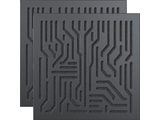
Absorptive acoustic panels are the foundation of any treatment. Made from porous materials such as acoustic foam, mineral wool, or recycled PET felt, they transform part of the sound energy into heat. Their effectiveness depends mainly on their thickness and density. Panels from 3 to 5 cm mainly absorb mid and high frequencies. To treat bass, greater thicknesses are required.
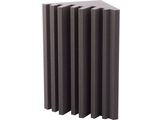
Bass traps target low frequencies, often the most difficult to control in an enclosed room. They are generally placed in corners, where acoustic pressure is highest. Depending on requirements, they can be porous, membrane-based, or tuned resonators.
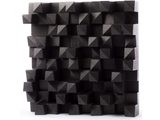
Acoustic diffusers disperse sound waves in several directions instead of absorbing them. They preserve acoustic energy while limiting localized echoes. Their design is based on precise mathematical sequences, such as QRD or PRD, which determine the depth of the wells. Diffusers provide a sense of space and a more natural rendering, particularly appreciated in hi-fi listening.
Applications and benefits
For home studios and recording studios, acoustic treatment remains essential. It ensures reliable monitoring for mixing and recording. First reflections on the side walls and ceiling are generally treated first, then supplemented with bass traps in the corners.
In home theater, acoustic correction improves immersion and dialogue clarity. The optimal reverberation time is around 0.5 seconds at 1 kHz, which is shorter than in hi-fi in order to prioritize accuracy and spatial effects.
For hi-fi listening, treatment aims to reveal detail and the soundstage. A good balance between absorption and diffusion preserves musical dynamics while correcting the room’s flaws. The recommended reverberation time is around 0.7 seconds at 1 kHz.
In commercial spaces, such as open-plan offices, restaurants, or meeting rooms, acoustic treatment reduces ambient noise and improves conversation intelligibility. Wall panels and suspended baffles lower the sound level and make the environment more comfortable.


