Russound D250LS
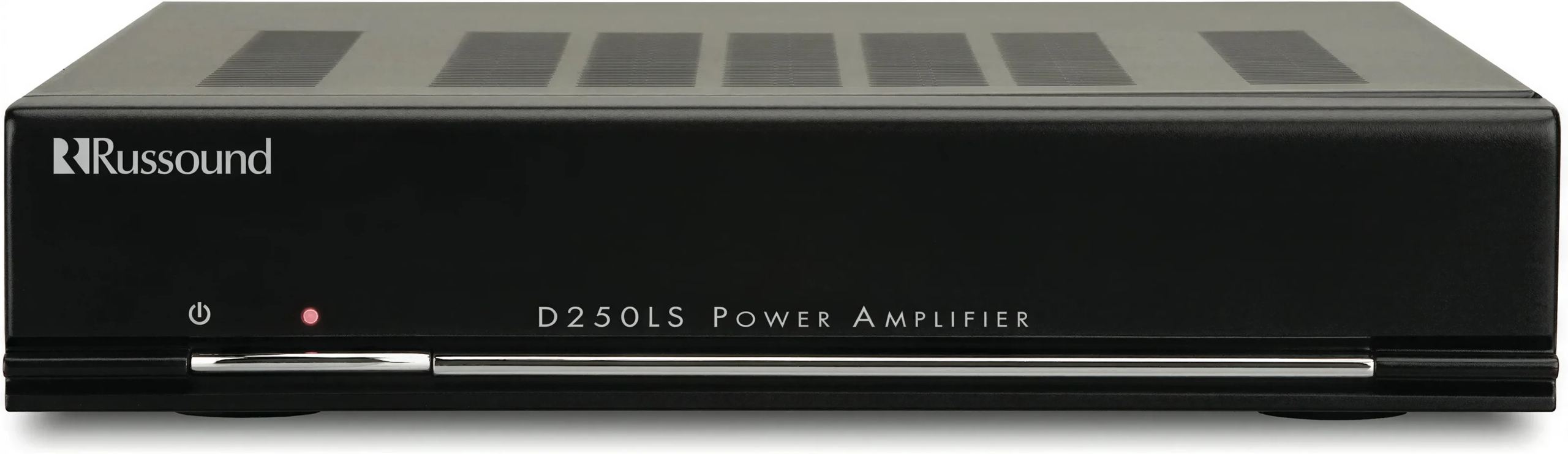
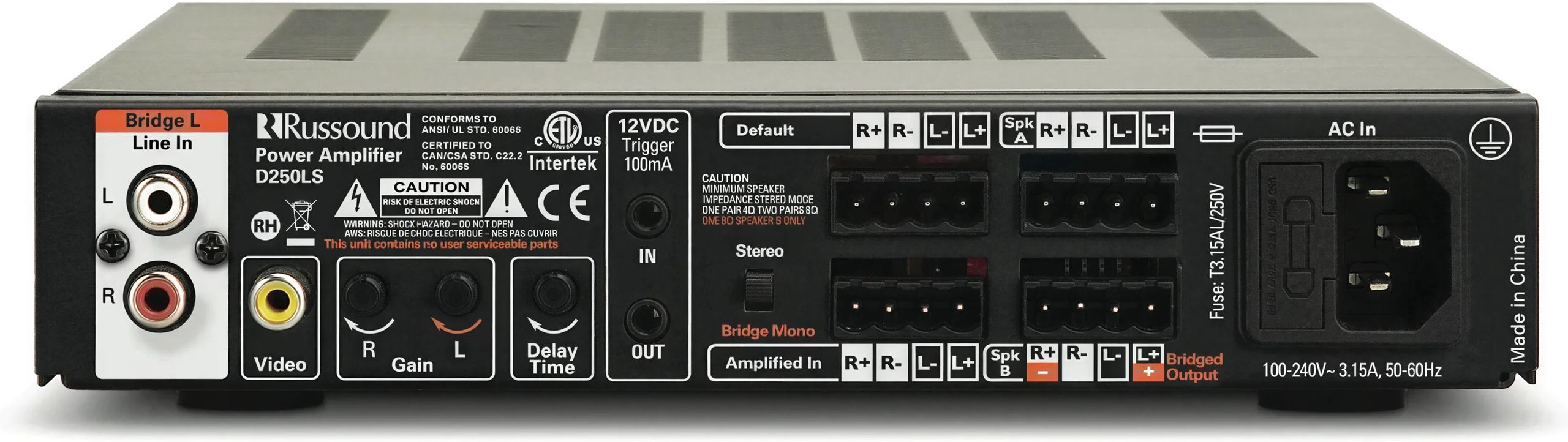
Russound D250LS, the local source amplifier
In a multiroom sound system, all zones receive the same centralized source. There remains the case of the bedroom or office, where you may sometimes want to listen to the room’s television or computer rather than the general broadcast. The D250LS from Russound addresses exactly this need: a compact stereo amplifier that switches the zone speakers to the local source as soon as it starts, then returns them to the central sound system once that source is turned off.
When the local source takes control
The LS initials in the name refer to this “local source” function. The principle is straightforward. As long as nothing is playing locally, the room’s speakers play the source from the multiroom system. Turn on the television or computer connected to the D250LS, and the D250LS detects the signal, disconnects from the central system and sends its own amplification to the speakers. When the local source stops, the speakers return to the general broadcast.
Several detection methods are provided depending on the type of source. Signal detection works with line-level inputs (low voltage, typically an RCA output) as well as speaker-level inputs (the already amplified signal from a small television, for example). Video signal detection and a 12 V trigger input complete the setup for installations that control switching through other equipment. An adjustable switching delay, from five seconds to five minutes, prevents the speakers from switching at the slightest passing sound or returning too quickly to the central source.
Two-channel stereo or mono bridge mode
In stereo operation, the D250LS delivers 50 watts per channel into 8 ohms and 75 watts per channel into 4 ohms, the minimum impedance supported in this mode. A stereo / mono bridge selector combines the two channels into a single 150-watt output into 8 ohms, useful for powering a speaker requiring more headroom or a single listening point. The eight screw terminals accept up to four speakers.
This is Class D amplification, which explains its low heat output and modest 2.1 kg weight. Each channel incorporates thermal protection and short-circuit protection, which cut the output in the event of prolonged overheating or a faulty speaker cable. In terms of measurements, THD+N distortion remains below 0.3% from 20 Hz to 20 kHz at 50 watts into 8 ohms, and drops below 0.05% at 1 watt. The A-weighted signal-to-noise ratio exceeds 112 dB, frequency response stays within ± 0.4 dB from 20 Hz to 20 kHz, and gain reaches 32 dB for a 47 kilohm line-level input impedance.
Four installation options
The flat chassis, 4.45 cm high (equivalent to a 1U rack), fits where a conventional amplifier would not. The supplied hardware enables four mounting options: flat on a shelf, wall-mounted, installed alone in a 1U space, or side by side with a second D250LS in the same 1U space to cover two zones within the height of a single rack. The unit measures 21.6 cm wide by 26.7 cm deep and weighs 2.1 kg.
Power is supplied via a detachable IEC connector mains cable, in the European 230 V version. Standby power consumption remains below 0.5 watt, in compliance with European requirements in this regard. A 12 V trigger input and output allow switching to be daisy-chained with a multiroom controller or other components in the installation.
Technical Specifications
Overview
- Two-channel stereo amplifier with priority local source
- Compact, low-profile form factor
- Automatic local source switching
- Bridgeable channels for high-power mono output
- Thermal and short-circuit protection on each output channel
Output Power
- Continuous output power (< 0.3% THD+N at 1 kHz)
- 50 W per channel into 8 ohms
- 75 W per channel into 4 ohms
- 150 W into 8 ohms in bridged mode (2 channels)
- Stereo / bridged mono switch to combine both channels
Audio Performance
- Distortion (THD+N)
- < 0.3% from 20 Hz to 20 kHz at 50 W into 8 ohms
- < 0.05% from 20 Hz to 20 kHz at 1 W into 8 ohms
- Signal-to-noise ratio: > 112 dB A-weighted
- Channel separation: > 60 dB at 1 kHz
- Frequency response: 20 Hz to 20 kHz ± 0.4 dB
- Voltage gain: 32 dB
Inputs and Sensitivity
- Input sensitivity
- 70 mV for 1 W into 8 ohms
- 550 mV for 50 W into 8 ohms
- Input impedance: 47 kohms on line input
- Automatic signal detection for high- and low-level inputs, video signal, and 12 V trigger
Switching and Triggering
- Adjustable switching delay: 5 seconds to 5 minutes
- Trigger input: 12 V DC, 10 kohms
- Trigger output: 12 V DC, 100 mA maximum
Power Supply
- Automatic switching power supply
- North American model: 120 V AC, 60 Hz, 2.5 A
- European model: 230 V AC, 50 Hz, 2.5 A
- IEC 320 connector with detachable 3-prong power cord
- Fuse rating: T3.15AL / 250 V
- Standby power consumption: < 0.5 W
Installation
- Four mounting options
- Wall mounting
- Shelf placement
- 1U rack mounting
- Side-by-side mounting of two amplifiers in a 1U rack
- Compatible with the MCA-C5 controller for powering zones 7 and 8
- Mounting hardware included
Dimensions and Weight
- Dimensions: 21.59 cm (W) x 26.67 cm (D) x 4.45 cm (H)
- Weight: 2.1 kg
Frequently Asked Questions
Does the D250LS work without a multiroom system, as a simple zone amplifier?
Yes. In the absence of a local source to monitor, it serves as a stereo amplifier for one zone: two channels, 50 watts per channel into 8 ohms, with the same line-level inputs. The switching function then remains inactive.
Can two pairs of speakers be connected?
The eight speaker terminals accommodate up to four speakers, with the outputs wired in parallel on each channel. Note the resulting impedance: two 8-ohm speakers in parallel present 4 ohms, which is the minimum allowed in stereo. Below that, the protection circuitry may trip.
What can mono bridge mode power?
With both channels combined, it delivers 150 watts into a single 8-ohm load, enough to power a demanding speaker or a single distribution point. The D250LS has no dedicated filtering for a subwoofer: without bass filtered upstream, it is not intended for this role.
Is a Russound controller necessary?
No. The D250LS is used standalone, as a zone amplifier, or for local source switching. The 12 V trigger inputs and outputs are used to integrate it with a multi-room controller or to daisy-chain several components, when the installation requires it.
How does the D250LS differ from Russound's MBX-AMP amplifier?
The MBX-AMP is a connected amplifier that directly plays network sources (AirPlay, Chromecast, Bluetooth, streaming services). The D250LS has no network playback capabilities: it is a power amplifier that receives the signal from an existing source and manages switching between this local source and the central sound system. Both meet different needs in a multi-room installation.
Does the D250LS need ventilation?
Its Class D amplification generates little heat, but each channel retains thermal protection. Leaving space for air circulation around the chassis is still recommended, especially if it is used at high volume for extended periods or installed in an enclosed space.
- Eco-contribution included in the sale price.