

SSC Bigpoint black noir Anodis
Overview
A power amplifier or a subwoofer does not vibrate only through its drivers. The transformer, chassis and cabinet also move, and the furniture supporting them feeds some of that energy back into them. This large black aluminium disc sits between the device and its support to reduce these exchanges. It supports up to 45 kg per support point, making it suitable for heavy electronics and speakers.
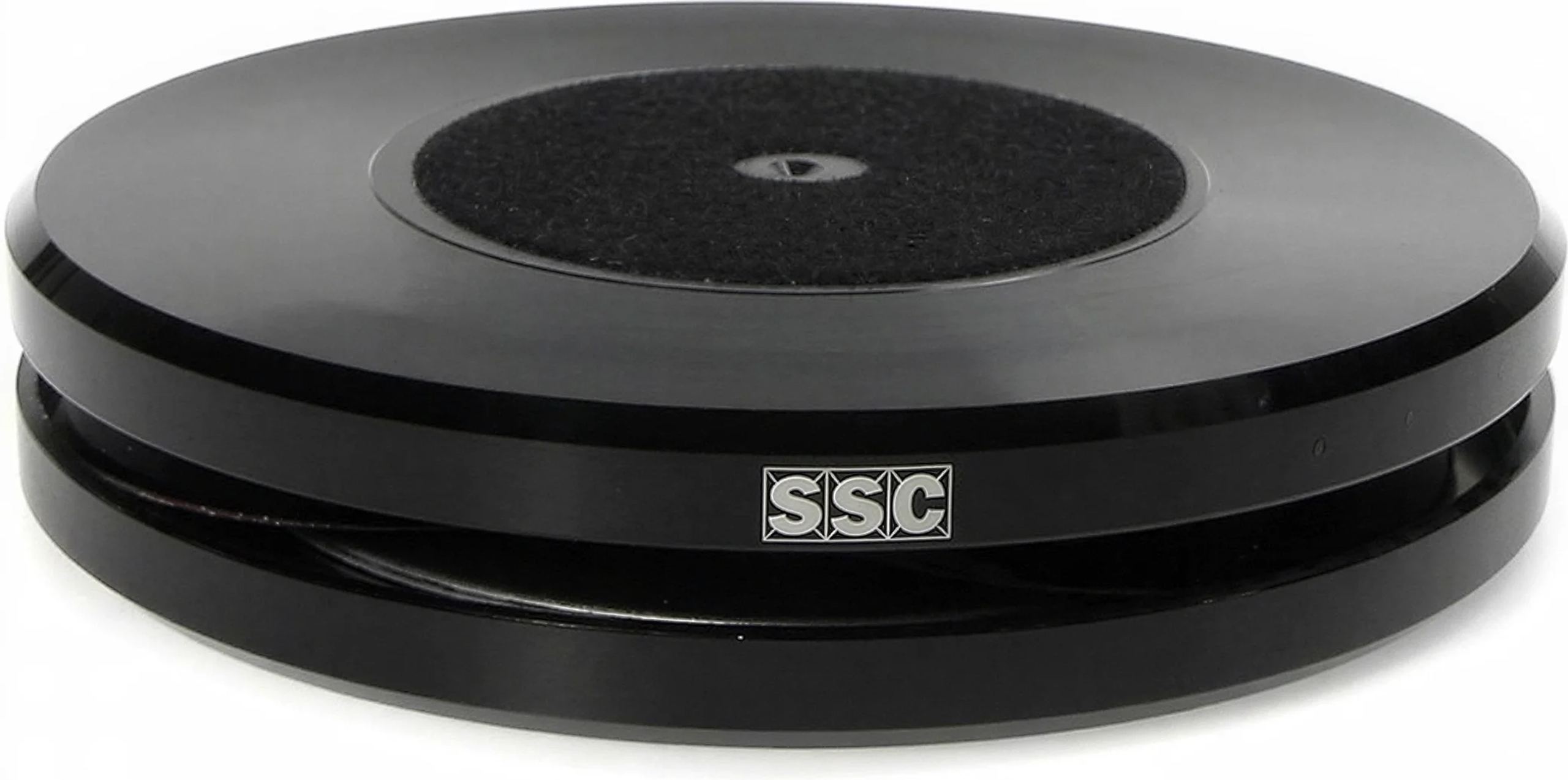
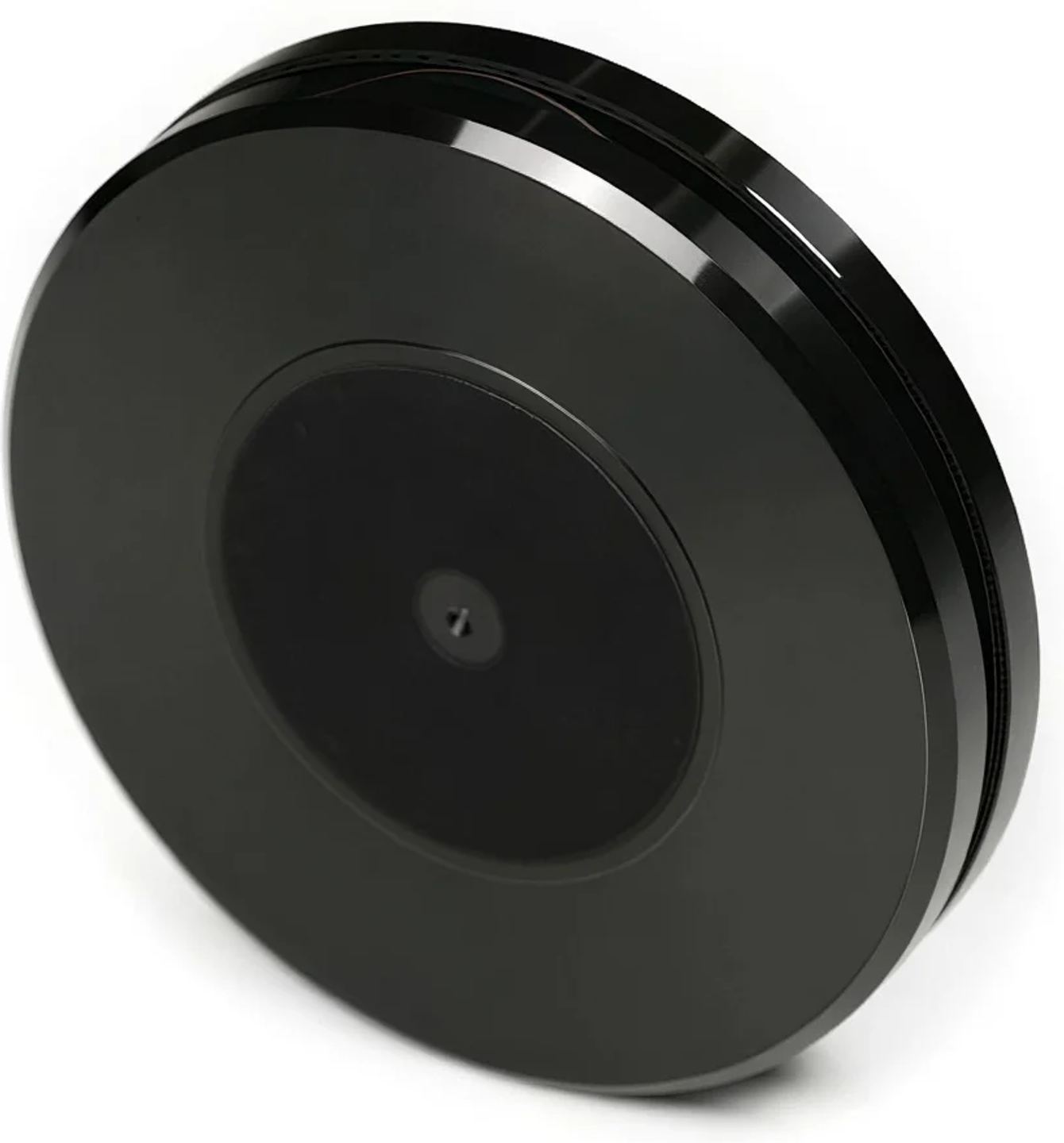
Two aluminium discs with a suspension between them
SSC is a German manufacturer founded in 1997, specialising in decoupling accessories for hi-fi. Its initials stand for String Suspension Concept: the brand replaces rigid contact with a suspension whose elements work under tension, much like strings. All materials are manufactured, processed and inspected in Germany.
The Bigpoint consists of two black anodised aluminium discs, with the SSC decoupling mechanism housed between them. It measures 105 mm in diameter and 12 mm in height. Anodising is an electrochemical treatment that forms a hard oxide layer on the surface, resistant to scratches and corrosion, and sets the black colour. The Bigpoint belongs to the first generation of SSC supports, with a simpler decoupling principle than the membrane used in the Netpoint and Matchpoint series. In return, it handles almost twice the load of a Matchpoint (25 kg per foot).
Decoupling rather than coupling: what this foot does
The Bigpoint is classified among spike shoes, but it works in the opposite way to a spike. A spike creates rigid contact over a very small area and transmits vibrational energy from the device to its support, and vice versa. A decoupling foot places a flexible element between two rigid masses. The assembly forms a mass-spring system: above its resonant frequency, vibrations pass less and less from one side to the other.
This behaviour depends on the weight placed on it. A suspension with too little load remains stiff, while an overloaded suspension compresses and no longer filters much. The 45 kg capacity per foot therefore places the Bigpoint under substantial equipment, rather than under a two-kilogram network player. The aim is cleaner bass with less overhang, and a more clearly defined soundstage, once the furniture or floor no longer adds its own resonances to the signal.
Which devices to place the Bigpoint under
Heavy integrated amplifiers, monoblocks, floorstanding speakers and subwoofers are the most suitable devices. The subwoofer is a typical case: it transmits its energy directly to the floor, and parquet or wooden floorboards begin to resonate with it. Decoupling it limits the excitation of the floor and gives the bass greater control.
The 12 mm height barely raises the device. In a hi-fi rack with closely spaced shelves, the clearance above an amplifier remains almost unchanged. The 105 mm diameter does, however, require a sufficiently large flat area beneath the chassis, which should be checked before purchase on devices with fins, protruding screws or original feet very close to the edge underneath. The Bigpoint is not height-adjustable: on a shelf that is not level, the support itself must be corrected.
A device’s weight is rarely distributed evenly. In an amplifier, the transformer often concentrates a substantial part of the mass on one side. Positioning the feet closer to this area distributes the load more evenly and prevents a single support point from exceeding 45 kg while the others carry little load.
Documentation
French
Technical Specifications
Dimensions
- Diameter: 105 mm
- Height: 12 mm
Capacity
- Maximum load: 45 kg per foot
Frequently asked questions
How many Bigpoint are needed under a device?
Three supports are sufficient in most cases, and they have an advantage: three points always define a plane, so the device cannot rock, even on a slightly uneven surface. Four feet are suitable for wide or very heavy devices, provided the supporting surface is level; otherwise, one of them bears little or no weight. In all cases, divide the weight of the device by the number of feet, taking into account the side carrying the most weight, and stay below 45 kg per support.
Can a speaker fitted with spikes be placed on a Bigpoint?
It is best to remove the spikes. A spike resting on the disc would mark the anodized aluminum and concentrate the entire load on a tiny point of the suspension. SSC’s 300 versions in the Netpoint and Matchpoint series have a top plate designed to accommodate spikes, with a lower load capacity (25 kg per foot for the Matchpoint 300).
Is the Bigpoint suitable for use under a turntable or CD player?
Usually, no. These source components rarely weigh more than 10 to 15 kg, which would leave each foot well below its load range: the suspension would remain too stiff to work properly. The Netpoint and Matchpoint series, designed for lighter loads, are better suited to these devices.
What's the difference compared to the Liftpoint feet from the same brand?
The Liftpoint 1.6 uses the SSC membrane from the Netpoint models and compensates for differences in height, an adjustment not available on the Bigpoint. The device can be screwed onto it or simply placed on it. The Liftpoint 3.5 combines SSC technology with a solid aluminium foot. The Bigpoint, lower and wider, remains the simple solution for a heavy load on an already level support.
Do Bigpoint damage parquet or tile flooring?
Unlike a spike, the flat 105 mm support surface does not puncture the flooring and distributes the weight over a wide area. On a floating floor, which tends to resonate beneath a subwoofer or floorstanding speaker, decoupling is an additional benefit. Slide the unit off the feet rather than dragging it with them in place to avoid scratching the floor.
Does an isolation foot replace a good hi-fi rack?
No, the two complement each other. A rigid, stable, level stand remains the foundation. The Bigpoint acts at the interface between the device and this support, and its effect will be all the more noticeable if the stand does not move on its own. On a lightweight shelf that bends under the weight, the support issue must be addressed first.
- Eco-contribution included in the sale price.


