

Lehmann Audio Black Cube Statement black
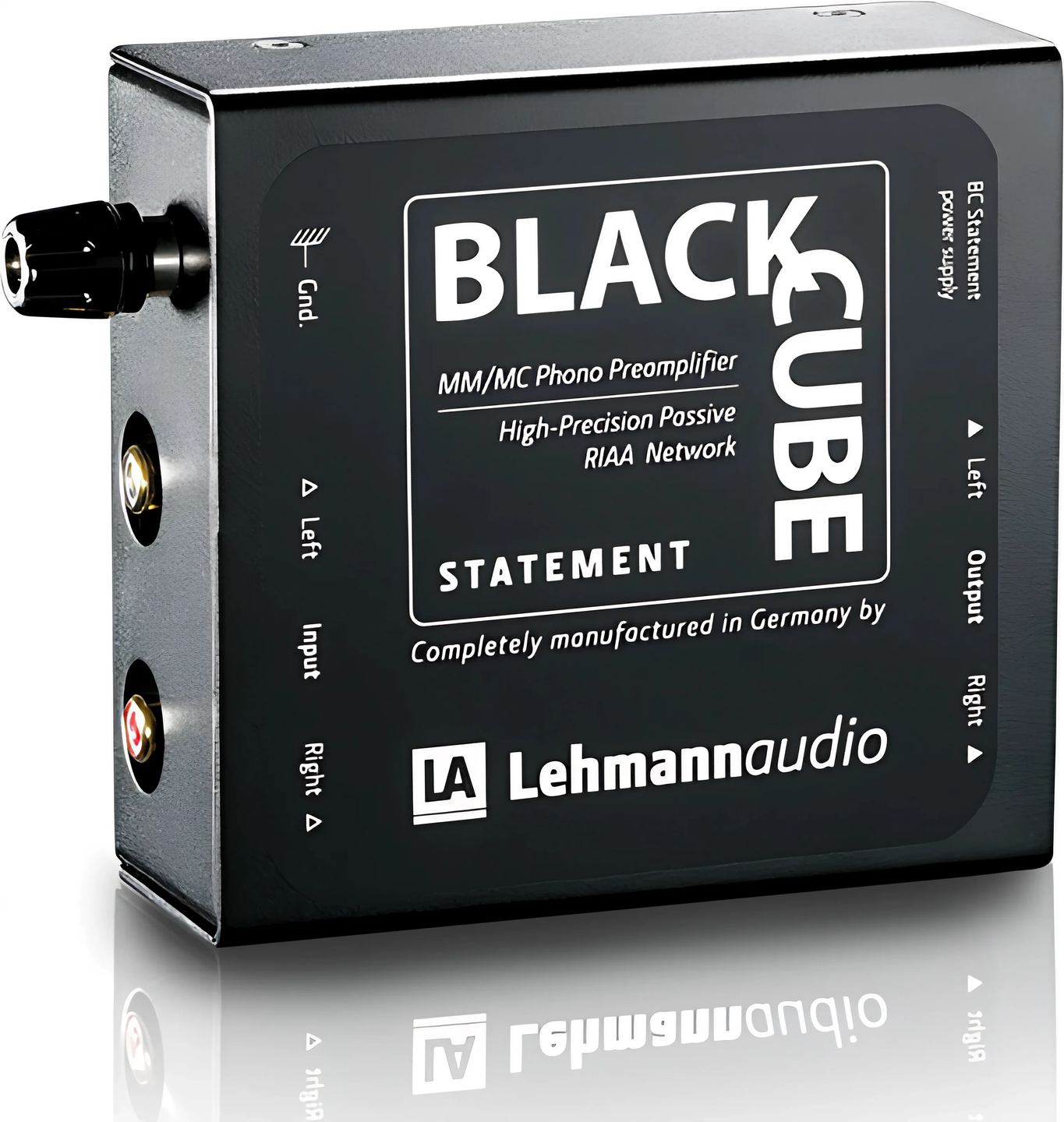

Lehmann Audio Black Cube Statement, MM and MC phono preamp
A turntable delivers a tiny signal, deliberately altered during cutting so that the bass fits into the groove. Before reaching the amplifier, this signal needs to be boosted in level and have its tonal balance restored. This little black box from Cologne does that job for moving-magnet cartridges as well as moving-coil cartridges, with four gain settings and three load impedances, in a format that sits right next to the turntable.
A line of phono preamps born in 1995
Lehmannaudio was founded in 1988 in Cologne by Norbert Lehmann, then a sound engineering student. The first Black Cube was released in 1995, and the brand has since built its entire range around phono amplification. Despite its name, the Black Cube Statement is the entry-level model in the Black Cube series: above it come the Black Cube II, the Black Cube SE II, the Black Cube Decade and then the Silver Cube, the brand’s reference model. The Statement adopts the principles of its bigger siblings (aluminium enclosure, passive RIAA equalisation, DIP switch settings) in a simpler format, powered by an external mains adapter rather than a separate power supply chassis.
Four gain settings for very different cartridges
A moving-magnet (MM) cartridge generally produces between 3 and 5 millivolts, while a low-output moving-coil (MC) cartridge often produces ten times less. The Black Cube Statement offers 31, 41, 51 and 61 dB of gain: each 10 dB step multiplies the voltage by a little over three. The 41 dB setting suits most MM cartridges, 61 dB is intended for the lowest-output MC cartridges, and the intermediate positions serve high-output MC cartridges or powerful MM cartridges that would overload the amplifier input with too much gain. Settings are adjusted underneath the unit using two rows of four DIP switches with gold-plated contacts. The signal-to-noise ratio drops from 78 dB in MM mode to 57 dB in MC mode: the difference naturally follows the increase in gain, and with a very low-output MC cartridge boosted to 61 dB, a slight hiss may be audible at high volume between tracks.
Loading the cartridge with the right impedance
The input impedance seen by the cartridge influences its treble response. The Black Cube Statement offers three options: 47 kΩ, the standard value for MM cartridges, followed by 1 kΩ and 100 Ω for MC cartridges, which favour lower or higher loads depending on the model. For cartridges requiring a specific value outside these three positions, an internal slot accommodates a resistor of the user’s choice, fitted without soldering. Input capacitance is fixed at 100 pF, a low value that suits most MM cartridges, especially since the turntable cable adds its own capacitance.
Passive RIAA equalisation between two gain stages
When a record is cut, the bass is attenuated and the treble boosted according to a standardised curve, the RIAA curve. The preamp applies the inverse curve to restore an accurate balance. Lehmannaudio assigns this equalisation to an entirely passive network, built with high-precision film capacitors and placed between two linear gain stages: the equalisation does not depend on a negative feedback loop, and each stage amplifies evenly across the frequency band. The gain stages use Burr-Brown audio operational amplifiers, the electrolytic capacitors have low equivalent series resistance, and the double-sided printed circuit board allows short traces between components. The RCA sockets are gold-plated.
A compact enclosure to place near the turntable
Measuring 103 × 45 × 108 mm, the Black Cube Statement fits on the same piece of furniture as the turntable, as close to the tonearm as possible. The cable carrying the cartridge signal, the most fragile in the entire chain, thus remains short, limiting its parasitic capacitance and susceptibility to interference. At the output, however, an impedance below 100 Ω allows it to drive a longer cable to the amplifier without difficulty. The audio section’s enclosure is made of aluminium, a non-magnetic metal that does not disturb the signal, and its lid features mechanical damping treatment to counter resonances. A ground terminal accepts the turntable’s ground wire. The Statement has just one stereo input and therefore handles only one turntable at a time.
Technical Specifications
Main Features
- Low-noise design
- Four different gain settings
- Compatible with all moving magnet (MM) and moving coil (MC) cartridges
- RIAA filter: passive equalization between two linear gain stages
Audio Performance
- Switchable gain (1 kHz): 31 dB, 41 dB, 51 dB, 61 dB
- Signal-to-noise ratio: 78 dB MM, 57 dB MC
- Input capacitance: 100 pF
- Switchable input impedance: 47 kΩ, 1 kΩ, 100 Ω
- Output impedance: < 100 Ω
- Channel separation: > 80 dB
Physical Specifications
- External power supply
- Power consumption: 2 W
- Dimensions (W × H × D): 103 × 45 × 108 mm
- Weight: 500 g
Frequently asked questions
Which input on the amplifier should the Black Cube Statement be connected to?
To a line input (CD, AUX, Tuner or equivalent). Connecting to a phono input would apply RIAA equalization a second time and unnecessary amplification: the sound would be distorted and unbalanced, with excessive bass.
My amplifier already has a phono input. Is there any benefit to using the Black Cube Statement?
Yes, in two common cases. Many built-in phono inputs only accept MM cartridges, without sufficient gain for a low-output MC cartridge. And when they support both, they rarely offer a choice of multiple gain settings and load impedances.
My turntable has a built-in phono preamp, can I use the Black Cube Statement?
Only if this built-in preamp can be disabled, usually via a Phono/Line switch on the back of the turntable, which should be set to Phono. A turntable whose preamp cannot be bypassed already outputs at line level and cannot benefit from an external preamp.
How do I choose between 100 Ω and 1 kΩ for an MC cartridge?
The cartridge manual specifies the recommended load. Otherwise, the usual practice is to use a load of at least five to ten times the cartridge’s internal impedance. Both settings are easy to try: a lower load softens the treble, while a higher load makes it more open, sometimes at the cost of a little brightness.
What setting should I use for a high-output MC cartridge?
These cartridges deliver an output level close to that of an MM, around 2 millivolts, and generally require a 47 kΩ load. A gain of 41 or 51 dB is suitable depending on the exact output level specified by the cartridge manufacturer and the amplifier’s sensitivity.
Can you listen to 78 rpm records with the Black Cube Statement?
Yes, with a cartridge or stylus suited to the wide grooves of 78 rpm records. Tonal reproduction remains approximate: most 78 rpm records were cut before RIAA standardization, using label-specific equalization curves that the Black Cube Statement does not offer.
Do I need to turn off the device to change a setting?
It is best to at least turn down the amplifier volume, or switch off the power, before adjusting the DIP switches: changing the gain or load while listening can produce a pop in the speakers.
- Eco-contribution included in the sale price.
- GTIN / EAN: 4250701310021


