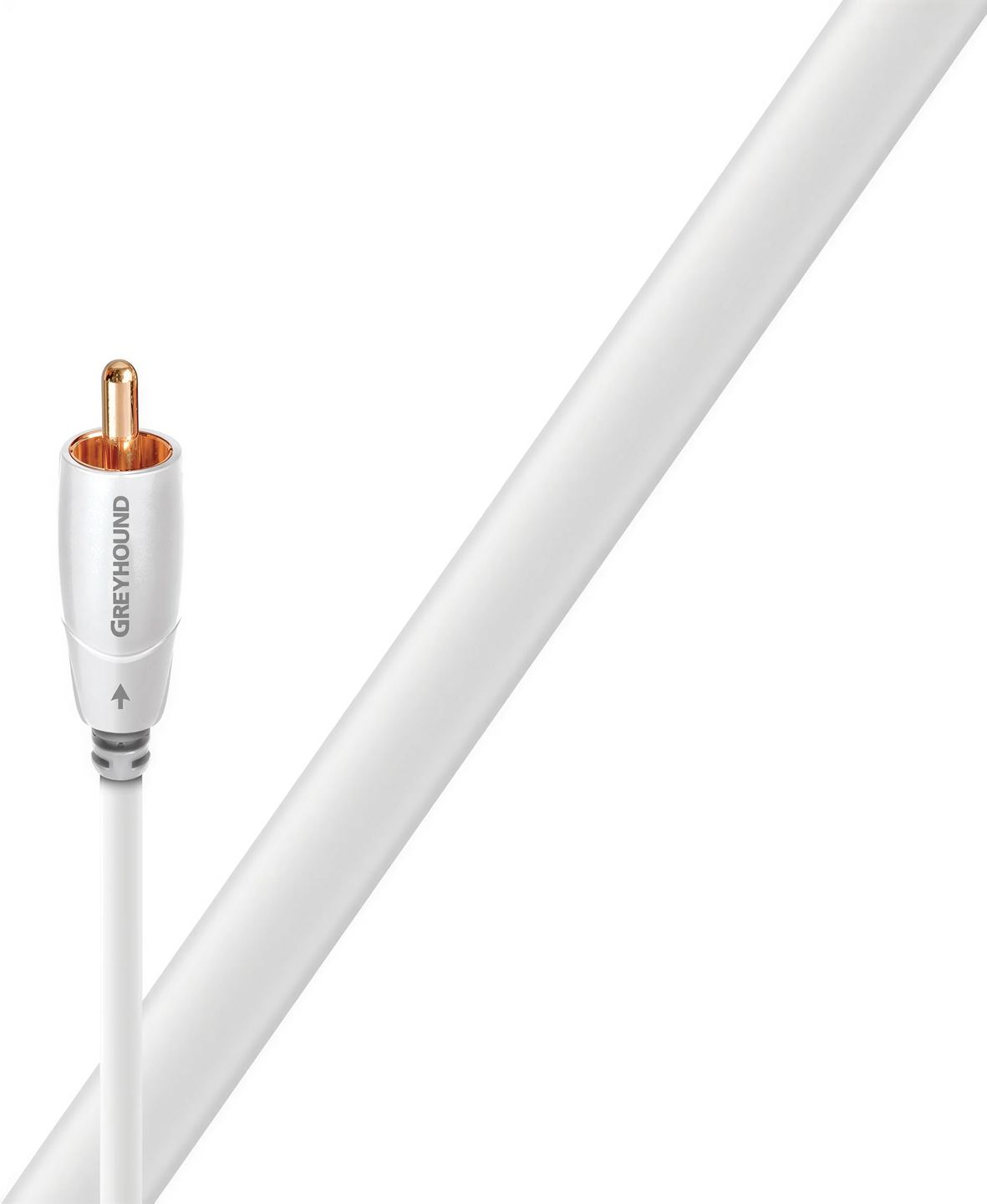
The Audioquest Greyhound cable is a subwoofer interconnect cable designed for low-frequency transmission. It sits in the Audioquest range between the Black Lab and Irish Red models. It uses long-grain copper (LGC) conductors with 0.5% silver plating, as well as a HyperLitz-type coaxial architecture. Its reduced diameter makes it easy to install in home theater setups where space is a key consideration.
A Distinctive Geometric Design for Low Frequencies
The fundamental feature of the Greyhound lies in its HyperLitz Coax geometry, an architecture where eight negative conductors form a perfect spiral circle around a larger-diameter central positive conductor. This arrangement creates a large cross-sectional area that minimizes the skin effect—a physical phenomenon where high frequencies tend to travel along the surface of conductors—while maintaining particularly low electrical resistance.
The cable’s remarkably slim diameter contrasts with its internal sophistication. This slenderness greatly facilitates routing through conduits, behind furniture, or along baseboards, while preserving appreciable flexibility during installation. The outer sheath features alternating white and light gray stripes, allowing for immediate visual identification while remaining discreet in a home environment.
Signal insulation relies on foamed polyethylene (Foamed-PE), a material in which air has been injected to create a cellular structure. This technique significantly reduces energy absorption by the dielectric, a phenomenon that usually causes temporary storage and then delayed release of energy in the form of distortion. Foamed polyethylene also maintains stable geometry along the entire cable length, ensuring constant impedance.
Hybrid Metallurgy and Noise Dissipation
The Greyhound’s conductors use long-grain copper (LGC) coated with 0.5% silver plating. This hybrid approach offers remarkable economic and technical advantages. LGC copper minimizes the boundaries between crystalline grains—those transition zones that generate resistance and distortion in traditional conductors. The silver plating, though representing only 0.5% of the conductor, significantly improves the transmission of high-frequency components present in subwoofer signal transients.
The Metal-Layer Noise-Dissipation System (NDS) is a distinctive feature of Audioquest’s design. Rather than simply shielding the cable in a conventional way—which can paradoxically create an antenna that picks up and drains interference to the equipment’s ground—the NDS system absorbs and reflects radio-frequency disturbances before they reach the ground plane. This approach, using successive metal layers, preserves the integrity of the reference signal between connected devices.
The gold-plated RCA connectors benefit from cold-weld crimping, a technique that applies several tons of pressure to create an almost perfect connection between the conductor and the plug. This method avoids introducing heat and additional materials such as solder, which alter the conductor’s characteristics at the termination point. The ground shells, stamped rather than machined, allow the metal to be selected for its low-distortion properties rather than ease of machining.