Nohan
Quality as expected. Does its job without any issues
Comment from August 29, 2026 — Experience from April 20, 2024
Automatically translated — Show original (French)
Qualité au rdv. Fait sont travail sans aucun soucis
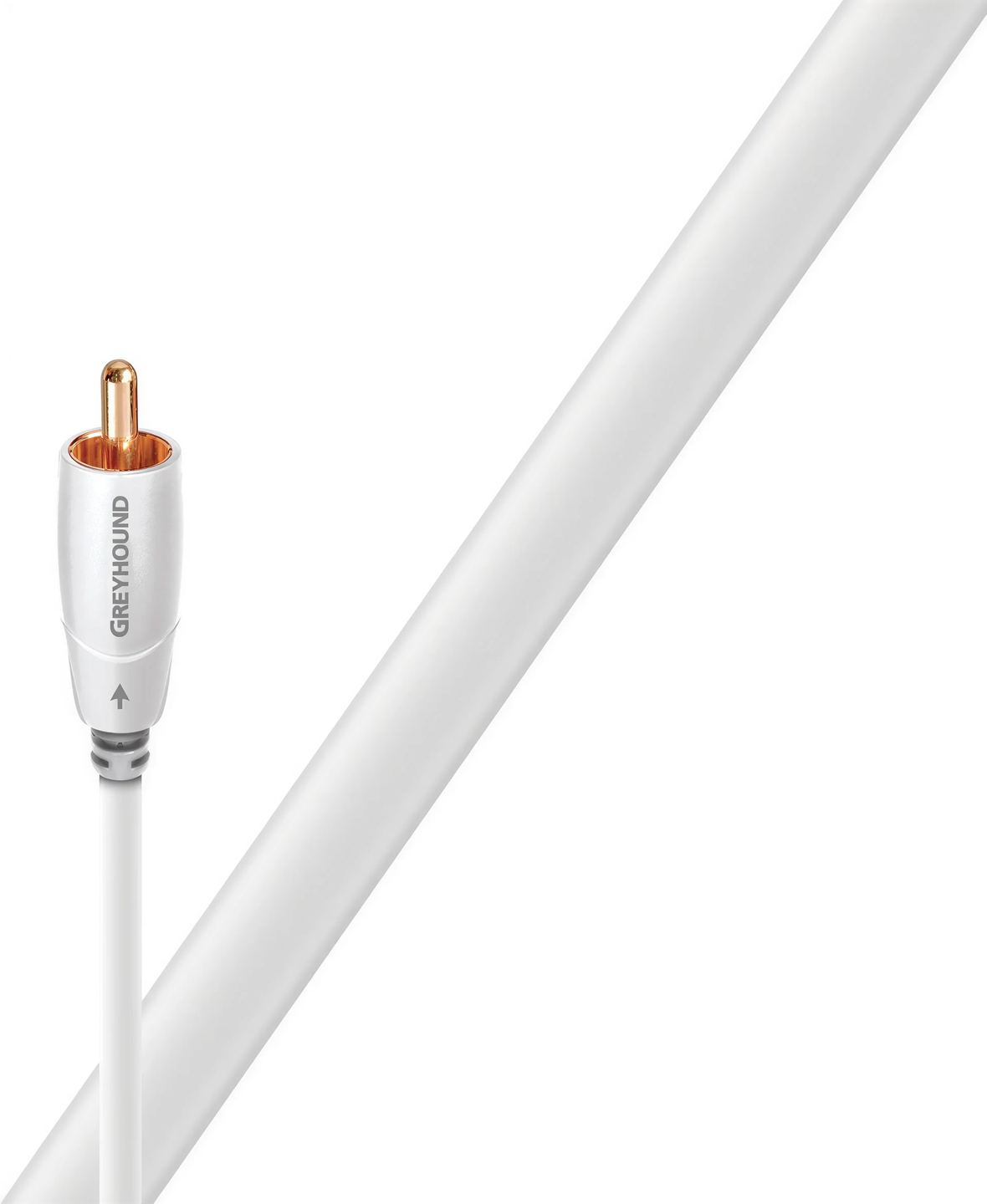
The Audioquest Greyhound cable is a subwoofer interconnect cable designed for low-frequency transmission. It sits in the Audioquest range between the Black Lab and Irish Red models. It uses long-grain copper (LGC) conductors with 0.5% silver plating, as well as a HyperLitz-type coaxial architecture. Its reduced diameter makes it easy to install in home theater setups where space is a key consideration.
The fundamental feature of the Greyhound lies in its HyperLitz Coax geometry, an architecture where eight negative conductors form a perfect spiral circle around a larger-diameter central positive conductor. This arrangement creates a substantial cross-section that minimizes the skin effect—a physical phenomenon where high frequencies tend to travel along the surface of conductors—while maintaining particularly low electrical resistance.
The cable’s remarkably slim diameter contrasts with its internal sophistication. This slenderness greatly facilitates routing through conduits, behind furniture, or along baseboards, while preserving appreciable flexibility during installation. The outer sheath features alternating white and light gray stripes, allowing for immediate visual identification while remaining discreet in a home environment.
Signal insulation relies on foamed polyethylene (Foamed-PE), a material in which air has been injected to create a cellular structure. This technique significantly reduces energy absorption by the dielectric, a phenomenon that usually causes temporary storage and delayed release of energy in the form of distortion. Foamed polyethylene also maintains stable geometry along the entire cable length, ensuring consistent impedance.
The Greyhound’s conductors use long-grain copper (LGC) coated with 0.5% silver plating. This hybrid approach offers remarkable economic and technical advantages. LGC copper minimizes the boundaries between crystalline grains—transition zones that generate resistance and distortion in traditional conductors. The silver plating, though only 0.5% of the conductor, significantly improves the transmission of high-frequency components present in subwoofer signal transients.
The Metal-Layer Noise-Dissipation System (NDS) is a distinctive feature of Audioquest’s design. Rather than simply shielding the cable in a conventional way—which can paradoxically create an antenna that picks up and drains interference to the equipment’s ground—the NDS system absorbs and reflects radio-frequency disturbances before they reach the ground plane. This approach, using successive metal layers, preserves the integrity of the reference signal between connected devices.
The gold-plated RCA connectors benefit from cold-weld crimping, a technique that applies several tons of pressure to create an almost perfect connection between the conductor and the plug. This method avoids introducing heat and additional materials such as solder, which can alter the conductor’s characteristics at the termination point. The ground shells, stamped rather than machined, allow the metal to be selected for its low-distortion properties rather than ease of machining.
The Black Lab uses only LGC copper conductors in a simpler Symmetrical-Coax geometry, while the Greyhound adds 0.5% silver plating and adopts the more sophisticated HyperLitz Coax geometry with eight spiral negative conductors. This configuration offers better management of the skin effect and more precise transmission of the fast transients present in low-frequency signals.
Unlike conventional cables that may require hours of use before reaching optimal performance, the Greyhound stabilizes its dielectric characteristics very quickly thanks to the foamed polyethylene structure. Performance is therefore consistent from the very first use, with no need for a prolonged break-in period.
Although subwoofers mainly reproduce low frequencies (typically below 120 Hz), the signals contain fast transient components essential for rhythmic precision and bass articulation. The silver plating improves the transmission of these high-frequency transients, resulting in tighter, better-defined bass rather than just more bass volume.
Soldering introduces a different material (usually a tin-lead or tin-silver alloy) at the connection point, creating an additional resistive barrier. The heat required for soldering also alters the crystalline structure of the surrounding copper. Cold-weld crimping under several tons of pressure creates a direct molecular connection between the conductor and the connector, preserving signal integrity throughout the transmission chain.
All Audioquest cables are directional due to the controlled orientation of the conductors during drawing. Arrows on the sheath or connectors indicate the signal direction, from the source to the subwoofer. This directionality optimizes noise drainage and minimizes electromagnetic interference picked up by the cable.
CL3/FT4 certification indicates that the cable meets fire safety standards for residential in-wall installation. The PVC sheath resists flame propagation and limits the emission of toxic smoke. This approval makes it easy to integrate the cable into professional in-wall installations while complying with building codes.
Based on reviews from customers who purchased this product, summarised by AI
Nohan
Quality as expected. Does its job without any issues
Comment from August 29, 2026 — Experience from April 20, 2024
Joaquim
Good cable. I just think it’s too thin. But OK.
Comment from April 23, 2026 — Experience from April 02, 2026
Rudi
Good product shipped in a short time
Comment from April 23, 2026 — Experience from April 09, 2026