

Sonance i10

Complementary product

Equivalent product
Sonance i10, wireless subwoofer from the Impact series
A subwoofer often ends up next to the amplifier because the cable is not long enough, even though this is almost never where it sounds best. This 25 cm model eases that constraint with a built-in wireless receiver, then adapts its bass to the room through acoustic correction configured from an iPhone. Its piano-black lacquer finish allows it to remain on display in a living room or blend into a dedicated room.
A 25 cm long-excursion driver
The 254 mm driver fires forwards behind a black fabric grille, and pairs a fibreglass cone with a rubber surround. Its long excursion, meaning the distance the cone can travel back and forth, matters as much as its diameter when reaching low frequencies: the further the cone moves, the more air it displaces, and it is this volume of displaced air that produces deep bass. Fibreglass gives the cone the rigidity it needs to retain its shape at these amplitudes rather than deforming and colouring the sound.
The enclosure is tuned with a Laminar Flow Port. A bass-reflex port reinforces the bass by using the air oscillating inside the enclosure, with one well-known drawback: at high volumes, the air rushing through it can cause chuffing or whistling. This port’s profile limits turbulence so the bass stays clean as the level rises. At 356 × 407 × 362 mm (width, height, depth), the enclosure retains the proportions of a small piece of furniture, suitable for a corner of the living room.
300 watts and electronics isolated from the enclosure
The built-in amplifier delivers 300 W RMS continuously and 600 W peak, a reserve that handles the brief peaks of a film explosion or a kick drum hit. It provides low-distortion, wide-bandwidth amplification, two qualities that matter in the bass range, where distortion adds unwanted harmonics that the ear perceives as a “muddy” sound.
The frequency response extends from 24 Hz to 250 Hz at ±3 dB, meaning that level variation is limited across this entire range. 24 Hz sits below the lowest note on a piano (27.5 Hz), in the range of large organ pipes and cinema effects that are felt as much as heard. The upper limit of 250 Hz leaves room to support small satellite speakers, which need the subwoofer to take over at a relatively high frequency.
The amplifier module is mounted on a sealed plate, airtight against the enclosure. The inside of a subwoofer undergoes significant pressure changes with every movement of the cone, and this separation keeps the electronics away from these stresses while preventing air leaks that would make the enclosure hiss.
Three ways to connect it to your system
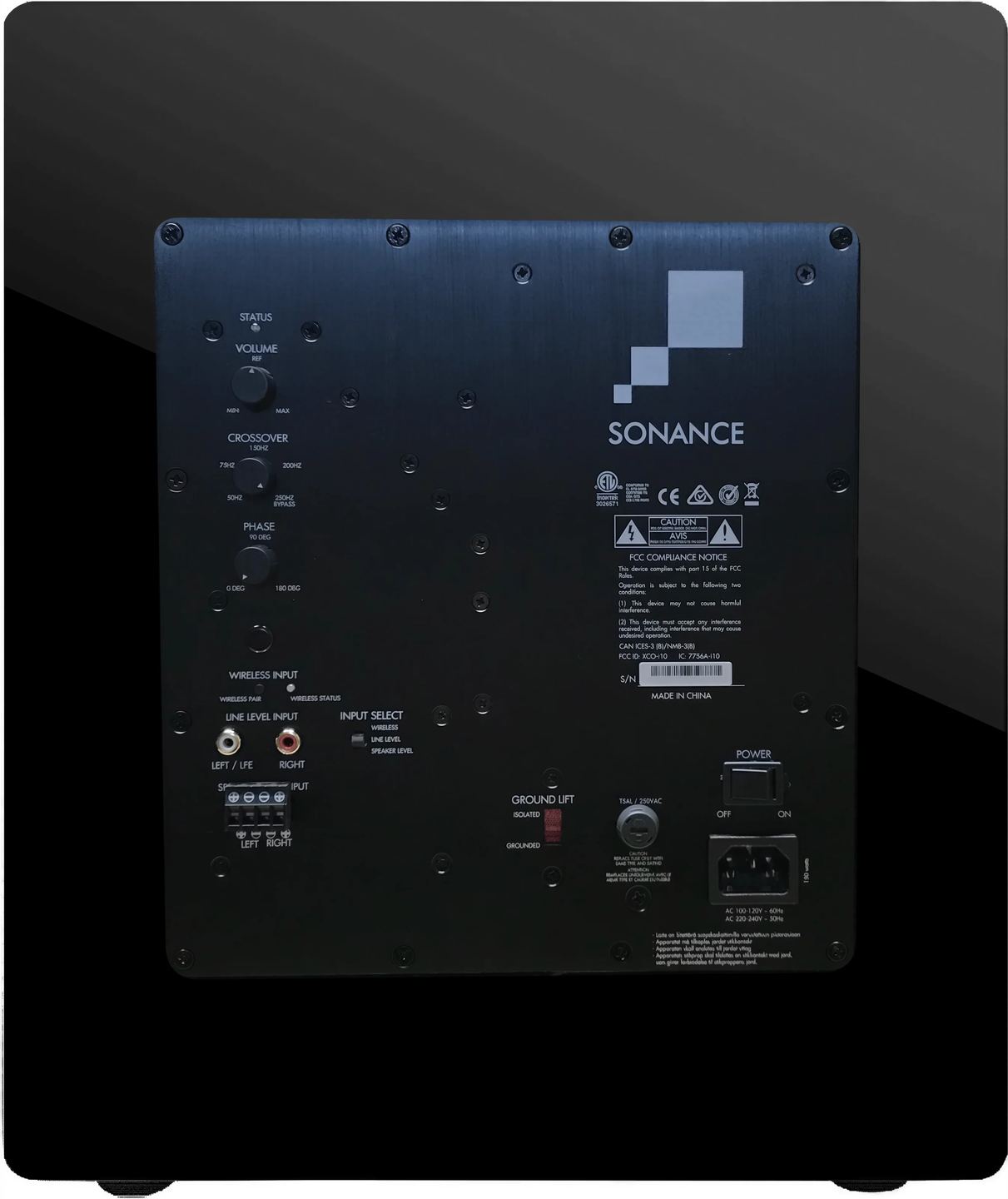
The line-level input receives the subwoofer output from a home cinema amplifier or a stereo amplifier equipped with one, often labelled LFE, Sub Out or Pre Out Sub. When the amplifier has no dedicated output, the speaker-level input takes over: the subwoofer connects to the amplifier’s speaker terminals and extracts the bass signal itself, opening the door to older stereo systems.
The third option uses the built-in wireless receiver, paired with the optional Sonance Wireless Transmitter. Connected to the amplifier’s subwoofer output, this transmitter sends the signal up to approximately 9 metres, without compression, at up to 24 bits/192 kHz. It operates on three frequency bands (2.4 GHz, 5.2 GHz and 5.8 GHz), a design that makes it largely resistant to interference from Bluetooth, Wi-Fi or a microwave oven. Latency remains below 20 ms, a delay that a home cinema amplifier’s distance setting easily compensates for. Pairing is performed by pressing a button on each device.
Acoustic correction configured from an iPhone
In a room, bass waves reflect off the walls, floor and ceiling, then reinforce or cancel one another depending on the location. The result is quickly audible: a subwoofer that booms on one note and seems to disappear on the next. The SONARC (Sonance Automatic Room Correction) digital processor built into the subwoofer corrects these variations with an automatic 16-band equaliser, each band acting on a specific portion of the bass range.
Setup is handled through the free SonARC for Subwoofers app, which connects to the subwoofer via Bluetooth and guides calibration in seven steps. The same app provides access to the active crossover (the frequency above which the subwoofer rolls off to let the speakers play), phase (which synchronises the movement of the cone with that of the speakers so their bass reinforces rather than opposes each other) and the bypass function, which disables the internal crossover when the amplifier already manages the crossover frequency. The app works on iPhone 6S or newer and on iPad, in English, with no Android version.
Its place in the Impact series
The Impact series comprises three subwoofers that share the same finish, wireless receiver and app. The i8, with its 20 cm driver and 200 W, reaches down to 30 Hz in a more compact enclosure. The i12 steps up to 30 cm and 400 W, reaches down to 22 Hz and takes up considerably more space. The i10 sits between the two: it gains six hertz of extension over the i8, an audible difference in cinema effects and the lowest notes, without imposing the bulk of the i12.
Documentation
Technical Specifications
Physical Components
- 254 mm long-throw speaker
- Fiberglass cone
- Rubber surround
- Dimensions (W × H × D): 356 × 407 × 362 mm
- Weight: 27 kg
Audio Performance
- Frequency response: 24 Hz - 250 Hz ± 3 dB
- Power: 300 W RMS, 600 W peak
- Low-distortion, wide-bandwidth amplifier
- High-excursion fiberglass woofer
Connectivity
- Inputs: line level, speaker level, low-latency wireless
- Built-in wireless receiver
- Optional SWT transmitter available
Signal Processing
- SONARC digital signal processor (DSP) with automatic acoustic correction
- 16-band automatic equalizer
- Settings: active filter, phase, bypass
Installation
- Easy installation
- Three connection options
- Dedicated app for acoustic correction
Frequently asked questions
Does the subwoofer come with the wireless transmitter?
No. The subwoofer has a built-in receiver, but the Sonance Wireless Transmitter (part number 93360) is sold separately. Without it, the connection is wired, at line level or speaker level.
Do you still need a cable when you go wireless?
Yes, the power cable. Wireless eliminates the audio connection between the amplifier and the subwoofer, not the connection to a mains socket, so you’ll need one at your chosen location.
Can the subwoofer be adjusted with an Android smartphone?
No, the SonARC for Subwoofers app is only available on iPhone and iPad. The device’s Bluetooth must be enabled during calibration. A borrowed iPhone is sufficient for the initial setup, which then remains stored in the subwoofer.
How do you adjust it with a home theater amplifier that already handles the crossover?
Enable the bypass function in the app to let the amplifier determine the crossover frequency, often set around 80 Hz. Ideally, run SonARC calibration first, then the amplifier’s automatic calibration, which will adjust the subwoofer’s distance and level relative to the speakers.
Where should the subwoofer be placed in the room?
A simple method is to place the subwoofer at your listening position, play a bass-heavy track, then move along the walls: the spot where the bass sounds most even is where you should install the subwoofer. The wireless connection makes this search easier, since the chosen location no longer needs to be near the amplifier.
Is the subwoofer suitable for a stereo system dedicated to music?
Yes, via the line-level input if the amplifier has a subwoofer output, or via the speaker-level input otherwise. With floorstanding speakers that already extend deep into the bass, set the active crossover low enough for the subwoofer to supplement the lowest bass without duplicating what the speakers already reproduce.
- Eco-contribution included in the sale price.


