

Audioquest FLX-Mini splitter
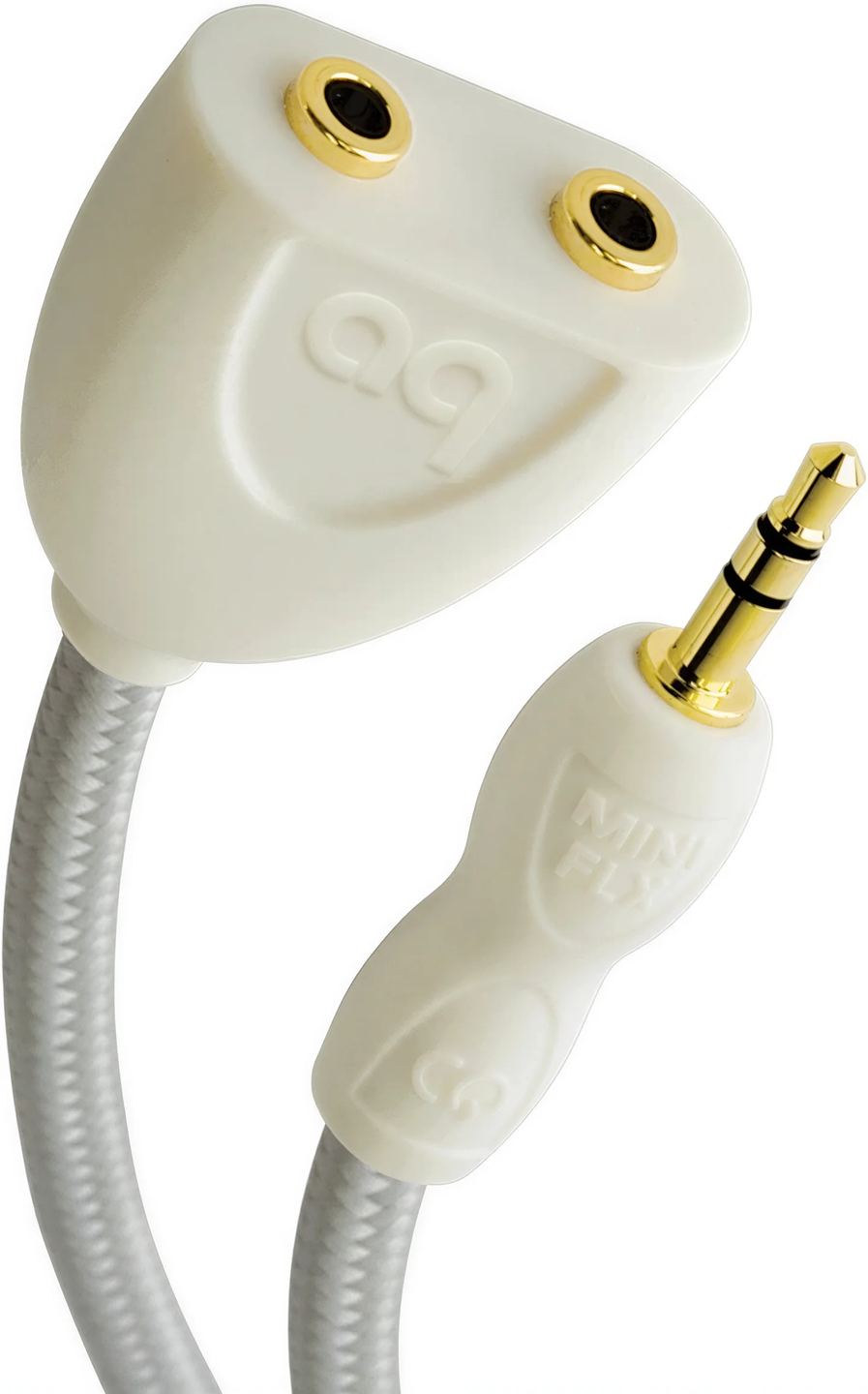
AudioQuest FLX-Mini, 3.5 mm mini-jack splitter
One film on a tablet, two people and two pairs of headphones: it is a familiar situation on a train, on a plane or on the sofa, when you want to watch together without making the rest of the household listen. This fifteen-centimetre AudioQuest splitter takes one mini-jack output and splits it into two female sockets. It uses the same copper the brand uses in its interconnect cables, over the shortest of lengths.
One headphone output split into two sockets
At the source end, a male 3.5 mm stereo mini-jack plug connects to the headphone output of a phone, tablet, laptop or portable music player. Fifteen centimetres further along, the cable splits into two female 3.5 mm stereo mini-jack sockets. Each receives the same left-right signal, and headphones, earphones or a mini-jack cable plug straight in, without an adapter.
The short length is intentional: the FLX-Mini hangs from the device without trailing across the table, and the headphone cables cover the rest of the distance. The silver and white braided jacket protects the conductors from abrasion in a pocket or bag, while keeping the assembly flexible.
Solid PSC+ copper, even in an accessory
AudioQuest uses its Perfect-Surface Copper+ (PSC+) here, with solid conductors: each conductor is a single solid wire, rather than a bundle of fine twisted strands. The brand justifies this choice by the absence of electrical and magnetic interactions between neighbouring strands, which it lists among the sources of distortion in a stranded cable. Its second argument concerns the metal itself, with its very smooth surface and high purity, to minimise grain boundaries, the borders between the crystals that make up any metal. AudioQuest ranks this copper above common OFHC, OCC and 8N copper.
Over fifteen centimetres, the benefit remains modest: a splitter of this size has little effect on the signal, and its primary role is to avoid degrading anything between the source and the headphones. The solid conductor calls for some care, as it tolerates tight, repeated bending less well than a stranded conductor. It is better to store it in a loose loop rather than bend it sharply right next to the plugs.
Listening together from the same source
Connecting two pairs of headphones to a single output puts them in parallel: the device sees an impedance load halved, with two pairs of 32-ohm headphones forming a 16-ohm load. Phone, tablet and computer outputs handle this well with portable headphones and earphones, which have low impedance and good sensitivity. With studio headphones rated at 250 ohms or more, or a low-powered output, the maximum volume may fall short.
The volume is adjusted at the source and applies to both pairs of headphones. Two identical models play at the same level; two different models do not, with the more sensitive one sounding louder at the same setting. Headphones with a volume control on the cable allow you to compensate for the difference.
One source for two line-level devices
The FLX-Mini is also useful beyond headphones. A mini-jack line output, such as that of a computer or portable music player, can feed two devices at once: a pair of active speakers and a headphone amplifier on a desk, or a listening system and a recorder. Line inputs have a high impedance of several thousand ohms, and connecting two to the same output places almost no load on the source. To connect to RCA inputs, simply plug a mini-jack-to-RCA cable into each female socket.
Technical Specifications
Materials
- Perfect-Surface Copper (PSC+)
- Silver-plated, white braided sheath
Connectors
- 1 male 3.5 mm stereo mini-jack
- 2 female 3.5 mm stereo mini-jacks
Dimensions
- Length: 15 cm
Frequently asked questions
Can it be used in reverse to combine two sources into a single input?
No. Connecting two outputs together means driving each device into the other, which causes distortion and can strain the output stages. To combine two sources, you need a mixer or an input selector.
Does a headset's microphone work through the FLX-Mini?
The sockets are stereo: they carry the left channel, the right channel and ground. The microphone on a headset with a four-contact plug (the kind used with phones) does not work; sound reaches the earpieces, but your voice is not transmitted.
How do I use it with a smartphone without a headphone jack?
First, you need a USB-C or Lightning to mini-jack adapter, or a small USB digital-to-analog converter such as AudioQuest’s DragonFly models, which have a 3.5 mm mini-jack output. The FLX-Mini then plugs into this output. A dedicated converter generally delivers more power than an entry-level adapter, which matters when two pairs of headphones share the signal.
Is there a version that connects to RCA?
Yes, AudioQuest offers the FLX-Mini with a male 3.5 mm mini-jack plug and two female RCA sockets. It connects a mini-jack output to a pair of RCA cables already in place, whereas the model shown here splits the output.
Can you connect headphones with a 6.35 mm plug to it?
Yes, with a 6.35 mm female to 3.5 mm male adapter on the headphone plug. Conversely, for a source equipped with a 6.35 mm output (a hi-fi amplifier, for example), a 6.35 mm male to 3.5 mm female adapter is placed before the FLX-Mini.
Can you daisy-chain two FLX-Mini units for three or four headphones?
It’s electrically possible, but the impedance seen by the source continues to drop: four pairs of 32-ohm headphones create an 8-ohm load, which many portable device outputs struggle to drive cleanly. For more than two pairs of headphones, a headphone amplifier with multiple outputs is more suitable.
Are the two female sockets different?
No, they are identical and each carries both stereo channels. There is no left or right socket, and neither takes priority.
- Eco-contribution included in the sale price.
- Manufacturer reference: MINI-FLX3.5
- GTIN / EAN: 92592057067


