Ortofon Diamant Concorde MKII DIGITAL
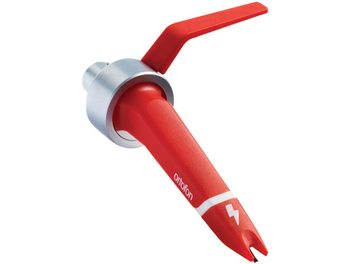
Complementary product
Overview
On a turntable controlling mixing software, the stylus reads a control signal, not just music. If that signal is distorted, the software may hesitate, lose tracking or skip. This red-and-white replacement stylus restores the Concorde MKII DIGITAL cartridge. It brings back the stable tracking and high output level it had originally, while reducing wear on timecode records that spin for hours under the tonearm.
A stylus tuned for timecode vinyl
Digital DJ systems (Serato DJ, Traktor or any other timecode vinyl software) rely on a record cut with a control signal called timecode. The turntable reads it like any other groove, then the interface sends it to the computer, which uses it to determine the record’s position, speed and direction of rotation. Every reading error produces an imprecise response from the software.
With this stylus, the cartridge delivers 10 mV at 1,000 Hz, or two to three times the voltage of a typical hi-fi cartridge. The timecode signal therefore sits well above the noise floor, limiting decoding errors. In the DJ booth, this high level also means less input gain is needed, reducing the risk of feedback when speakers are playing loudly near the turntables. Channel balance stays within ± 1 dB at 1 kHz, giving the software two channels with consistent levels.
The frequency response extends to 18,000 Hz (at −3 dB), while channel separation reaches 22 dB at 1 kHz and 15 dB at 15 kHz. These figures are modest by home hi-fi standards, but more than sufficient for timecode and playback through a club sound system. Reliable tracking takes priority.
Spherical stylus and 4-gram tracking force
The tip is a spherical diamond with an 18 µm radius. Its rounded shape contacts the groove in the same way regardless of the tonearm’s orientation, and it stands up well to the back-and-forth movements of scratching and hand-cueing. It also spreads wear over a larger area of the groove, extending the life of timecode records subjected to repeated handling. An elliptical stylus extracts more detail from a music record, but it demands more precise alignment and is less forgiving of sudden movements.
The recommended tracking force is 4 g, within a possible range of 3 to 5 g. That is considerably more than in hi-fi, and the added weight keeps the tip in the groove when the record is slowed, pushed or reversed. Tracking ability reaches 100 µm at 315 Hz at this tracking force: deep groove modulations and jolts can be tracked without skipping. The lateral dynamic compliance of 14 µm/mN describes the flexibility of the stylus suspension. This relatively low value suits high-mass tonearms such as those on direct-drive DJ turntables.
A stylus body that’s easier to handle
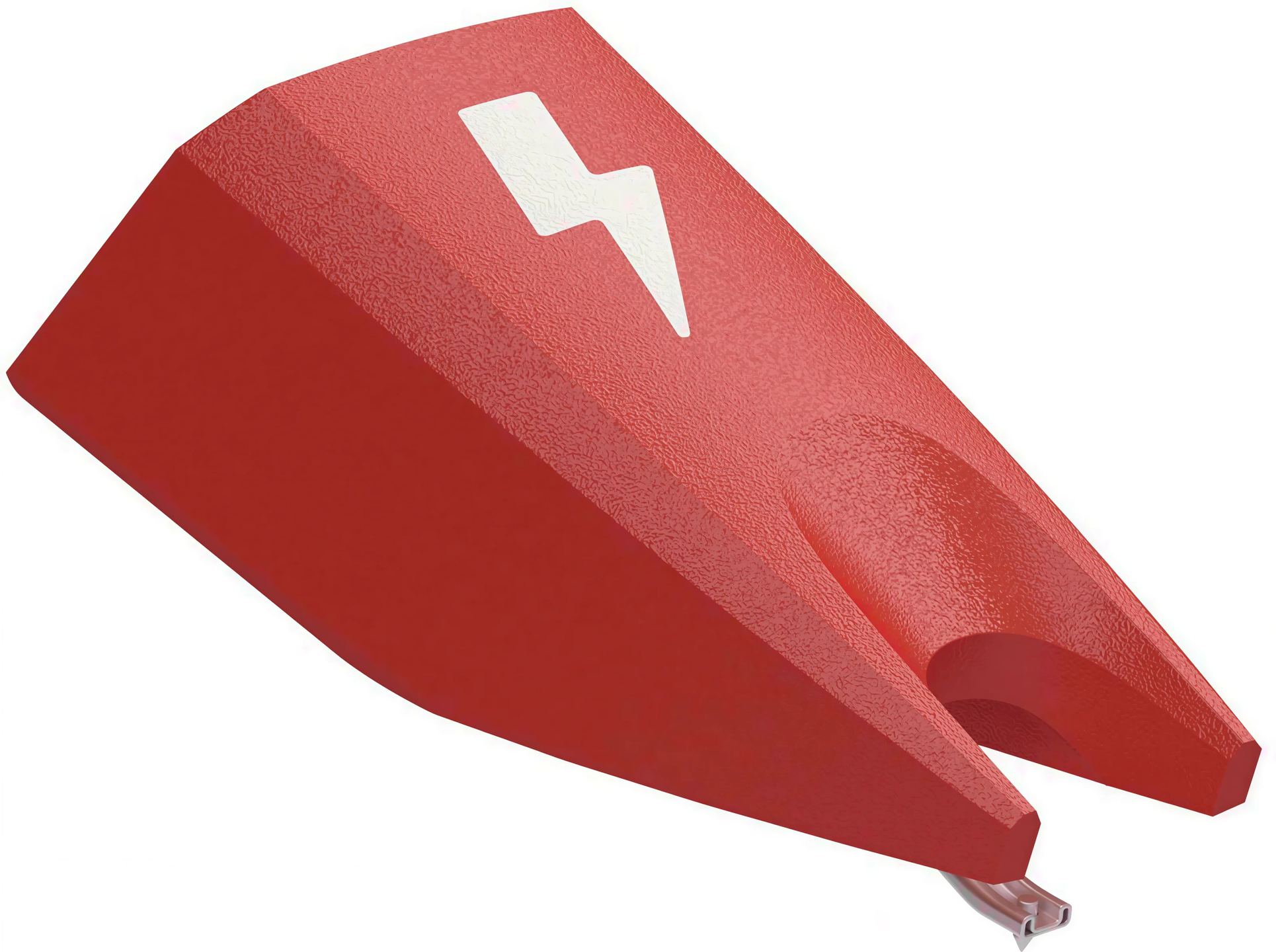
The MKII generation of Concorde cartridges, launched in 2018, introduced a new stylus body that is wider, longer and sturdier than the first-generation version. It is easy to grip without fumbling, even in a dim DJ booth. A metal spring holds it firmly on the cartridge, and a distinct click can be felt when it is fully seated, leaving no doubt that it is fitted correctly.
A wide cutout at the front of the body provides a clear view of the tip. This makes it easier to place the stylus precisely on the record—a gesture repeated constantly when cueing a track by ear or looking for a marker on a timecode record. The red-and-white color scheme matches the DIGITAL cartridge, making the model easy to spot at a glance in an accessory case holding several Concorde styli.
Compatible only with the DIGITAL cartridge
This stylus fits the Concorde MKII DIGITAL cartridge, and no other. MKII styli from the other models in the series (MIX, DJ, CLUB, SCRATCH, ELITE) physically fit into the cartridge body, but each stylus is tuned to the magnet and coil of its own cartridge. Mixing them changes the output level and can upset the balance between channels. Ortofon does not support any of these combinations.
First-generation Concorde styli and MKII-generation styli are not interchangeable: their bodies have different shapes and dimensions, and they do not fit together.
Technical Specifications
Compatibility and Appearance
- Recommended exclusively for Concorde MKII DIGITAL
- Color: red and white
Audio Performance
- Output voltage: 10 mV (1,000 Hz, 5 cm/s)
- Channel balance: ± 1 dB at 1 kHz
- Channel separation:
- 22 dB at 1 kHz
- 15 dB at 15 kHz
- Frequency response: 20-18,000 Hz (−3 dB)
- Tracking ability: 100 μm at 315 Hz at the recommended tracking force
- Lateral dynamic compliance: 14 μm/mN
Technical Specifications
- Stylus tip: spherical diamond R 18 μm
- Tracking force:
- Possible: 3-5 g
- Recommended: 4 g
Frequently Asked Questions
How do I replace the stylus on the cartridge?
Hold the cartridge firmly by its body, then pull the worn stylus straight forward without twisting it. Align the new stylus the same way and push it in until it clicks into place. It is best to do this with the cartridge resting on a stable surface or the tonearm locked in its rest, never above a spinning platter.
Do I need to readjust the turntable after replacing it?
A quick check is all it takes. Check the tracking force with a precision scale and set it back to 4 g if necessary, then adjust the anti-skating according to the turntable manufacturer’s instructions. On a DJ turntable, many scratch DJs reduce or turn off anti-skating to keep the stylus stable during scratching: adjust this setting to suit your style.
What are the signs that it’s time to replace the stylus?
The first signs are often software-related: more frequent timecode reading errors, a cursor that hesitates, and skips when moving backward. When listening to a music record, a worn stylus shows itself through harsh, spitty sibilance, distortion in busy passages, and dulled treble. Inspection with a magnifying glass can also reveal a bent stylus shank or a dirty tip. A worn stylus damages the grooves, and replacing it costs less than buying new timecode vinyl.
Can you play music records with this stylus?
Yes, it plays all 33 and 45 rpm records without restriction, and it performs well when mixing with real vinyl. However, its frequency response is limited to 18,000 Hz, and its spherical stylus favors tracking stability over detail. For a DJ who mainly plays music on vinyl, the Concorde MKII CLUB cartridge, with its elliptical stylus, delivers greater detail.
Which input should I connect the turntable fitted with the DIGITAL cartridge to?
The cartridge outputs a phono-level signal, which must go through a phono input. On a digital DJ system interface or mixer, set the switch for the relevant input to phono (often labeled PHONO or TT). In the line position, the signal would be too weak and the software would have trouble reading the timecode.
How do you maintain the stylus on a daily basis?
A soft stylus brush, moved from back to front along the cartridge and never sideways, removes dust accumulated between listening sessions. Coded vinyl records also benefit from regular dusting: dust that builds up on the stylus tip interferes with signal playback and accelerates wear. Avoid touching the tip with your fingers; skin oils trap particles.
Does the stylus fit a first-generation Concorde cartridge?
No. The MKII stylus body and those of the previous generation have different shapes, and the stylus will not fit an older Concorde. In this case, you need to switch to a complete Concorde MKII cartridge.
- Eco-contribution included in the sale price.
- GTIN / EAN: 5705796141023