

Fluid Audio FX50
Fluid Audio FX50: coaxial monitoring in a compact format
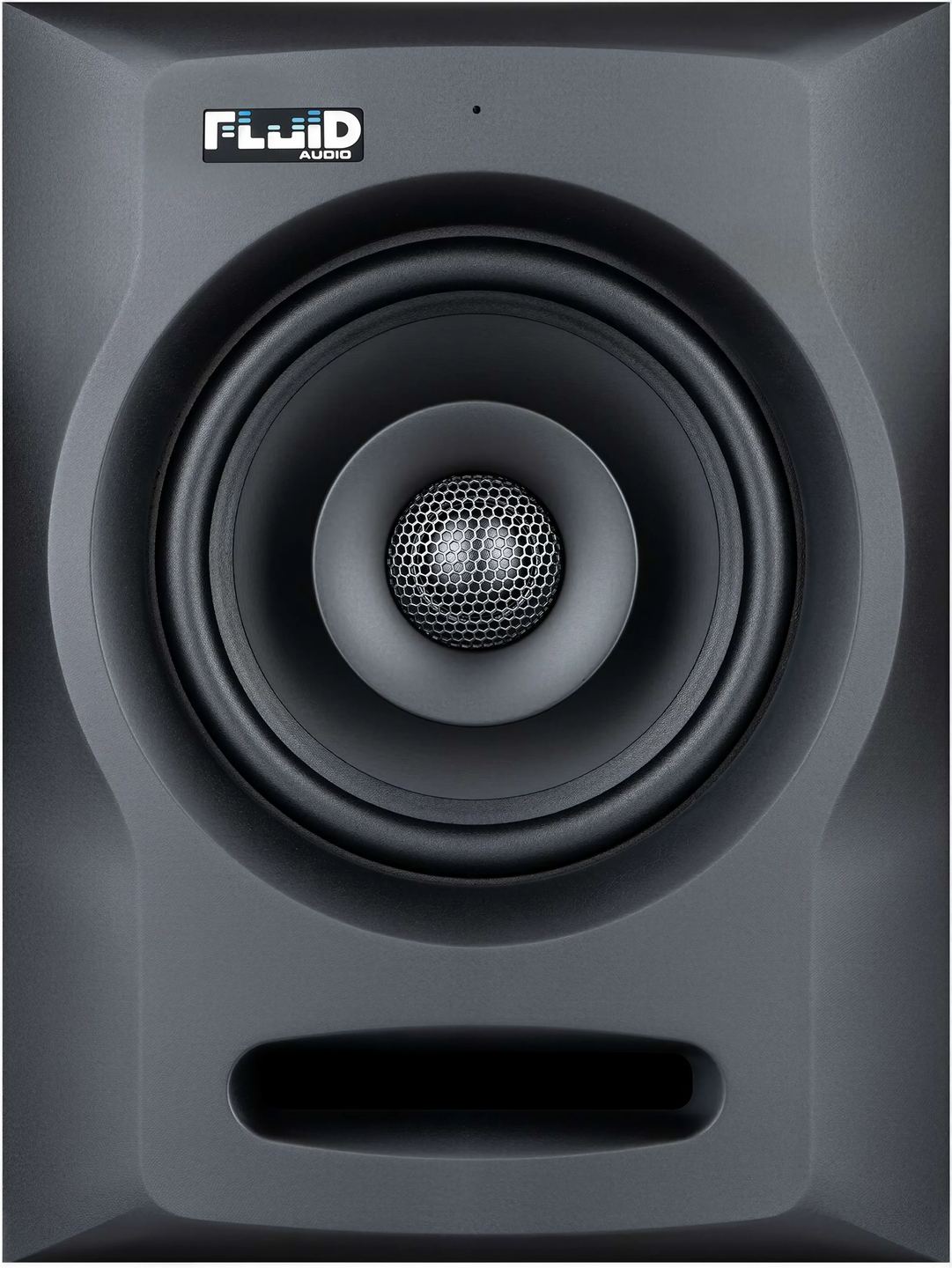
On a home studio desk, speakers sit less than a metre from your ears, often close to a wall, sometimes laid on their side to keep the screen in view. Fluid Audio addresses these constraints with a powered monitor speaker whose tweeter is positioned at the centre of the woofer: sound comes from a single point, the stereo image stays stable when you move your head, and the cabinet remains reasonably sized.
A tweeter aligned with the woofer
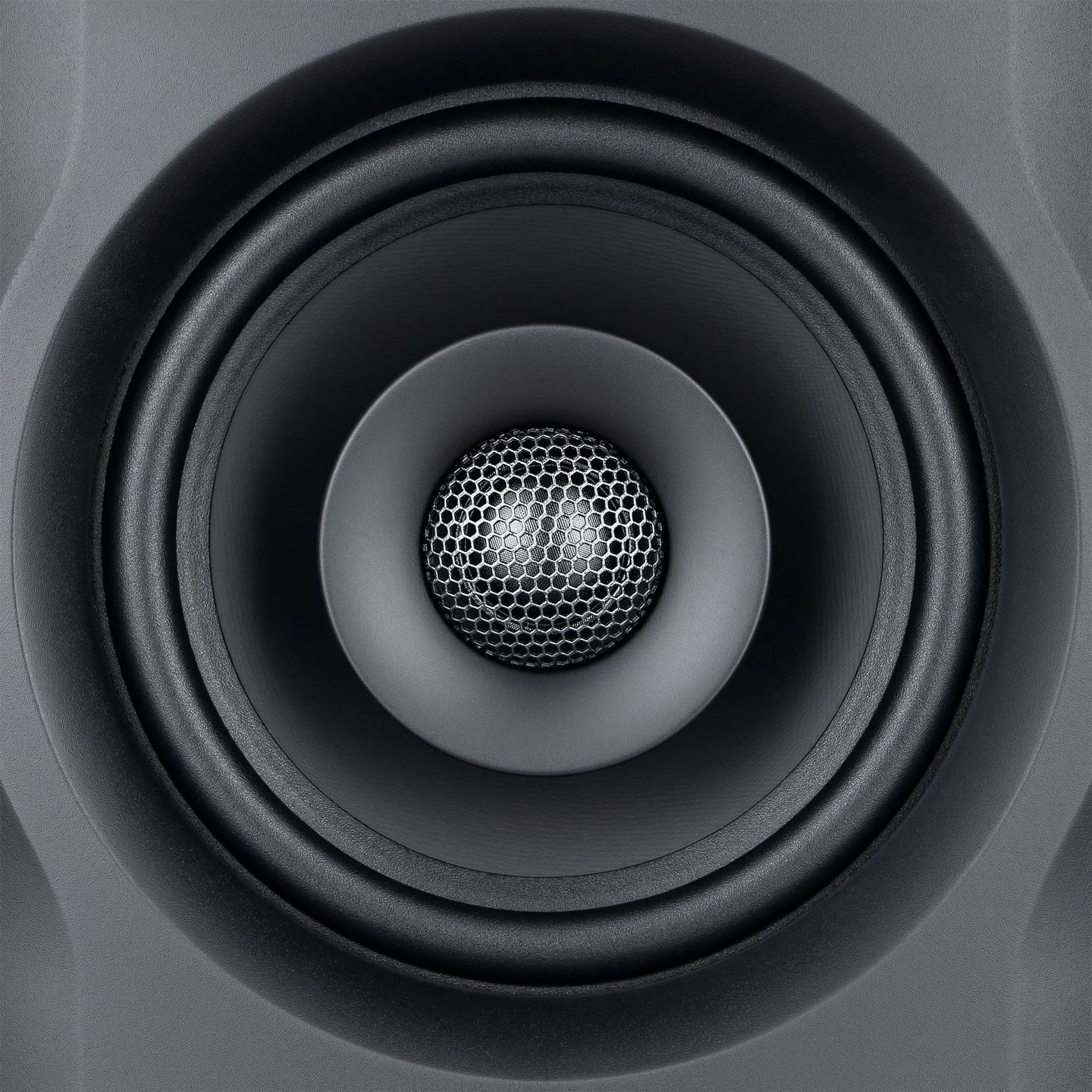
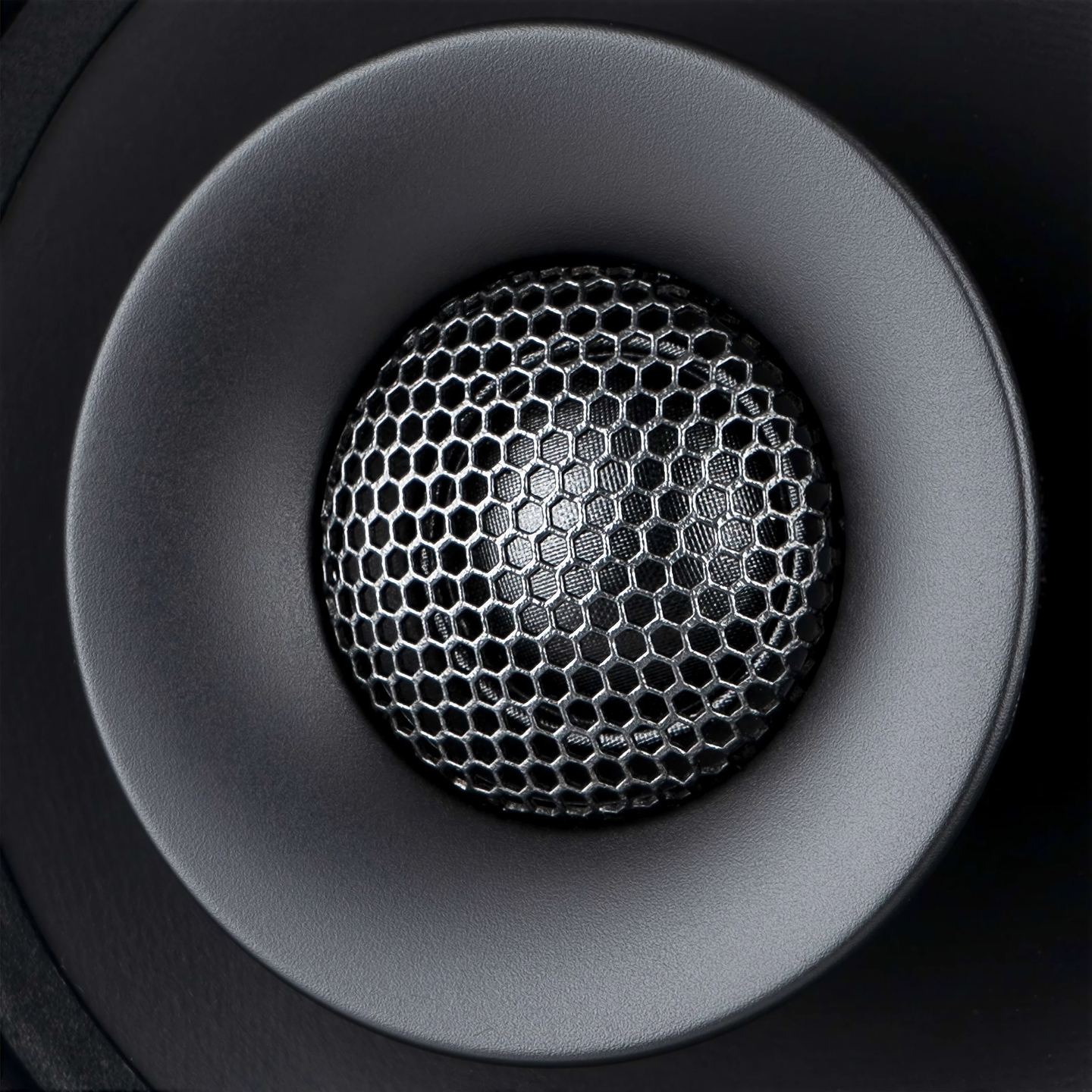
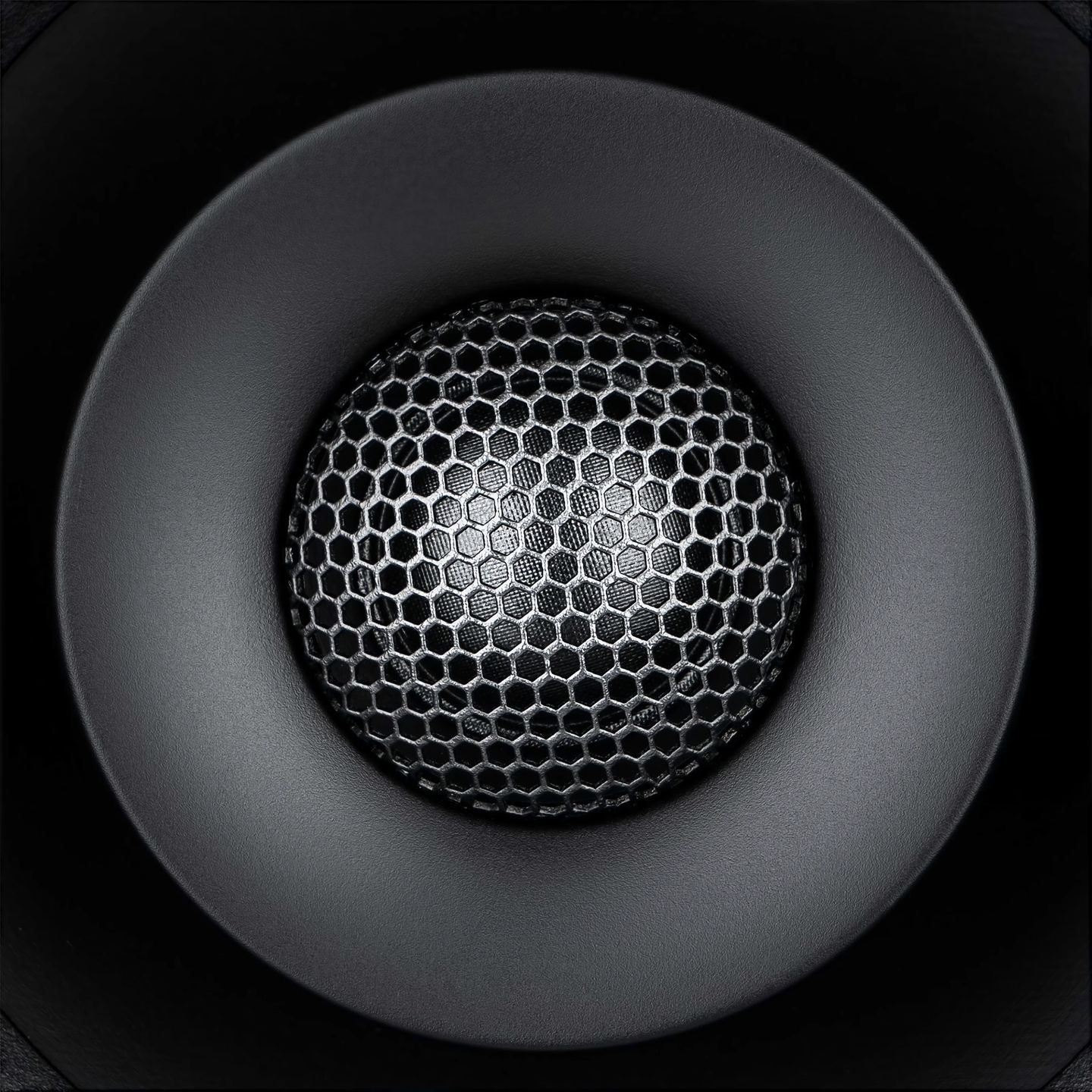
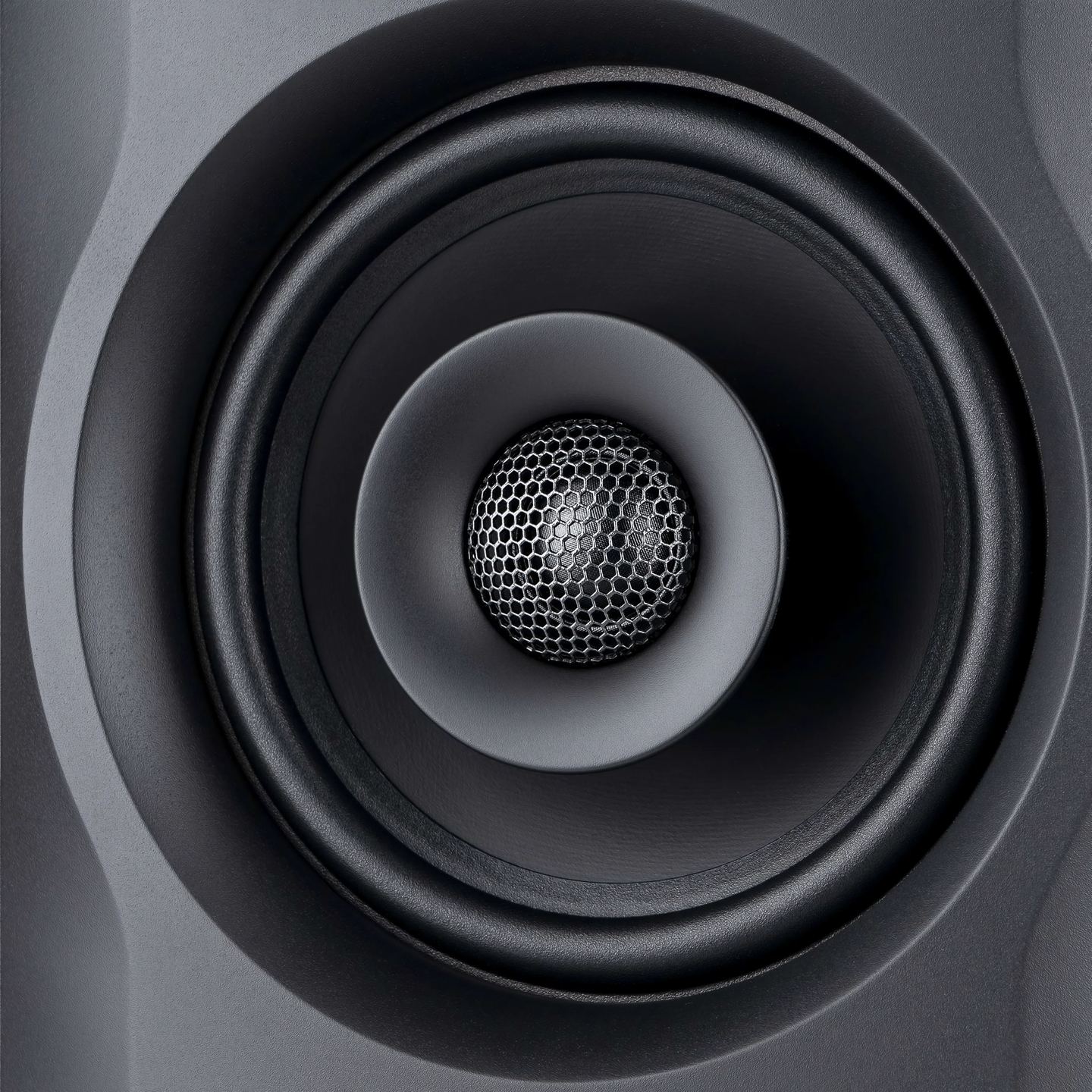
On a conventional two-way speaker, the tweeter and woofer are mounted one above the other on the front baffle, about ten centimetres apart. At close range, this gap is audible: depending on the height of your head, the two sources do not reach your ears at quite the same time, and the tonal balance changes. On the FX50, the 25 mm natural silk dome is mounted in front of the 13 cm woofer on a central support and shares its acoustic axis. The two drivers then behave as a single source, known as a point source, including in the region where they hand over to each other, around 2.95 kHz. For anyone mixing, this means instruments are more precisely positioned in the stereo field and timbre remains consistent when moving away from the central position.
Studio coaxial speakers of the 1950s and 1960s placed the high-frequency driver behind the woofer and routed its output through the woofer’s core. Fluid Audio took the opposite approach by bringing the tweeter forward in front of the cone, limiting interactions between the movement of the diaphragm and high-frequency output. The woofer combines a curved composite cone, a high-temperature voice coil and a damped rubber surround.
Two amplifiers and digital filtering
Each driver has its own Class D amplifier: 50 W for the bass and 40 W for the treble, giving 90 W per speaker. This bi-amplification eliminates the passive crossover usually placed between a single amplifier and the drivers; frequencies are divided upstream by a digital signal processor (DSP), which also manages the overall response. Class D generates little heat and consumes moderate amounts of power, an advantage for a speaker left on throughout a full day’s session.
The version currently in production, known as v2, benefits from revised DSP tuning to flatten the response curve. Frequency response extends from 49 Hz to 22 kHz, and maximum output reaches 107 dB at one metre, providing ample headroom for nearfield listening. The electronics include a subsonic filter, output current limiting, thermal protection, protection against radio interference and a circuit that suppresses power-on and power-off noise.
Adjustments for rooms that are not studios
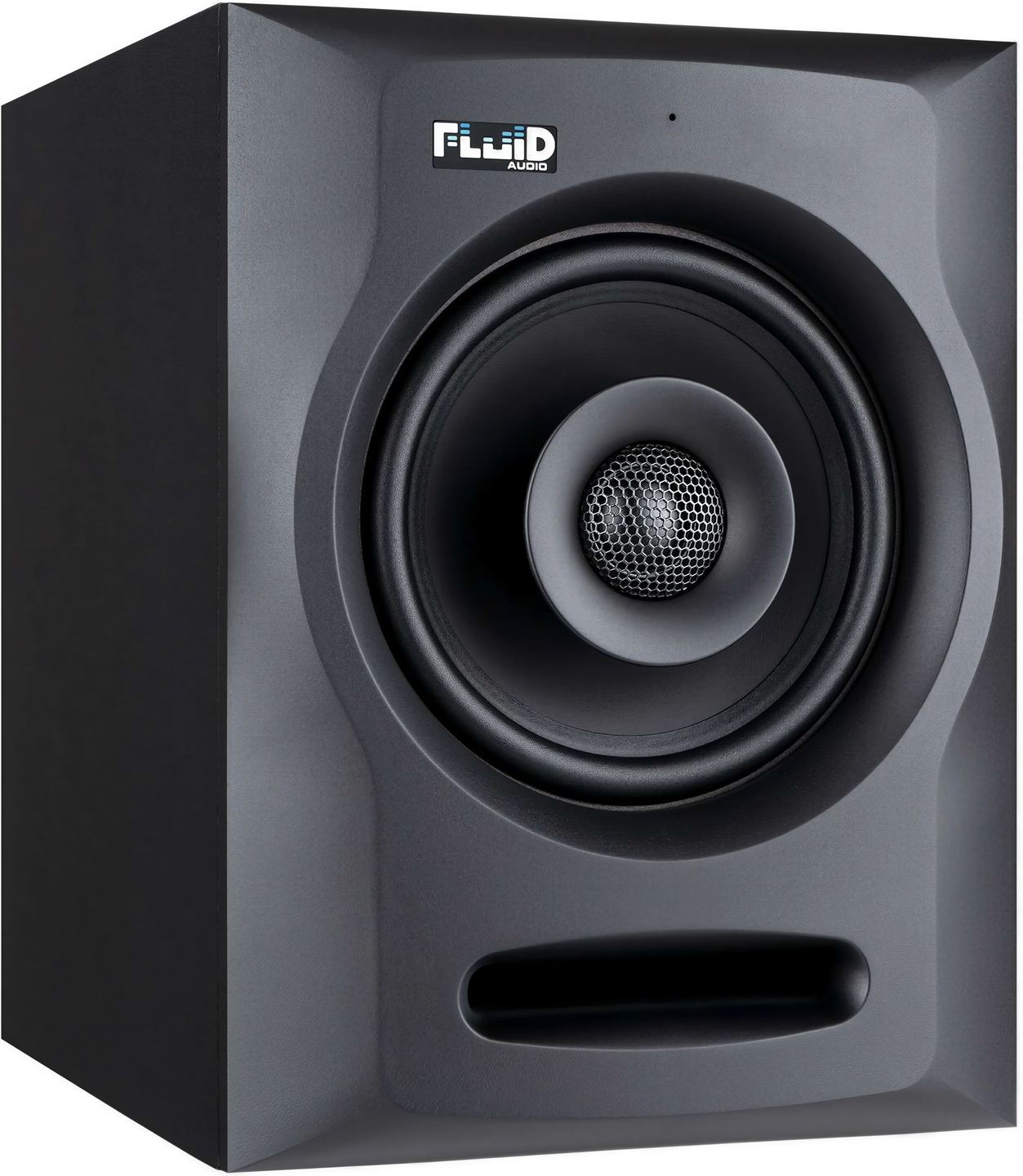
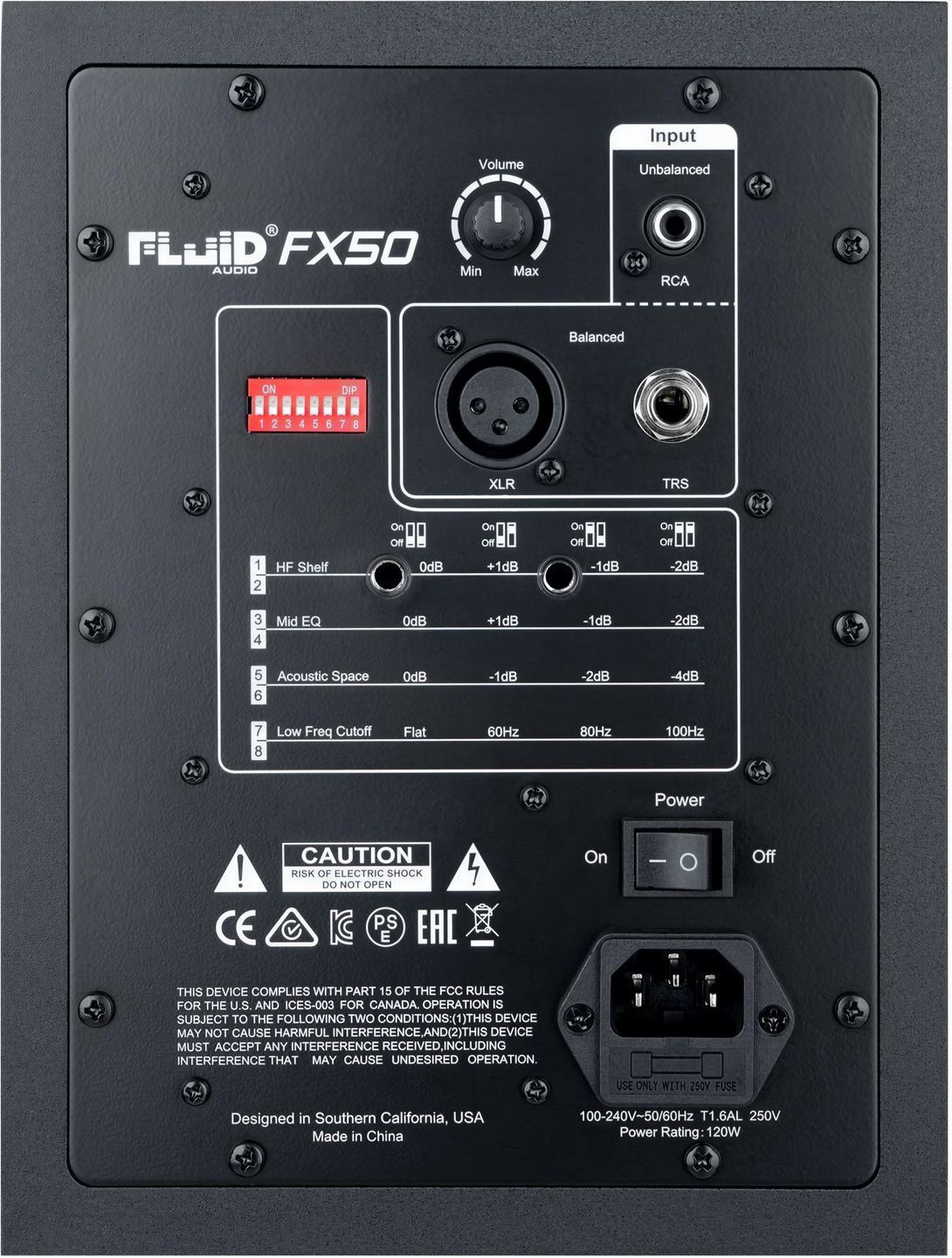
A bedroom or office converted into a studio almost never has the acoustic treatment of a mixing room, and proximity to a wall artificially boosts the bass. The DSP-controlled switches on the rear panel adjust bass and treble levels to compensate for these effects, with a guide printed directly on the back to help you find the combinations without opening the manual. The front-mounted slot port directs bass towards the listener rather than the wall and makes the speaker less sensitive to its distance from the wall.
The front LED indicates whether the speaker is on, off or in automatic standby, and also serves as an alignment reference: when it is at eye level in the listening position, the tweeter is correctly aimed at your ears. The coaxial design behaves the same way upright or on its side, allowing the FX50 to be placed horizontally beneath a screen without compromising the stereo soundstage.
A carefully shaped front baffle and a mount-ready cabinet
The vinyl-covered MDF cabinet measures 234 × 176 × 230 mm and weighs 3.8 kg. Its front baffle features the “keyhole” shape distinctive to the FX range, with edges rounded to a complex radius: this curvature reduces diffraction, meaning the unwanted reflections that arise at the sharp edges of a baffle and blur the stereo image.
For connectivity, the FX50 offers a balanced XLR input, a balanced 6.35 mm jack input and an unbalanced RCA input. Balanced connections, such as those on audio interfaces and mixing consoles, protect the signal from interference over long cable runs; the RCA input accommodates a converter, a network audio player or a consumer sound card. M6 threaded inserts on the back allow mounting on a wall or ceiling bracket, useful for the side, rear or height channels of a Dolby Atmos multichannel monitoring system, where the coaxial design’s compact size and consistent dispersion are advantages.
Documentation
Technical Specifications
Acoustic System
- Coaxial speaker:
- 130 mm composite woofer
- 25 mm dome tweeter
- Cabinet made of medium-density fiberboard (MDF)
Amplification
- Total power: 100 W class D
- Distribution:
- Low-frequency section: 50 W
- High-frequency section: 40 W
- Controls:
- Bass level adjustment
- Treble level adjustment
- Automatic standby mode
Connectivity
- Inputs: Balanced XLR, 6.35 mm jack, unbalanced RCA
- Outputs: Balanced XLR, unbalanced 6.35 mm jack
Physical Characteristics
- Dimensions (H × W × D): 234 × 176 × 230 mm
- Weight: 3.8 kg
Frequently asked questions
Is the FX50 sold individually or in pairs?
It is sold individually. For stereo listening, you need to order two; for a multichannel system, as many units as there are channels to equip.
Can the FX50 be used to listen to music outside the studio?
Yes. Connected to the output of a DAC, network player or computer sound card via the RCA input, it works as a pair of active desktop speakers. It has neither Bluetooth nor a digital input: the source must provide a line-level analog signal. A turntable requires a phono preamplifier between the turntable and the speaker.
At what distance and in what size room does the FX50 perform best?
It’s a near-field speaker, most at home between 70 cm and 1.5 m from the listener, in a small or medium-sized room. For a larger room or listening from farther away, the FX range also comes in a 20 cm version, the FX80, which uses the same coaxial principle.
Should I add a subwoofer?
For mixing vocals, podcasts, acoustic music or pop, a frequency response down to 49 Hz is sufficient in most cases. Electronic music, hip-hop or sound editing for picture goes lower: a subwoofer then lets you monitor the lowest octave, home to deep kick drums and synth bass, which the FX50 only partially reproduces.
Can the FX50 be placed directly on a desk?
It’s possible, but a desktop tends to vibrate with the cabinet and thicken the lower midrange, while directing the tweeter toward your chest rather than your ears. Desktop stands, ideally tiltable, or isolation supports significantly improve bass precision and alignment with the listening position.
What is the difference between the FX50 and the FX50v2?
The FX50v2 is the version currently in production. It retains the cabinet, drivers, amplification and connectivity of the original FX50, but features revised DSP tuning that makes the frequency response curve more linear.
How do you balance the level between two speakers?
Each FX50 has its own volume control on the back. The simplest method is to set both controls to the same position, then adjust the overall volume from the audio interface or source, ensuring an even balance between left and right.
- Eco-contribution included in the sale price.
- GTIN / EAN: 858445004721


