

Fluid Audio FX80
Fluid Audio FX80: 20 cm coaxial studio monitor
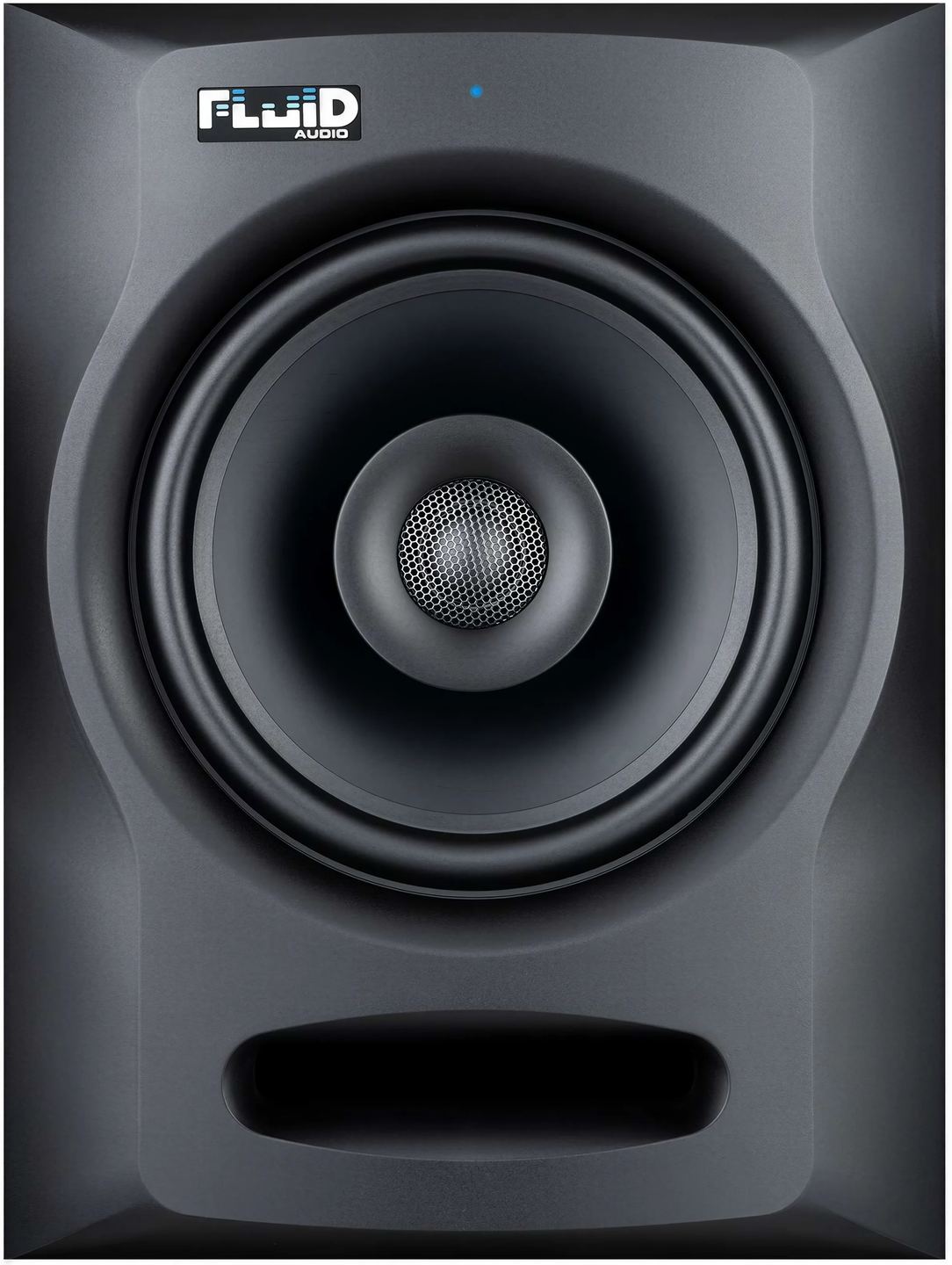
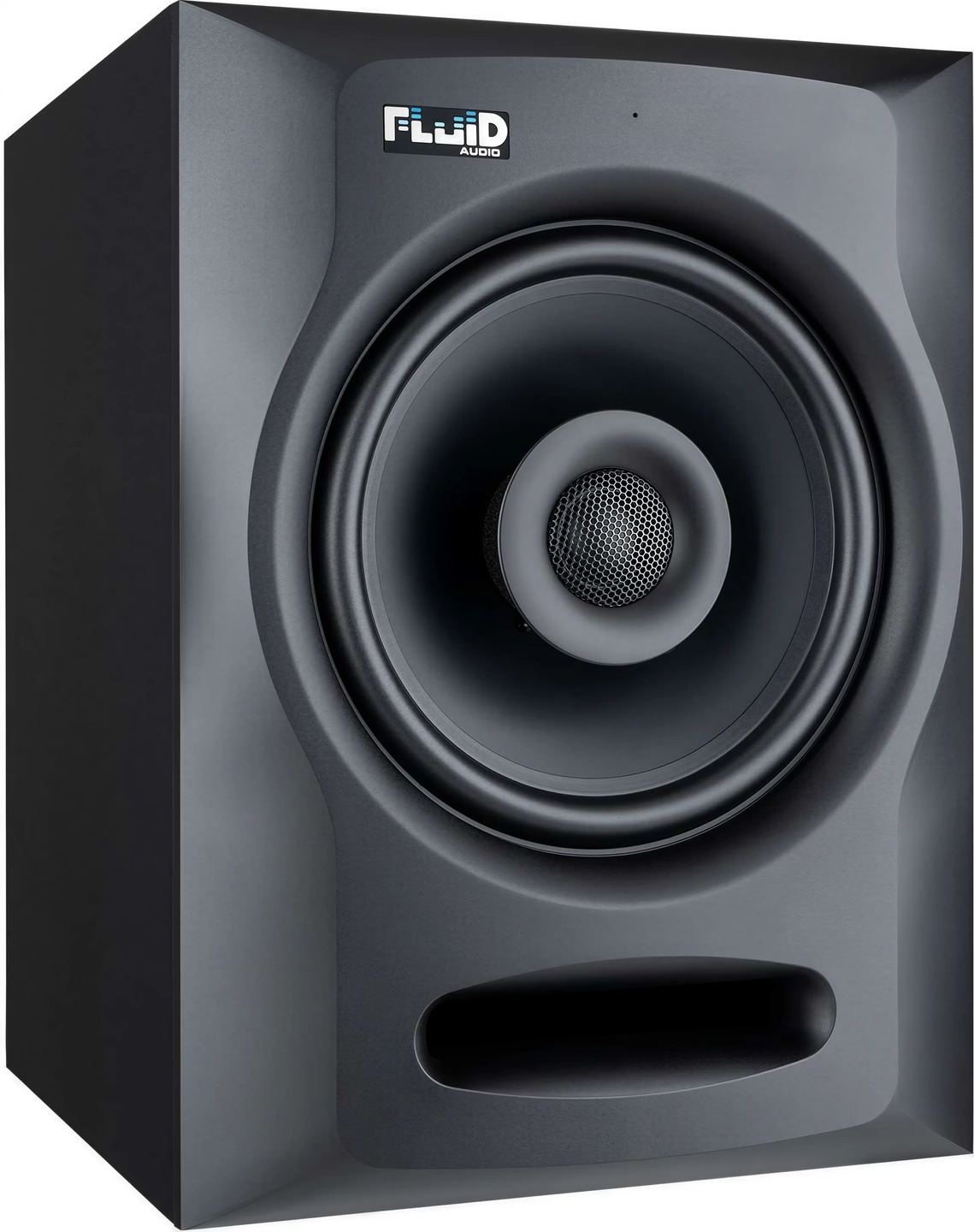
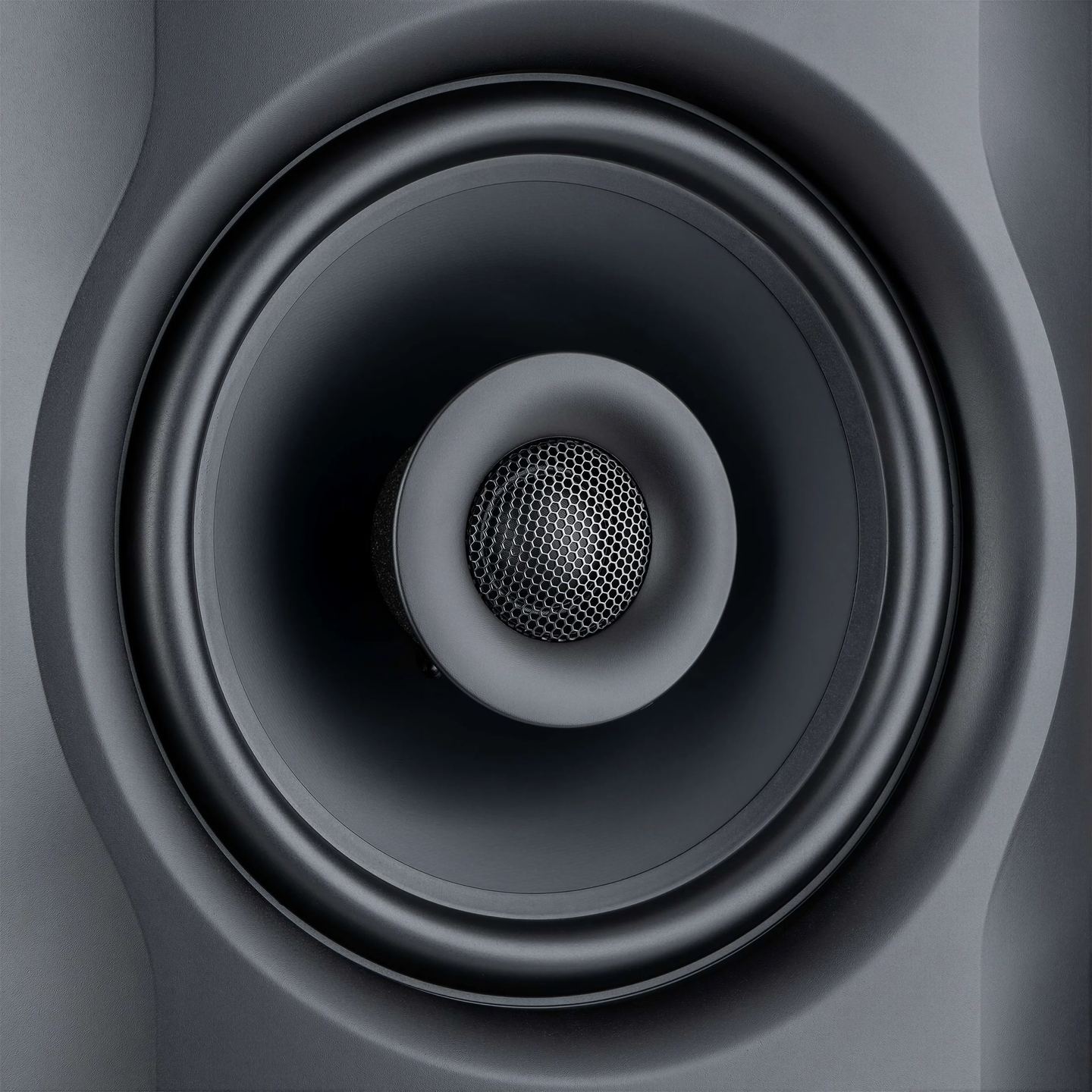
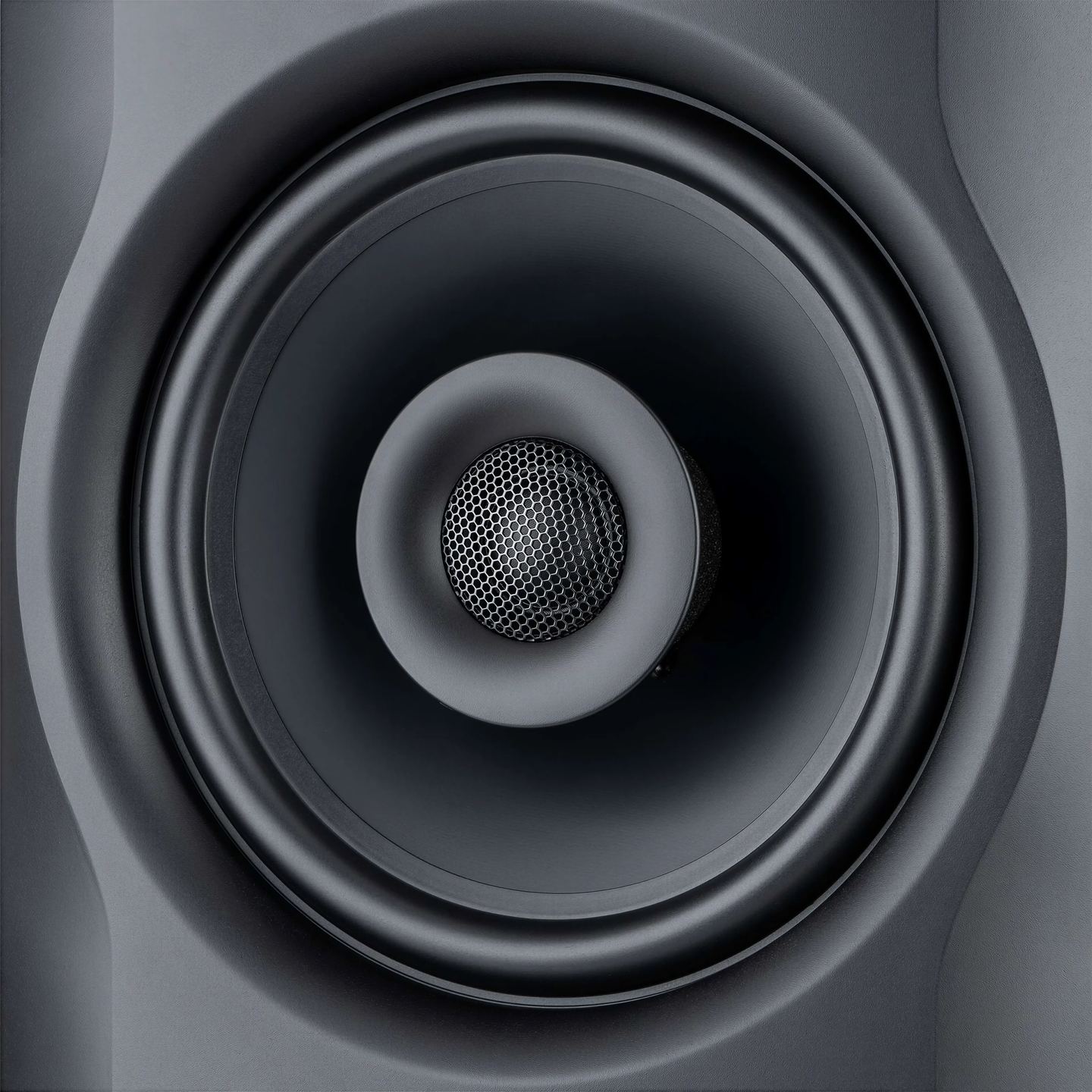
On most studio monitors, the tweeter and woofer are positioned one above the other, and the stereo image shifts as soon as you move your head slightly. Here, the two drivers share the same axis, with the tweeter housed at the centre of a 20 cm cone, so that all the sound comes from a single point. This arrangement, rare at this price level, is equally suited to mixing in a home studio and close-range listening at a desk.
A tweeter positioned in front of the woofer
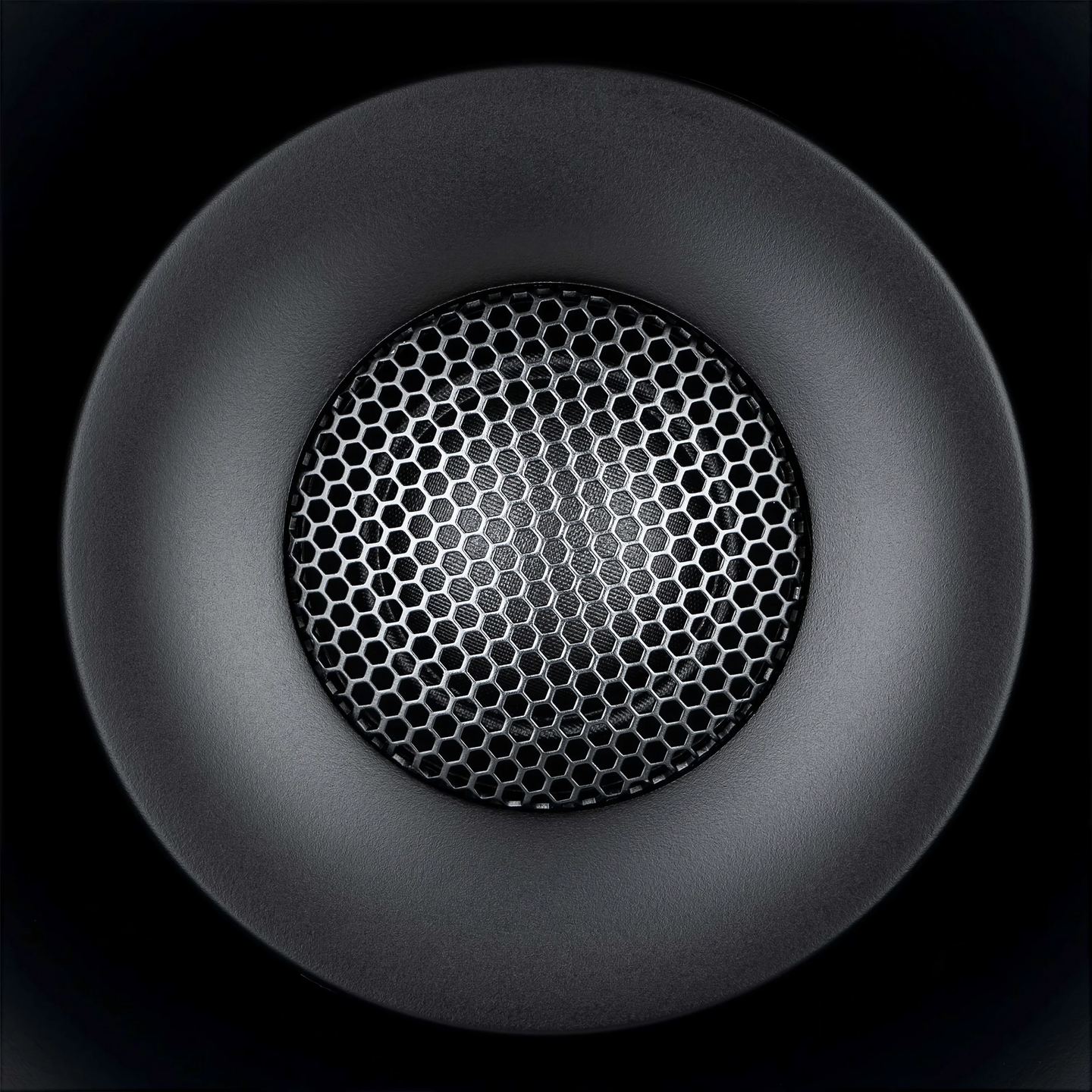
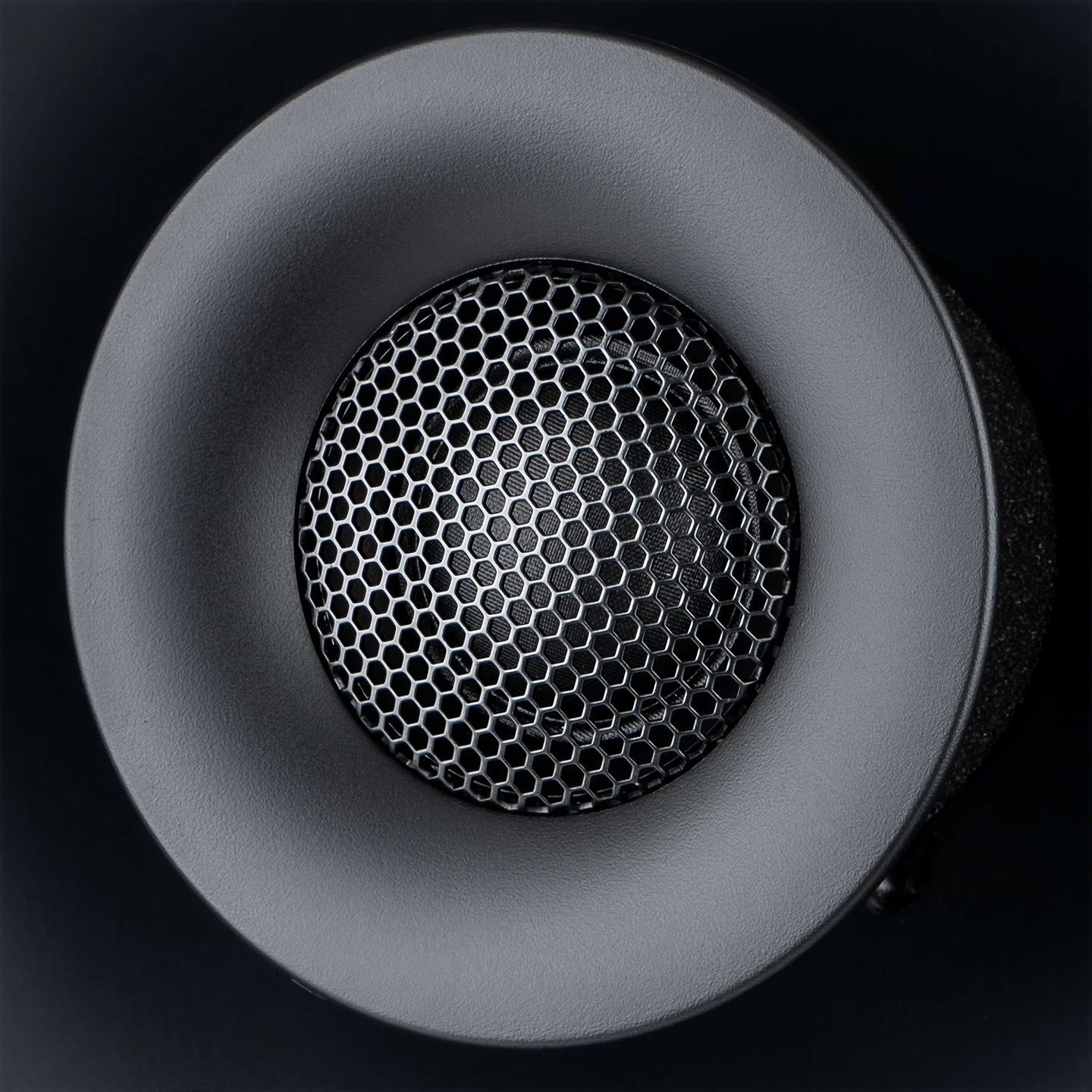
The coaxial principle involves mounting the tweeter, a 30 mm natural silk dome, on a post secured in front of the mid-woofer cone. The latter, made of composite paper, is paired with a voice coil that withstands high temperatures and a damped rubber surround. Both drivers emit sound from the same acoustic centre, so their waves reach the ear at the same time in the region where they share the workload, around 2.4 kHz. Phase remains coherent, the position of instruments in the stereo image is stable, and the tonal character changes little when the listener moves away from the central listening position. A grille protects the dome, which is exposed at the front of the cone.
This symmetry allows upright or horizontal placement without changing the sound, something a speaker with vertically stacked drivers cannot offer. Placed horizontally, the FX80 fits more easily under a computer screen or on a low shelf.
Two amplifiers and a digital crossover
The electronics are bi-amplified: a 60 W amplifier powers the woofer and a second 50 W amplifier powers the tweeter, for a total of 110 W. Each driver receives only the part of the signal intended for it and operates more efficiently. Both amplifiers are Class D, a technology that generates little heat and consumes less power than conventional amplification. The split between bass and treble is handled by a digital signal processor (DSP), which is more consistent than a passive-component crossover: two speakers in a pair behave identically, a prerequisite for accurately assessing a mix.
The frequency response extends from 35 Hz to 22 kHz, and the maximum level reaches 110 dB at one metre, allowing you to work at high volumes without clipping in a medium-sized room. Several safeguards govern operation: output current limiting, thermal protection, radio-frequency interference filtering, suppression of pops at power-on and power-off, and a subsonic filter that removes inaudible frequencies below the speaker’s lower limit, which would place unnecessary strain on it.
Adjustments to accommodate the room
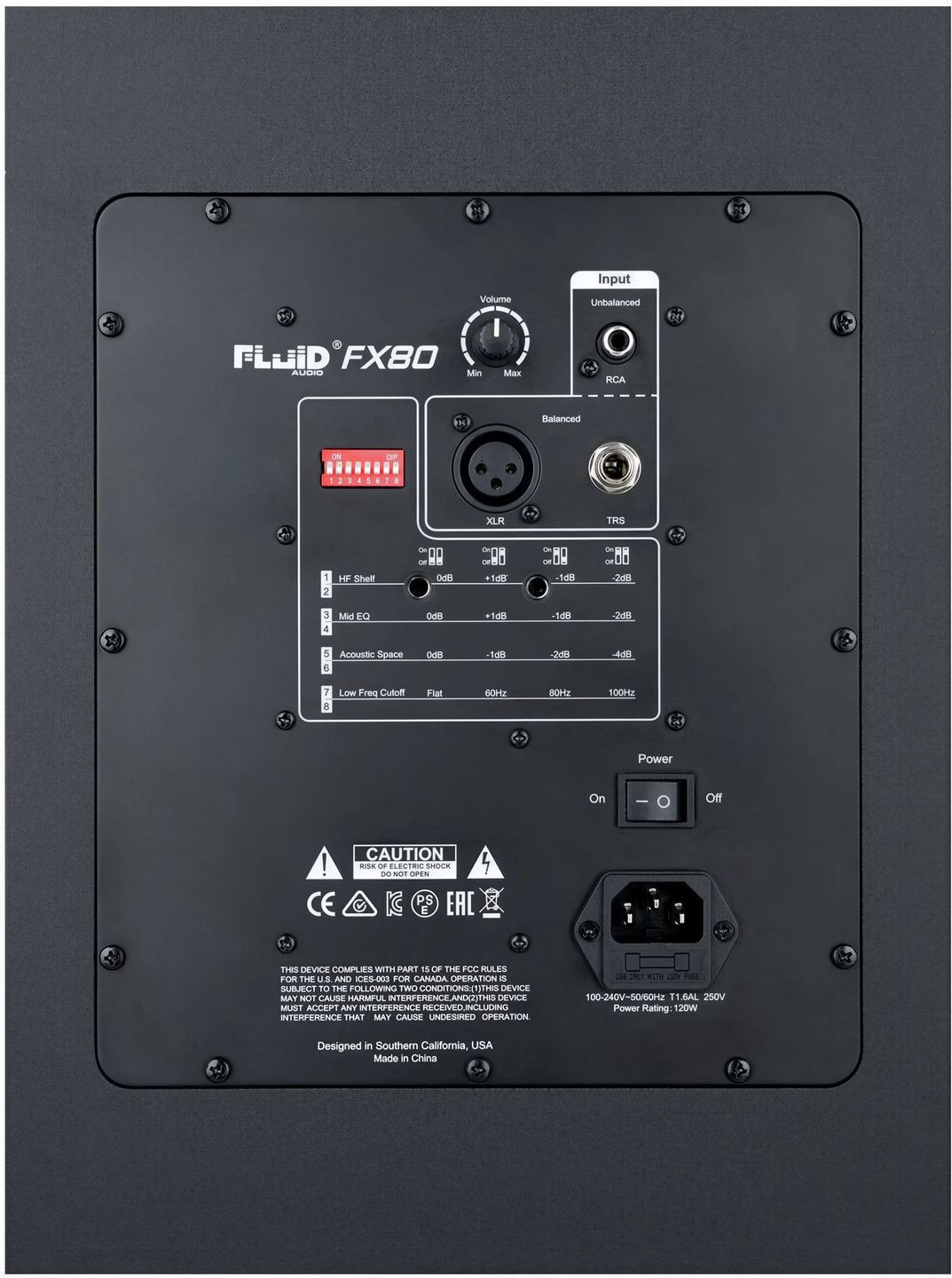
Few home studios benefit from carefully designed acoustic treatment, and the FX80 provides switches on the rear to compensate for room shortcomings, accompanied by a guide printed directly on the panel. The treble adjustment boosts or cuts the top end of the spectrum, useful in a room heavily damped by curtains or absorbent panels, or one that is overly reverberant. The midrange control operates around 1.5 kHz, from -2 to +1 dB. The acoustic space setting (boundary compensation) reduces the excess bass that occurs when a speaker is placed near a wall or in a corner. A low-frequency cut at 60, 80 or 100 Hz, with a slope of 12 dB per octave, makes it easier to integrate a subwoofer.
The bass-reflex port, an opening that increases efficiency in the bass range, is a slot in the front panel. Positioned at the front, it directs bass energy towards the listener and allows the speaker to be placed close to a wall, something a rear port makes tricky. The front LED indicates the speaker’s status (on, off, standby) and serves as a reference for positioning the tweeter at ear level.
Cabinet, connections and installation
The vinyl-covered MDF cabinet features the keyhole-shaped front panel characteristic of the FX range. Its rounded edges limit diffraction, the unwanted reflections that occur at the sharp edges of a cabinet and blur imaging precision. At 34 cm tall and weighing 7.9 kg, the FX80 can still be placed on a deep desk or dedicated stands.
At the rear, three inputs accommodate most sources: balanced XLR and 6.35 mm jack inputs for an audio interface or mixing console, and an unbalanced RCA input for a consumer device. A balanced connection carries the signal over three conductors and eliminates interference picked up along the cable, an advantage over long distances. A volume knob completes the panel. M6 threaded inserts on the back accommodate a compatible wall mount or ceiling mount, a solution for the side, rear or height channels of a Dolby Atmos mixing setup.
Documentation
Technical Specifications
Speakers
- Bass: 20 cm, composite
- Treble: 25 mm dome
- Cabinet: Medium Density Fiberboard (MDF)
Amplification
- Power: 140 W Class D
- Bass: 60 W
- Treble: 50 W
- Bass level adjustment
- Treble level adjustment
- Automatic standby mode
Connectivity
- Inputs:
- Balanced XLR
- Unbalanced 6.35 mm jack
- Unbalanced RCA
- Outputs:
- Balanced XLR
- Unbalanced 6.35 mm jack
Dimensions and Weight
- Dimensions (H × W × D): 340 × 254 × 295 mm
- Weight: 7.5 kg
Frequently asked questions
Is the FX80 sold individually or as a pair?
It is sold individually. For stereo listening, you therefore need to order two. The box contains the speaker, its power cord and a set of adhesive rubber pads to attach to the underside of the cabinet, isolating it from the furniture and preventing it from slipping.
What is the difference between the FX80 and the FX80v2?
The version currently sold by Fluid Audio is called the FX80v2. It retains the drivers, power output and cabinet of the original FX80, but features revised processor tuning, a more linear response and more legible rear-panel labeling. The FX80 itself succeeded the FX8, with a redesigned front baffle and a port relocated to the front.
Can it be connected directly to a computer or via Bluetooth?
No, the FX80 has neither a USB input nor wireless reception. With a computer, it connects to a sound card via the balanced XLR or jack inputs. The RCA input accepts a network player, a converter or a preamplifier. A turntable requires an intermediate phono preamplifier, as the signal from a cartridge is too weak for a line input.
Should you add a subwoofer?
Not necessarily. Reaching down to 35 Hz is a good result for a 20 cm driver, and most pop, rock or acoustic mixes can be worked on without a subwoofer. For electronic music, hip-hop or film post-production, where deep bass matters, a subwoofer adds the lowest octave. Setting the crossover to 60, 80 or 100 Hz then relieves the speaker of these frequencies to prevent them from overlapping with those of the subwoofer.
How should speakers be positioned on a desk?
The classic placement forms an equilateral triangle between the two speakers and the listener’s head, with the tweeters aimed at the ears. The front-panel LED helps check the height: it should be roughly at eye level. Tilting desktop stands or isolation mounts prevent the desktop from vibrating and coloring the bass. If the speaker has to remain close to the wall, the acoustic space setting corrects the resulting excess bass.
Can it be used to listen to music in a living room?
Yes, by connecting a source to the RCA input. The sound remains that of a monitor, neutral and without flattering effects, which is what those who want to hear a recording as it was produced are looking for. The volume is adjusted on each speaker and there is no remote control: a source or preamplifier with adjustable volume makes everyday use more convenient.
Does it work with the French mains supply?
Yes. The power supply accepts a voltage of 100 to 240 V at 50 or 60 Hz, which covers the French power grid and most countries.
- Eco-contribution included in the sale price.
- GTIN / EAN: 858445004776


