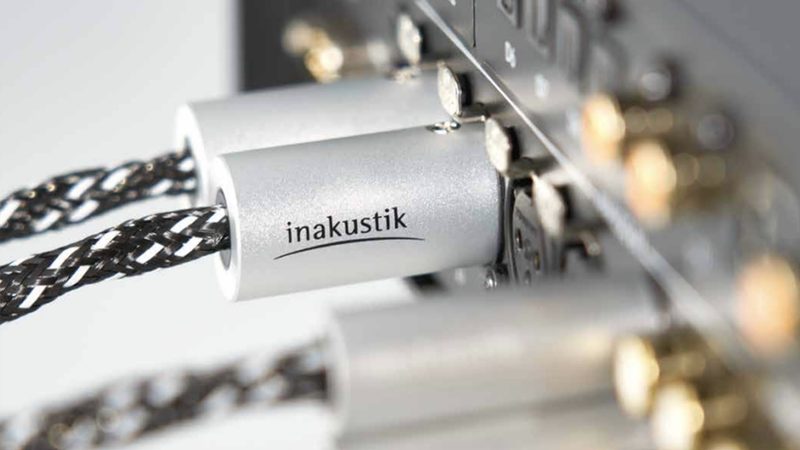
Inakustik Reference LS-1102
Complementary products
Overview
A large cross-section alone does not make a good speaker cable: the way the copper is distributed matters too. Here, each polarity is split between three conductors that alternate with those of the opposite polarity, inside a sheath measuring 10 mm in diameter. Sold cut to length, it can be ordered to the exact length your installation requires. It is the most advanced model in in-akustik’s Referenz series sold by the metre, manufactured in Germany.
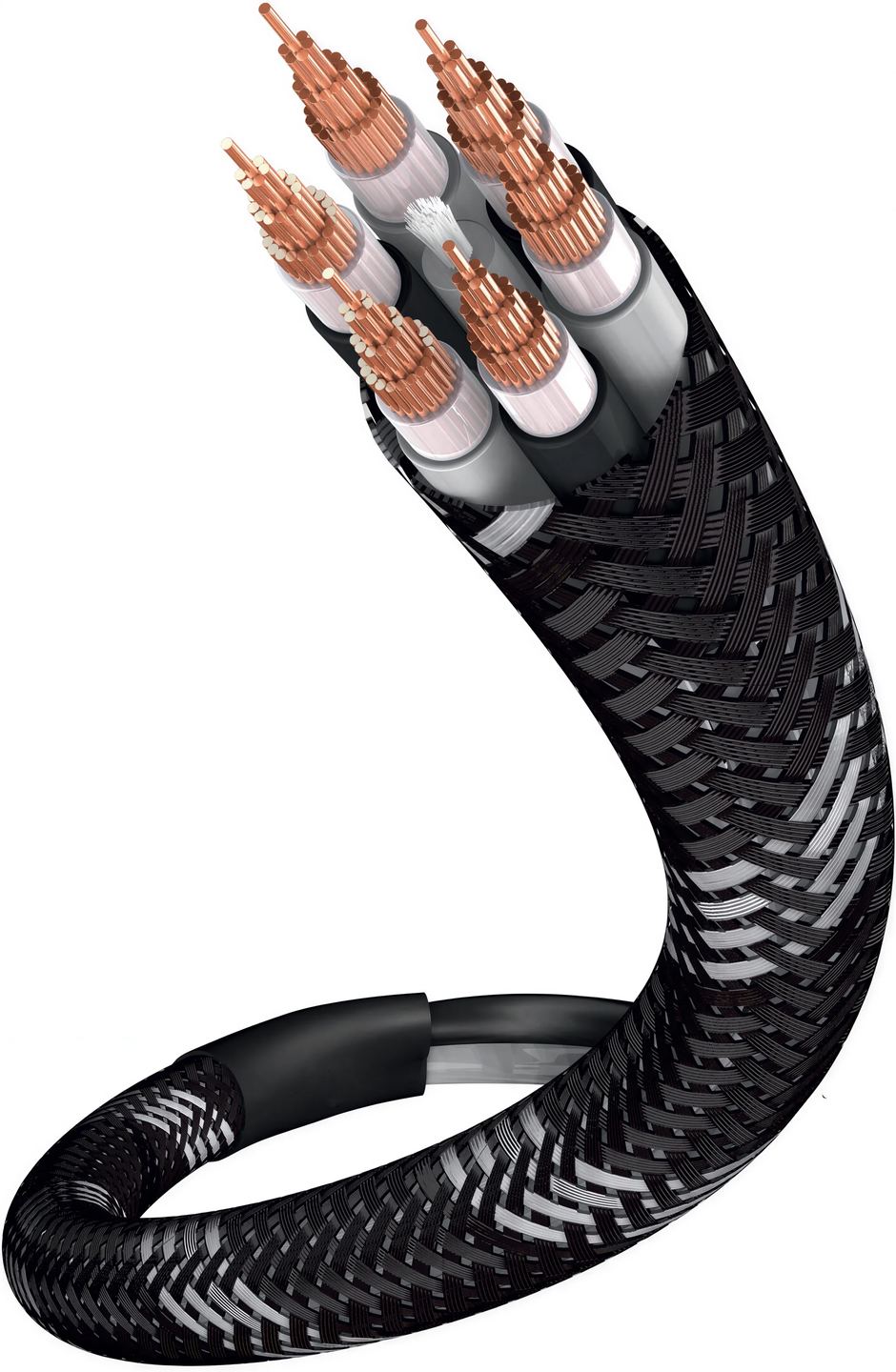
Three conductors per polarity, alternating
The LS-1102 combines six conductors of 1.95 mm² each. Three carry the signal, and three provide the return path, giving a cross-section of 5.85 mm² per pole. Their arrangement follows a triple symmetry: around the cable’s axis, each positive conductor has negative conductors as its neighbours.
This alternating arrangement targets inductance. Between the outgoing and return current paths, every cable forms a loop, and this loop generates a magnetic field that impedes the signal increasingly as frequency rises. When the two polarities are close together and interwoven, their fields cancel each other out and inductance decreases. Over a few metres, the effect remains subtle; it becomes more significant over long runs and with speakers whose impedance drops low in the treble. Bringing the polarities closer together comes at a cost, however: the conductors face each other over a larger surface area, which increases the cable’s capacitance. The insulation’s role is to keep it in check.
Foamed insulation to keep capacitance in check
Each conductor is sheathed in two-layer DUO-PE II insulation. The first layer is foamed polyethylene: foaming traps air in the material, and air has the lowest dielectric constant achievable in a cable. Less insulating material between the conductors means lower capacitance, so the cable stores less energy in the manner of a small capacitor. A layer of solid polyethylene covers the more fragile foam and protects it against crushing. A polyethylene mesh sheath covers the entire assembly.
Most transistor amplifiers are unaffected by the capacitance of a typical speaker cable. Some designs with very wide bandwidth or low negative feedback are more sensitive to it, and it is with these that the compromise between low inductance and controlled capacitance is most useful.
Strands arranged layer by layer
Each of the six conductors contains 37 high-purity copper strands twisted concentrically: one central strand, followed by successive layers of 6, 12 and 18 strands, each in a defined position. In conventional stranding, the strands cross randomly along the entire length, and their contact points vary from one place to another. The concentric structure fixes these contacts and provides a uniform conductor from end to end.
The skin effect, the tendency of current to concentrate at the surface of a conductor, remains weak at audio frequencies for strands of this diameter. The main benefit of concentric stranding lies in the conductor’s mechanical and electrical consistency along the entire cut length.
A cross-section that goes the distance
With 5.85 mm² per pole, resistance is around 0.006 ohm per metre, counting both the outgoing and return paths. Over a 10-metre connection, this represents approximately 0.06 ohm, barely 1.5% of the impedance of a 4-ohm speaker. A typical 2.5 mm² cable reaches nearly 0.14 ohm over the same distance.
This resistance adds to that of the amplifier and reduces its ability to restrain the movement of the bass drivers, known as the damping factor. The lower it remains, the better the bass is controlled. The LS-1102 is suited to situations where the speakers are far from the amplifier (rear channels in a home cinema system, a large room with the electronics placed to one side), or where their impedance drops sharply in the bass. For two 8-ohm bookshelf speakers two metres from the amplifier, this cross-section far exceeds what is needed.
Cutting, stripping and terminations
Sold by the metre, the LS-1102 is cut into two identical lengths for the left and right channels, even if one speaker is closer: both channels retain the same electrical behaviour. At each end, the three conductors of the same polarity are grouped and twisted together before connection.
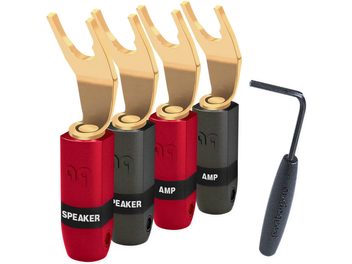
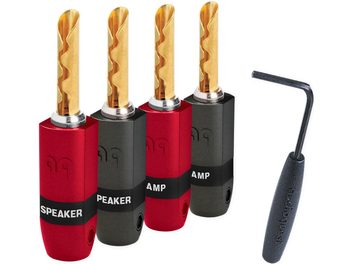
Once grouped, each pole’s cross-section fits into most screw terminals as bare wire. For banana plugs or spade connectors, models accepting at least 6 mm² are required; the rhodium-plated versions in in-akustik’s Referenz range accommodate up to 10 mm². The 10 mm diameter and firm sheath require a generous bend radius and some space behind the furniture or speaker, and the cable’s weight puts strain on the terminals when it hangs vertically: it is best to let it rest on the floor before making the connection.
Its place in the Referenz series sold by the metre
The series starts with the LS-502, two twisted 2.97 mm² conductors within an 8.5 mm diameter. The LS-602 moves up to four 1.87 mm² conductors in double symmetry (9 mm), followed by the LS-1002 with four 2.97 mm² conductors (10 mm). The LS-1002 offers almost the same cross-section per pole as the LS-1102, 5.94 mm² versus 5.85 mm²: choosing the LS-1102 therefore means opting for triple symmetry and lower inductance, not more copper. Above these, the Referenz Micro AIR and AIR series use a different principle and insulate the conductors primarily with air.
Documentation
Technical Specifications
Structure
- Hexa CC-195 design (6 × 1.95 mm²)
- Symmetrical 3-conductor structure
- 37 strands per conductor, concentrically twisted
Insulation
- Double polyethylene (DUO-PE II) around each conductor
- Polyethylene (PE) anti-vibration outer sheath
Performance
- Induction arm for uniform reproduction
Commercialization
- Sold by the meter
Frequently asked questions
What length should I order?
Measure the actual cable route to the farthest speaker, following the skirting boards and going around furniture rather than in a straight line, then add a few tens of centimetres for stripping and terminations. Then multiply by two, one length per speaker, and by the number of speakers in a home cinema system.
Can it be used for bi-wiring?
Yes, using two lengths per speaker: one feeds the bass, the other the midrange and treble, after removing the jumpers from the terminal block. The six conductors in a single length are grouped into two sets of three to form a single pair; they cannot be split into two balanced pairs.
Should the stripped ends be tinned?
This is not recommended under a screw terminal. Tin solder slowly creeps under the clamping pressure, the contact loosens over time and its resistance increases. A tightly twisted bare wire, retightened after a few days, or a crimped or screw-on plug provides a more stable contact.
Does it work with a tube amplifier?
Without difficulty. The output of a tube amplifier passes through a transformer, which is not very sensitive to cable capacitance, and its low resistance preserves the damping factor, which is often modest in these amplifiers. Connect it to the output terminal (4 or 8 ohms) that matches your speakers’ impedance.
Can you mix different sections in a home theater system?
Yes. There is no need to wire all channels with the same cable model: the LS-1102 is suited to long runs to the rear channels or height speakers, while an LS-602 or LS-502 is sufficient for a centre speaker placed below the TV. The three front channels, however, benefit from using the same cable to keep their tonal character consistent.
My speakers have spring clip terminals, is it compatible?
Spring terminals, commonly found on entry-level speakers and some older amplifiers, rarely accept more than 2.5 mm². The three conductors bundled together will not fit. In this case, the LS-502 from the same series is more suitable.
Banana, spade or bare wire?
Bare wire provides the most direct contact as long as it is securely tightened. A spade connector offers a large contact area under a screw terminal and stays in place once tightened. A banana plug connects and disconnects in one motion, making it convenient if you often change speakers or amplifiers.
- Eco-contribution included in the sale price.
- Manufacturer reference: 00781102
- GTIN / EAN: 4001985781119