Audioquest Thunder HC IEC15 1m
Overview
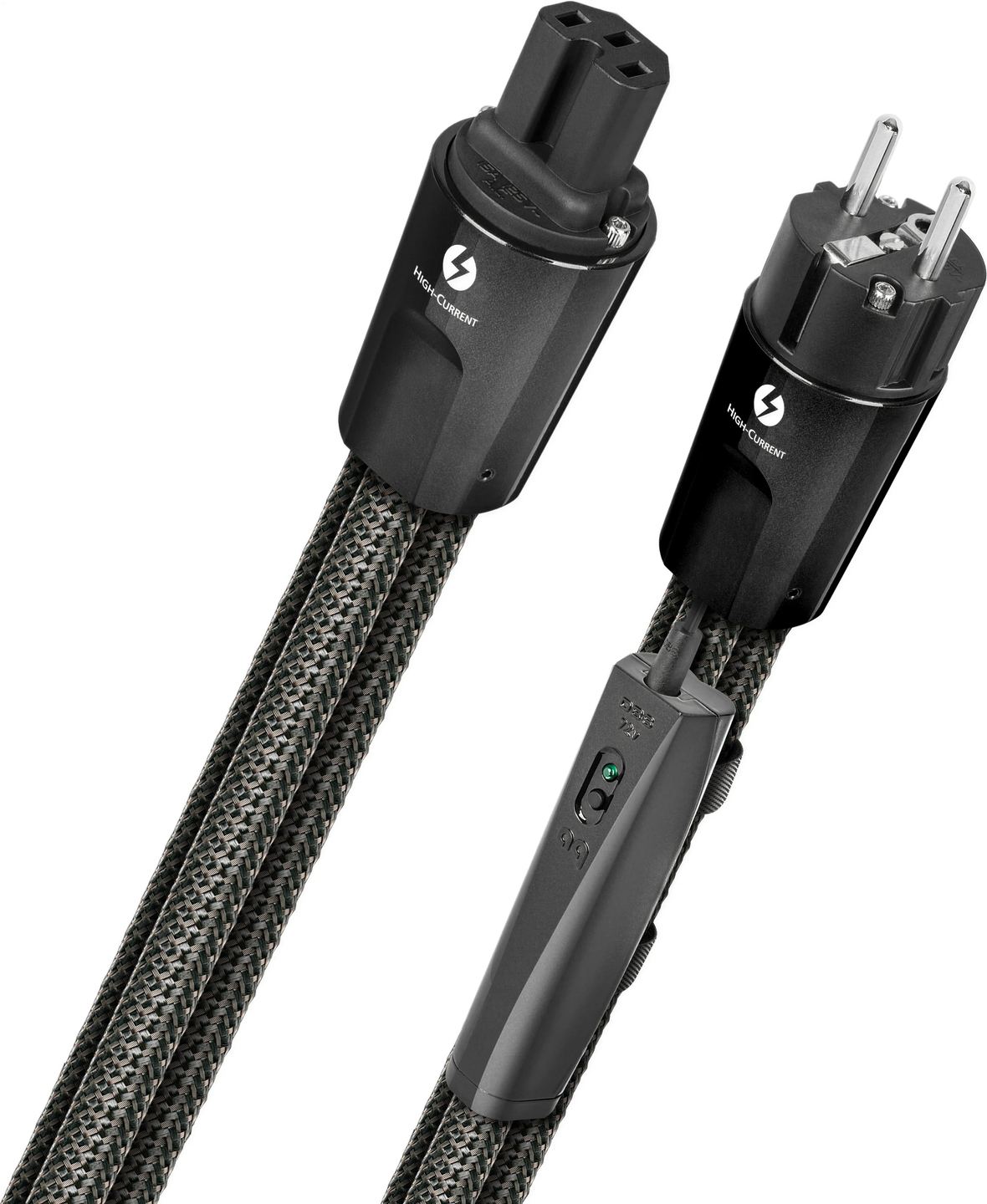
The Thunder HC IEC15 marks the entry point into AudioQuest’s Storm series, a family of power cables that redefines the standards of AC power transmission. Designed for power-hungry equipment, this cable combines high-purity copper conductors with a patented noise dissipation system, delivering uncompressed current transfer capability up to 20 amps RMS.
Construction and Architecture: The Alliance of LGC and PSC Copper
The Thunder HC is built on a sophisticated architecture that combines two types of high-purity copper. The solid conductors are made up of 66% LGC (Long Grain Copper) and 34% PSC (Perfect Surface Copper), both in solid form. This specific combination is no accident: LGC, with its long-grain crystalline structure, minimizes the boundaries between crystals where distortion typically occurs. PSC takes this logic further with a perfectly polished surface that eliminates the microscopic irregularities responsible for signal disruption.
Unlike traditional stranded cables, the Thunder’s solid conductors eliminate strand-to-strand interactions, a major source of transient intermodulation distortion. Each phase, neutral, and ground conductor is constructed as an independent cable, with all three then braided together and protected by a robust black sheath. This particular geometry helps reduce electromagnetic interference while maintaining enough flexibility for installation.
The Thunder’s characteristic impedance is kept at zero between 50 Hz and 1 MHz, a technical feat that ensures uncompressed current transfer. This feature becomes crucial during the transient demands of power amplifiers, where peaks can reach several times the average consumption.
72V Dielectric-Bias System: A Patented Innovation
At the heart of Thunder’s innovations is the DBS (Dielectric-Bias System) powered by a 72-volt supply. This patented technology creates a stable electrostatic field that polarizes the dielectric molecules. Traditional insulators absorb and release energy in a nonlinear way, creating a variable time lag depending on frequency—a phenomenon particularly problematic for multi-octave audio reproduction.
The DBS keeps the dielectric in a constant state of electrostatic saturation, preventing this parasitic energy absorption. A small module containing the battery, with a claimed lifespan of nearly ten years, is integrated into the cable. A push-button with LED allows you to check the system’s operation. The inclusion of an RF trap (Radio Frequency Trap), originally developed for Niagara conditioners, ensures that radio frequency noise will not be induced into the signal conductors from the DBS field elements.
Ground Noise Dissipation: Protection Against RF Interference
The ground wires in electrical installations, while essential for safety, act as antennas picking up ambient radio frequency noise. This RF noise bypasses component power supplies and couples directly to the most sensitive audio circuits. AudioQuest’s patented Ground-Noise Dissipation technology tackles this problem head-on.
The circuit uses a unique topology with a common-mode phase-cancellation network, combined with proprietary dielectric materials providing additional linear differential filtering. This approach enables noise dissipation over the widest possible radio frequency bandwidth, significantly reducing distortion induced by these interferences.
Controlled Directionality: The Importance of Signal Flow
All drawn metal conductors have an asymmetrical, and therefore directional, grain structure. AudioQuest meticulously controls this characteristic by listening to each batch of conductors to determine the optimal direction. The resulting RF impedance variation is thus managed so that noise is directed away from sensitive areas where it could cause distortion.
Clearly marked arrows on the connectors ensure this directionality is respected. This attention to detail may seem excessive, but it is part of AudioQuest’s philosophy, where every parameter that could affect sound quality is optimized.
IEC 15 Terminations: Uncompromising Connections
The Thunder HC’s connectors benefit from cold-welded terminations, a technique that preserves the metallurgical integrity of the conductors. The European IEC 15 termination ensures a reliable and secure connection with compatible equipment. Hanging-Gold Purple-Copper plated contacts offer optimal conductivity while resisting corrosion.
It is important to note the difference between standard 15-amp IEC connectors and 20-amp versions: some equipment rated for 20 amps still uses 15-amp connectors. AudioQuest recommends carefully checking your equipment’s connector type before purchase.
Applications and Real-World Performance
With its capacity of 20 amps RMS at 125VAC (16 amps RMS at 220-240V), the Thunder HC is perfectly suited for demanding equipment: power amplifiers, powered subwoofers, integrated amplifiers, power conditioners, power regenerators, and isolation transformers. Amplifiers present a particular challenge as their consumption varies dynamically with volume and musical content, creating transient current demands that can far exceed average consumption.
User feedback highlights noticeable improvements: a wider soundstage, increased dynamics, deeper and more controlled bass, more transparent mids with body, and open highs with presence and weight. The reduction in background noise allows details previously masked to emerge, creating a more three-dimensional and engaging sound presentation.
Technical Specifications
Composition
- Metal: 66% rigid LGC (Low Grain Copper), 34% rigid PSC (Pure Single Crystal Copper)
- Black sheath
Electrical Specifications
- Zero characteristic impedance (50 Hz - 1 MHz)
- 72 V polarized dielectric system
- Ground noise dissipation
Connectivity
- Cold-welded connectors
- European IEC 15 termination
Frequently asked questions
What is the difference between the High-Current and Source versions of the Thunder?
The High-Current versions use larger gauge conductors, optimized for current-hungry equipment like amplifiers and conditioners. The Source versions, about 15% less expensive, are better suited for source devices with more stable power consumption.
Does the DBS system require any special maintenance?
No, the DBS system’s battery has a lifespan of about 10 years. A test button with LED allows you to check its operation. No maintenance is required during this period.
Can I use the Thunder HC with any audio equipment?
The Thunder HC is designed for equipment accepting up to 20 amps with an IEC15 connector. Always check your equipment’s connector compatibility and electrical specifications before use.
Is the Thunder HC compatible with European voltages?
Yes, the Thunder HC works perfectly at 220-240V 50Hz with a capacity of 16 amps RMS under these conditions.
How does the Thunder compare to other models in the Storm series?
The Thunder uses an LGC/PSC combination, the Tornado steps up with PSC/PSC+, and the Hurricane uses exclusively PSC+. Each level brings further refinements, but the Thunder already offers the core Storm technologies.
- Eco-contribution included in the sale price.
- Manufacturer reference: NRGTHUNEU01