

Consonance AMP150 black
Specifications and features


Consonance AMP150: integrated amplifier, converter and network player
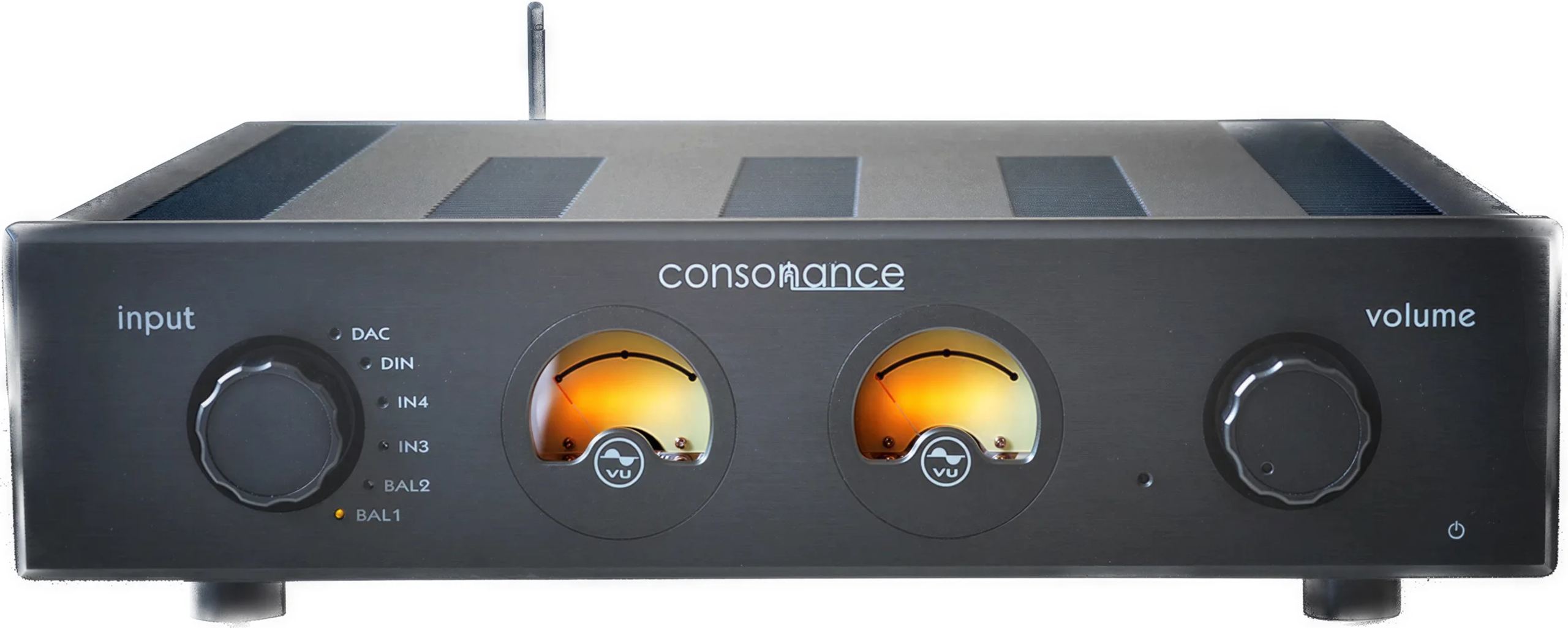
Bringing together in a single device everything needed to amplify speakers, convert digital audio and play music over a network is Consonance’s approach with this transistor integrated amplifier. Where a conventional setup stacks an amplifier, a converter and a streamer connected by several cables, everything here fits into the same chassis. It remains to be seen what this versatility delivers in terms of power, connectivity and sound performance.
Amplifier, converter and network player
The principle is quickly summed up: connect a pair of passive speakers on one side, your sources on the other, and do without the components usually kept separate. The AMP150 combines amplification, a digital converter (DAC) to process signals from digital sources, and a network player capable of retrieving music from the Internet or the home network. Consonance describes the device as a Swiss Army knife: a single unit covering most of today’s ways of listening to music. For the user, this reduces the number of components to choose, power and connect together.
Cool Class A technology and power
Consonance announces amplification derived from its in-house technology called Cool Class A. A useful reminder: Class A refers to an operating mode in which the transistors remain constantly active, renowned for its finesse and low distortion, but which generates a great deal of heat and consumes more power. The “Cool” prefix refers to the work carried out by the brand to retain these sonic qualities while controlling heat dissipation.
In terms of figures, the AMP150 delivers 105 watts per channel into 8 ohms and 170 watts into 4 ohms, enough to drive average-sensitivity speakers without running short of headroom. The damping factor exceeds 1,000. This value measures the amplifier’s ability to control the movement of the speaker drivers, especially in the bass: the higher it is, the tighter and clearer the bass remains rather than becoming loose. With such a margin, the device maintains control over demanding or low-impedance speakers. Distortion remains below 0.018% at 20 watts into 8 ohms, and the frequency response spans 5 Hz to 100 kHz with less than 0.5 dB deviation.
Analog inputs and relay switching
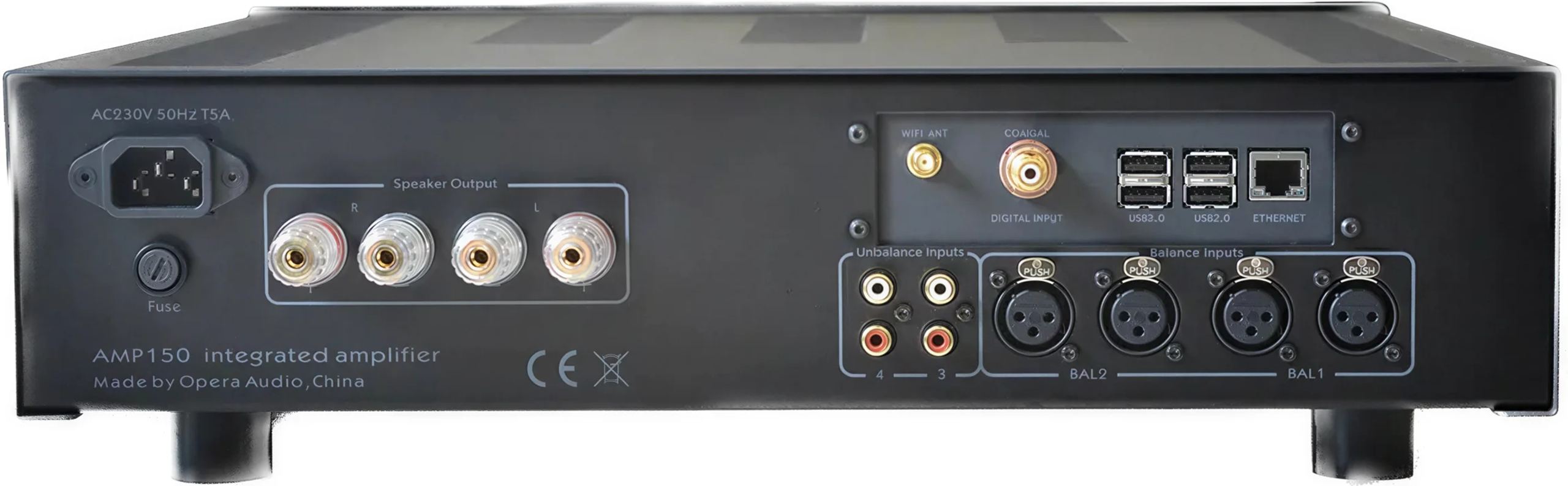
On the analog side, the AMP150 offers unbalanced RCA inputs and balanced XLR inputs, all with gold-plated connectors. The difference lies in how the signal is carried: a balanced connection (XLR) separates the useful signal from noise picked up along the cable, making it more robust over long distances and against interference. In practice, most consumer hi-fi sources use RCA, while XLR is mainly found on high-end electronics.
Input selection is handled by relays with gold-plated contacts, a switching method that limits background noise and losses compared with a conventional selector. These inputs are assignable: each can be associated with a specific source, simplifying everyday control. The AMP150 does not include a phono preamplifier; to connect a turntable, an external phono preamp must be used, connected to one of the line inputs.
The digital converter and supported formats
The built-in converter supports the two main families of digital files. In PCM, the most widespread format (FLAC, ALAC, WAV, AIFF, MP3, AAC), it goes up to 384 kHz at 16 to 32 bits. In DSD, the encoding used by SACD and some high-resolution downloads, it accepts DSF and DIFF files up to 11.2 MHz. Enough to play both a quickly downloaded MP3 and a high-definition recording.
To feed this converter, the rear panel includes a coaxial S/PDIF digital input, useful for connecting a CD player or television, and a USB port that reads content from a USB drive or external hard disk. This USB port is intended for reading storage media, however, not for connecting the amplifier to a computer in converter mode: connection to a PC or Mac is via the network.
Network streaming and remote control
The network connection opens up uses that a purely analog integrated amplifier does not allow. Connected via Gigabit Ethernet, the AMP150 plays music stored on the home network (a server or shared drive) and connects to the main streaming platforms: Spotify, Tidal and Qobuz. It also works as a Roon endpoint and plays Internet radio. Bluetooth, identified under the name “Opera”, completes the package for quickly streaming sound from a phone or tablet.
Control does not require a navigation screen on the device: from any equipment connected to the same network, a web browser displays the playback interface, with library and playlist management. Consonance also provides an Android application. The physical remote control is limited to volume, source selection and muting.
Size, heat and installation
The format remains compact for an integrated amplifier of this power: 12 cm high, 43 cm wide and 40 cm deep, weighing 11.6 kg. The black finish and clean front panel match the brand’s understated design, without an intrusive display or a proliferation of buttons.
One point deserves attention during installation. The high idle current of this design generates heat, and the manual stresses the need to leave free air around the device, above it as well as at the sides. It is therefore best to avoid enclosing it in a closed cabinet or stacking it without clearance. Placed in the open on a ventilated support, it operates under good conditions.
Documentation
Technical Specifications
Audio Formats and Frequencies
File Formats
- DSD (Direct Stream Digital): DSF, DIFF
- PCM (Pulse Code Modulation): FLAC, ALAC, WAV, AIFF, MP3, AAC
Sampling Frequencies
- PCM: 44.1 kHz to 384 kHz, 16 to 32 bits
- Stereo DSD: 2.8 MHz to 11.2 MHz, 1 bit, stereo
Audio Performance
Output Power
- 105 W + 105 W (8 Ω)
- 170 W + 170 W (4 Ω)
Audio Characteristics
- Frequency response: less than ± 0.5 dB deviation, 5 Hz to 100 kHz
- Signal-to-noise ratio: greater than 95 dB
- Distortion: less than 0.018% at 20 W under 8 Ω
- Damping factor: greater than 1,000
Connectivity
Analog Inputs
- 6 remote-controllable inputs switched by gold-plated relays
- Phono/RCA unbalanced and XLR balanced gold-plated inputs
Digital Inputs
- USB 2.0
- Coaxial
- Bluetooth (name: Opera)
- Local network (LAN): gigabit
Physical Specifications
- Dimensions (H × W × D): 12 × 43 × 40 cm
- Weight: 11.6 kg
Frequently asked questions
Do I need to leave a computer on to use the network drive?
No. The streamer is self-contained: it plays online platforms, files from a network server or a USB drive, and can be controlled from a browser or the Android app. A computer is only one possible library source among others, not an essential component for operation.
Is a subscription required for Spotify, Tidal, or Qobuz?
Yes. The AMP150 provides access to these services, not the content itself. You need your own subscription to the desired platform to access it from the device.
Can Bluetooth send sound to wireless headphones?
No. Here, Bluetooth is an input: it receives sound from a phone or tablet to play it through the speakers, but does not transmit to wireless headphones. For the best quality, wired sources and the network remain preferable to Bluetooth.
How do I connect a television to the digital input?
The digital input is coaxial S/PDIF. A CD player or television with a coaxial digital output can be connected directly. Many televisions only offer an optical output: in this case, a small optical-to-coaxial converter is required.
Can the AMP150 be used as a simple amplifier, without the network?
Yes. Simply use the RCA or XLR line inputs, or the coaxial digital input, and leave the network section aside. Streaming functions remain optional and do not need to be configured to listen to an analog source or a CD player.
Does an XLR connection provide an audible improvement over RCA?
Its main advantage lies in noise rejection over long distances and with certain sources. For short connections in a living room, the audible difference is generally small. The simplest approach is to use the type of output available on the source, without trying to convert from one to the other.
- Eco-contribution of €1.67 included in the sale price.


