

Wireworld Ultraviolet 10 (UVV) Coaxial 2m
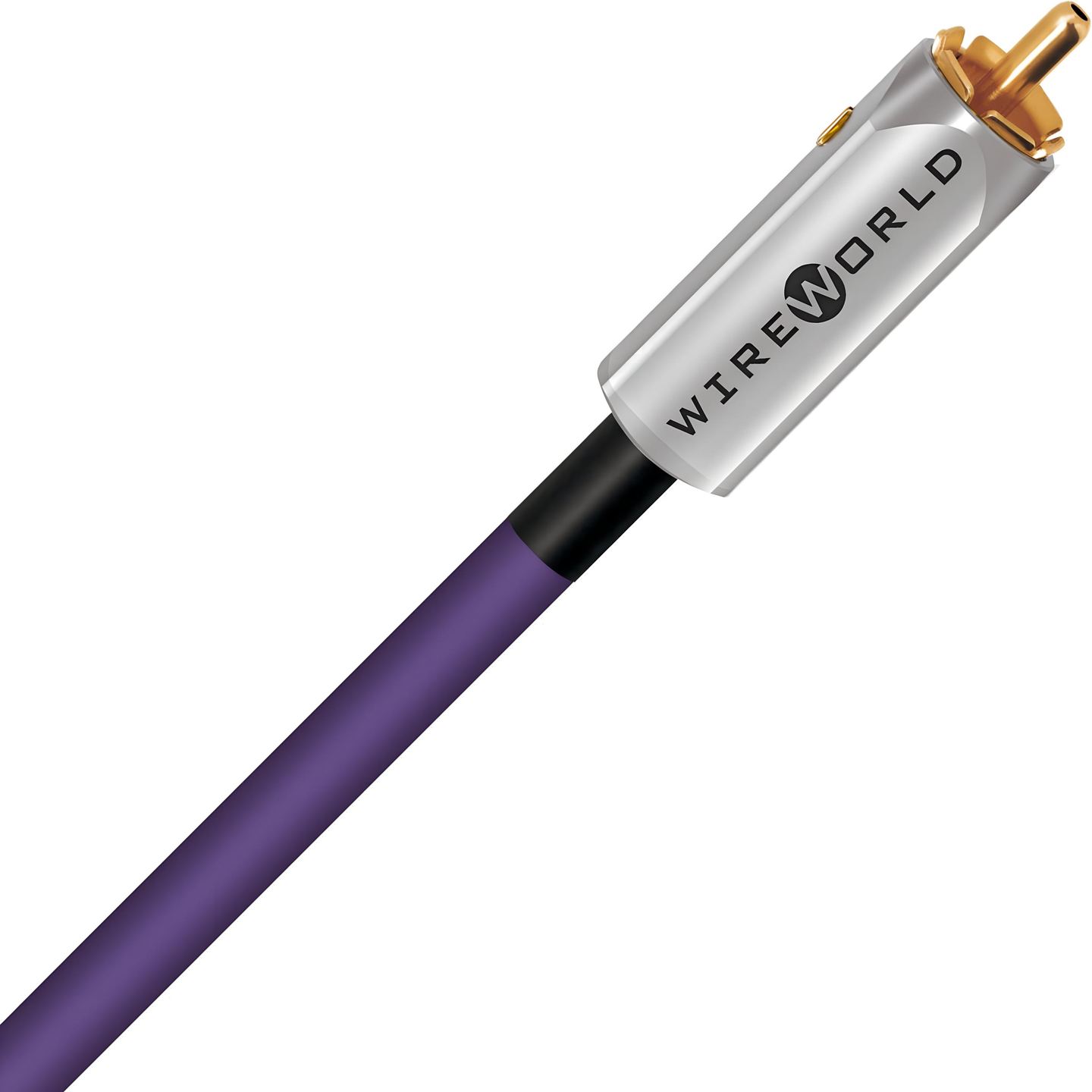


Wireworld Ultraviolet 10 (UVV) digital coaxial
Between a CD player, a streamer or a television and the converter that turns the digital stream into music, the coaxial connection remains one of the most widespread. It seems simple, yet this single cable carries both the audio data and the clock timing the converter needs to decode it. This Series 10 model from Wireworld therefore focuses on its internal geometry, conductors and insulation rather than its appearance.
An S/PDIF connection maintained at 75 ohms
The digital coaxial signal (S/PDIF) travels at frequencies of several megahertz, well beyond the audio band. At these frequencies, the cable behaves like a transmission line: its characteristic impedance must remain at 75 ohms from end to end, including the connectors. If it deviates, part of the signal is reflected at the ends, rounding off the pulse edges. The converter reconstructs its clock from these edges, and distorted edges make synchronization less consistent, a phenomenon known as jitter. An ordinary analog RCA cable often works as a digital connection, but offers no guarantee in this respect. The Ultraviolet 10 is a true 75-ohm cable, including all its terminations.
Parallel strands in a helix rather than a twisted core
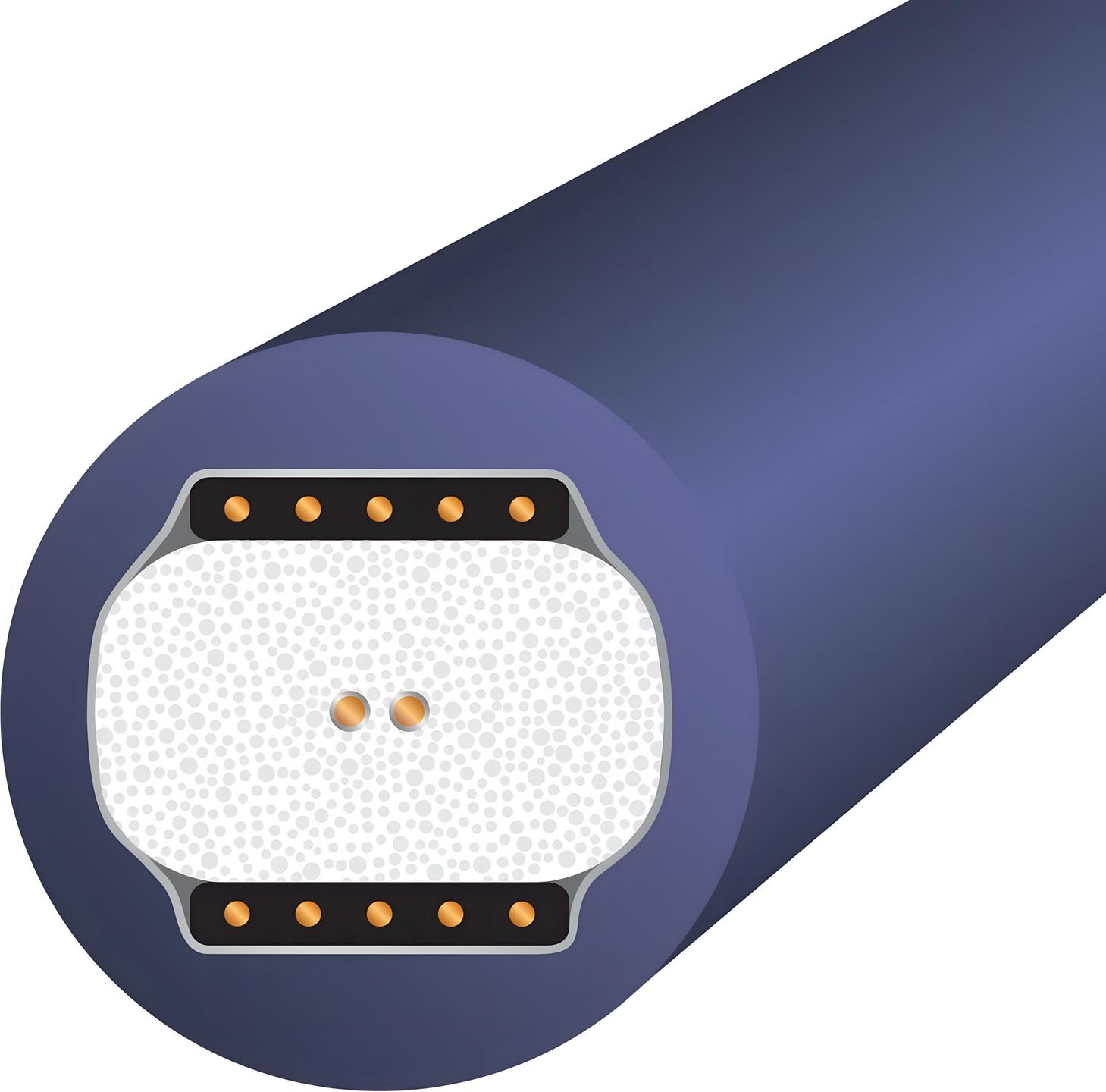
The DNA Helix design (short for Delineated Neutralizing Array), patented by Wireworld, replaces the bundle of twisted strands found in conventional cables with flat conductors arranged in layers, whose strands remain parallel to one another before being wound into a helix. In a conventional stranded conductor, the strands constantly cross one another, and each strand’s magnetic field induces small parasitic currents, known as eddy currents, in its neighbors, dissipating some of the signal’s energy. Keeping the strands parallel limits these losses. The “Tri” version used here brings together three conductors, comprising twelve individually insulated strands. The move to Series 10 added groups of strands compared with the previous generation, Series 8.
Silver-plated copper for high frequencies
The strands are made of oxygen-free copper (OFC), copper from which most of the oxygen has been removed to limit internal oxidation and impurities, coated with a thin layer of silver. This plating has a specific role in a digital connection: at high frequencies, current tends to flow near the surface of the conductor (the skin effect). In an analog cable, this phenomenon remains modest, whereas it directly affects an S/PDIF signal at several megahertz, which then travels largely through the silver layer. This is the fundamental difference from the Chroma 10, the entry-level model in Wireworld’s coaxial range, which uses the same Tri DNA Helix geometry with bare OFC copper. The Ultraviolet 10 thus occupies the second of the brand’s six coaxial tiers, below the Starlight 10 and the three precious-metal Starlight models (Silver, Gold and Platinum).
Composilex 5 insulation against friction noise
When a cable moves, vibrates or simply carries a signal, electrostatic charges arise at the points of contact between the conductor and its insulation. This triboelectric noise is low, but it is superimposed on the desired signal. Composilex 5, Wireworld’s proprietary composite material, produces less triboelectric noise than conventional low-loss insulation materials, including PTFE (Teflon). It succeeds the Composilex 3 used in Series 8 and is one of the major developments in Series 10. Its effect remains secondary to impedance or connector quality, but it contributes to a design that is coherent as a whole.
Gold-plated RCA connectors for everyday connections
Both ends feature RCA connectors with 24-karat gold-plated contacts. Gold does not conduct better than copper; it protects the contact from oxidation and maintains a stable connection through repeated plugging and unplugging. The cable connects any device with a digital coaxial output to an input of the same type: a CD player or transport to a converter, a streamer to an integrated amplifier with a built-in converter, a network player or console to a home theater receiver. On the device, the relevant socket is generally labeled “Coaxial” or “Digital”, sometimes with an orange ring, and should not be confused with the neighboring red and white analog outputs.
Technical specifications
Design and insulation
- Architecture: triple DNA helix (Tri DNA HELIX®)
- Insulation technology: COMPOSILEX® 5
Signal conductors
- Conductors
- Number: 3
- Number of insulated strands: 12
- Material: silver-plated oxygen-free copper
- Cross-section: 0.16 mm² (25 AWG)
Connectivity
- Available connectors: RCA, BNC 75 Ω
- Plug contacts: 24-karat gold-plated
- Configurations: RCA / RCA, RCA / BNC, BNC / BNC
Frequently asked questions
What's the difference between the Chroma 10 and the Starlight 10?
The Chroma 10 shares the Tri DNA Helix geometry, Composilex 5 insulation and gold-plated contacts, but its strands are bare OFC copper. The Ultraviolet 10 adds silver plating, which is useful at the high frequencies of the digital signal. The Starlight 10 and higher-end Starlight models use more sophisticated versions of DNA Helix and more noble metals.
Should you choose a coaxial or optical connection?
Both carry the same S/PDIF signal. Optical (Toslink) electrically isolates the devices, eliminating any risk of a ground loop. Coaxial generally supports higher sampling rates depending on the devices, handles bends and repeated connections better, and does not depend on the quality of a light emitter. When both are available, coaxial is often the simplest choice, unless there is ground-related hum.
Which audio formats can this cable transmit?
Coaxial S/PDIF carries stereo PCM, up to 24-bit and 192 kHz when supported by the source and converter, as well as compressed Dolby Digital and DTS 5.1. Lossless multichannel formats (Dolby TrueHD, DTS-HD Master Audio) and full-resolution Dolby Atmos require an HDMI connection, or eARC for a TV.
Can it be used for an analog connection or for a subwoofer?
Technically yes, since it is an RCA-to-RCA connection: it will carry an analog channel without difficulty, for example to a subwoofer’s LFE input. However, the 75-ohm impedance offers no benefit at audio frequencies, and a stereo connection requires two cables. Wireworld interconnect and subwoofer cables are better suited to these uses.
Is there a version with BNC connectors?
Yes, the Ultraviolet 10 is also available in BNC to BNC, RCA to BNC and BNC to RCA versions. The BNC connector, locked with a quarter-turn, more readily ensures 75-ohm impedance and is found on some high-end converters, transports and professional equipment.
What does Series 10 offer compared to Series 8?
Two main developments: additional groups of strands in the DNA Helix geometry to counter eddy current losses, and the switch from Composilex 3 insulation to Composilex 5, with lower triboelectric noise. They represent five additional years of development.
Can a digital cable really change the sound?
The data itself either arrives intact or does not arrive at all. With S/PDIF, however, the clock travels with the data, and the signal’s shape affects the consistency of timing at the converter’s input. Modern converters with reclocking or asynchronous resampling are much less sensitive to this than older models. The difference therefore depends primarily on the device receiving the signal.
- Eco-contribution included in the sale price.
- GTIN / EAN: 8100573597364