

Elac Debut Reference DFR52 black/walnut (pack of 2)
This product is no longer available for sale!
Other tower speakers
Overview
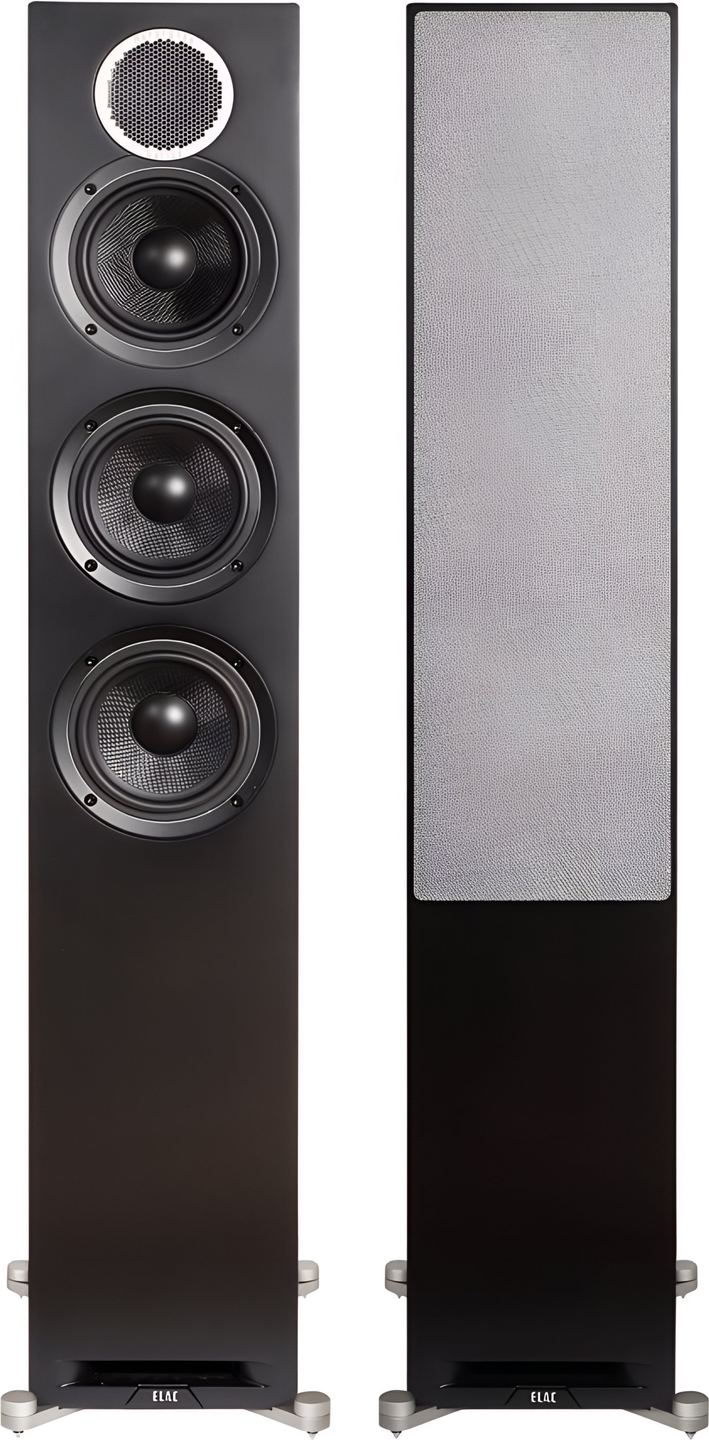
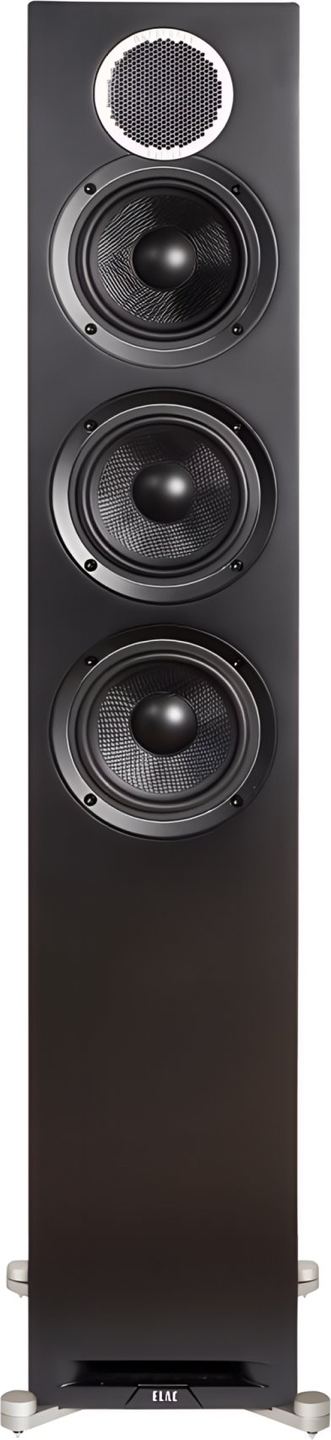
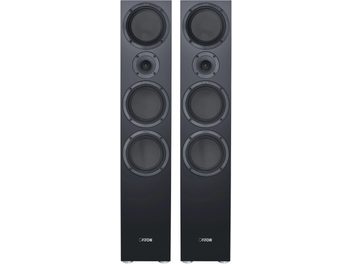
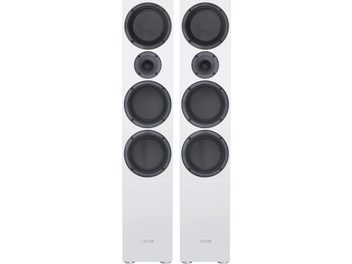
The Elac Debut Reference DFR52 is a three-way floorstanding speaker developed by Andrew Jones and the ELAC teams. It uses three aramid-fibre woofers, an optimized soft-dome tweeter, and a triple-port bass-reflex configuration. This speaker combines technical materials and meticulous construction to deliver performance appropriate to its price range.
Technical design in the service of musicality
The DFR52 immediately stands out for its robust construction in CARB2 MDF, a dense material specifically chosen for its acoustic properties. The cabinet benefits from a comprehensive perimeter bracing system, an innovation that connects the top, bottom, and side panels. This sophisticated internal structure significantly limits unwanted cabinet vibrations, thereby reducing sonic coloration that could compromise the purity of the audio signal.
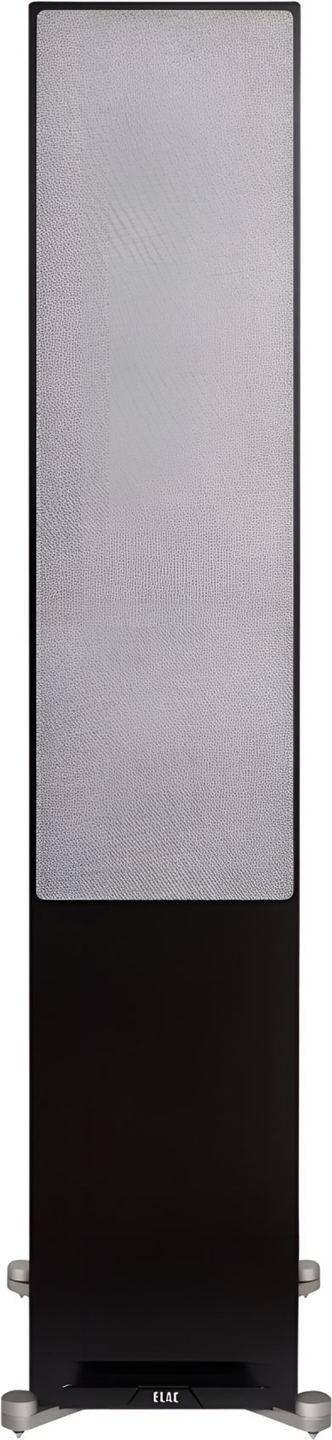
With dimensions of 1016 mm in height, 185 mm in width, and 242 mm in depth, the DFR52 has a slim silhouette that naturally fits into contemporary living spaces. Despite its compact size for a floorstander, the speaker weighs in at 16.7 kg, reflecting the density of the materials used and the solidity of its construction. The available finishes—black baffle with walnut cabinet or white baffle with oak cabinet—offer refined visual integration that transcends mere technical equipment to become a fully-fledged decorative element.
The bass-reflex system adopts a particularly elaborate configuration with three flared, slot-shaped ports. This multi-port design, rather than the traditional single port, allows for better distribution of airflow and minimizes acoustic turbulence, especially at higher volumes. The flared ports help deliver dynamic bass while maintaining quiet operation, preventing the chuffing noises that can occur with poorly designed ports.
Three-way configuration and specialized drivers
The DFR52’s three-way configuration is a deliberate technical choice that sets this speaker apart from the more common two-way designs in this price range. This architecture allows for optimal specialization of each driver: the tweeter focuses on the treble (above 2200 Hz), the midrange handles the crucial vocal band (90 Hz to 2200 Hz), while the two woofers reproduce the bass frequencies (down to 90 Hz).
The 25 mm soft-dome tweeter benefits from a newly developed waveguide, paired with a redesigned grille offering a more open structure. This combination significantly improves upper high-frequency response, allowing extension up to 35 kHz. The waveguide optimizes the tweeter’s directivity, ensuring controlled dispersion that widens the sweet spot while minimizing diffraction effects related to the baffle edges.
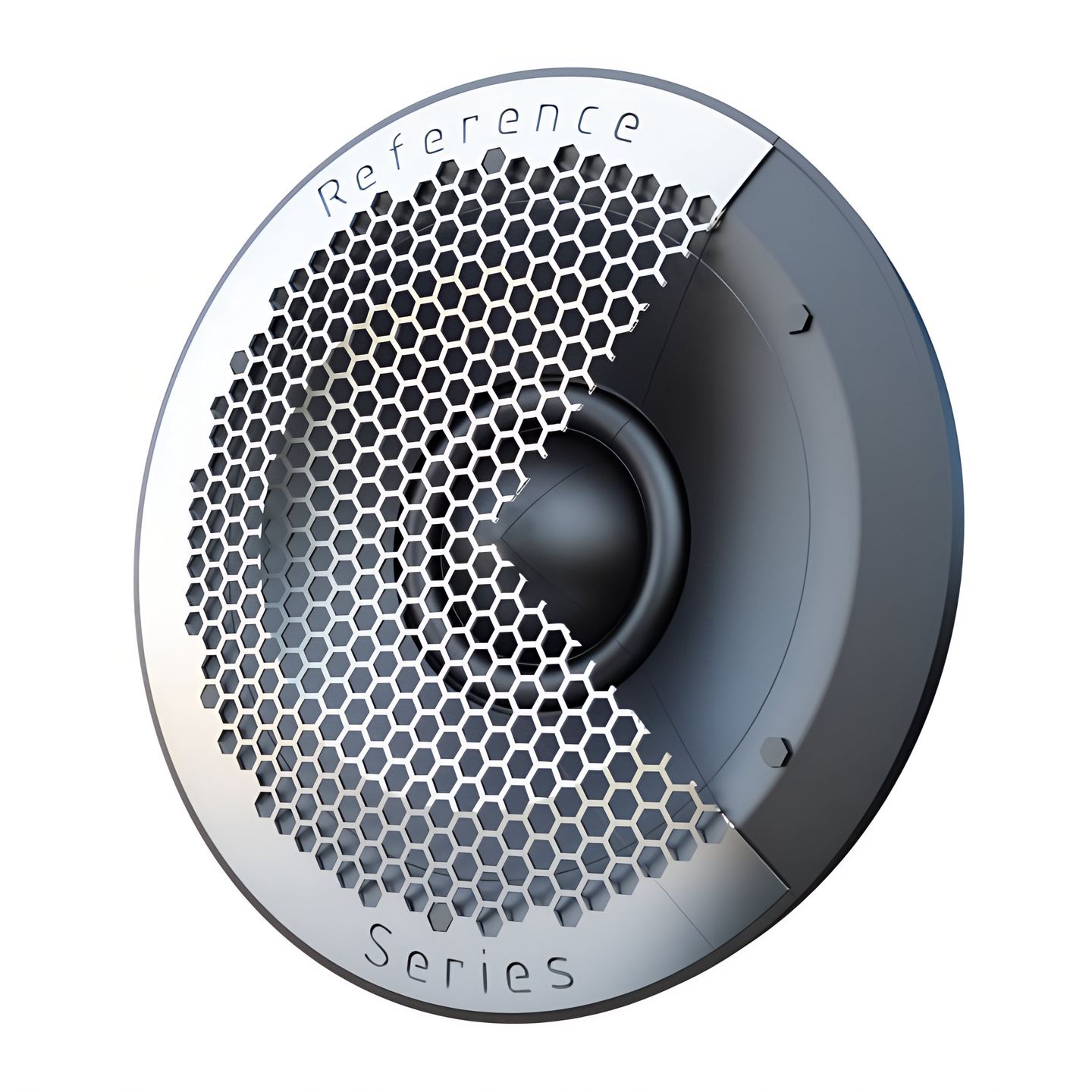
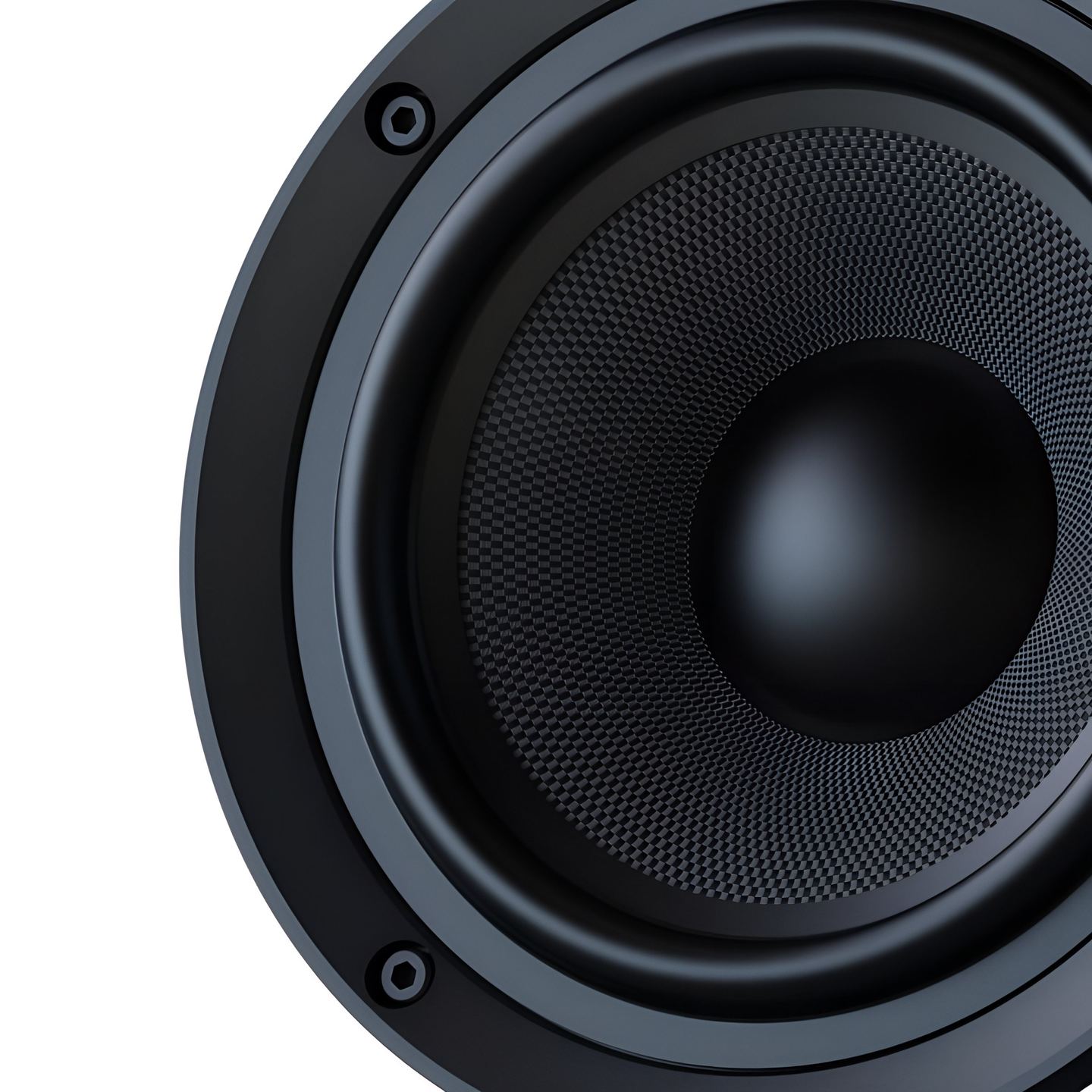
The three 13.3 cm aramid-fibre drivers form the technological heart of this speaker. One is dedicated to midrange reproduction, while the other two focus on low frequencies. Aramid fibre, a high-performance synthetic material also used in bulletproof vests and aerospace, offers an exceptional stiffness-to-weight ratio. This characteristic allows the cones to maintain their shape even during large excursions, thereby reducing distortion and improving sound reproduction accuracy.
The cast driver frames add extra rigidity that minimizes unwanted resonances. This robust construction ensures the energy from the magnetic motor is fully transmitted to the cone, without losses to undesirable frame vibrations. The specific profile of the aramid cones, combined with these optimized frames, provides damping characteristics markedly superior to polypropylene or paper traditionally used in this price range.
Acoustic performance and technical specifications
The DFR52 delivers a frequency response extending from 42 Hz to 35 kHz, a remarkably wide range for a speaker of this size and price positioning. The 42 Hz low-end ensures satisfyingly deep bass reproduction for most musical genres, although fans of electronic music or home cinema may consider adding a subwoofer to explore the lowest octaves.
Extension up to 35 kHz in the highs—well beyond conventional human hearing limits (around 20 kHz)—is not just a marketing point. This capability ensures a linear response across the entire audible band and contributes to faithful reproduction of upper harmonics, essential to the perception of timbre and soundstage. The crossover frequencies, set at 90 Hz and 2200 Hz, have been carefully chosen to optimize workload distribution among the drivers.
With a sensitivity of 87 dB for 2.83V at 1 metre, the DFR52 sits within the average of modern floorstanding speakers. This value indicates it will require a quality amplifier with sufficient power reserves to truly shine. The nominal 6-ohm impedance makes it compatible with the majority of amplifiers on the market, without presenting a particularly difficult load. The maximum power handling of 140 watts speaks to the robustness of the design and allows for high listening levels without risk of damage.
Connectivity and system integration
The 5-way metal binding post is a quality choice for connectivity. This configuration not only supports different terminal types (bare wire, banana plugs, spades), but also allows for bi-wiring. This option, generally reserved for more expensive speakers, lets demanding users optimize their system by using separate cables for the bass and mid/treble sections, or even experiment with bi-amping.
The metal connections ensure optimal electrical contact and long-term durability, avoiding the oxidation that can affect lower-grade plastic terminals. The layout of the terminals makes connections easy, even with thick-gauge cables—a practical detail appreciated during installation.
Market positioning and evolution from previous generations
The Debut Reference series represents a significant evolution from the preceding Debut 2.0 range. While the Debut 2.0 F5.2 already used aramid-fibre cones, the DFR52 benefits from redesigned cast frames offering increased rigidity. The cabinet’s perimeter bracing, absent on previous models, is a major structural improvement that results in a measurable reduction in coloration.
Switching from a multiple rear-port configuration to a system of three flared slots optimizes bass behaviour, particularly in placements close to walls. This evolution addresses real-world installation constraints, as users do not always have the ideal space to pull their speakers far from boundaries.
The improved tweeter waveguide and redesigned grille constitute subtle yet significant refinements. These changes, the fruit of Jones’s experience on the higher-end Uni-Fi and Adante series, demonstrate a top-down technology transfer within the range—an approach opposite to the traditional strategy of many manufacturers.
Technical specifications
Design and type
- Type: 3-way bass-reflex speaker
- Cabinet: CARB2 MDF with perimeter anti-vibration bracing
- Ports: 3 flared slots for powerful, low-noise bass
Drivers
- Tweeter: 25 mm soft dome with waveguide for precise highs
- Woofer: 3 × 133 mm aramid fiber, cast frame for rigidity and reduced resonances
Acoustic performance
- Frequency response: 42 Hz – 35 kHz
- Crossover frequencies: 90 Hz / 2,200 Hz
- Nominal impedance: 6 Ω
- Sensitivity: 87 dB @ 2.83 V / 1 m
- Maximum power: 140 W
Dimensions and weight
- Height × width × depth: 1,016 × 185 × 242 mm
- Weight: 16.7 kg
Connectivity
- Binding posts: 5-way metal, bi-wiring compatible
Key benefits
- Detailed highs: optimized waveguide and grille
- Stable structure: perimeter bracing reducing vibrations and coloration
- Rigid woofer: cast frame and aramid-fiber cones
- Dynamic bass: triple flared slot port
- Premium design: high-end, elegant finishes
Frequently Asked Questions
What amplifier power is recommended for the DFR52?
With a sensitivity of 87 dB and an impedance of 6 ohms, the DFR52s require an amplifier ideally delivering between 40 and 100 watts per channel. A quality amplifier within this power range will fully exploit the speakers’ dynamic potential while preserving headroom for demanding musical passages. Amplifier quality matters more than sheer power: a well-designed 50-watt amplifier will outperform a mediocre 150-watt model.
Can the DFR52s be used without a subwoofer?
Absolutely. With response down to 42 Hz, the DFR52s offer sufficiently deep bass for most musical genres. Jazz, classical, rock, and pop will be reproduced with convincing low-end foundation. However, for home cinema or electronic music rich in infrabass, adding a quality subwoofer (such as the Elac SUB3010 or SUB3012) will significantly enhance the experience, particularly below 40 Hz.
How should the DFR52s be positioned in a room?
The DFR52s offer some placement flexibility thanks to their front ports. Ideally, place them 30–60 cm from the rear wall and form an equilateral triangle with your listening position. A slight toe-in of 5 to 15 degrees will optimize stereo imaging. The supplied adjustable feet allow you to compensate for uneven floors and ensure perfect stability. Avoid placing them too close to corners, which can generate excessive low-frequency resonances.
What is the difference between the DFR52 and Elac’s Uni-Fi models?
The Uni-Fi series uses coaxial drivers where the tweeter is placed at the centre of the midrange, creating a point source ideal for imaging. This sophisticated technology, however, presents a more challenging load for the amplifier (4 ohms). The DFR52s, with their traditional three-way design, offer an easier load (6 ohms) and better compatibility with a wide range of amplifiers, while maintaining excellent sonic performance thanks to the meticulous optimization of each component.
Does bi-wiring provide an audible improvement?
Bi-wiring can bring subtle improvements, notably better separation between frequency ranges and a slight increase in transparency. The effect will be more noticeable with quality cables and on systems that are already well optimized. For most users, single wiring with good-quality cables will yield excellent results. Bi-wiring remains an optimization option for audiophiles looking to extract the last few percentage points of performance.
How do the DFR52s perform in a home cinema setup?
The DFR52s excel as main front speakers in a home cinema system. Their extended response, dynamic capability, and controlled dispersion create a wide and precise soundstage, ideal for surround effects. Paired with the matching DCR52 centre channel, they ensure perfect tonal consistency. Their moderate sensitivity makes them compatible with most AV receivers on the market, although a mid-/high-end model is recommended to unlock their full potential.
- Eco-contribution of €1.20 included in the sale price.
- Manufacturer reference: EL-DEBUT-REF-52-BK
- GTIN / EAN: 4011822324041