iFi Audio iEmatch 4.4
Complementary product
Overview
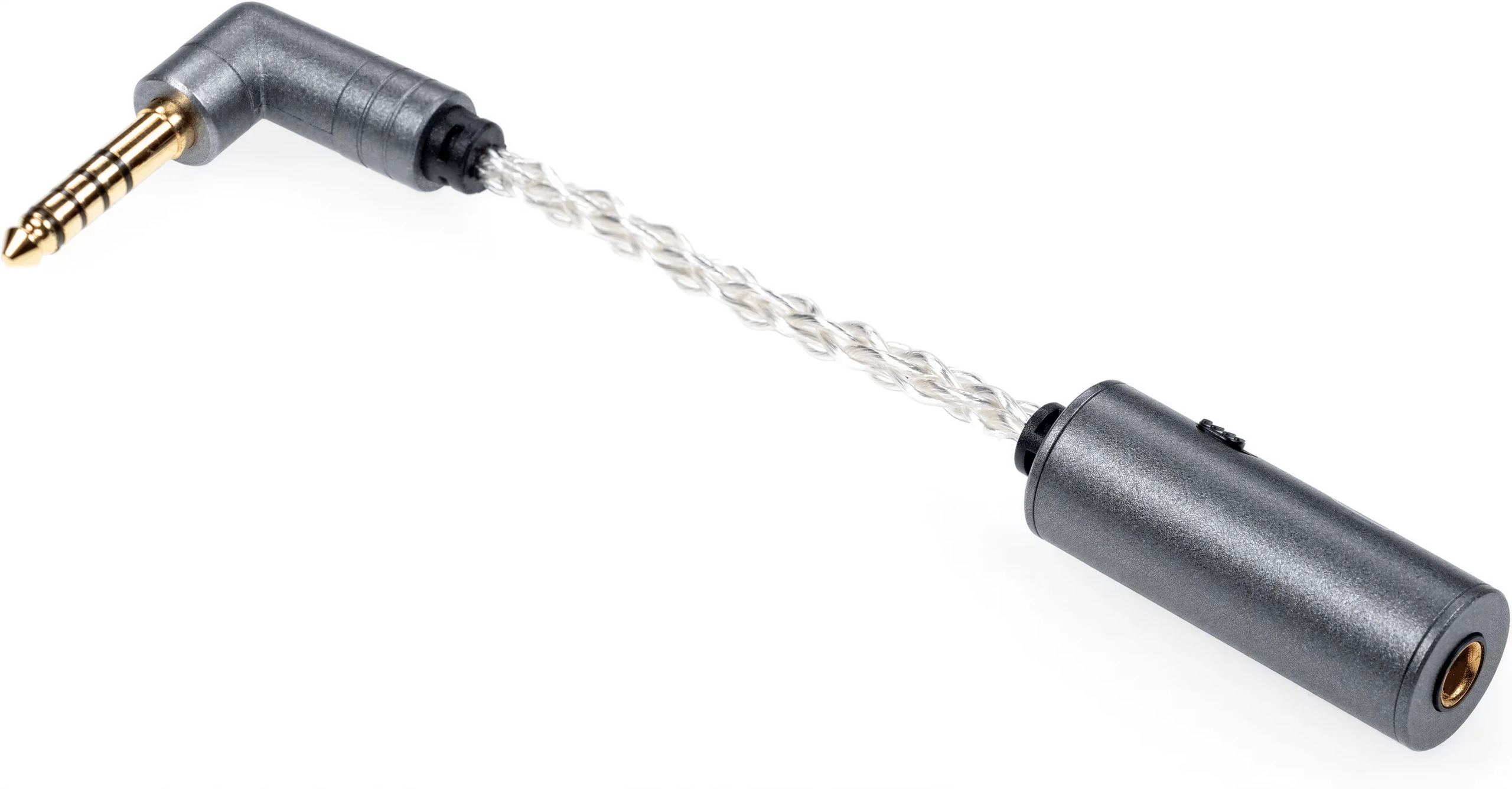
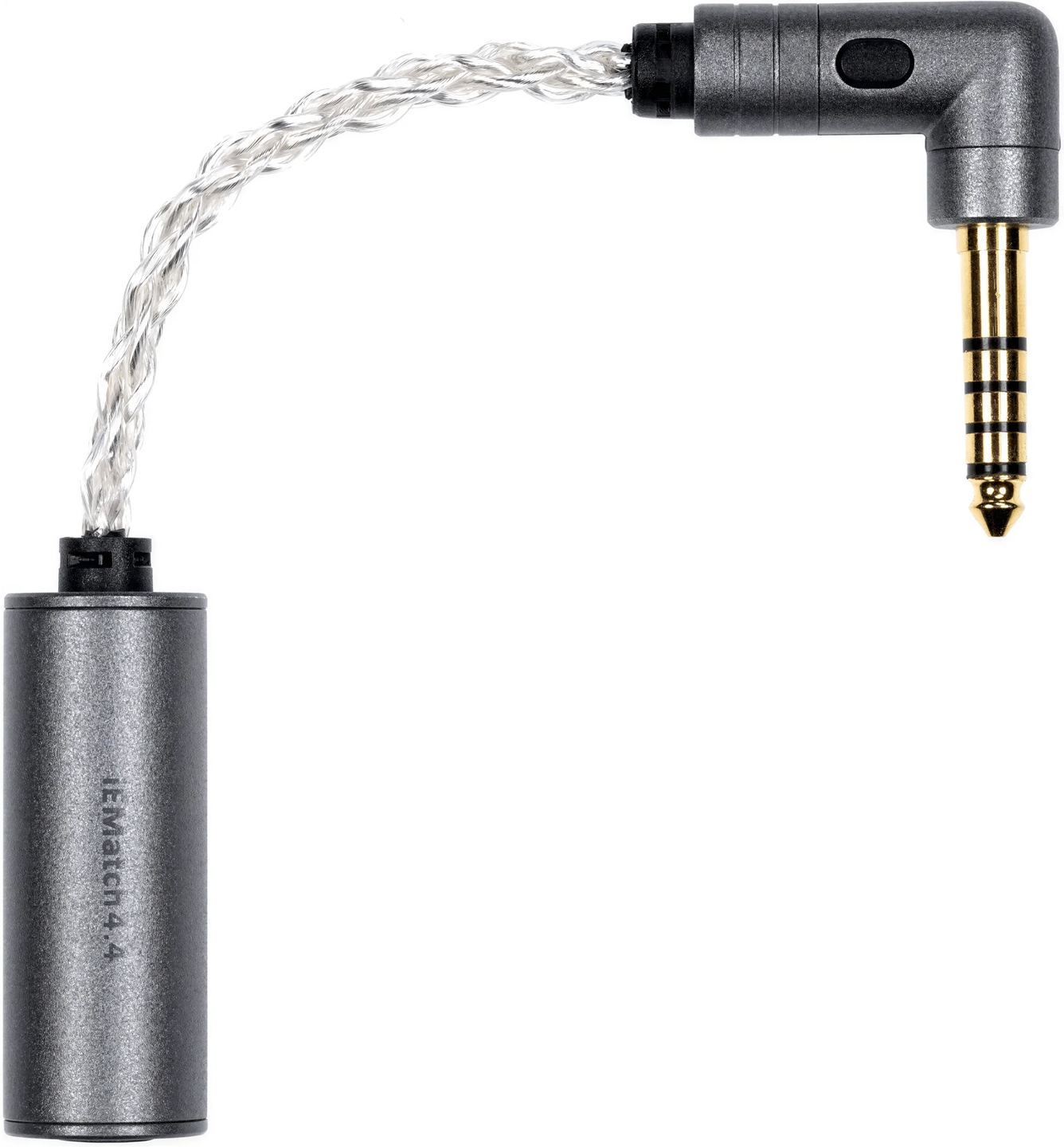
The iEMatch 4.4 from iFi Audio is an adapter for balanced connections designed for sensitive headphones and in-ear monitors. It uses 4.4 mm Pentaconn connectors and offers two attenuation levels to reduce hiss, adjust the volume range, and preserve low-level audio resolution. It sits between the balanced source and the earphones.
Premium build and minZ technology
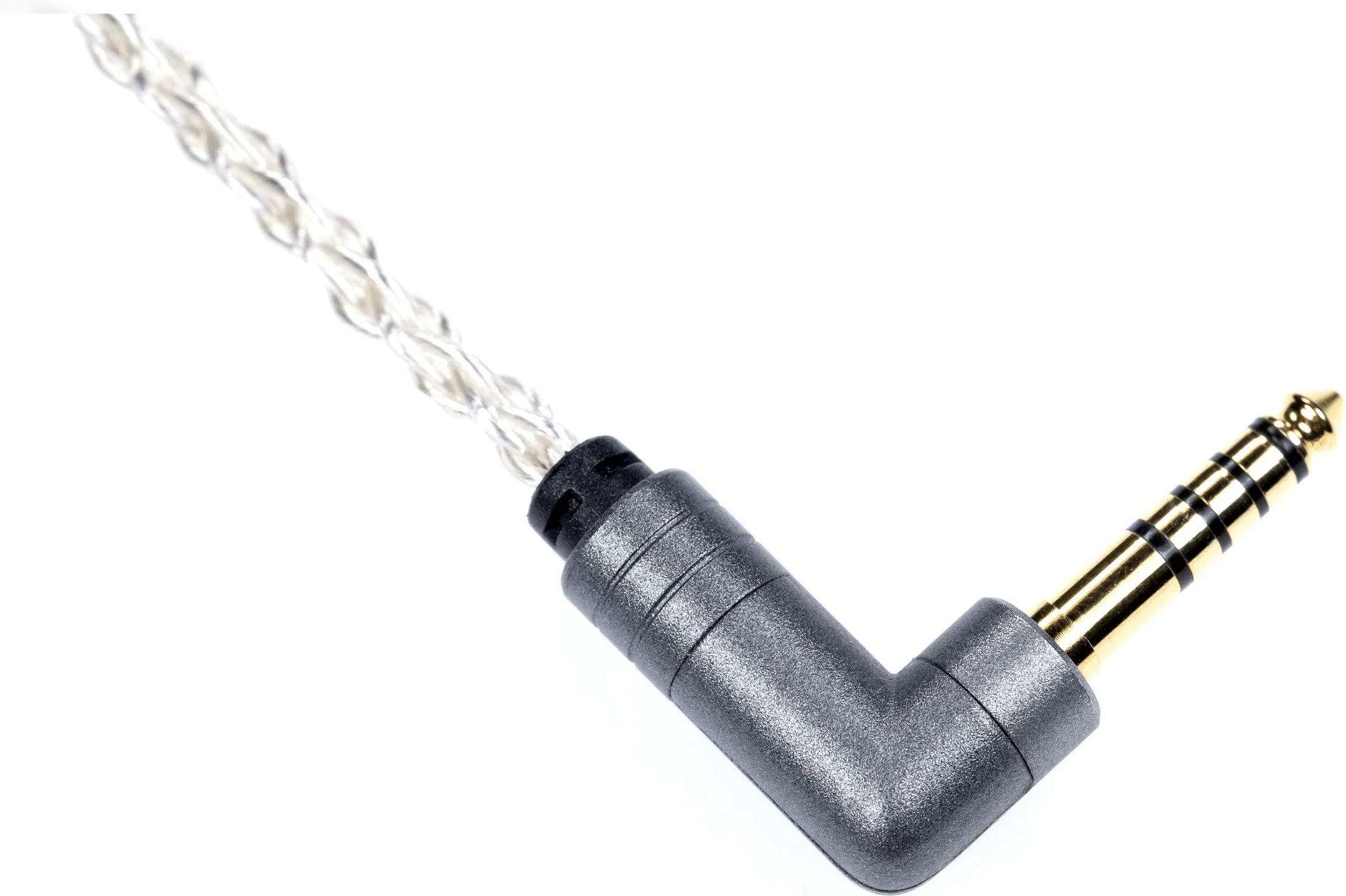
The iEmatch 4.4’s housing is machined from an aerospace-grade aluminum-magnesium alloy (FINAL6063-T5), ensuring robustness and light weight at just 17.5 grams. This metal construction provides a remarkable tactile finish while effectively protecting the onboard electronics. The 4.4 mm male and female connectors are gold-plated to ensure optimal signal transmission and increased durability under repeated handling.
The gold-plated PCB integrates hand-picked audiophile-grade components, notably MELF (Metal Electrode Leadless Face) resistors. These cylindrical components, more costly than standard SMD resistors, offer superior characteristics in terms of thermal stability, low noise, and tight tolerance. Internal wiring uses a 6N silver/copper matrix, ensuring 99.9999% purity to minimize signal loss.
The major innovation lies in the cable’s minZ Helix construction. This custom helical geometry simultaneously minimizes cable capacitance and inductance—two critical electrical parameters for preserving audio signal integrity. The helical structure also provides intrinsic shielding against radio-frequency (RFI) and electromagnetic (EMI) interference, without requiring an additional shielding layer that could negatively affect electrical characteristics.
Two sensitivity modes to fit any earphones
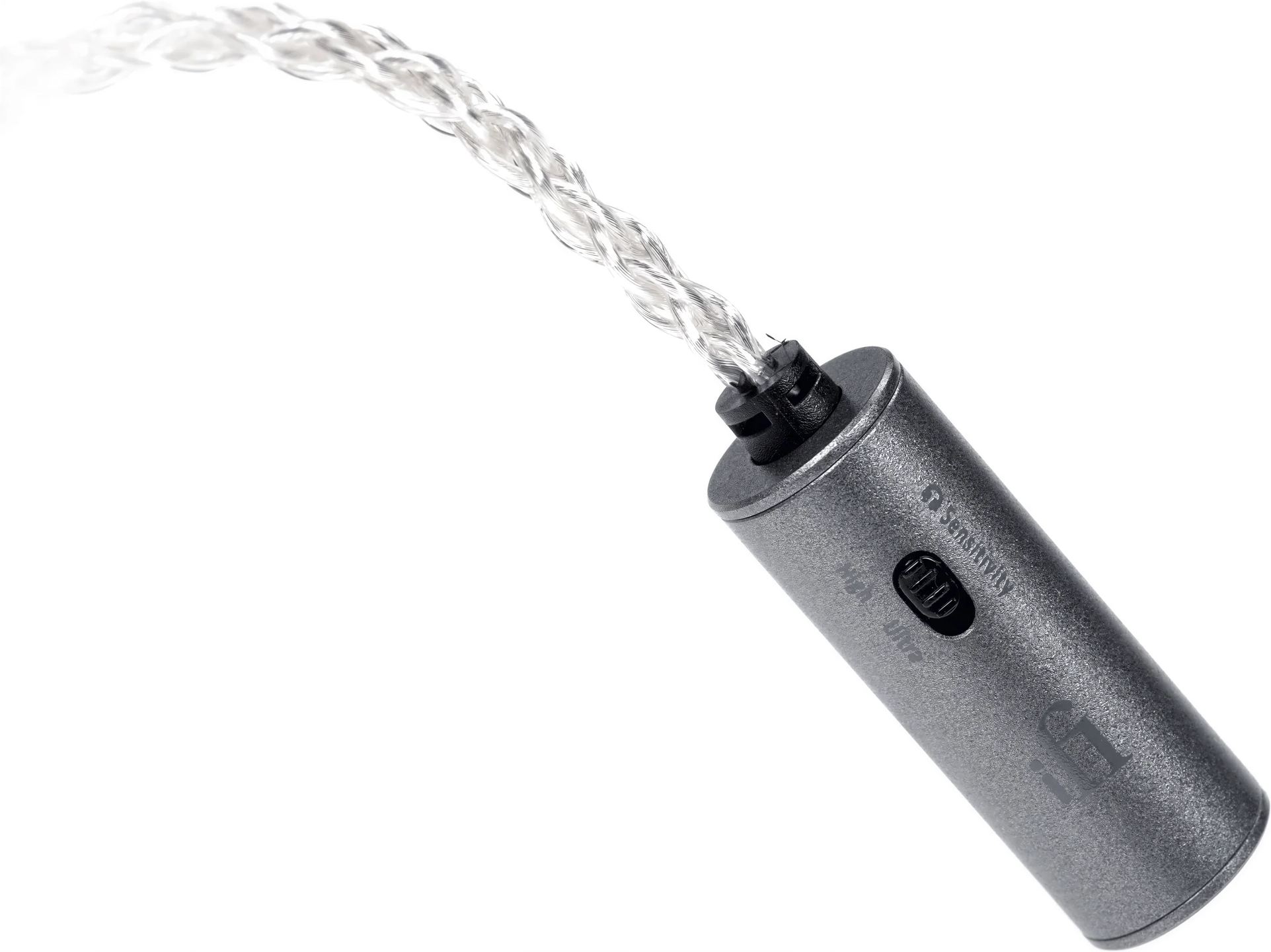
The iEmatch 4.4 offers two selectable sensitivity settings via a switch:
High Mode (-12 dB): Designed for high-sensitivity earphones, this mode reduces gain by 12 decibels. Input impedance remains below 40 ohms while output impedance is under 8.4 ohms. This setting suits moderately sensitive earphones that exhibit slight hiss or need a wider volume range.
Ultra Mode (-24 dB): Intended for ultra-sensitive earphones, this mode applies 24 dB of attenuation. Input impedance rises to below 50 ohms and output impedance drops to below 3.6 ohms. This configuration targets highly sensitive multi-driver balanced armature IEMs, such as models from Campfire Audio, Vision Ears, or 64 Audio.
These output impedance values, notably higher than those of the 3.5 mm and 2.5 mm iEmatch versions (under 1 ohm), are explained by the typical use of 4.4 mm connections with more powerful sources. Desktop amps and high-end DAPs equipped with 4.4 mm outputs generally deliver higher power, requiring a different approach.
Recovering lost digital resolution
A lesser-known aspect of low-volume listening is the loss of digital resolution. When you reduce your source’s digital volume to reach a comfortable listening level with sensitive earphones, you lose about 2 bits of resolution for every 12 dB reduction. On a source offering 114 dB of dynamic range, a 30 dB volume cut brings the dynamic range down to just 84 dB—less than CD quality.
The iEmatch 4.4 circumvents this limitation by attenuating the signal in the analog domain. You can keep your source’s digital volume at an optimal level (typically 80–100%) while achieving a comfortable listening level. This approach preserves the 24-bit or 16-bit resolution of your audio files, maintaining dynamic range and micro-details that disappear with digital attenuation.
Eliminating hiss and improving dynamics
The audible hiss with sensitive earphones mainly comes from the inherent noise floor of amplification circuits. High-sensitivity earphones amplify not only the music signal but also this residual noise, making it noticeable even during quiet passages. The iEmatch 4.4 reduces this noise by 12 or 24 dB depending on the selected mode, pushing hiss well below the threshold of audibility.
This noise reduction comes with a noticeable improvement in dynamics. The softest passages emerge from a deeper silence, increasing the contrast between pianissimos and fortissimos. Vocals gain clarity and presence, standing out better from the instrumental backing. The soundstage opens up, with each instrument finding its place in a more precisely defined space.
Compatibility and use cases
The iEmatch 4.4 primarily targets users of high-sensitivity multi-driver in-ear monitors connected to powerful balanced sources. Portable amplifiers like the iFi Diablo, audiophile DAPs from FiiO, iBasso, or Astell&Kern with 4.4 mm outputs, and desktop amplifiers are ideal partners.
Certain iconic earphones particularly benefit from the iEmatch 4.4. The Campfire Audio Andromeda, known for extreme sensitivity and susceptibility to hiss, regains its potential on virtually any source. Models from Vision Ears, Flipears, ThieAudio, and other high-end IEMs see their compatibility extended to the most powerful amplifiers.
The accessory is also useful with sensitive over-ear headphones used on tube amplifiers or systems designed for higher loads. The Sony MDR-MV1, for example, can be used comfortably on amplifiers originally intended for 300-ohm headphones.
Comparison with previous versions
The iEmatch 4.4 stands out from the 3.5 mm and 2.5 mm versions thanks to electrical characteristics tailored to more powerful balanced sources. The higher output impedance (3.6 to 8.4 ohms versus under 1 ohm for previous versions) reflects this focus on desktop amplifiers and high-end DAPs.
This technical difference divides users. Some prefer the ultra-low impedance of earlier versions to perfectly preserve the sound signature of IEMs with variable impedance. Others appreciate the effect of this slightly higher impedance, which can smooth certain sharpness in the upper spectrum.
Physical dimensions remain identical at 116 mm in length, making integration easy in any setup. The slightly higher weight (17.5 g versus 12.2 g) is explained by the bulkier 4.4 mm connectors and reinforced housing.
Technical Specifications
Sensitivity Levels
- High Sensitivity (-12 dB): for high-sensitivity earphones
- Ultra Sensitivity (-24 dB): for ultra-sensitive earphones
- Input Impedance: < 40 Ω (high sensitivity), < 50 Ω (ultra sensitivity)
- Output Impedance: < 8.4 Ω (high sensitivity), < 3.6 Ω (ultra sensitivity)
Cable Technology
- minZ Helix: helical design reducing capacitance and inductance
- Integrated shielding: protects against RFI/EMI for optimal signal
- Background noise reduction up to 24 dB
Construction and Materials
- 6N silver/copper conductors for audiophile-grade signal
- FINAL6063-T5 aluminum-magnesium alloy housing
- Printed circuit board with audiophile components
- MELF resistors
- 4.4 mm gold-plated connectors for a reliable connection
Physical Specifications
- Length: 116 mm
- Weight: 17.5 g
- Warranty: 12 months
Benefits
- Enhancement: richer sound, increased dynamics, reduced hiss, and clearer vocals
- Improved sound quality and 24 / 16-bit audio resolution
- Full frequency transfer without loss
- Easy volume adjustment for safe and comfortable listening
General Information
- Compatibility: smartphones, digital audio players, and other sources with 4.4 mm balanced output
- On-the-go volume adjustment for safe and comfortable listening
Frequently Asked Questions
Does the iEmatch 4.4 alter my earphones’ sound signature?
The impact on sound signature depends on your earphones’ impedance curve. Models with a flat impedance, such as those from 64 Audio or Custom Art, will not undergo any change. IEMs with variable impedance may experience slight variations—typically a softening of the treble that can be beneficial on some bright models.
Can I use the iEmatch 4.4 with high-impedance earphones?
Technically possible, but it brings no benefit. The iEmatch is designed for earphones of roughly 16 to 100 ohms. Beyond that, the added attenuation could require excessive source amplification, negating the noise benefits.
How do I choose between High and Ultra mode?
Start with High (-12 dB). If hiss remains audible or the volume range is still too narrow, switch to Ultra. Some users prefer Ultra even without a technical need to benefit from the widest possible volume range.
Does the iEmatch 4.4 work with unbalanced 4.4 mm connections?
4.4 mm connections are by definition balanced (symmetrical). If your headphones use a 4.4 mm cable, they are necessarily wired in balanced mode and compatible with the iEmatch 4.4.
What’s the difference compared to a simple impedance adapter?
Basic impedance adapters add a fixed resistor that degrades resolution and significantly alters frequency response. The iEmatch uses a complex network of audiophile components to maintain sonic transparency while providing the required attenuation.
Is the accessory compatible with inline microphones on cables?
Balanced 4.4 mm connections generally do not include a microphone. This feature remains the domain of unbalanced 3.5 mm TRRS connections, for which iFi offers the iEmatch+ compatible model.
- Eco-contribution included in the sale price.
- Manufacturer reference: IFI0039
- GTIN / EAN: 5060738785223