

Fyne Audio Classic XII walnut (pack of 2)


Overview
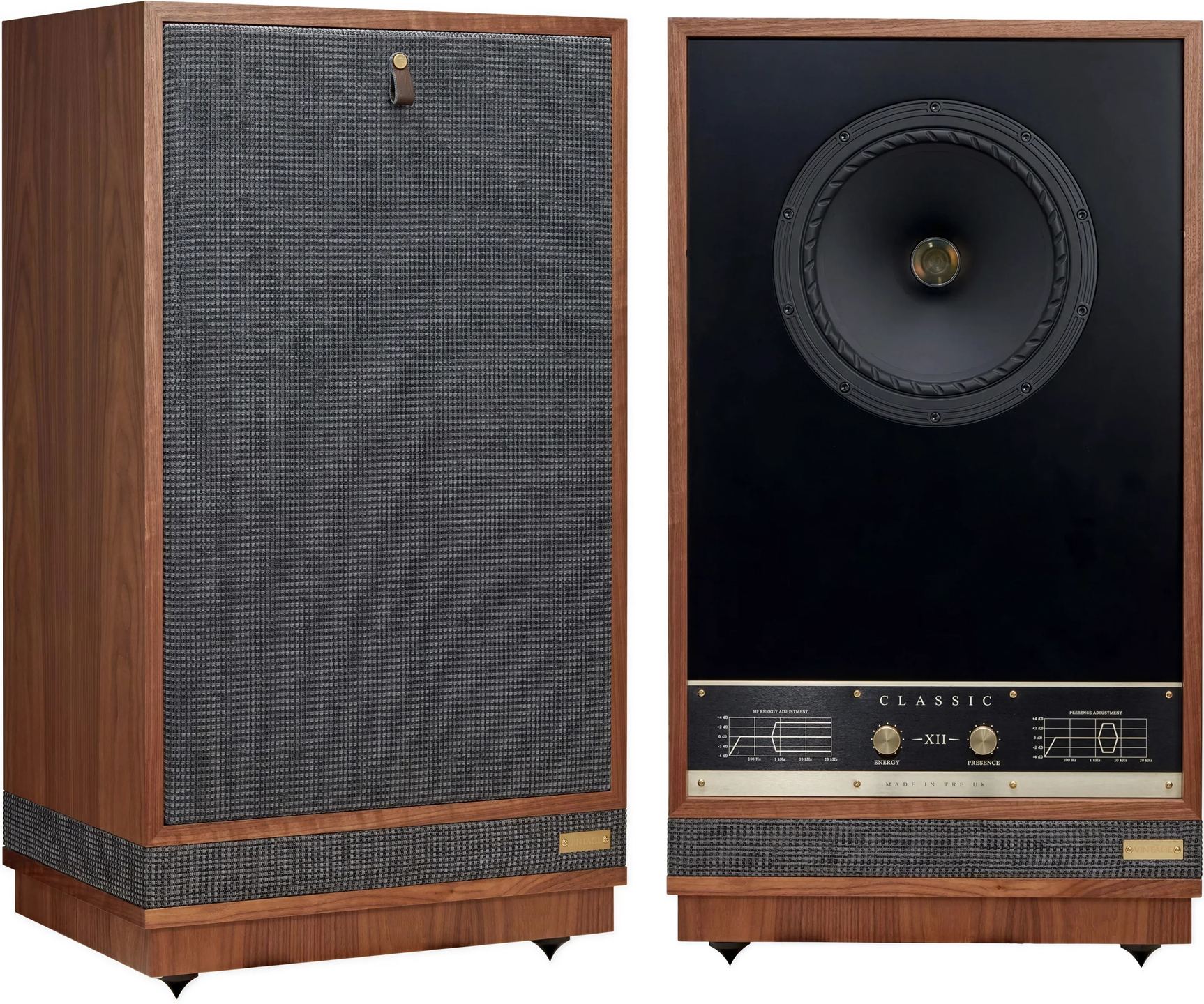
The Classic XII floorstanding speakers in walnut finish embody the distinctive vision of Fyne Audio, a Scottish brand founded in 2017 by former Tannoy senior executives. This imposing, nearly one-meter-tall tower skillfully blends 1970s aesthetics with state-of-the-art acoustic technologies, offering a modern interpretation of the domestic monitor concept without ever lapsing into easy nostalgia.

An IsoFlare driver at the heart of the design
At the heart of the Classic XII is a 300 mm IsoFlare driver, a coaxial design that positions a 75 mm titanium-dome compression tweeter at the exact center of the mid/bass driver. This point-source configuration, developed by Dr. Paul Mills, who brings over three decades of expertise in the field, represents far more than a mere technical choice.
The IsoFlare system allows the mid/bass driver to share a common center with the high-frequency unit, producing exceptional stereo imaging even off-axis, with energy radiated isotropically at constant directivity. This approach differs radically from conventional speakers, where separate drivers create interference and time shifts depending on listening position.
By placing the tweeter at the center of the woofer, point-source speakers ensure that the sound waves emitted by both drivers are time-aligned and reach the listener’s ears simultaneously and from the same direction. The result is a significantly expanded listening sweet spot and remarkable sonic coherence, particularly appreciable when moving around the listening room.
FyneFlute technology: taming unwanted resonances
The driver’s surround incorporates FyneFlute technology, which uses computer-designed variable geometry in the flutes to eliminate termination issues and reduce coloration. The visible transverse ribs around the cone are not merely decorative: they efficiently dissipate energy that, in a conventional surround, could be reflected back into the cone and cause undesirable coloration at certain frequencies.
The flutes make the distance from the voice coil to the termination discontinuous, dispersing reflections across a wide frequency range to levels so low they never become problematic. This innovation delivers improved musical accuracy and faster transient response, particularly audible on note attacks and complex dynamic passages.
The BassTrax system: redefining low-frequency dispersion
One of the Classic XII’s most remarkable innovations lies in its bass-reflex loading system with BassTrax Tractrix diffuser. Beneath the port located at the base of the speaker, the BassTrax Tractrix-profile diffuser converts planar wave energy into an expanding 360-degree spherical wavefront, integrating the energy uniformly into the room.
This profile maintains a 90-degree angle at each intersection of the expanding wavefront, thus avoiding reflections. This ingenious arrangement also makes the speaker less critical about its placement in the room. The system uses a dual-cavity load that acts as an acoustic filter, extending the usable bandwidth while reducing cone excursion at the lowest frequencies.
The tractrix cone diffuser is geometrically comparable to the shape of a Hershey Kiss. This particular geometry was historically applied to horns in the 1920s by Voigt, but its application to a diffuser of this type is an innovative approach patented by Fyne Audio.
Mechanical design and construction: Scottish excellence
The Classic XII are manufactured at Fyne Audio’s Glasgow facility, where every production stage reflects artisanal craftsmanship. The cabinet, built from high-density MDF with multiple internal braces, adopts generous dimensions that deliberately recall British domestic monitors from the 1970s. The real walnut veneer envelops panels whose thickness and structure have been optimized to minimize unwanted resonances.
Crossover design has received particular attention from Fyne Audio, with an unusually low 750 Hz crossover point, meaning the critical upper midrange (where most speakers must hand over) remains free of filter-induced distortion. The bi-wireable second-order passive network uses components selected by ear and hand-assembled on an anti-vibration substrate.
Cryogenic treatment: pushing the limits of transparency
The deep cryogenic treatment process involves cooling to -170 degrees very slowly and then gradually reheating, relieving stress within the crystalline structure of metals, cables, or solder joints by effectively aligning the molecules. Fyne Audio treats the speaker’s entire electrical network, known as the crossover, which is responsible for ensuring each driver receives the correct frequency band.
Dr. Paul Mills explains that this treatment effectively realigns the crystalline boundaries inside cables and solder joints, with particularly notable effects on solder joints where the crystalline structure can be especially poor. This meticulous attention to detail translates into greater transparency and improved definition of micro-detail.
Performance and placement: the art of implementation
With a sensitivity of 96 dB for 2.83 V at 1 meter and a nominal impedance of 8 ohms, the Classic XII are undemanding in terms of amplification. This high efficiency allows their dynamic potential to be fully exploited with modest-power amplifiers, while also accommodating more ambitious amplification up to 350 watts RMS.
Reviewers note that the Classic XII reward careful room placement and precise toe-in, capable of delivering a strikingly tactile, wonderfully rich presentation that projects well beyond the cabinets, with bass performance remarkable for its ability to sound fully formed in space.
The S-Trax and SuperTrax settings, at 130 mm and 106 mm respectively from the front edge of the speaker, allow optimization of the system’s time alignment according to listening conditions. Frequency response extends from 25 Hz to 26 kHz (-6 dB typical in-room), offering full spectral coverage without the need for an additional subwoofer.
Technical Specifications
System and Design
- System type: 2-way, downward-firing port, BassTrax Tractrix diffuser
Electrical Characteristics
- Recommended power (RMS): 20 – 350 W
- Maximum power: 700 W
- Continuous power (RMS): 175 W
- Sensitivity (2.83 V @ 1 m): 96 dB
- Nominal impedance: 8 Ω
Acoustic Response
- Frequency response (typical in-room, -6 dB): 25 Hz – 26 kHz
Transducer Equipment
- Bass / midrange: 300 mm IsoFlare point-source, multi-fiber cone
- Tweeter: 75 mm titanium alloy dome, ferrite magnet system, Cryo-Lite treatment
Crossover
- Crossover frequency: 750 Hz
- Crossover type: low-loss passive bi-wiring, 2nd-order low-pass and 2nd-order high-pass
Available Adjustments
- High-frequency energy (750 Hz – 26 kHz): ± 3 dB
- Presence (2.5 – 5 kHz): ± 3 dB
Adjustment Positions
- S-Trax: 130 mm from the front edge of the cabinet
- SuperTrax: 106 mm from the front edge of the cabinet
Dimensions and Construction
- Dimensions: 948 × 550 × 421 mm (H × W × D)
- Net weight: 54.5 kg
- Finish: walnut
- Cabinet construction: high-density MDF with extensive internal bracing
Frequently asked questions
What is the difference between the Energy and Presence controls on the front panel?
The Energy control affects the tweeter’s entire response from 750 Hz upward, altering the speaker’s overall tonal balance. The Presence control specifically targets the 2.5–5 kHz region, influencing vocal clarity and instrumental presence. Together, these controls allow fine-tuning to your room and preferences without resorting to external EQ.
Do the Classic XII require a powerful amplifier?
With their high 96 dB sensitivity, the Classic XII perform remarkably well with modest-power amplifiers from 20 watts. This efficiency makes them compatible with low-power tube amplification as well as with more muscular solid-state amplifiers up to 350 watts RMS, offering great flexibility in system matching.
How does the BassTrax system improve speaker placement?
The BassTrax diffuser converts port energy into a 360-degree spherical wave, greatly reducing interaction with walls and the floor. This omnidirectional dispersion of low frequencies makes the speaker less sensitive to room modes and allows more flexible placement without compromising bass quality.
What is the difference between a conventional coaxial driver and IsoFlare?
IsoFlare places the tweeter at the woofer’s exact acoustic center, not merely on the same axis. This precision ensures perfect phase coherence across the entire bandwidth, including in the critical crossover region. The result is stable, precise stereo imaging, even off the optimal listening axis.
Is cryogenic treatment really audible?
The Cryo-Lite treatment applied to the internal wiring restructures the material at the molecular level, reducing micro-stress in conductors and solder joints. While subtle, this effect contributes to greater transparency and lower noise floor, particularly noticeable on complex recordings and low-level passages.
- Eco-contribution included in the sale price.


