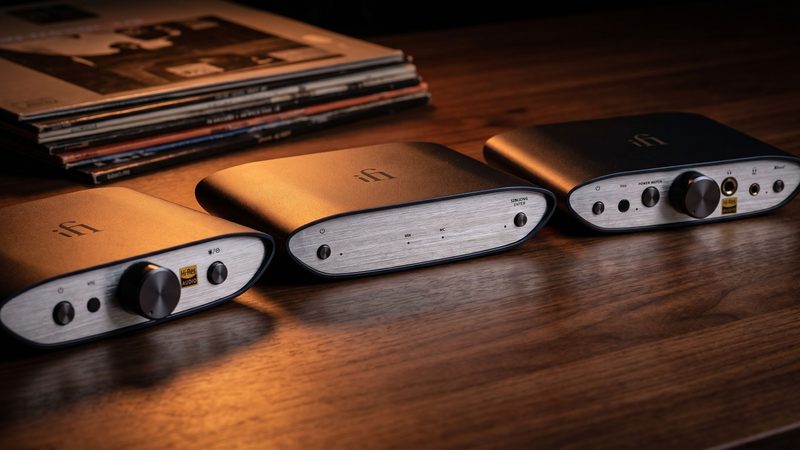
iFi Audio Zen Air Phono 2


Overview
Succeeding the ZEN Air Phono, this entry-level phono preamp from iFi Audio uses the proven formula (MM and MC support, proprietary Subsonic filter) while refining its measured performance. The ZEN Air Phono 2 sits between the turntable and the amplifier, with a simple goal: to extract from every groove a cleaner, more faithful signal than the phono stage built into most amplifiers or turntables.
An external phono stage: why?
The signal produced by a turntable cartridge is measured in millivolts. Before reaching the amplifier, it must be amplified and corrected according to the RIAA equalization curve, a standard in force since 1954. Most amplifiers include a phono stage, but it is often treated as a secondary addition: budget components, high noise floor, approximate RIAA accuracy. A dedicated phono preamp like the ZEN Air Phono 2 handles this job with a circuit optimized for this task alone.
The RIAA curve of the ZEN Air Phono 2 is calibrated to ± 0.15 dB across the entire 20 Hz – 20 kHz band. In practice, this means playback remains very faithful to the tonal balance intended by the sound engineer when the record was cut. A larger deviation (common on built-in phono stages) tends to color the sound, with highs that are too bright or a diminished low end.
MM and MC cartridges: two modes, one device
Moving magnet (MM) and moving coil (MC) cartridges do not produce the same signal level. An MM cartridge generally delivers 2 mV or more, whereas an MC can drop well below that. The ZEN Air Phono 2 handles both cases with a gain selector located on the rear: 40 dB for MM cartridges (47 kΩ input impedance) and 64 dB for MC cartridges (1 kΩ input impedance).
This dual compatibility is far from standard at this price point, where most phono preamps are limited to MM. It also means you can keep the device if you switch from an MM cartridge to an MC, which often happens when upgrading your turntable. It should be noted, however, that the MC impedance is fixed at 1 kΩ, with no adjustment: MC cartridges with very low impedance (a few ohms) and very low output level will not find an optimal impedance match here. For these high-end cartridges, iFi offers the ZEN Phono 3, which provides four gain levels and impedance adjustment.
A locking mechanism protects the gain selector: after ten minutes of operation, the switch locks automatically and requires unlocking by pressing the Subsonic Filter button on the front panel. This prevents any accidental switching during listening, which could damage the speakers or headphones.
The Subsonic filter: handling warps without touching the bass
Vinyl records, especially older ones, tend to warp over time. This warping generates infrasonic frequencies (typically below 10 Hz) that are not audible as such, but that make the speakers “pump” and can overload the amplifier. Traditional high-pass filters address the problem bluntly: they cut everything below a given frequency, including musical bass. Since 2012, iFi has used a different approach, based on the distinction between lateral and vertical information in the groove.
The principle is as follows: when cutting the record, bass is encoded almost exclusively in mono (lateral information), because this is a physical constraint of the vinyl format (elliptical equalization during cutting folds the bass into mono). Warping, on the other hand, produces vertical modulation. iFi’s Subsonic filter applies much more aggressive high-pass filtering to the vertical information than to the lateral information, allowing it to eliminate warp frequencies without attenuating musical bass or introducing group delay.
The filter is activated by a button on the front panel. On a record in good condition, the difference compared with the filter disabled is barely perceptible, which is a good sign: the filter does not alter the useful signal. On a warped record, the effect is clear: unwanted cone movement disappears, and the bass regains definition.
Background noise and channel separation
The ZEN Air Phono 2 posts an equivalent input noise (EIN) of -146 dBV A-weighted in MC mode and -126 dBV in MM mode. To put these figures in context, a lower EIN means the electronics add less hiss to the signal, allowing fine details (the resonance of a room, the decay of a piano note, the musician’s breathing) to be heard that noise would otherwise have masked.
The circuit design is based on a symmetrical layout of the left and right channels. In concrete terms, both channels use identical routing and matched components, which reduces noise and crosstalk between channels. Channel separation reaches 75 dB at 1 kHz, and total harmonic distortion remains below 0.005% in MM mode. This type of layout is uncommon at this price level, where circuits more often adopt an asymmetrical arrangement that is less costly to design.
The integrated microcontroller automatically goes into standby after a few minutes of operation, which reduces its electromagnetic radiation and helps lower the noise floor. This is why you need to press the power button twice to turn the device off if it has been left on for a while: the first press wakes the MCU, the second turns it off.
Technical Specifications
Highlights
- MM / MC-compatible phono preamplifier
- Intelligent anti-warp Subsonic filter
- Selectable gain according to cartridge
- Low noise and high channel separation
- Low-distortion audiophile design
- Analog RCA inputs / outputs
- Dedicated grounding for turntables
Cartridge compatibility
- MM mode (Moving Magnet)
- For cartridges ≥ 2 mV
- Gain: 40 dB
- Input impedance: 47 kΩ
- MC mode (Moving Coil)
- For cartridges < 2 mV
- Gain: 64 dB
- Input impedance: 1 kΩ
Integrated technologies
- Intelligent Subsonic filter
- Eliminates parasitic frequencies caused by record warping
- Preserves musical bass intact
- Reduces vibrations and speaker pumping
- Low-noise architecture
- Circuit designed for ultra-low input noise
- Reduced interference and distortion
- MCU with standby mode to reduce electronic noise
Audio performance
- Frequency response: 20 Hz – 20 kHz (± 0.15 dB)
- Channel separation: 75 dB at 1 kHz
- Maximum output level: 6.5 V RMS @ 600 Ω (< 1 % THD+N)
- Signal-to-noise ratio (SNR)
- MM: 86 dB (A-weighted)
- MC: 82 dB (A-weighted)
- Equivalent input noise (EIN)
- MC: -146 dBV (A-weighted)
- MM: -126 dBV (A-weighted)
- Total harmonic distortion
- MM: < 0.005 % / -90 dB
- MC: < 0.036 % / -80 dB
- Output impedance: 100 Ω
Connectivity
- Inputs
- 1 x analog stereo RCA
- Ground terminal (Ground)
- Outputs
- 1 x analog stereo RCA
Power supply
- Voltage: DC 5 V / ≥ 1 A (center positive only)
- Consumption: < 1.8 W
- Compatible with low-noise power supplies, iFi iPower2 / iPower X type recommended
Controls and functions
- Power on / off
- MM / MC selector
- Subsonic filter activation
- Gain selector unlock
- Safe gain switching
Dimensions and weight
- Dimensions: 158 x 117 x 35 mm
- Weight: 320 g
Frequently asked questions
Is the power supply included?
A DC to USB-A cable is included. It must be connected to a USB port delivering at least 1 A (computer port, phone charger, USB power adapter). The supplied cable is short; a longer cable or a dedicated power adapter may be necessary depending on the setup.
Can you use an MC cartridge with a very low output level (< 0.5 mV)?
MC mode provides 64 dB of gain with a fixed input impedance of 1 kΩ. Medium-output MC cartridges (0.5 to 2 mV) work well. Very low-output MC cartridges (< 0.3 mV) with low internal impedance will be amplified, but the impedance matching will not be optimal. The iFi ZEN Phono 3, with its broader impedance and gain settings, is better suited to this type of cartridge.
Does the Subsonic filter affect sound quality on a record in good condition?
No, or in an imperceptible way. The filter targets the infrasonic frequencies produced by warping (vertical modulation) and lets musical bass (lateral modulation) pass through. On a flat record, there is virtually nothing to filter.
Does the ZEN Air Phono 2 have a headphone output or a balanced output?
No. The output is exclusively analog stereo on RCA connectors. For a balanced 4.4 mm Pentaconn output, you need to look to the ZEN Phono 3.
What is the difference compared with the ZEN Phono 3?
The ZEN Phono 3 features a metal chassis, four gain levels (36 to 72 dB), input impedance and capacitance adjustment, a 4.4 mm balanced output, and a dedicated 12 V power supply. The ZEN Air Phono 2 keeps the essentials (Subsonic filter, precise RIAA curve, MM/MC compatibility) in a simpler, lower-priced format.
- Eco-contribution of €3.10 included in the sale price.
- Manufacturer reference: IFI0053
- GTIN / EAN: 5061043053304