

Line Magnetic LM-212IA
Overview
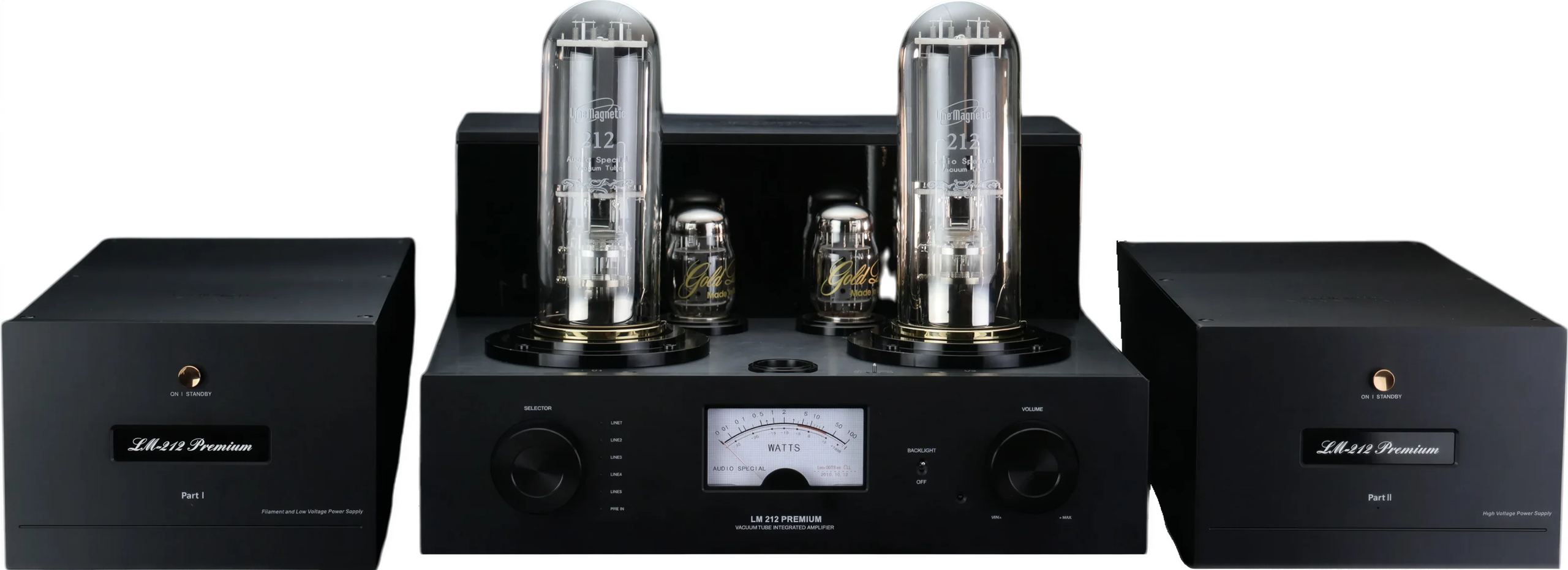
Originally designed for transoceanic radio links, the 212 tube operated at voltages that few manufacturers dare tame for audio. Line Magnetic has revived it and built around it a stereo integrated amplifier that delivers 50 watts per channel in single-ended class A. The LM-212IA combines a power supply housed in a separate chassis, Z11-core transformers, and a tube lineup that the brand borrows from its most ambitious creations.
A power tube from military radio
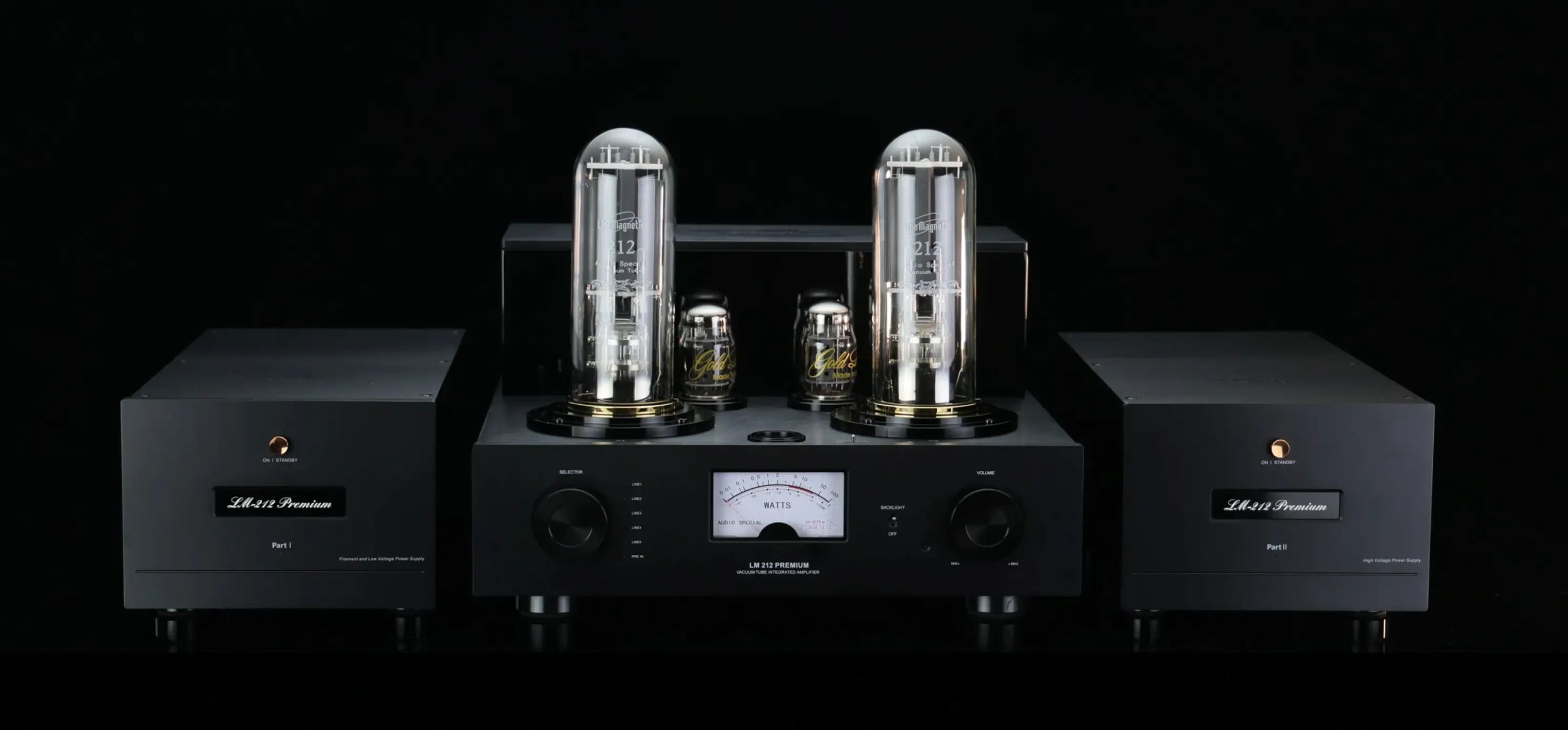
The 212 is nothing like an ordinary audio tube. Its original purpose was high-power long-distance transmission, a use that required operating voltages on the order of 1000 volts. Line Magnetic redeveloped its 212E version with a partner manufacturer, starting from an analysis of the original tube. Current environmental constraints have made some period materials unusable, which forced the teams to find compliant equivalents without degrading the electrical characteristics. The tube’s glass base, thick and sensitive to shocks during transport, has been reinforced to improve reliability. Few manufacturers offer an integrated amplifier built around this component, and the technical difficulty largely explains this rarity.

50 watts in single-ended, what that changes when listening
A single-ended class A design usually produces a few watts, sometimes around ten with a 300B tube. Reaching 50 watts per channel in this topology is due to the 212’s intrinsic power. In practical terms, this eases the main constraint of traditional single-ended amplifiers: their difficulty driving low-sensitivity speakers or speakers that demand current. The intended rendering remains that of class A, with a characteristic midrange density and timbral clarity, but the power reserve opens up the choice of speakers well beyond high-efficiency models alone.
The stated 5% harmonic distortion and 86 dB signal-to-noise ratio should be read in this context. A single-ended design does not seek the numerical performance of a feedback-based circuit; it favors a harmonic profile dominated by even-order harmonics, considered more musical by advocates of this approach. The frequency response extends from 20 Hz to 35 kHz.
Two chassis to isolate the power supply
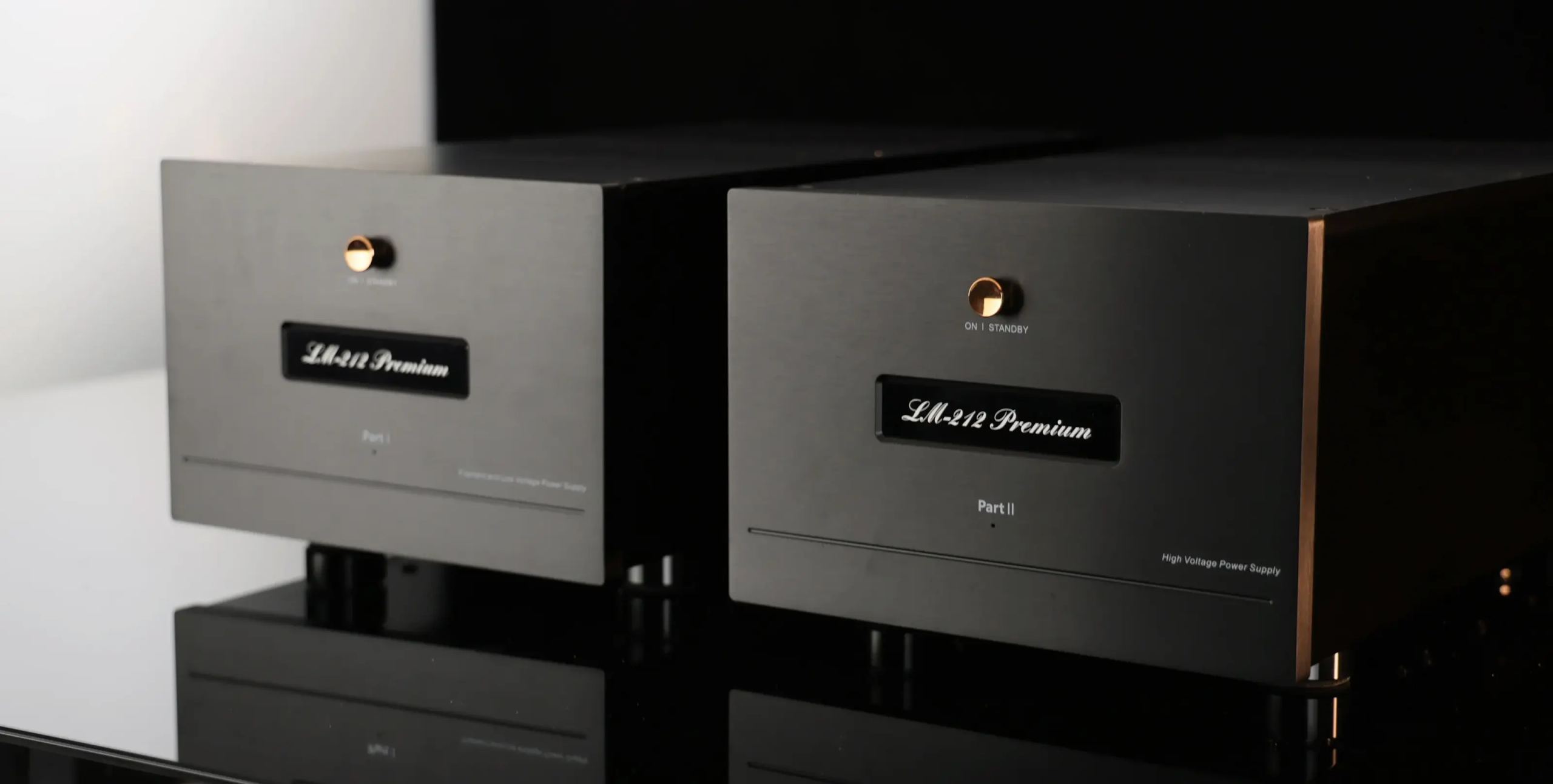
Separating the power supply and amplification stages into two distinct units serves a specific purpose: keeping the power circuits away from the signal-sensitive sections. The magnetic fields and mechanical vibrations generated by the power transformer have less influence on the noise floor, which helps preserve a clean background silence. This layout explains part of the total weight, which reaches 135.75 kg split between the main unit and the power supply unit. The set must be handled by two people and requires sturdy support and ample space.
The energy comes from Z11-core transformers, a grain-oriented silicon steel known for its low losses. Line Magnetic dedicates them separately to the high voltages, the low-voltage circuit, and the filament heating.
The LM-212IA tube lineup
Three tube families follow one another. A pair of 12AX7s handles preamplification, two KT88s serve as driver tubes, and the two 212s provide the final amplification. This arrangement is specific to the brand’s 212 amplifiers: the KT88, usually used as a power tube in more conventional designs, takes on a driver role here to properly drive the 212. This design explains the nature of the intended sound, a warmth and midrange shaping inherited from single-ended class A, supported by power that the topology does not usually provide.
A soft-start circuit accompanied by a delay of around 30 seconds protects the tubes each time the unit is powered on, giving the cathodes time to reach their operating temperature.
Settings, outputs, and speaker compatibility
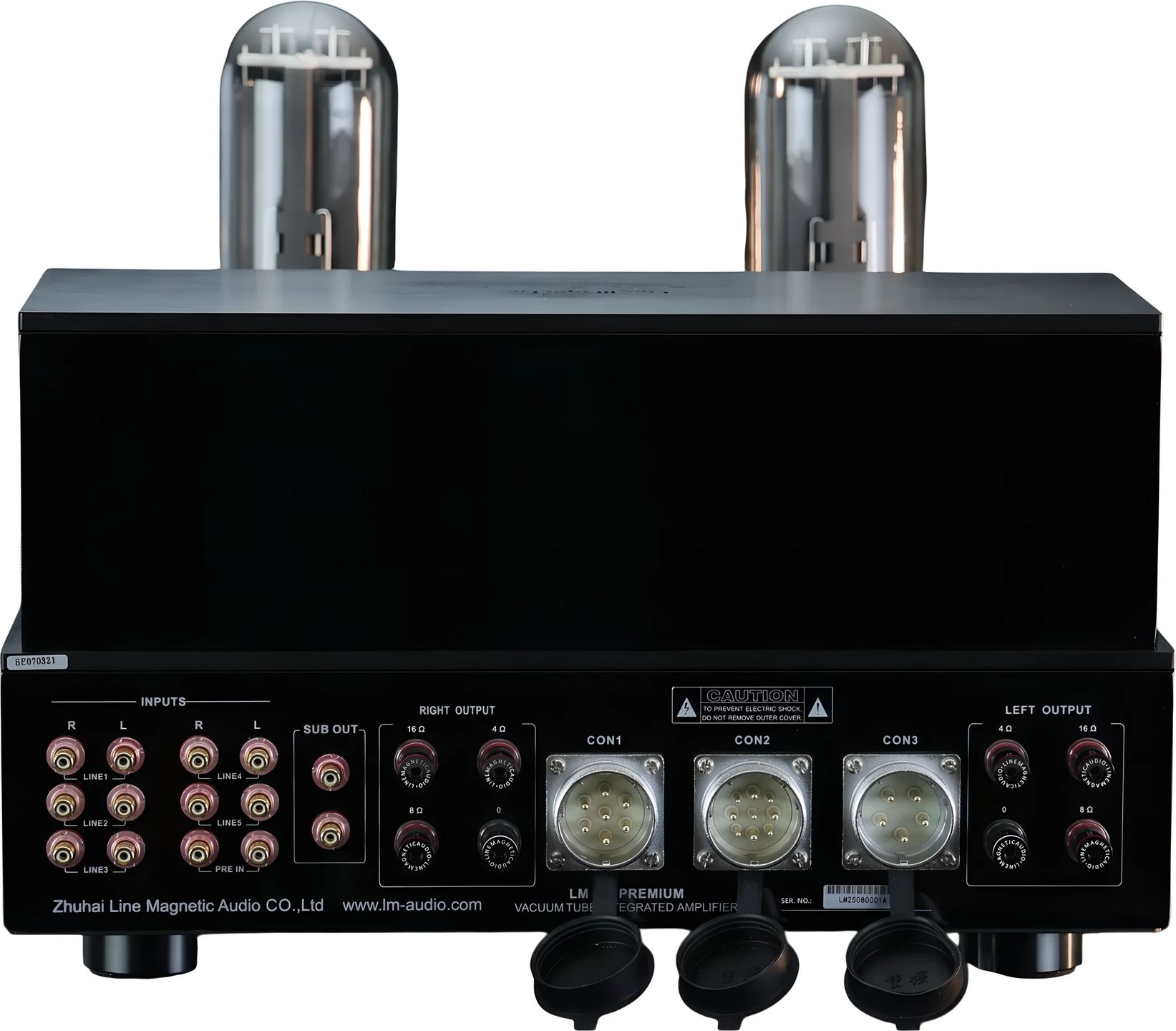
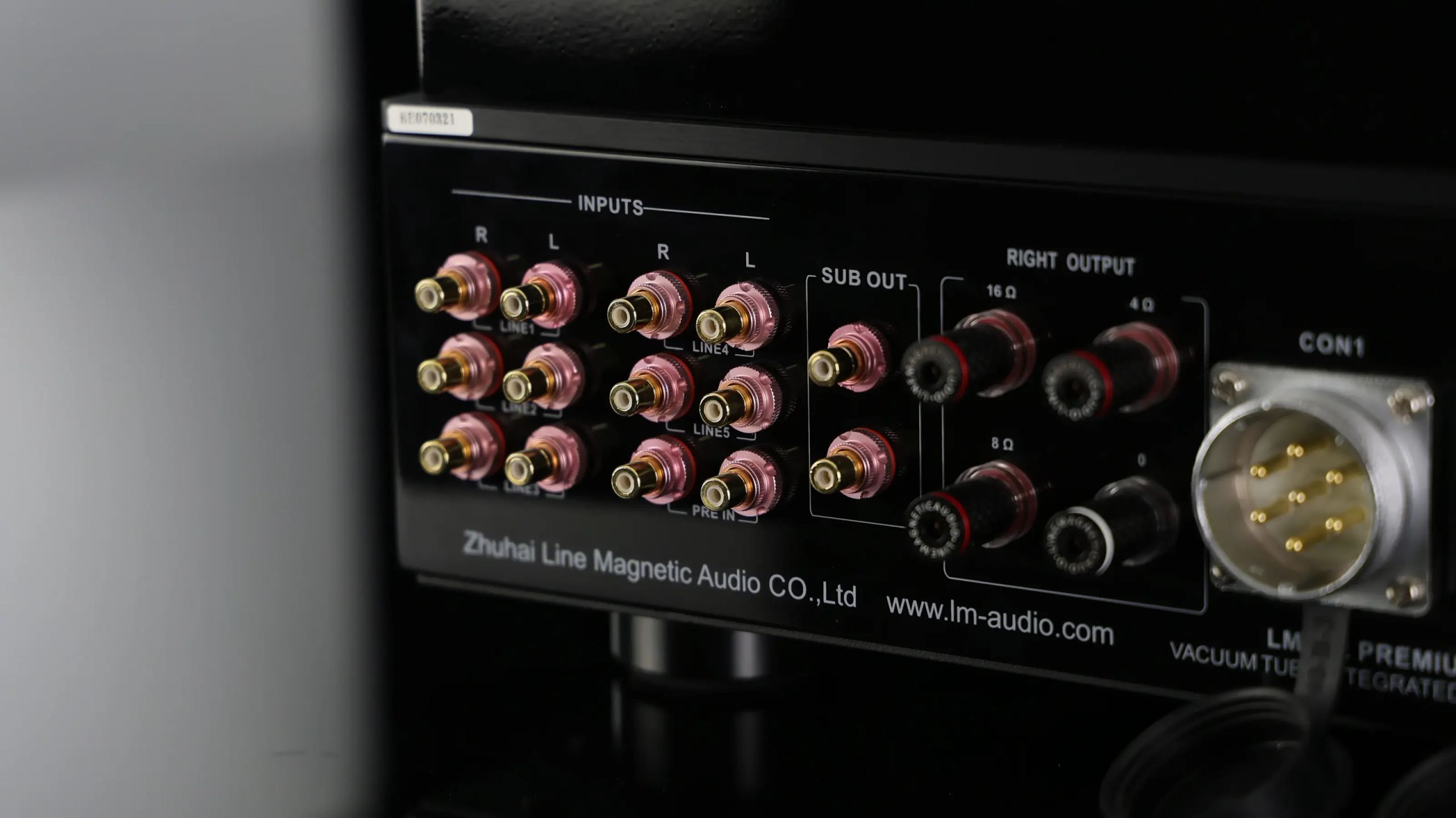
Three output impedances are available: 4, 8, and 16 Ω. Using the terminal corresponding to your speakers’ impedance is essential for the proper operation of a tube amplifier, a point to check during connection. The 150 mV input sensitivity and 100 kΩ input impedance are suitable for standard line-level sources.
Adjusting the bias of the power tubes is done using a front-panel meter and dedicated controls, a useful operation after replacing tubes that the owner can perform themselves by following the manufacturer’s procedure. Power consumption reaches 750 W, a logical value for a class A design that dissipates heat continuously: make sure to provide proper ventilation around both units.
Construction and physical presence
The internal wiring is done point-to-point by hand, a method that Line Magnetic applies to all its production and that aims to shorten connections and limit interactions between circuits. Two needles animate a central VU meter that tracks the output power of each channel, as much a visual cue as a nod to period measuring instruments. With dimensions of 500 × 610 × 555 mm per unit and considerable mass, the LM-212IA occupies space like a piece of reference electronics rather than a simple component in a system.
Technical specifications
Overview
- Type: high-end integrated tube amplifier
- Configuration: Single-Ended 212
- Power: 2 × 50 W
Tube complement
- Power tubes: 2 × 212
- Output tubes: 2 × KT88
- Preamplifier tubes: 2 × 12AX7
Audio performance
- Output power: 50 W + 50 W (Class A, single-ended)
- Frequency response: 20 Hz – 35 kHz
- Total harmonic distortion (THD): 5%
- Signal-to-noise ratio: 86 dB
Input and output characteristics
- Input sensitivity: 150 mV
- Input impedance: 100 kΩ
- Output impedance: 4 Ω, 8 Ω, 16 Ω
Power supply
- Power consumption: 750 W
Dimensions and weight
- Dimensions (W × D × H): 500 × 610 × 555 mm
- Net weight: 135.75 kg
Frequently asked questions
Is the 212 tube reliable for daily home use?
The 212 operates at high voltage, which requires rigorous design. Line Magnetic has redesigned its 212E with a reinforced structure and materials compliant with current standards to improve mechanical strength and stability. Like any power tube amplifier, it requires careful maintenance and periodic tube replacement over hours of use.
Should you wait before being able to listen after switching on?
Yes. A delay circuit of approximately 30 seconds postpones startup while the tubes warm up. This delay protects the components and is part of the normal operation of the device.
Can I replace the tubes myself?
Replacing the preamplifier and driver tubes remains straightforward. After changing the power tubes, bias adjustment using the front-panel meter is necessary. Since 212 tubes are specific and costly components, handling them requires caution and compliance with the manufacturer’s instructions.
Can the LM-212IA power low-sensitivity speakers?
Its 50 watts per channel in Class A partly overcome the usual limitation of single-ended amplifiers, which are often reserved for high-efficiency speakers. It accommodates a wider range of speakers, while remaining a tube amplifier whose pairing with speakers of adequate sensitivity will deliver the best results.
What is the difference compared with a push-pull design like the LM-211IA or LM-216IA?
A push-pull configuration combines two tubes operating in opposition to deliver more power with lower measured distortion. The LM-212IA’s Class A single-ended design uses a single tube per channel and a different harmonic profile, sought after for the texture of the midrange, at the cost of a more demanding design and lower electrical efficiency.
Why a power supply in a separate chassis?
Moving the power transformer away from signal-sensitive stages reduces the influence of magnetic fields and vibrations on the noise floor. This separation contributes to a cleaner background silence, at the cost of increased bulk and weight.
- Eco-contribution included in the sale price.