ROCKNA Wavedream DAC Reference Signature + Streamer
Specifications and features


Overview
Ten years after the original Wavedream, Rockna is starting from a blank sheet for its flagship converter. The Romanian manufacturer, true to its method, rejects off-the-shelf DAC chips, OEM streaming modules, and ready-made operational amplifiers: every subassembly is developed in-house, from the R2R conversion network to the Linux system that runs the machine. The result combines in a single chassis a very high-end discrete converter and a complete network player.
Discrete R2R conversion driven by five processors
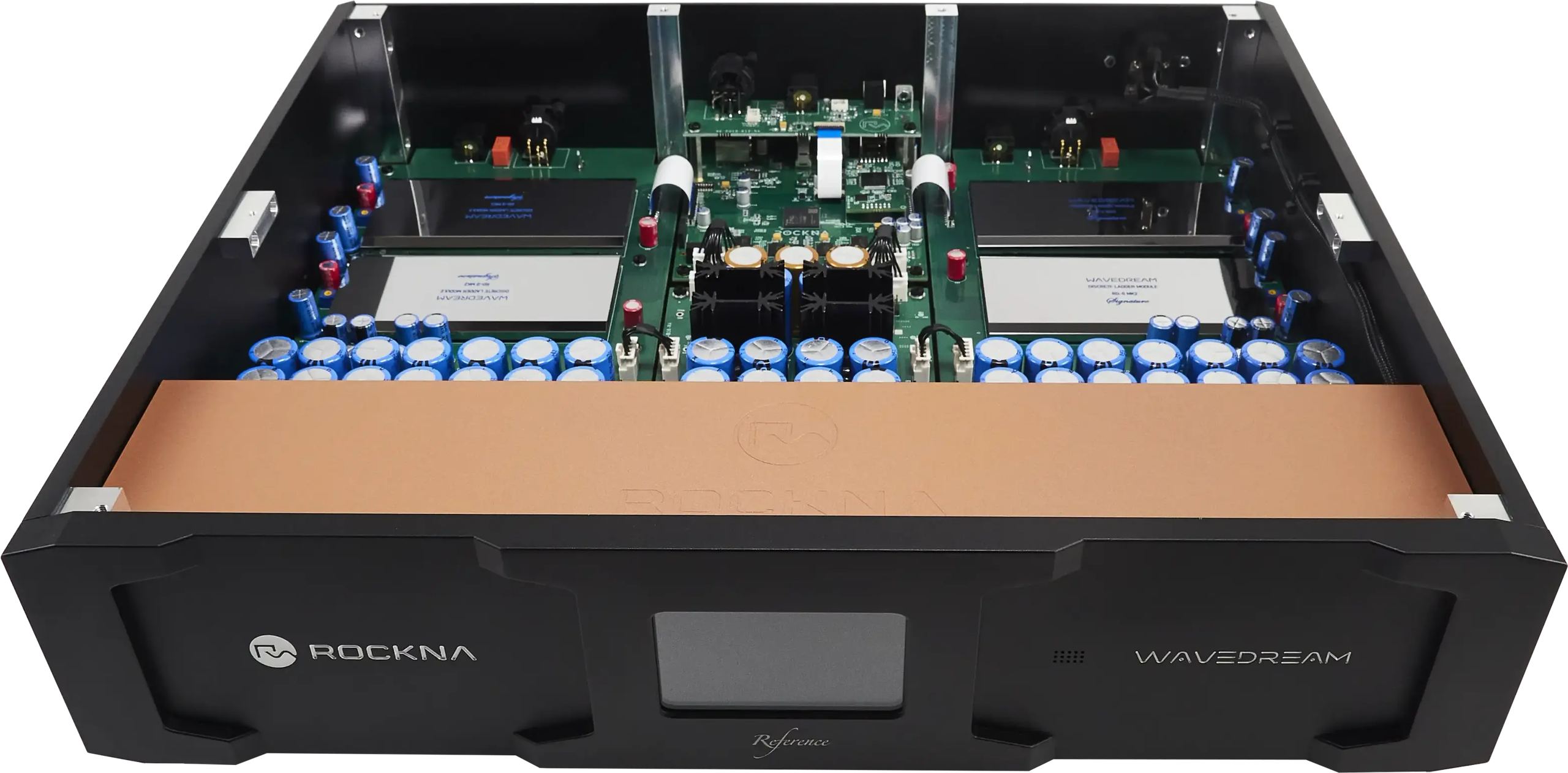
Conversion is based on four RD-0 MK2 modules, two per channel, arranged in a symmetrical configuration. Each implements a discrete resistor network in a hybrid sign-magnitude topology, with an individual switch for each of the 28 bits of resolution. A dedicated FPGA manages the control algorithm for each conversion phase, while an AMD ZynQ SoC supervises the whole system and hosts the network player. This division of tasks frees the conversion circuits from any ancillary load: the ZynQ and its custom Linux handle the system, while the four FPGAs perform audio processing only.
The output of the R2R modules is not buffered, a choice that favors transparency at the cost of increased demands on the analog stage that follows. An adjustable output dither makes it possible to optimize the linearity of the resistor network according to the content being played.
16x oversampling and custom Parks-McClellan filters
Any incoming signal is oversampled in hardware by a fixed factor of 16, i.e. 768 kHz or 705.6 kHz depending on the original frequency family. Rockna has developed its own oversampling filters using the Parks-McClellan method, with a number of coefficients far greater than what the integrated chips on the market offer. Three responses are available (linear phase, minimum phase, and hybrid phase), differing in how pre- and post-ringing energy is distributed around the impulse. A NOS mode disables all filtering for those who prefer raw conversion.
Clock management follows the same logic of complete control. The Femtovox 2 clock in LPN version, with lowered phase noise, feeds a mirrored distribution to the conversion modules. Above all, Rockna has eliminated any asynchronous sample rate converter (ASRC) in favor of a proprietary digital PLL, with two response modes depending on whether the source is the network stream or a local input. The ASRC built into off-the-shelf DAC chips introduces its own sonic signature; the digital PLL avoids this while locking down jitter.
A network player integrated at the heart of the converter
The streamer is not an add-on board grafted into the chassis: the network renderer is integrated natively into the ZynQ SoC, within the DAC’s very digital front end. This integration removes the internal link between a streamer board and the conversion section, one less link in the signal path.
On the protocol side, coverage is broad: Roon Bridge, UPnP, OpenHome, AirPlay, Spotify Connect, Qobuz Connect, HQPlayer NAA, Squeezelite, and Diretta. The machine therefore behaves as a universal endpoint, regardless of the software ecosystem already in place. A simple Ethernet connection is enough to stream to the device, which also makes it possible to move it to another room without an external network transport.
Inputs, outputs, and preamplifier function
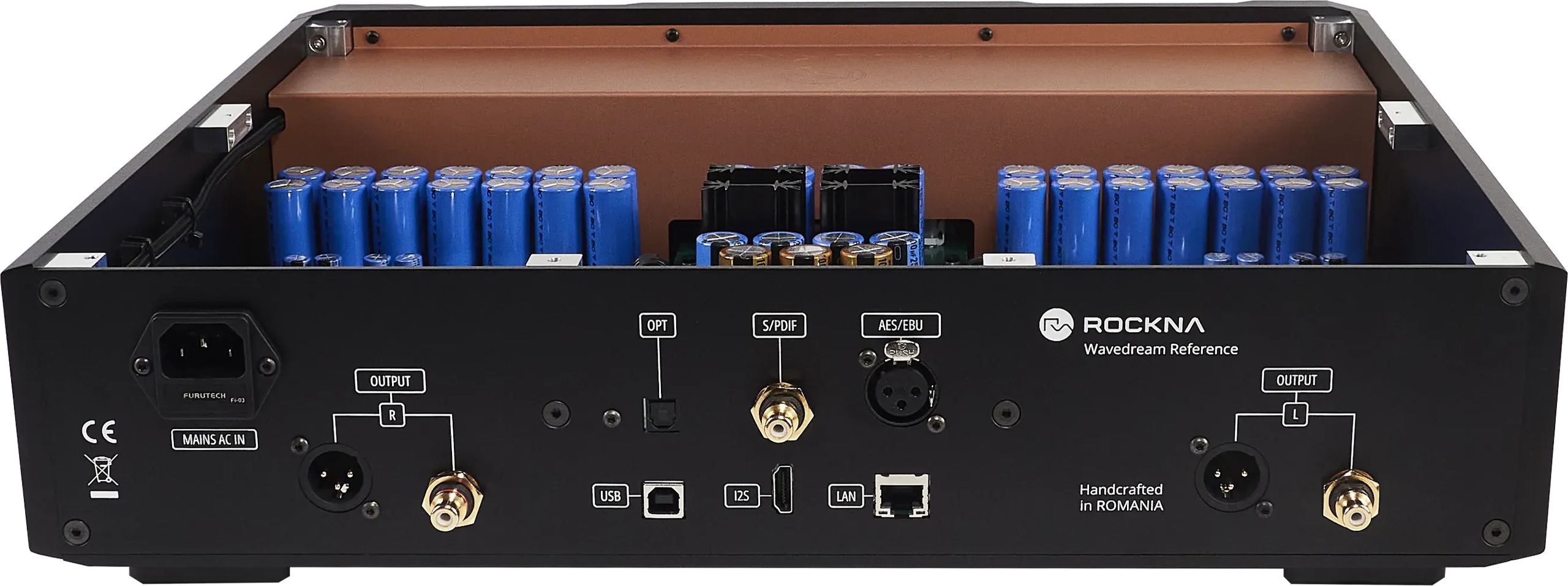
Alongside networking, the digital inputs cover USB, I2S on a fully configurable port (selectable Rockna and PS Audio modes), coaxial S/PDIF, AES/EBU, and optical Toslink. The analog outputs are available in unbalanced RCA (3.5 V RMS maximum) and balanced XLR (7 V RMS maximum).
The digital volume control operates at 32 bits in 0.5 dB steps, with sufficient resolution to drive a power amplifier directly without a preamplifier. Fine settings complete the picture: absolute phase selection (normal or inverted) and wide or narrow DSD bandwidth.
Class A output stage and oversized power supply
The output stage, entirely discrete, combines JFET and bipolar transistors in a Class A design. Developed specifically for the new conversion modules, it acts as a fast buffer with low output impedance. Measurements place harmonic distortion at -102 dB (at -3 dB) and dynamic range at 139 dB, figures rarely seen for discrete R2R conversion, a technology reputed to be less compliant in measurements than delta-sigma chips.
The hybrid power supply includes more than 20 distinct circuits and filtering capacity exceeding 90,000 µF. The audio-grade toroidal transformers are shielded by a copper cage, as is the display, and critical nodes benefit from local regulation, discrete for the analog stages.
Touch ergonomics, mobile app, and upgradeable firmware
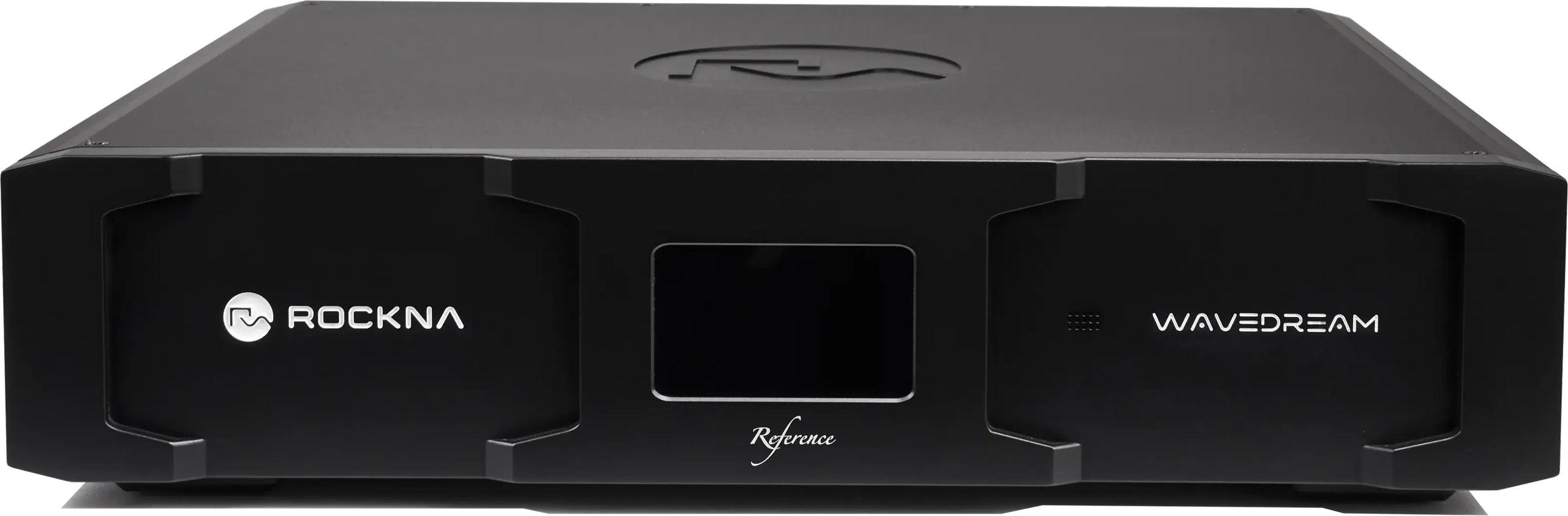
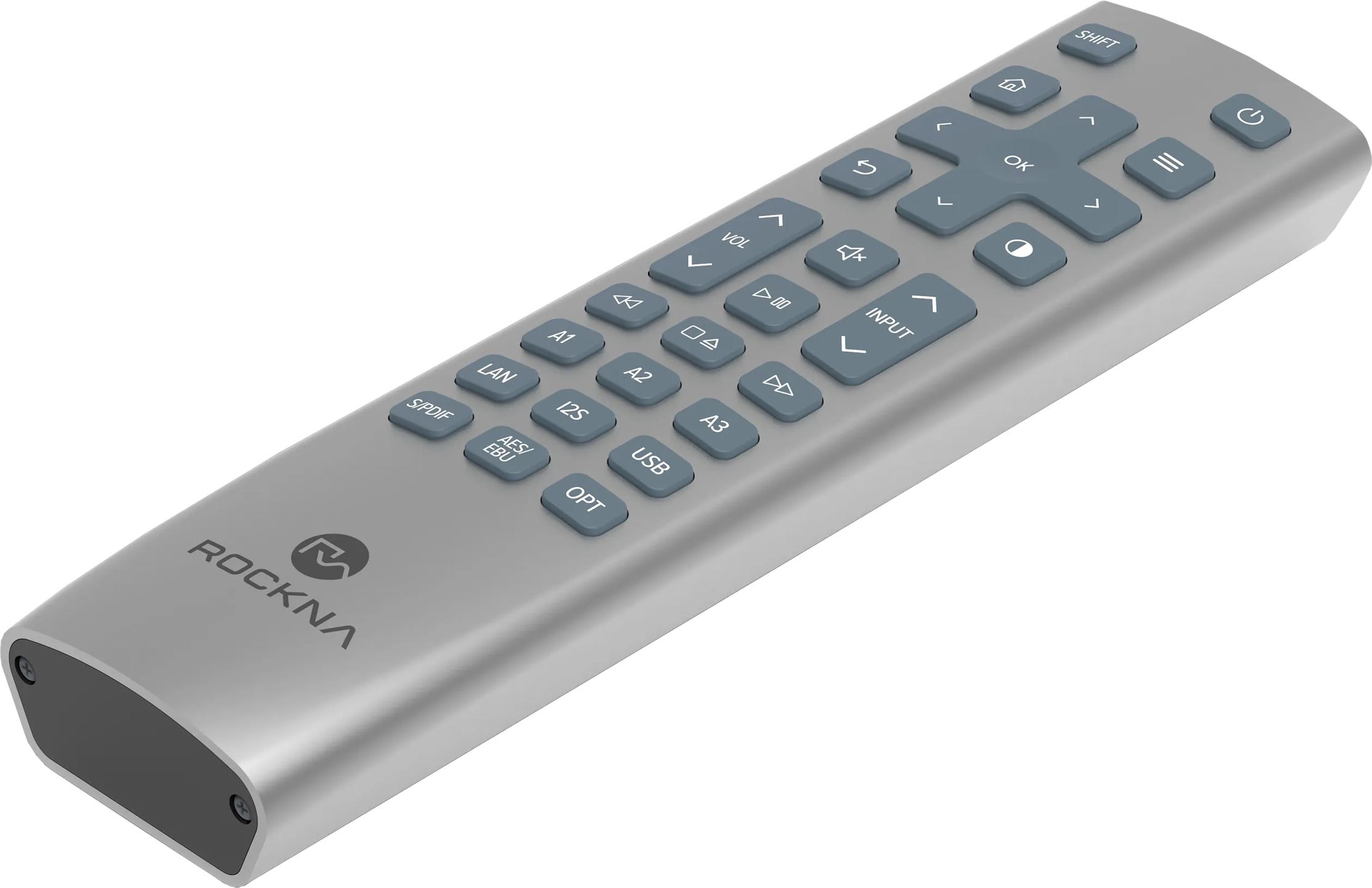
The solid aluminum chassis (450 x 390 x 105 mm, 10 kg) is available in matte black or matte silver. On the front panel, a touchscreen with light and dark themes provides access to all settings. The Rockna Wavedream Reference app, available on iOS and Android, mirrors these functions remotely, including the finest audio settings. The metal infrared remote control, with backlit buttons and motion sensor, completes the three control modes.
The FPGA firmware is updated over the internet, with automatic download. This is a structuring point of the platform: since the conversion characteristics are defined by the code loaded into the FPGAs, the device can evolve over time without hardware intervention. The warranty covers three years.
Technical specifications
Digital-to-analog conversion
- Conversion type: discrete R2R, hybrid sign-magnitude topology
- DAC modules: RD-0 MK2 x 4 (2 per channel, balanced configuration)
- Switch resolution: 28 bits, individual per-bit switch controlled by FPGA
- Architecture: AMD ZynQ SoC (control and streamer) and 4 FPGAs (one per conversion phase)
- Oversampling: hardware FPGA, fixed 16x factor
- Frequencies: 768 kHz / 705.6 kHz depending on the input frequency
- Custom Parks-McClellan digital filters
- Linear phase
- Minimum phase
- Hybrid phase
- NOS mode (no filter)
- Clock management: Femtovox 2 LPN version (reduced phase noise), mirrored clock distribution
- PLL: proprietary Digital-PLL topology, without ASRC
- Two response modes: stream and local
- Adjustable output dither to optimize the linearity of the R2R network
Audio settings
- Absolute phase selection: normal or inverted
- DSD bandwidth: wide or narrow
- Ultra-fine 32-bit digital volume control, 0.5 dB steps
- Direct output to a power amplifier possible
Integrated network streamer
- Integration: native network renderer in the ZynQ SoC, without a separate streamer card
- Supported protocols: Roon Bridge, UPnP, OpenHome, AirPlay, Spotify Connect, Qobuz Connect, HQPlayer NAA, Squeezelite, Diretta
- System: custom Rockna Linux
Inputs and outputs
- Digital inputs: LAN (Ethernet), USB, I2S (fully configurable port), coaxial S / PDIF, AES / EBU, optical Toslink
- I2S compatibility: selectable Rockna and PS Audio modes
- Analog outputs: unbalanced RCA and balanced XLR
- Maximum output level
- RCA: 3.5 V RMS
- XLR: 7 V RMS
- Fully discrete Class A output stage, JFET and bipolar, Signature version
Measured performance
- Harmonic distortion (THD): -102 dB (at -3 dB)
- Dynamic range (DNR): 139 dB
Power supply
- Ultra-low-noise hybrid type, more than 20 power supply circuits
- Filtering capacity: more than 90,000 µF
- Audio-grade toroidal transformers, shielded by a copper cage
- Local regulation on critical nodes, discrete for the analog stages
Control and ergonomics
- Front touchscreen
- Two display themes: light and dark
- Rockna Wavedream Reference mobile app (iOS and Android)
- Access to fine audio settings
Physical characteristics
- Solid aluminum chassis
- Finishes: matte black or matte silver
- Dimensions (W x D x H): 450 x 390 x 105 mm
- Weight: 10 kg
Updates and warranty
- Upgradable firmware, internet updates
- Automatic download
- Warranty: 3 years
Included accessories
- Power cable
- Metal infrared remote control, backlit buttons with motion sensor
- User manual
- Warranty card
Frequently Asked Questions
What is the difference between the Reference version and the Reference Signature version?
The Signature version features RD-0 MK2 conversion modules, Rockna’s top-of-the-range offering, along with a dedicated analog output stage. The standard Reference version uses RD-1 Edition MK2 modules. Both share the same digital platform, the same built-in streamer, and the same user experience.
Can this DAC be used without a preamplifier?
Yes. The 32-bit digital volume control in 0.5 dB steps maintains high resolution even at low listening levels, which allows a direct connection to a power amplifier. Those who prefer an analog preamplifier can set the volume to 0 dB and use the device as a fixed source.
Does the built-in streamer replace an external network player like the Wavedream NET?
For the network endpoint function, yes: the renderer integrated into the ZynQ receives the stream directly without an external digital link. An upstream server is still required to host a local library (Roon Core, UPnP server, or NAS), a role not covered by the integrated streamer.
What formats and frequencies does the DAC support?
PCM is supported up to 384 kHz in 32-bit depending on the input, and DSD in native mode or DoP depending on the interface, with the USB and I2S inputs offering the highest rates. Internally, all signals are brought to 768 kHz or 705.6 kHz by 16x oversampling.
How do you choose between linear, minimum, hybrid filters, and NOS mode?
The linear-phase filter distributes Gibbs ringing before and after the impulse, the minimum-phase filter shifts it entirely after, and the hybrid combines both behaviors. The choice comes down to listening preference and the type of music; NOS mode removes all filtering and leaves the raw signal, with the aliasing this entails. The filters can be switched from the touchscreen, the remote control, or the mobile app, which makes direct comparisons easier.
Can firmware updates change the sound of the device?
Yes, that’s even one of the advantages of the FPGA platform: the digital filters and conversion algorithms are defined by software. Rockna evolved the original Wavedream over a decade in this way, and the automatic online distribution mode makes the process even simpler on this generation.
What are the two PLL modes, stream and local, used for?
They adapt the response of the clock lock loop to the nature of the source. Stream mode is suited to the built-in network renderer, while local mode is suited to the physical digital inputs (S/PDIF, AES/EBU, I2S, USB), whose timing behavior differs from that of a network stream.
- Eco-contribution included in the sale price.