EverSolo DMP-A8 Gen 2, the all-in-one digital source
Bringing together the network player, converter, preamplifier and music server in a single enclosure: the first generation DMP-A8 paved the way. Its successor embraces the concept with greater confidence. EverSolo widens the chassis, moves to an 8.6-inch display and redesigns the network section, without altering the AKM design that made the original model so credible. Enough to serve as the hub of a two-channel system, where the source controls volume and distributes the signal.
A wider chassis, a more spacious design
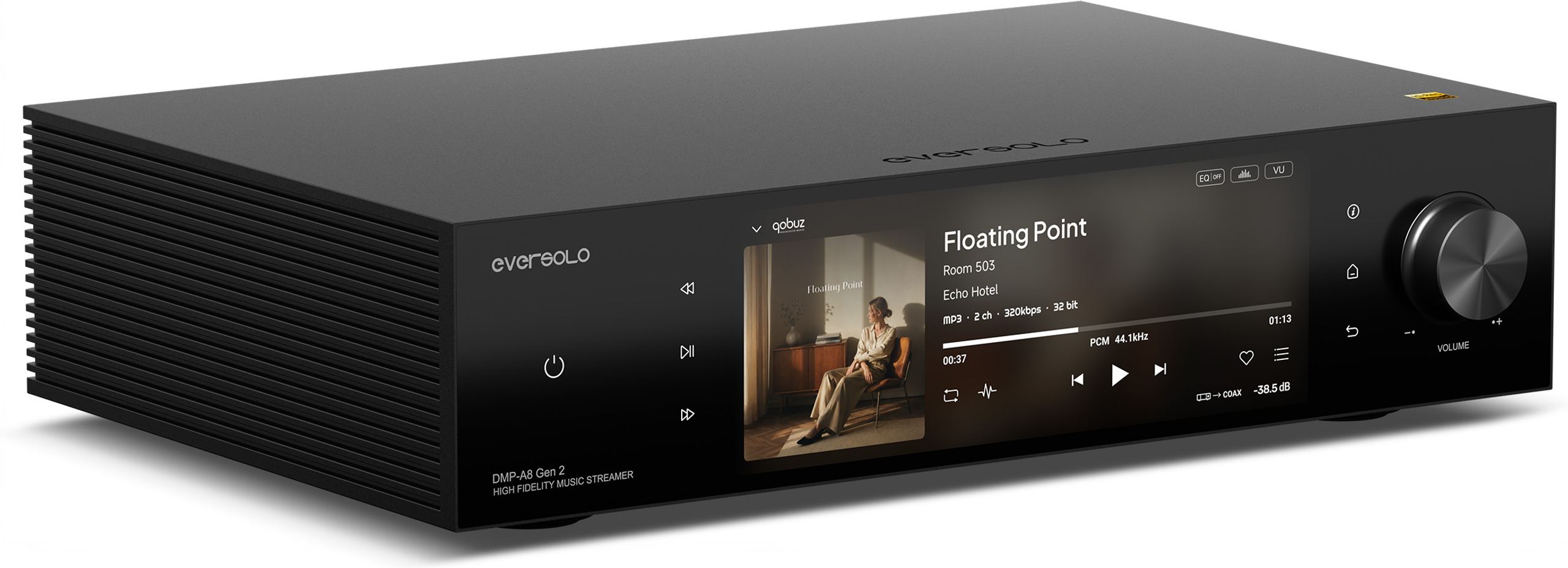
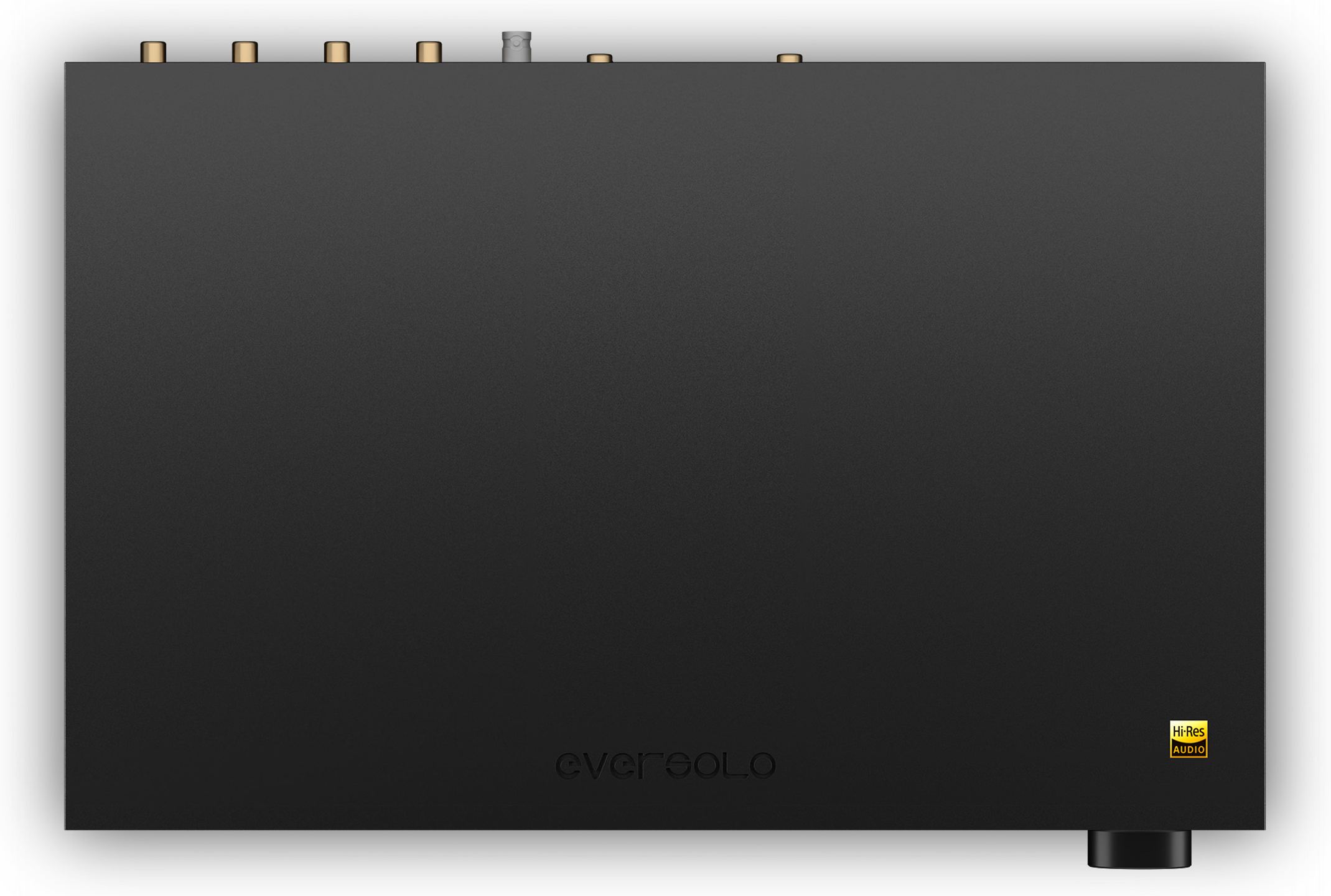
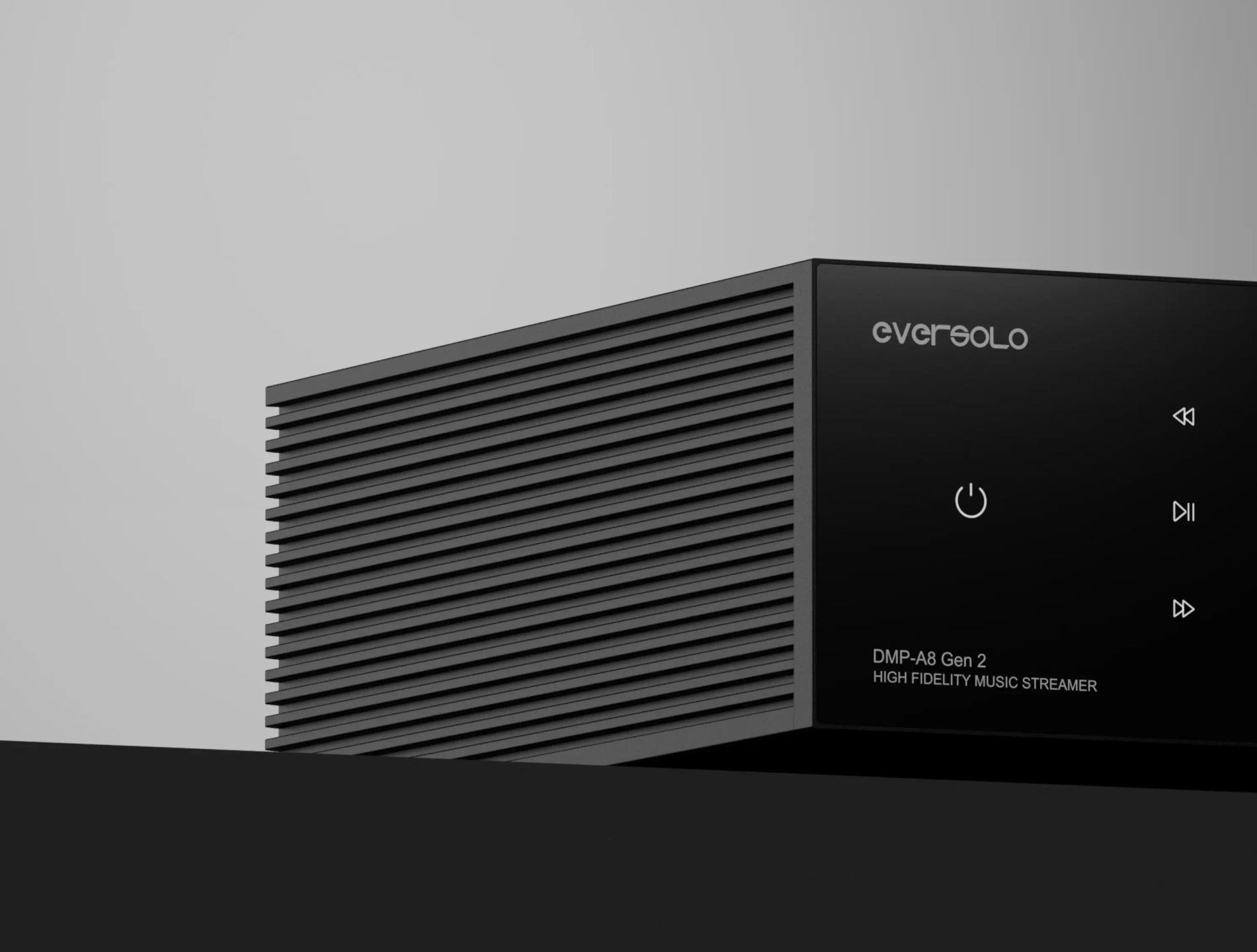
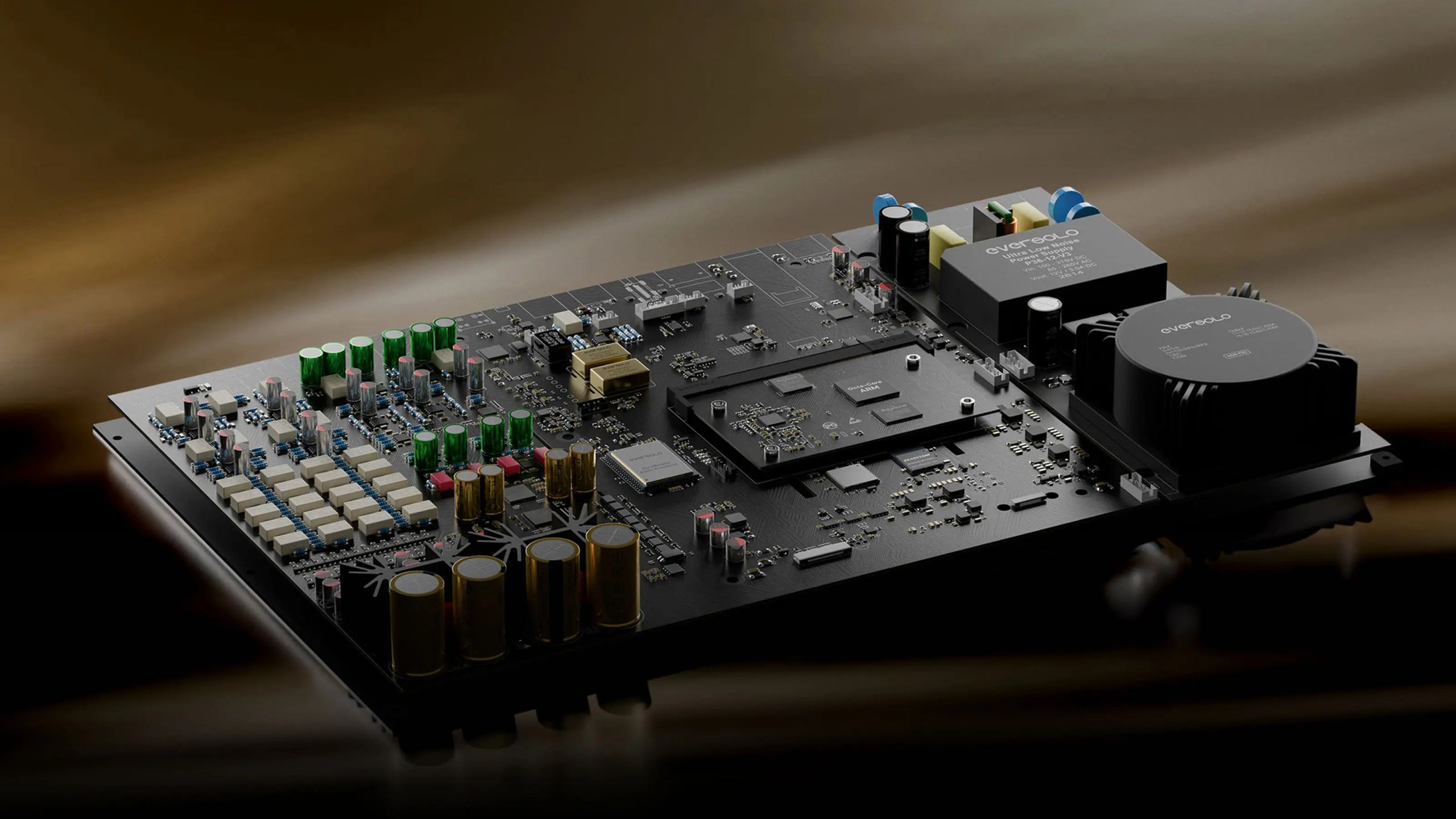
The first thing that stands out when taking the DMP-A8 Gen 2 out of the box is its size. EverSolo has extended the aluminium chassis to 388 mm wide, 265 mm deep and 88 mm high, a format more in line with a traditional hi-fi component than a desktop streamer. This additional volume serves a purpose: it provides room to dissipate heat and to keep the power supply away from the audio circuits. Inside, two power supplies separate the linear section from the digital section, each designed for minimal noise. On the scales, the DMP-A8 Gen 2 weighs 5.25 kg, enough to warrant a proper shelf in the cabinet.
The 8.6-inch display and control knob at the heart of operation
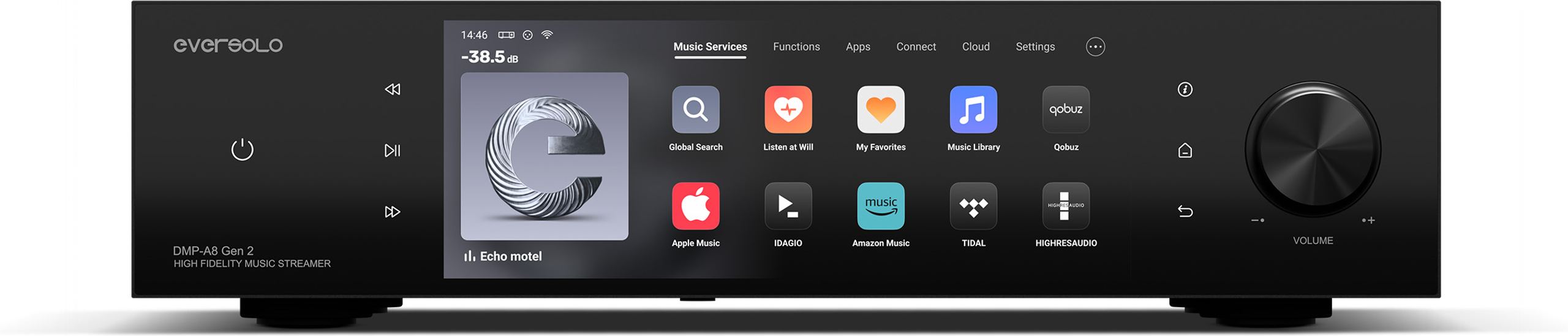
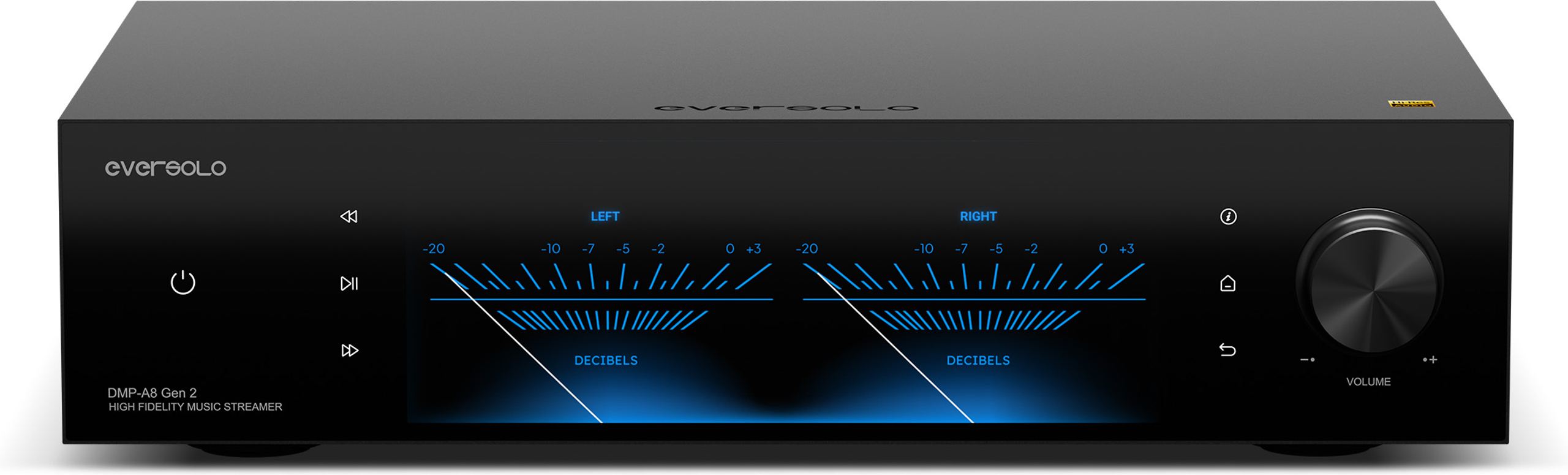
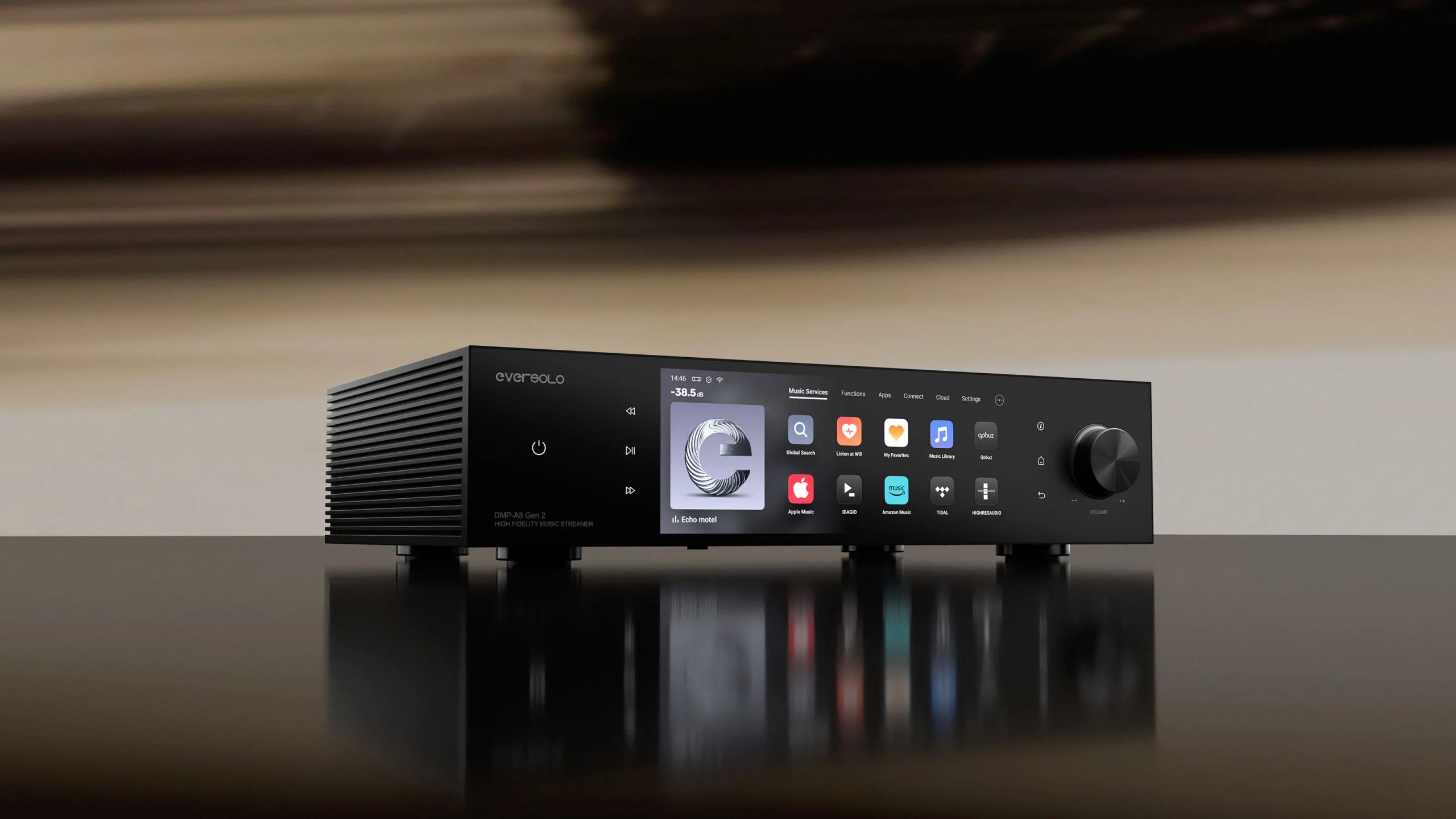
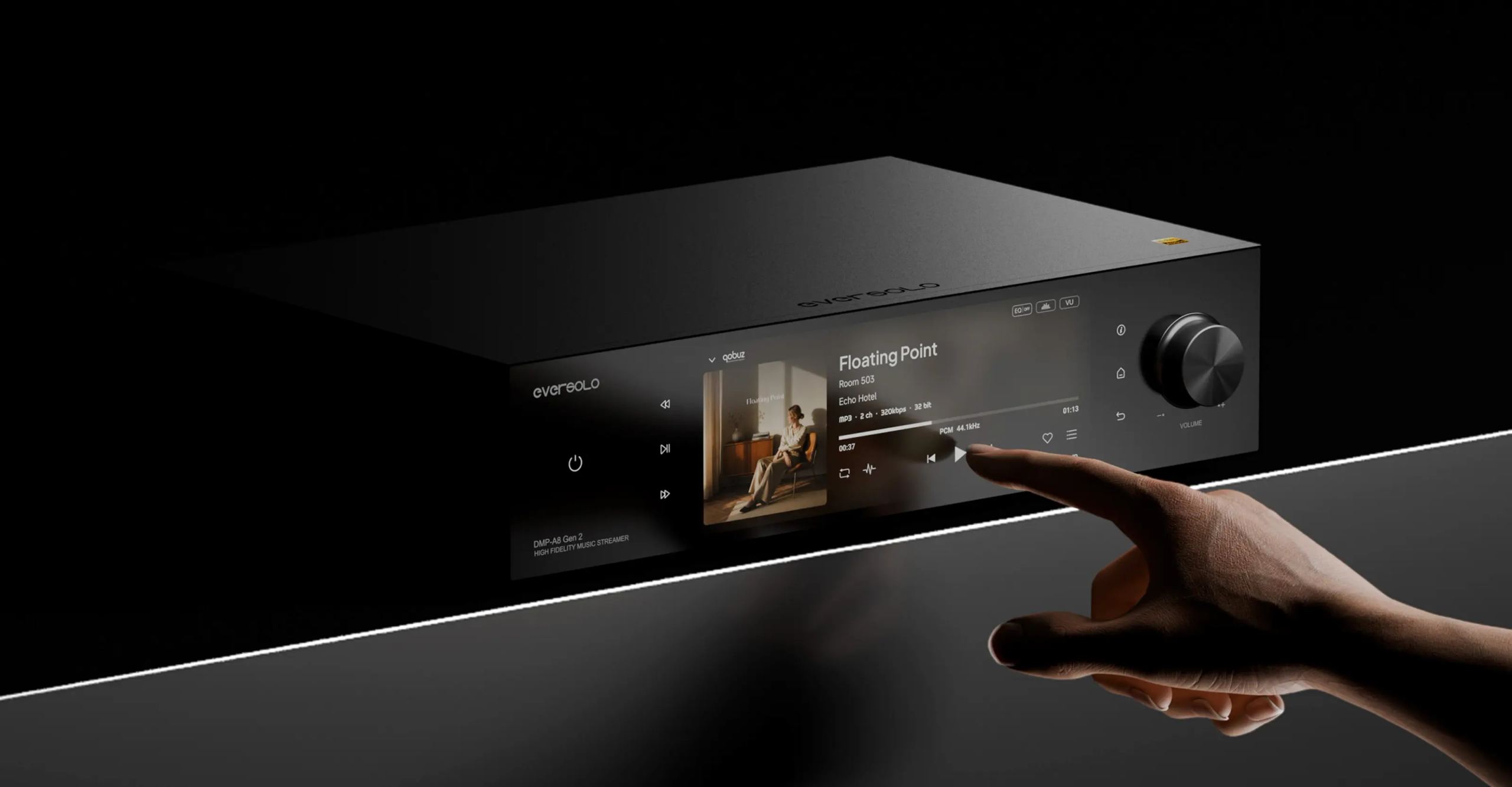
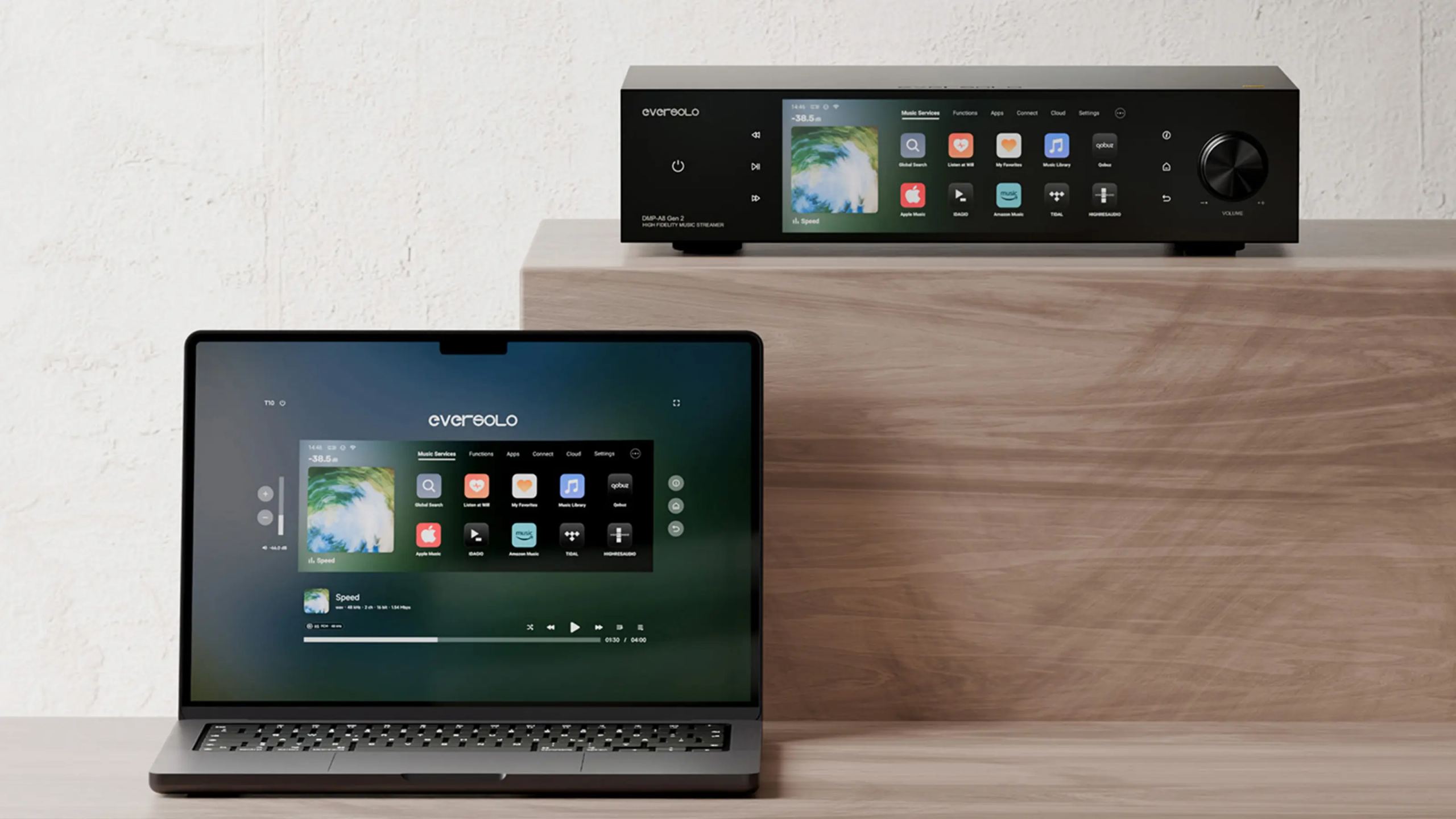
The other visible change is immediately apparent when switched on. The touchscreen grows to 8.6 inches (21.8 cm), compared with six inches on the previous model, and the interface has been redesigned to act as a dashboard. You can browse your library, switch between inputs and adjust volume, all without necessarily taking out your phone. The multifunction rotary knob supports this control: its damping is smooth, its micro-adjustments precise, and it brings volume, input selection and everyday functions together in one gesture. There are actually three control options: the display, the EverSolo Control app (phone, tablet, web browser and television), and a dual-mode Bluetooth and infrared remote control, housed in an alloy enclosure. For those who enjoy watching music as much as listening to it, the display offers VU meters, spectrum analysers and visual effects synchronised with the current track.
AKM conversion and analogue-domain volume control
Under the hood, the conversion section retains the AKM pairing that built the reputation of the first DMP-A8: an AK4499EXEQ converter supported by the AK4191EQ digital processor, using the brand’s Velvet Sound technology. The idea behind this design is to separate digital processing from the actual analogue conversion, keeping noise away from the useful signal. EverSolo adds a fully balanced preamplifier, with XLR and RCA inputs, and above all R-2R volume control. This last point deserves an explanation: instead of attenuating the signal in the digital domain, which means discarding bits and losing finesse at low volume, the R-2R resistor ladder operates in the analogue domain and preserves dynamics regardless of listening level. An in-house volume engine, called EVC, completes level management. Two ultra-low phase-noise clocks time the entire system, while electrical isolation limits interference between stages. The stated figures indicate the level of ambition: distortion of 0.000075% (or -122 dB) and a signal-to-noise ratio of 129 dB on the balanced output, delivering 4.2 volts versus 2.1 volts for the RCA output.
High-resolution formats and Bit-Perfect audio engine
In terms of formats, the DMP-A8 Gen 2 plays almost everything available in high resolution: native DSD up to DSD512, PCM up to 768 kHz in 32-bit, as well as FLAC, WAV and APE files, plus MQA decoding. To deliver these streams without altering them, EverSolo has revised its USB audio processor, AuralEngine, designed to improve data transmission and scheduling, especially when files become large. A second proprietary engine, EOS Audio Engine, bypasses Android’s resampling limitations to maintain a Bit-Perfect signal path, meaning bit-for-bit playback faithful to the source. This feature also applies to third-party applications installed on the player, allowing them to output a high-resolution stream without passing through the system mixer. Adjustable upsampling up to 16 times completes the feature set for those who like to fine-tune the sound.
Inputs, outputs and the SFP optical fibre port
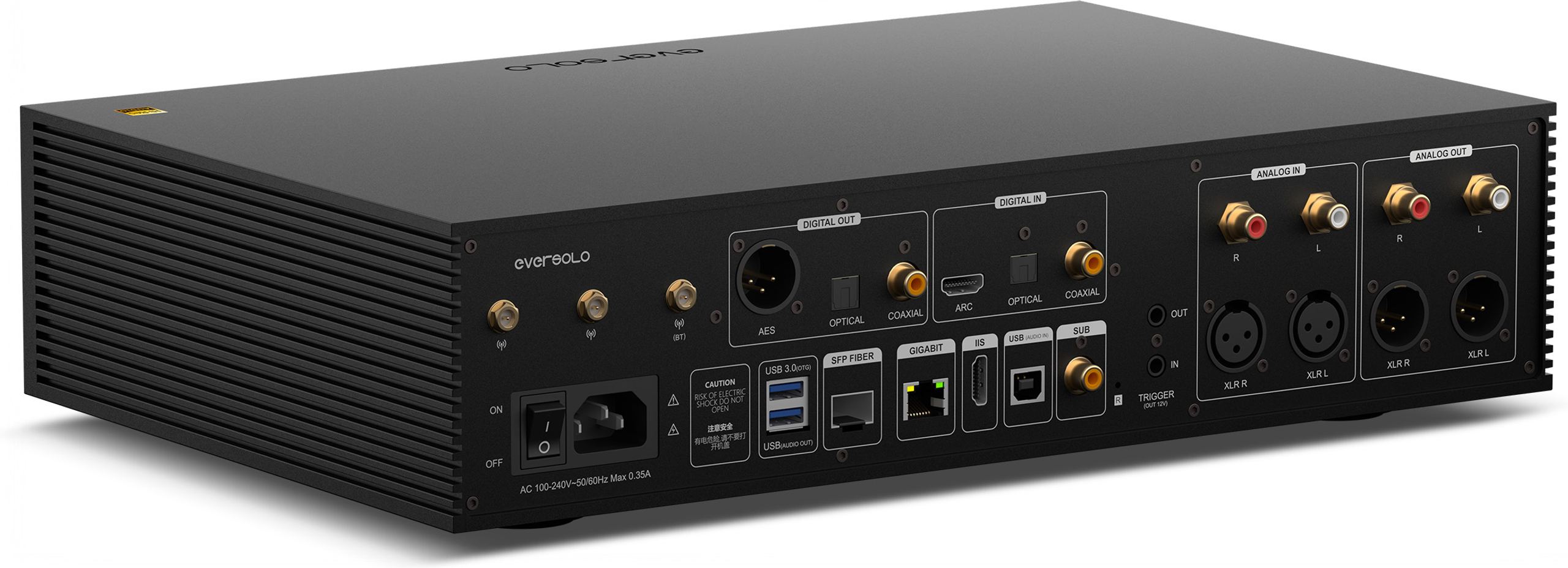
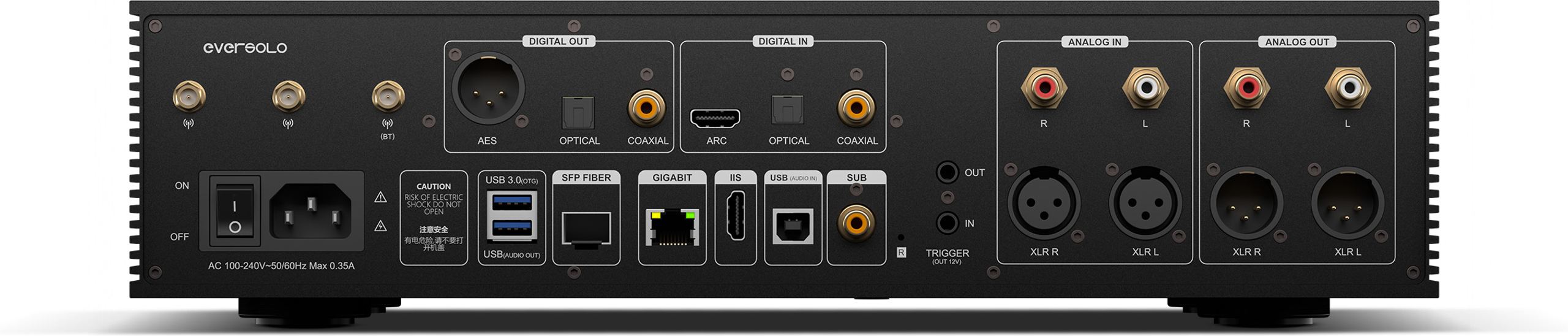
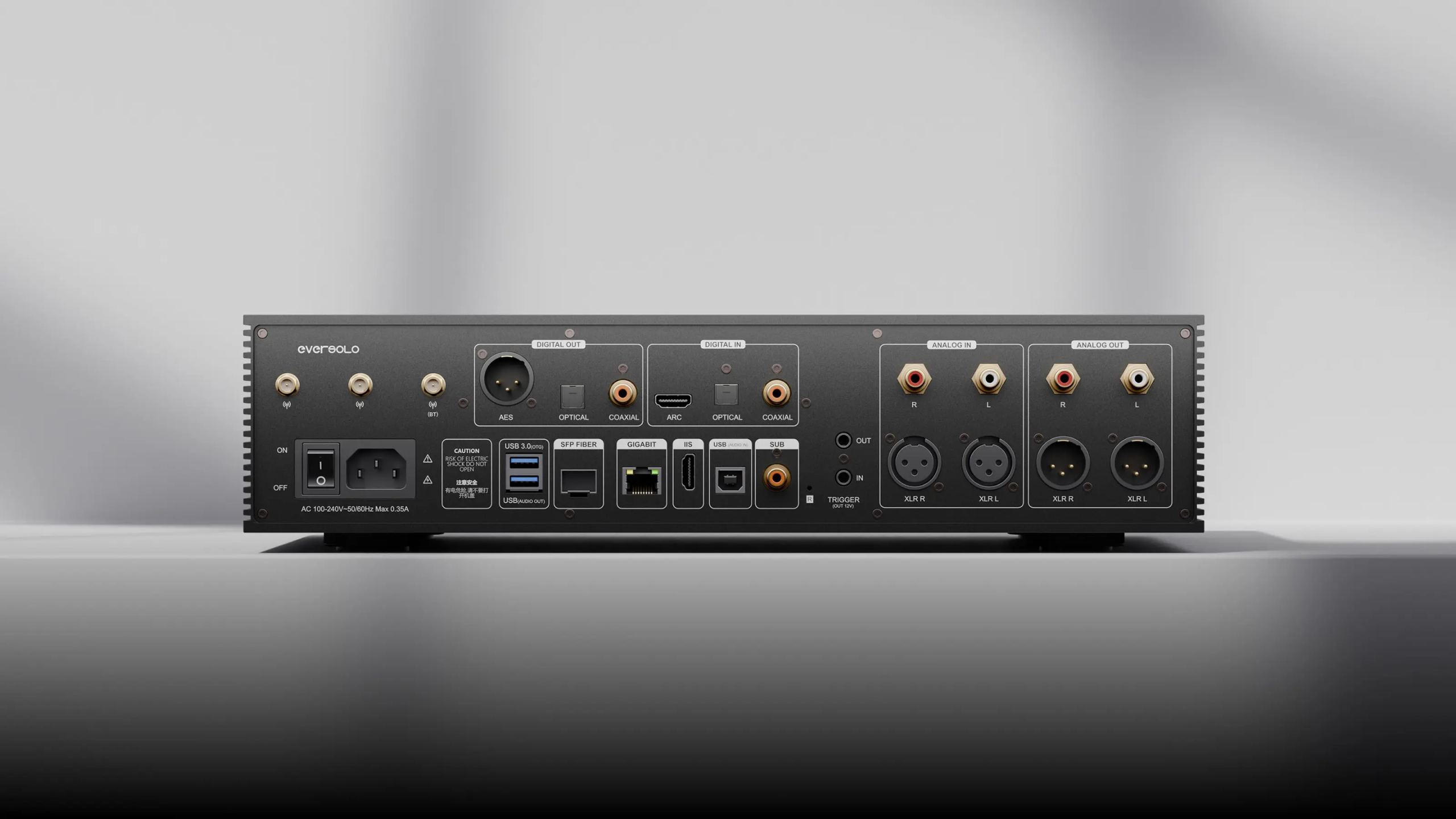
The rear panel reflects its centralisation ambitions. Inputs include Bluetooth 5.4 (Qualcomm QCC3095 receiver module), a USB-B port that turns the DMP-A8 Gen 2 into a converter for Windows, macOS, Android and iOS computers or mobile devices, traditional coaxial and optical inputs, as well as an HDMI ARC/eARC input for retrieving stereo sound from a television. The latter is new compared with the first DMP-A8, whose HDMI port was limited to I2S output. Analogue sources are not overlooked: a balanced XLR and unbalanced RCA pre-input accepts an external component, with adjustable preamplification gain up to +10 dB.
Outputs are just as comprehensive: USB audio output (reserved for UAC-compatible DACs), I2S connection with eight configurable modes to work with as many converters as possible, coaxial, optical, professional AES/EBU output on XLR, and of course analogue XLR and RCA pre-outs to an amplifier or active speakers. A dedicated subwoofer output, with adjustable crossover frequency from 40 to 500 Hz, is particularly useful in a real room, especially with compact speakers that struggle with bass.
The real curiosity is hidden in a small optical slot: an SFP network port. It allows a fibre connection to electrically isolate the player from the rest of the home network, including the router and switches. The SFP module is not supplied and must remain compatible with your switch, noting that the SFP+ format is not supported; EverSolo lists several proven references, for both single-mode fibre and copper. Alongside it are a Gigabit Ethernet port and dual-band Wi-Fi 6, plus a Wake-on-LAN function for waking the player remotely.
A music server with internal storage up to 8 TB
The DMP-A8 Gen 2 does not simply play other sources: it can become the source itself. An M.2 NVMe slot (PCIe 3.0, 2280 format) accommodates an SSD of up to 8 TB, accessible without unscrewing the entire chassis. The drive is not included, but the space is there to host an entire music library without relying on a computer being permanently switched on. To orchestrate everything, EverSolo has strengthened the internal platform: an octa-core processor, 8 GB of DDR5 memory and 64 GB of eMMC storage. The brand claims indexing of around 200,000 tracks in two hours, an order of magnitude that will resonate with those whose library has survived three computers.
Disc enthusiasts are not left out, with one caveat: CD playback and ripping require an external drive connected via USB, whereas the Master Edition version includes a dedicated mechanism. Once the drive is connected, the DMP-A8 Gen 2 automatically retrieves cover art and metadata, corrects reading errors and detects duplicates. A NAS, private cloud or network storage can be connected via SMB, NFS and WebDAV protocols.
On the streaming side, the list of integrated services is extensive: TIDAL, Qobuz, HIGHRESAUDIO, Amazon Music, Deezer, Apple Music, IDAGIO, SoundCloud, Presto Music, Calm Radio, Radio Paradise, TuneIn and web radio stations. These are joined by platform-specific protocols, Spotify Connect Lossless, TIDAL Connect and Qobuz Connect, as well as DLNA/UPnP. Library management brings these sources together under a single search function and automatically sorts metadata, provided the platforms maintain their certification through firmware updates.
evotune PRO room correction and 20-band equaliser
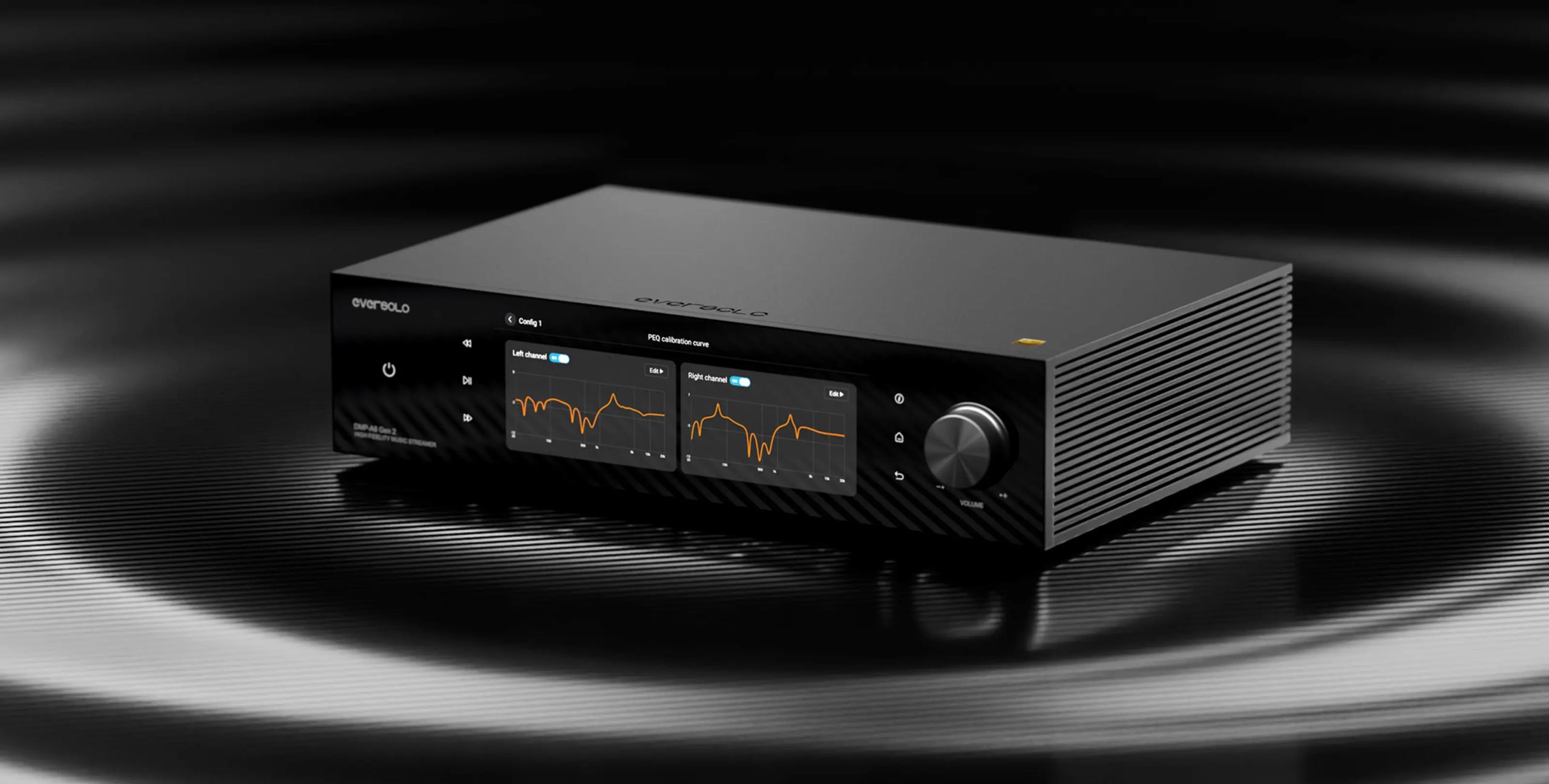
The final aspect, and not the least useful, is signal processing. A listening room always imposes its own signature, and the DMP-A8 Gen 2 addresses it with evotune PRO, an acoustic correction system combining DRC modelling and FIR filtering. Measurement can be performed using a smartphone microphone, but a dedicated USB measurement microphone will provide more reliable results, and this is what the brand recommends for serious calibration. Once the room has been mapped, the parametric equaliser expands to 20 bands, compared with ten on the first DMP-A8, with fine adjustment of frequency, gain and Q factor across a range from 3.51 Hz to 20 kHz. You can also import your own FIR filters, activate loudness control or dynamic-range compression for low-level listening late in the evening. A fade-in and fade-out is applied to local music, integrated services and third-party applications, to avoid abrupt starts.
Technical specifications
Design and chassis
Aerospace-grade aluminum chassis
8.6-inch (21.8 cm) LCD touchscreen
Redesigned user interface serving as an intuitive control center
Multifunction rotary knob
Smooth damping and precise response
Unified control of volume, inputs and functions
Clearly defined micrometric graduations
Audio architecture
Digital-to-analog converter: AK4499EXEQ paired with AK4191EQ digital processor
AKM Velvet Sound technology
Audio processor: Eversolo AuralEngine
Operational amplifiers: OPA1612
High-performance octa-core processor
Fully balanced preamplifier architecture with XLR / RCA analog inputs
R-2R volume control
High-precision R-2R resistor ladder
Volume adjustment in the analog domain
Preservation of dynamics and detail without loss from digital attenuation
Electrical isolation
Dual audio clock with ultra-low phase noise
High-quality, low-noise dual power supply, with separate linear and digital sections
Audio performance
THD + N: 0.000075% (-122 dB)
Signal-to-noise ratio and dynamic range: 129 dB
Lossless format support: FLAC, WAV, APE, DSD up to DSD512
NAS, private cloud and network storage device compatibility
Streaming service support subject to platform certification and firmware updates
Third-party application support with the EOS engine for Bit-Perfect high-resolution audio output
Audio processing and features
Proprietary EOS Audio Engine
Bypasses Android SRC limitations
Direct Bit-Perfect signal path
Audio upsampling up to 16 ×
evotune PRO room correction
DRC-based modeling and FIR filtering
Compatible with dedicated USB measurement microphones and smartphone microphones
Professional USB measurement microphone recommended for optimal accuracy
20-band parametric equalizer
Precise adjustment of frequency, gain and Q factor
DSP EQ adjustment range: 3.51 Hz – 20,000 Hz
FIR filter import, loudness control, dynamic range compression
Proprietary EVC volume engine
Global fade-in / fade-out for local music, integrated streaming services and third-party music applications
Automatic metadata classification
Dynamic visualizations: VU meters, spectra and music-synchronized visual effects
Control and interface
Control methods: touchscreen, Eversolo Control app, remote control
Eversolo Control app compatible with phone, tablet, Web and TV
Dual-mode Bluetooth and infrared remote control
Alloy housing
General
Dimensions: 388 × 265 × 88 mm (L × W × H)
Net weight: 5.25 kg
Gross weight: 7.7 kg
Power supply
Mains power: 110 – 240 V AC, 50 / 60 Hz
Rated power: 30 W
Included accessories
Remote control × 1
Power cable × 1
Product manual × 1
Screwdriver × 1
Frequently asked questions
What is the difference between the DMP-A8 Gen 2 and the Master Edition version?
+
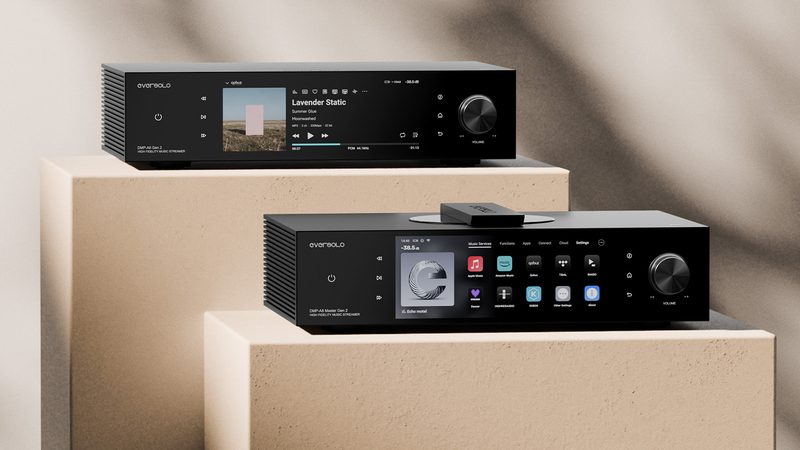
The two models share the same foundation: the same AKM conversion, the same display, and the same connectivity. The Master Edition adds an integrated CD drive for disc playback and ripping, a temperature-controlled OCXO clock for greater stability, and an external clock input that allows it to be integrated into a master-clock system. It is also slightly taller (98.5 mm versus 88 mm). On the standard version described here, CD playback is still possible, but via an external USB-connected drive.
Which SSD should I choose, and is installation complicated?
+
The enclosure supports a PCIe 3.0 NVMe M.2 SSD in 2280 format, with a capacity of up to 8 TB (single drive). The SSD is not included. It can be accessed without dismantling the entire chassis, and a screwdriver is even included in the box for the operation. There is no need to install one: the player works very well with a NAS or USB drive, with the internal drive mainly intended for those who want a self-contained, silent local source.
Can it be used solely as a transport for an external DAC?
+
Yes. The digital outputs include USB audio, the I2S link (eight modes), coaxial, optical, and AES/EBU on XLR, allowing you to feed a separate converter without using the internal conversion. The only USB requirement is that the intended DAC must comply with the UAC standard. The EOS engine then ensures bit-perfect output faithful to the source.
Should you choose Ethernet, Wi-Fi or SFP fiber?
+
Dual-band Wi-Fi 6 is sufficient for stable streaming, including at high resolution. For a large local library or to limit electrical interference from the network, a wired Ethernet connection remains safer, and the SFP fibre port goes further by galvanically isolating the player from the router and switches. However, the latter requires the purchase of a compatible module, sold separately.
Does the DMP-A8 Gen 2 decode MQA files?
+
Yes, MQA decoding is among the supported formats, alongside DSD (up to DSD512), PCM up to 768 kHz at 32 bits, and the usual FLAC, WAV and APE formats. Enough to play most high-resolution catalogs on the market without conversion.
User reviews
Pierre
Of course. Here’s an enthusiastic but credible review, without sounding too much like an advertisement:
I upgraded from the DMP-A6 Gen 2 Master to the DMP-A8 Gen 2 and, honestly, I don’t regret my choice at all.
In a word: everything is better. The build quality is superb, the unit feels solid and well-engineered, and the step up in quality is immediately noticeable. When listening, there’s even greater precision, dynamics, scale and naturalness. The soundstage is particularly beautiful, and the overall sound remains very enjoyable, even during long listening sessions.
The interface is still just as well-designed, smooth and intuitive, with a huge range of connectivity and adjustment options. I also really appreciate the quality of the preamp section, which allows you to drive a power amplifier directly and have a system that is both very capable and very streamlined.
Of course, the DMP-A8 Gen 2 is considerably more expensive than the DMP-A6 Gen 2 Master, but the difference goes beyond a few details. It really feels like moving up to a higher category and, in my opinion, you get your money’s worth.
An excellent purchase that I’m completely satisfied with. I would make the same choice again without hesitation.
Comment from 1 October 2026 — Experience from 20 September 2026
Automatically translated — Show original (French)
Bien sûr. Je te propose un avis enthousiaste mais crédible, sans tomber dans le commentaire trop publicitaire :
Je suis passé du DMP-A6 Gen 2 Master au DMP-A8 Gen 2 et, franchement, je ne regrette absolument pas mon choix.
En un mot : tout est mieux. La qualité de fabrication est superbe, l’appareil respire le sérieux et la montée en gamme est immédiatement perceptible. À l’écoute, on gagne encore en précision, en dynamique, en ampleur et en naturel. La scène sonore est particulièrement belle et l’ensemble reste très agréable, même lors de longues écoutes.
L’interface est toujours aussi réussie, fluide et intuitive, avec énormément de possibilités de connexion et de réglage. J’apprécie également beaucoup la qualité de la section préampli, qui permet d’attaquer directement un ampli de puissance et d’avoir un système à la fois très performant et très épuré.
Bien sûr, le DMP-A8 Gen 2 est sensiblement plus cher que le DMP-A6 Gen 2 Master, mais la différence ne se limite pas à quelques détails. On a vraiment le sentiment de passer dans une catégorie supérieure et, à mon avis, on en a pour son argent.
Une très belle acquisition dont je suis pleinement satisfait. Je referais le même choix sans hésiter.
To better understand our visitors, measure marketing effectiveness and personalise ads, we and our partners use cookies and mobile advertising identifiers on your device. This data makes it possible to display personalised and non-personalised ads and measure their performance. Some cookies, which are technically necessary, are exempt from consent. You can accept those that require your consent, refuse them by clicking “Reject”, or customise your choices via “More options”.
To find out how Google uses the data collected once you have given your consent, see Google’s Business Data Responsibility site (opens in a new window).
You can change or withdraw your consent at any time via the “Cookies” link. Your choices will apply on our site for 12 months.