

Audioquest Niagara 3000 + JAWS C13 2m
Audioquest Niagara 3000 and JAWS C13 power cable
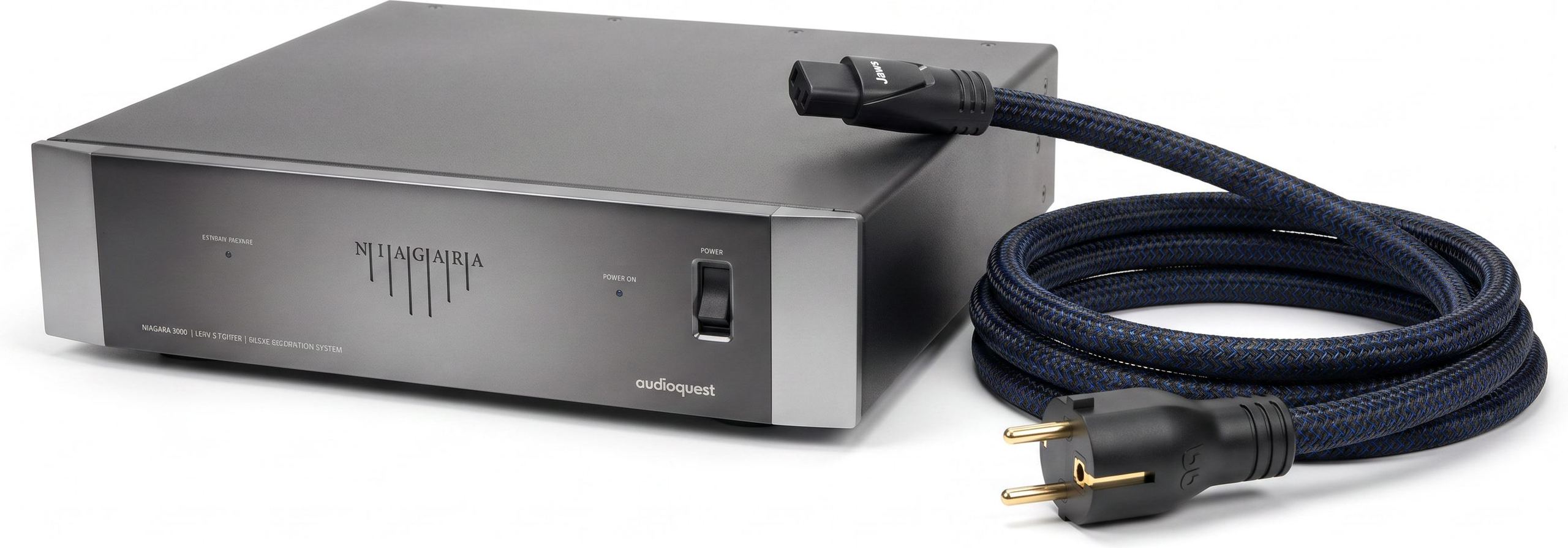
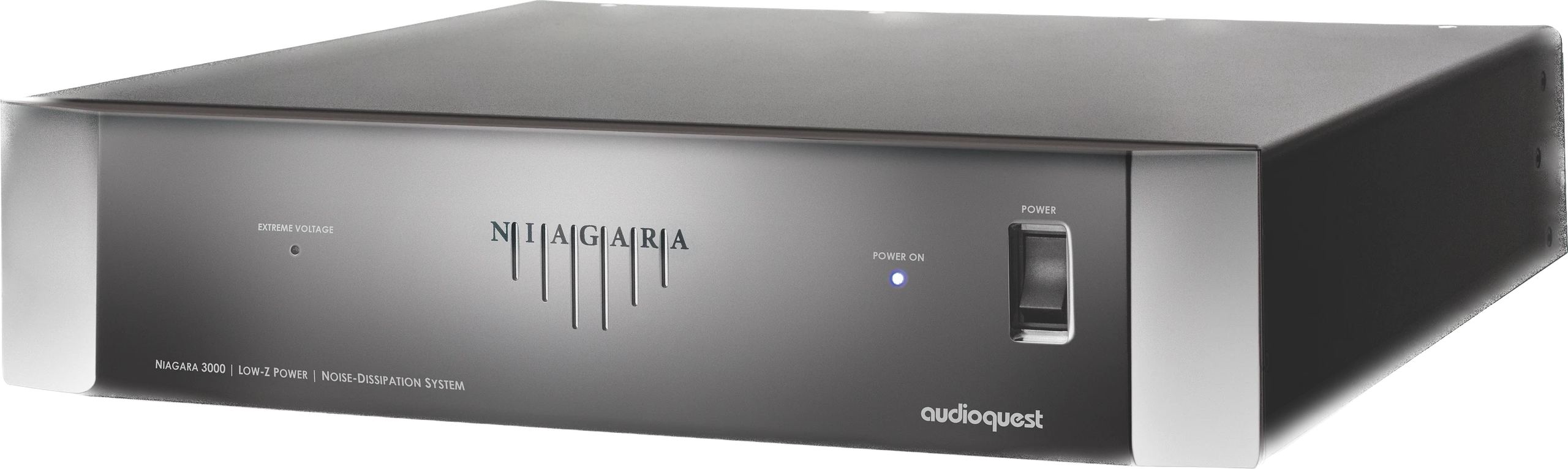
No power conditioner in the Niagara range is sold with its power cord. AudioQuest explains this choice: the cable connecting the unit to the wall outlet has too great an impact on the result to be selected lightly. This package settles the matter by pairing the Niagara 3000, the most compact of the three Niagara models, with the 2-metre JAWS C13, the latest power cable in the Wind Series. The former filters and distributes, the latter powers it.
Two high-current outlets and five filtered outlets
At the rear, there are seven Schuko outlets on the European version, divided into two groups that do not serve the same purpose. Five of them receive Level-X linear filtering, calibrated for components whose power consumption remains stable: network player, DAC, turntable, preamplifier. AudioQuest claims attenuation exceeding 24 dB over more than 21 octaves, up to 1 GHz.
The figure matters less than its consistency. A conventional mains filter acts strongly on certain frequencies and lets others through, with resonance peaks that colour the result instead of cleaning it up. The work of Garth Powell, AudioQuest’s chief engineer and designer of the range, focused on this linearity: uniform attenuation across all three conductors—live, neutral and earth—and throughout the treated band.
A 55-amp reserve for amplifiers
The remaining two outlets operate on a different principle. An amplifier does not draw power evenly: during a transient, a bass-drum strike or a piano attack, it demands far more current within a few milliseconds than its average consumption. If the power supply cannot keep up, the transient is clipped, and the ear perceives this as a lack of life rather than distortion.
The Niagara 3000’s transient power correction circuit stores energy in a high-capacity capacitor and delivers it on demand: up to 55 amps peak for 25 milliseconds. A DC offset suppression circuit completes the package. The Niagara 5000 and 7000 increase this reserve to 90 amps, and the 7000 adds dielectric-biased symmetrical isolation transformers, which the 3000 does without.
Dissipating noise travelling through earth
The earth wire protects against electrical faults. It also picks up radio interference like an antenna, and this interference bypasses the power supplies of components to couple directly with the most sensitive circuits. This is the starting point for AudioQuest’s patented ground-noise dissipation system, present on all seven Niagara 3000 outlets in the form of three controlled-direction stages.
The manufacturing care follows the same logic. Internal wiring and inductors use direction-controlled PSC+ copper, the filtering capacitors undergo prior electrical forming, and the contacts of both inlets and outlets are silver-plated over high-purity copper to maintain strong contact pressure.
Protection that does not sacrifice itself
Most household surge protectors rely on varistors that wear out with every clipping event and eventually fail without warning. The Niagara 3000 uses non-sacrificial protection: it withstands repeated surges of up to 6,000 volts and 3,000 amps, the maximum likely to pass through a building’s electrical panel, without degradation of its components. Daily micro-surges, less spectacular but far more frequent, are handled in the same way.
A second device monitors the input voltage and cuts the outputs as soon as it exceeds approximately 275 volts on 220-240 V versions, with a response time of around a quarter of a second and automatic reconnection as soon as it returns to a safe value. A significant voltage drop triggers the same shutdown.
Two functions are deliberately absent: the Niagara 3000 does not regulate voltage and does not regenerate the sine wave. AudioQuest stands by this position, considering that the mains waveform matters little since every component converts it to DC anyway, and that the real problem remains the noise passing through power supplies.
The cord connecting the package to the wall
AudioQuest explains its refusal to include a cord without hesitation: putting a low-end cable in the box of a component at this level would restrict it from the outset, and would impose a length that will not suit every installation. The brand simply specifies the technical requirement: its 15 A models require an IEC C13 connector, while 20 A models require a C19. The Niagara 3000 has a C14 inlet and therefore requires a cable terminated in C13.
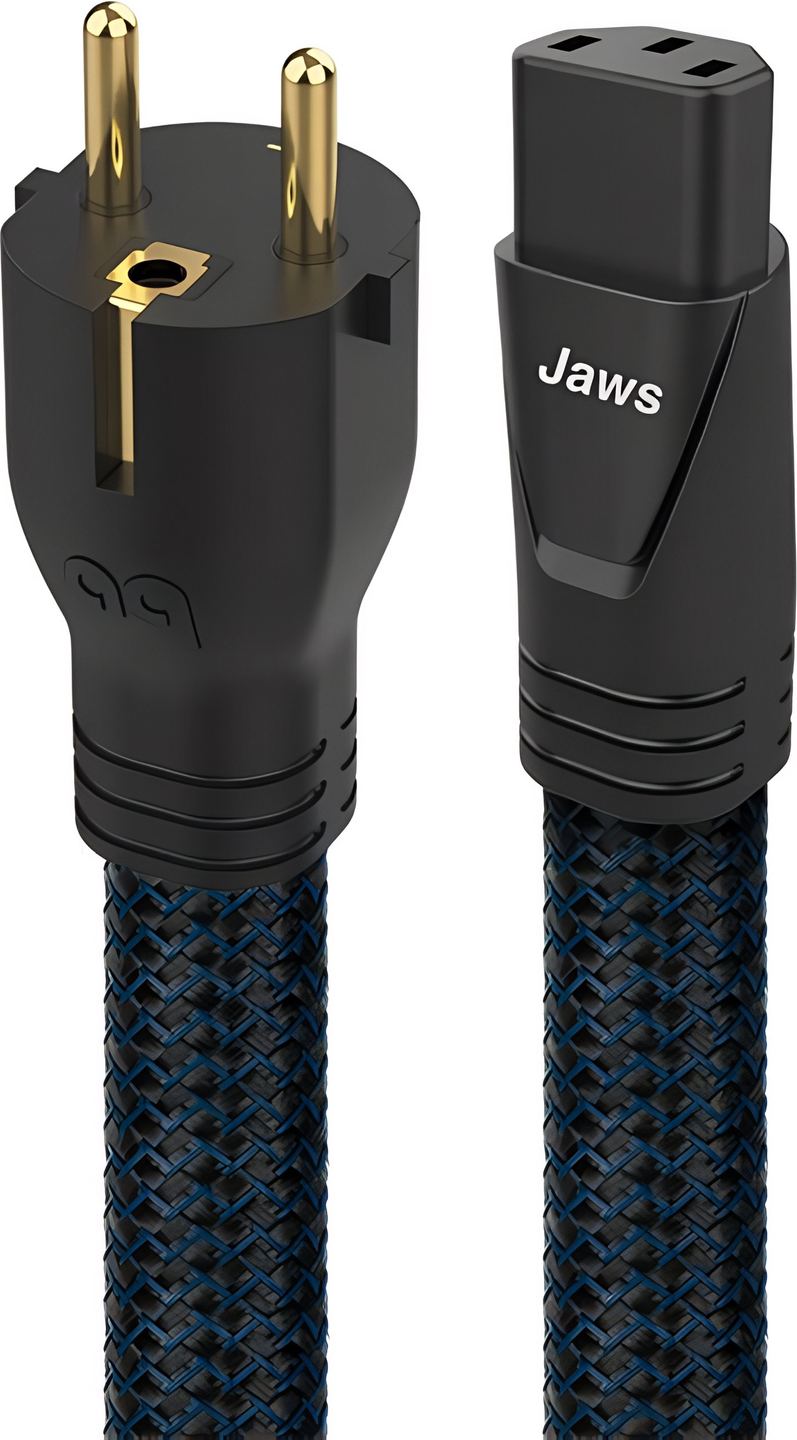
That is the role of the JAWS supplied here, in a 2-metre version, with a Schuko plug on the wall side. It handles 16 A RMS at 220-240 V, matching the rating of a dedicated circuit in a French installation. AudioQuest recommends keeping it short without overdoing it: two metres provide the necessary slack to reach the wall outlet from a cabinet or rack, without straining the connectors.
One final argument justifies the pairing. The conductors in AudioQuest cables are direction-controlled, with the direction indicated by arrows on the connectors, and this orientation is aligned with the dissipation system fitted to the Niagara 3000. The cable drains interference in the same direction as the component it powers.
Solid PSC+ conductors and graphene shielding
The JAWS succeeds the Monsoon, long the best-selling power cable in the Wind Series. The Monsoon combined an outer layer of PSC+ copper with a Long-Grain Copper core. The JAWS moves to 100% PSC+, copper treated using an in-house process to achieve the smoothest possible surface, with fewer solid conductors of larger cross-section: 2 × 3.31 mm² for live and neutral, 1 × 2.08 mm² for earth. Fewer strands mean fewer interactions between them and less transient intermodulation distortion.
The shielding also evolves: four layers, including one made of graphene, whose conductivity and absorption capacity dissipate high-frequency interference before it reaches the component’s ground. Two in-house technologies complete the picture. ZERO-Tech cancels the cable’s characteristic impedance, so that a brief current draw is neither compressed nor slowed down. RF/ND-Tech relies on a common-mode phase-cancellation network and proprietary dielectrics to filter induced radio-frequency noise.
The trade-off of this design is obvious at first glance: an 18 mm outer diameter and a stiff cable that does not appreciate tight bend radii.
Niagara 3000 Power Conditioner
Signal Filtering and Processing
- Patented background noise dissipation on all outlets
- Noise attenuation: > 24 dB over 21 octaves (20 kHz to 1 GHz)
- Surge protection clamping voltage: 140 V AC
Connectivity
- 2 high-current power outlets
- 5 filtered power outlets
- 1 IEC input
Power Supply
- Supply voltage: 100-250 V AC, 50-60 Hz
- Rated current: 20 A RMS
- Maximum current: 55 A peak
Physical Specifications
- Dimensions (W × H × D): 44.5 × 9.7 × 38.6 cm
- Weight: 13.1 kg
JAWS C13 2 m Power Cable
Conductors and Materials
- Solid PSC+ (Perfect-Surface Copper+) copper conductors
- Very high-purity copper for improved RF noise dissipation
- Solid conductor design limiting interactions between strands
- Reduced dynamic distortion
- Optimized cross-sections
- Live and neutral: 2 × 3.31 mm²
- Ground: 1 × 2.08 mm²
- Directional conductors and RF drain wires
- Controlled conductor orientation to direct interference away from sensitive circuits
Proprietary Technologies
- ZERO-Tech (zero characteristic impedance)
- Eliminates impedance mismatch effects for uncompressed current transfer
- RF / ND-Tech (Radio-Frequency Noise Dissipation)
- Radio interference dissipation system over a wide bandwidth
- Ground Noise Dissipation (GND)
- Multi-layer shielding system (4 layers including graphene) to effectively reduce ground noise
Connectivity and Power
- High-quality power connectors: EU Schuko to IEC C13
- Supported current: 16 A RMS at 220-240 V (50 / 60 Hz)
Construction and Dimensions
- Outer diameter: 18 mm
- Optimized geometry to minimize internal electrostatic fields
- High-performance insulation for power signal stability
Audio Benefits
- Significant reduction in background noise
- Improved dynamics and micro-detail
- Greater power signal stability
- Cleaner, more precise soundstage
Frequently asked questions
Should the power amplifier be plugged into the Niagara 3000 or directly into the wall?
AudioQuest is unequivocal: use the Niagara 3000, and one of its two high-current outlets. The brand is aware of the opposing argument, often put forward by amplifier manufacturers, that a power filter limits the available current. Its answer lies in the transient power correction circuit, which supplies the amplifier with instant low-impedance current rather than restricting it. The manufacturer recommends trying it both ways, taking care to switch off the Niagara 3000 when comparing it with the wall outlet.
Can the Niagara 3000 be connected to a power strip or another power conditioner?
No. AudioQuest formally advises against daisy-chaining two Niagara products: placing two linearized filters in series creates resonance modes and makes filtering uneven, which runs counter to the very principle of the range. The Niagara 3000 should be connected directly to a wall outlet, on a dedicated circuit if the installation allows.
Does the Niagara 3000 protect against a power outage?
No, it has neither a battery nor an inverter. In the event of a severe voltage drop, it cuts off its outputs and automatically switches back on as soon as the voltage returns to a usable level. Its role is to deal with noise and power surges, not to maintain the power supply.
Does filtering also benefit the picture?
AudioQuest states this, with one useful caveat: the improvement depends on the dynamics of the source signal. With a heavily compressed video stream, the benefit remains subtle. With a high-resolution, high-dynamic-range source projected onto a properly calibrated video projector, the difference becomes more noticeable.
What happens if the system consumes more than the set's capacity?
The Niagara 3000 is one of the 15 A models in the AudioQuest catalogue, hence its C14 inlet and the C13 connector on the supplied cable, which itself is rated for 16 A at 220–240 V. In a French installation, the actual limit most often comes from the circuit supplying the whole setup: the breaker in the electrical panel has the final say, before the capacity of the individual components.
Can the JAWS C13 power a device other than the Niagara 3000?
Yes, any device fitted with a C14 inlet—the most common in hi-fi and home cinema: integrated amplifier, CD player, DAC, network player. Current-hungry devices benefit the most. For C20 inlets, found on certain power amplifiers and power distributors, there is a C19 version of JAWS with an identical design.
Should the cables between the Niagara 3000 and the connected devices also be replaced?
It is not essential, but that is the direction the system’s logic is moving in. Common-mode noise dissipation works best when conductor directionality is controlled throughout the entire chain, from the wall outlet to the final component. The input cable remains the main lever, which explains why it is included here; replacing the interconnect cables is a later upgrade, component by component.
- Eco-contribution included in the sale price.
- Manufacturer reference: 092592197985
- GTIN / EAN: 92592197985








