

Furutech e-TP80ES NCF
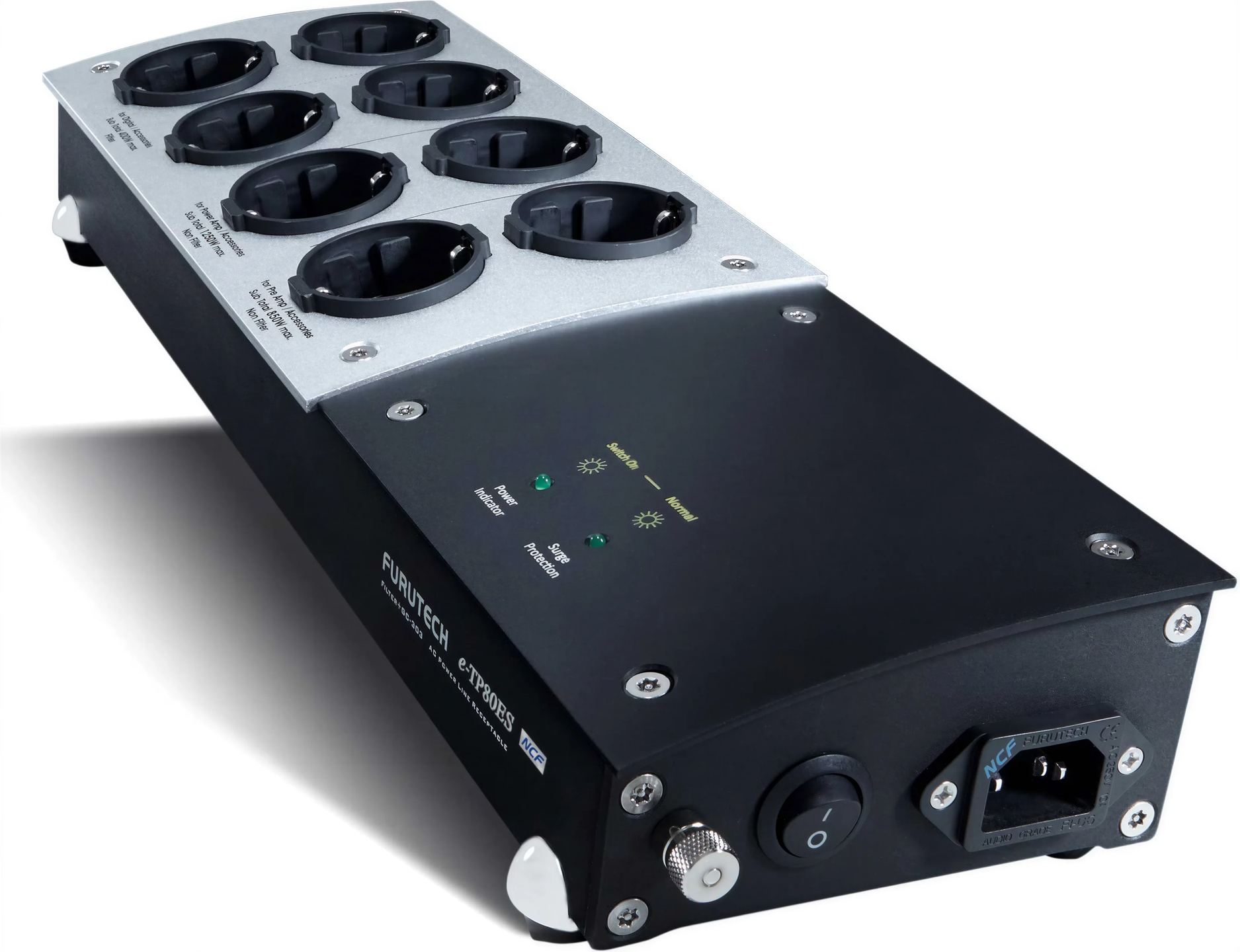
Furutech e-TP80ES NCF: distribute and filter mains power without restricting amplifiers
Clean mains power is not achieved by filtering everything indiscriminately. Filtering a power amplifier restricts the current it draws during transients; filtering nothing allows high-frequency noise from digital sources to spread throughout the entire system. Furutech addresses both issues at once by separating, within a single enclosure, four filtered outlets for sources and four direct outlets for amplifiers and analogue equipment.
Why separate filtered and direct outlets
The enclosure combines eight Schuko outlets, divided into two zones. Four receive EMI filtering and accommodate digital devices, which both generate high-frequency noise and are sensitive to it: streamers, network players, converters, internet boxes. The other four bypass the filter. Two are reserved for low-power analogue electronics, preamplifiers or phono preamps; the final two, with higher current capacity, are intended for power amplifiers, which need a direct path to draw current on peaks.
This is the meaning of the term “multimode” used by Furutech: filtered and direct outlets coexist rather than excluding one another. A filter placed in series adds impedance; on an amplifier demanding several dozen amps during a bass impact, this impedance can compress dynamics. Leaving the amplifier on a direct outlet avoids this, while cleaning up the power supply to the most exposed digital components. Furutech also offers distributors without any filter; the e-TP80ES adds a filtering stage and surge protection to this foundation.
EMI filter and surge protection
The filter attenuates by -20 to 92 dB across the 2 to 100 MHz range, where switch-mode power supplies and digital connections inject noise. Alongside it, a metal-oxide varistor (MOV) circuit clamps voltage spikes: it withstands up to 6,000 V peak, limits voltage to around 360 V, absorbs surge current of up to 4,500 A (8 × 20 μs waveform) and 40 J. An automatic circuit breaker covers overloads, while two LED indicators show power status and protection status.
One point should be clear: the varistor is a sacrificial component. A severe surge can wear it out, in which case the distributor continues to operate but restoring full protection requires replacing it, with the LED indicating the changeover. Another useful clarification: the enclosure filters and clamps; it does not regulate voltage level or reconstruct the sine wave, functions handled by a regulator or regenerator.
FI-E30 NCF outlets and FI-06 NCF input
The eight sockets are Furutech FI-E30 NCF models, with non-magnetic rhodium-plated phosphor bronze conductors. The choice of rhodium prioritises long-term contact stability over raw conductivity, a sensible trade-off for an outlet that is plugged and unplugged repeatedly. Power enters through an IEC FI-06 NCF(R) inlet: the power cord is detachable, and the upstream cable remains the user’s choice. Each outlet block receives a GC-303 coating that absorbs EMI interference. The bodies are made from audio-grade glass-fibre-reinforced nylon, RoHS-compliant, while the polycarbonate covers incorporate NCF material.
Internal wiring, chassis and shielding
Internal wiring uses Furutech μ-14 wire in 14 AWG (2 mm²), for low resistance from one end of the enclosure to the other. The chassis is made from painted aluminium alloy; it shields the interior from radio interference, while a layer of Formula GC-303 absorbs its electromagnetic components. The format remains low-profile and compact, approximately 400 × 130 × 60 mm and around 1.9 kg, a weight that reflects the density of its construction and fits behind or beside a cabinet.
Alpha treatment and NCF material
All metal parts undergo Furutech’s two-stage Alpha treatment. First comes deep cryogenic treatment, between -196 and -250 °C under liquid nitrogen or helium, which relieves internal stress in the conductors. This is followed by ring demagnetisation, so that the current path remains non-magnetic. NCF (Nano Crystal² Formula) material combines a crystalline compound, nanometre-scale ceramic particles and carbon powder; its piezoelectric behaviour damps vibrations and dissipates static charges. It is found on the outlet covers, while the insulating feet rest on a nano-ceramic composite with a damping material based on piezoelectric ceramic and carbon. The aim is mechanical: fewer micro-vibrations and resonances around the contacts.
Distributing your system across the eight outlets
During installation, wiring follows the two zones. Digital sources and anything with a switch-mode power supply go on the filtered outlets; the preamplifier and phono preamp on the direct analogue outlets; the power amplifier, or an active subwoofer, on the higher-current direct pair. The total power draw must remain below the enclosure’s limit, 2,500 W at 10 A and 250 V: comfortable for a stereo system or a modest home cinema setup, but tighter once several large amplifiers are delivering power simultaneously. In terms of electrical safety, dielectric withstand voltage is 1,500 V AC for one minute at 5 mA, insulation resistance exceeds 300 MΩ at 500 V DC, and leakage current remains below 1 mA.
Documentation
Technical Specifications
General
- Type: multimode AC mains filter and distributor
- Model: e-TP80ES NCF
- Compliance: RoHS
Electrical Specifications
- Rated voltage: 250 V AC
- Rated current: 10 A
- Maximum power: 2500 W
- Dielectric strength: 1500 V AC / 1 minute / 5 mA
- Insulation resistance: > 300 MΩ at 500 V DC
- Leakage current: < 1.0 mA
Mains Outlets
- Total number: 8 Schuko outlets
- Filtered outlets: 4
- Unfiltered outlets: 4
- Outlet model: Furutech FI-E30 NCF Schuko, high-end audio grade
- Outlet conductors: non-magnetic phosphor bronze
- Plating: rhodium
- IEC inlet: Furutech FI-06 NCF(R)
Filtering and Protection
- EMI filter: -20 to 92 dB (2 to 100 MHz)
- Surge protection: automatic circuit
- Maximum peak voltage: 6000 V
- Maximum clamping voltage: 360 V (8 × 20 μs)
- Maximum surge current: 4500 A (8 × 20 μs)
- Energy absorbed: 40 J (2 ms)
- Overload protection: automatic circuit breaker
- LED indicators: surge protection, power
NCF Technology
- Technology: Nano Crystal² Formula (NCF)
- Composition: crystalline material, nanometric ceramic particles and carbon powder
- Function: electrical and mechanical damping
- Effect: reduction of vibrations, static electricity and resonances
Internal Wiring and Treatment
- Internal wiring: Furutech μ-14, 14 AWG
- Metal parts treatment: Furutech Alpha Process
- 2-stage cryogenic treatment
- Demagnetization
- Internal coating: Formula GC-303 EMI interference-absorbing
Insulation and Damping
- Outlet material: special audio-grade nylon / fiberglass, RoHS compliant
- Outlet cover: polycarbonate with NCF material
- Insulating feet: composite based on nano-ceramic particles
- Damping material: piezoelectric ceramic and carbon
Chassis
- Material: aluminum alloy
- Finish: painted aluminum
- RFI protection: shielded chassis
- Dimensions: approximately 400 × 130 × 60 mm
- Net weight: approximately 1.9 kg
Frequently Asked Questions
Should the power amplifier be plugged into a filtered or direct outlet?
On a direct, unfiltered outlet. These outlets let the amplifier draw all the current it needs during peaks, without the impedance added by a series filter. The two higher-amperage direct outlets are specifically intended for this use, while digital sources benefit from the filtered outlets.
Does the e-TP80ES NCF regulate the mains voltage?
No. It attenuates high-frequency noise and clamps voltage surges, but it does not correct the voltage level or reshape the sine wave. A device that stabilizes or regenerates the voltage belongs to a different product category.
What happens after a major power surge?
The protective component, a varistor, is sacrificial: a severe event can consume it, and the LED indicator then shows the protection status. Power distribution continues to operate, but restoring full protection requires replacing the varistor. This is how an MOV circuit works.
What total power can it supply?
The total load of all connected devices remains capped at 2,500 W, or 10 A at 250 V. A reasonably sized stereo system or home theater system will work without issue; the margin decreases as soon as several high-power amplifiers draw current at the same time.
What is the difference between the e-TP80S and the e-TP80ES?
The suffix identifies the intended market. The e-TP80S is fitted with North American NEMA outlets (125 V, 15 A, 1,875 W), while the e-TP80ES has European Schuko outlets (250 V, 10 A, 2,500 W). The filtering and protection electronics are identical.
How does it attach to the wall?
Via a detachable cable, connected to its IEC FI-06 NCF(R) inlet. Since the cord is not fixed, each user can choose the mains cable that powers the unit.
What are NCF material feet and caps used for?
Mechanical damping. The NCF in the covers and the nano-ceramic composite in the feet absorb some of the micro-vibrations and resonances that reach the contacts, and dissipate static charges. This is a treatment of the support and enclosure, distinct from the electrical filtering provided by the internal circuit.
- Eco-contribution included in the sale price.




