

EarMen CH-Amp Signature
Specifications and features


EarMen CH-Amp Signature: DAC, headphone amplifier and preamplifier
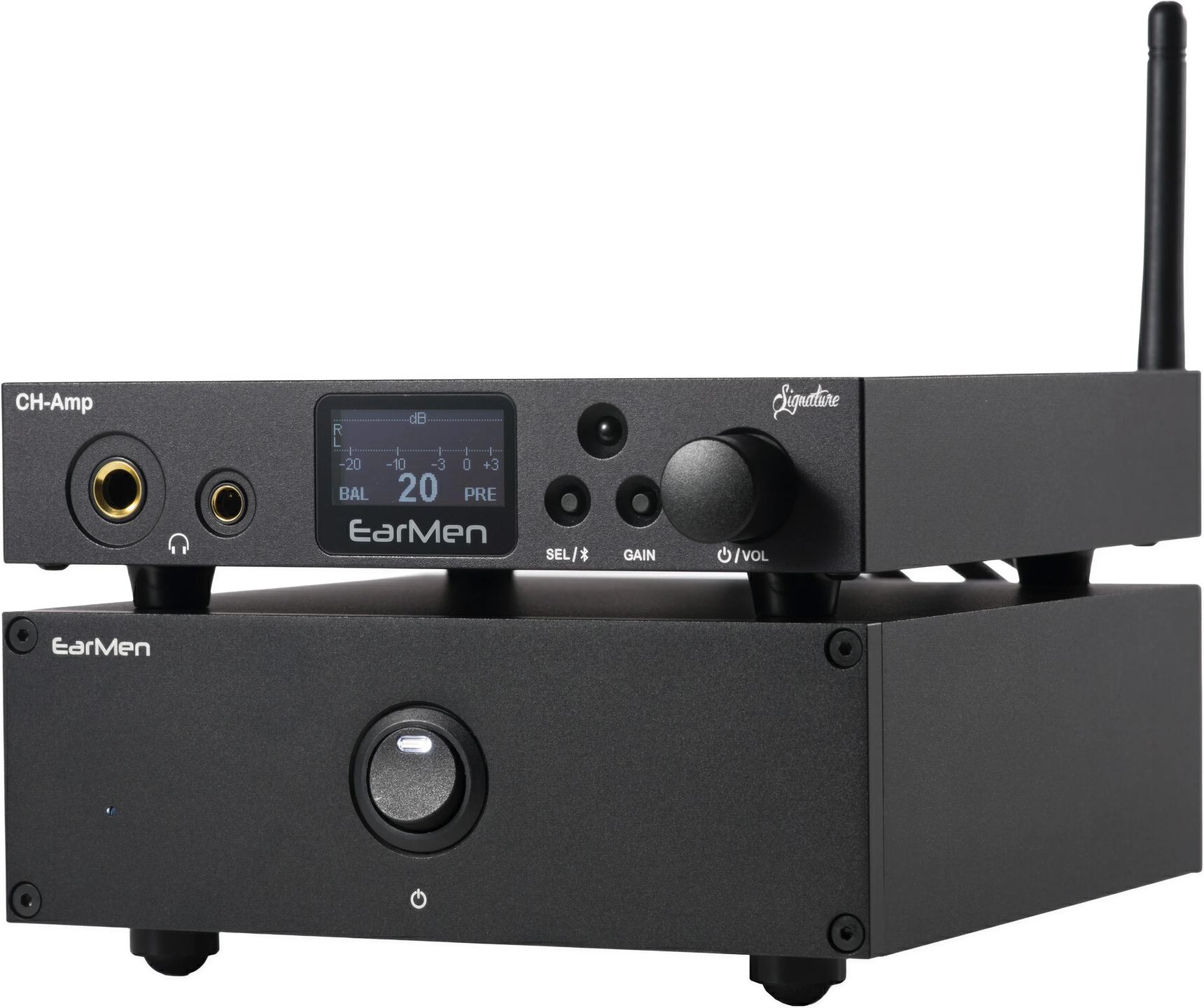
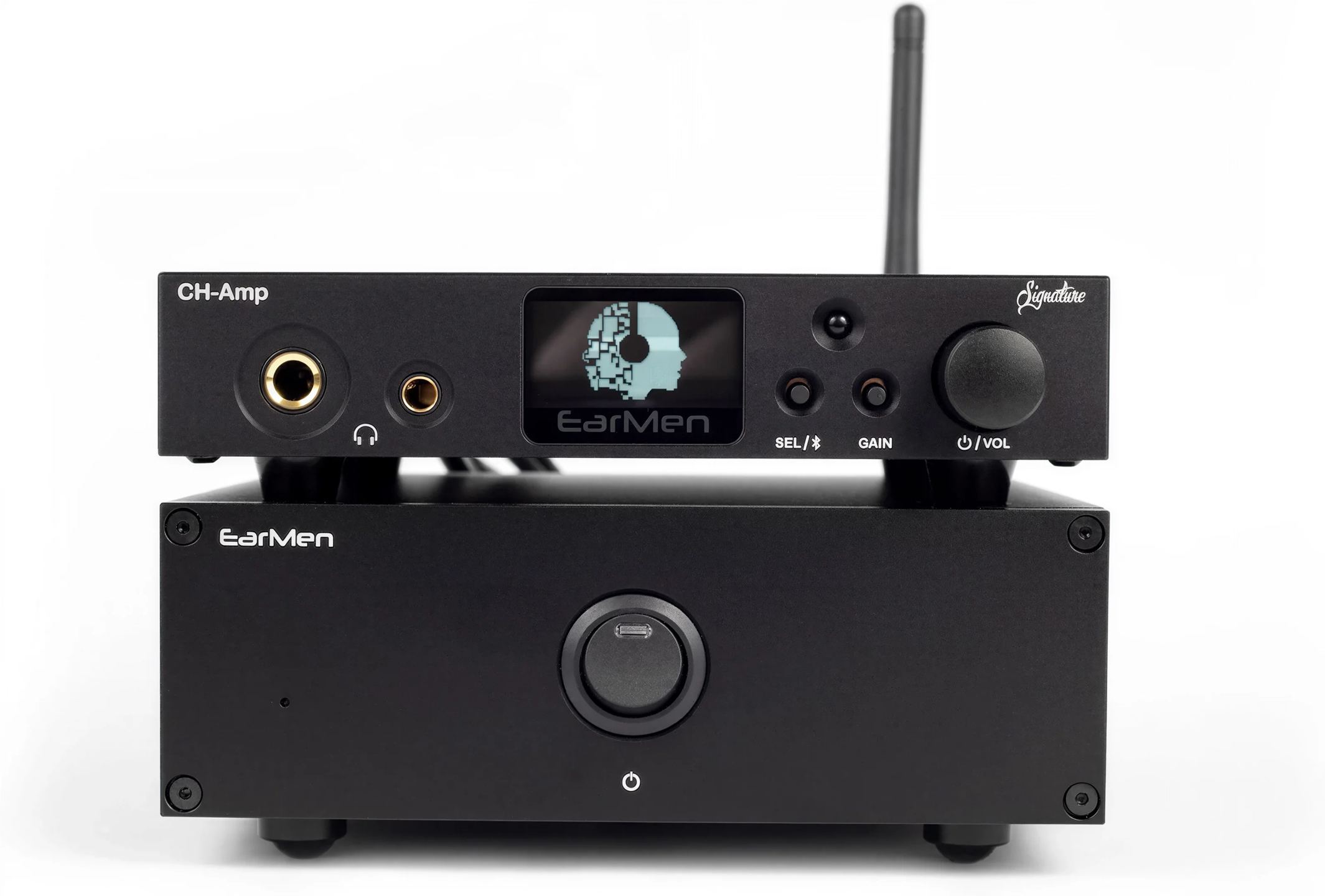
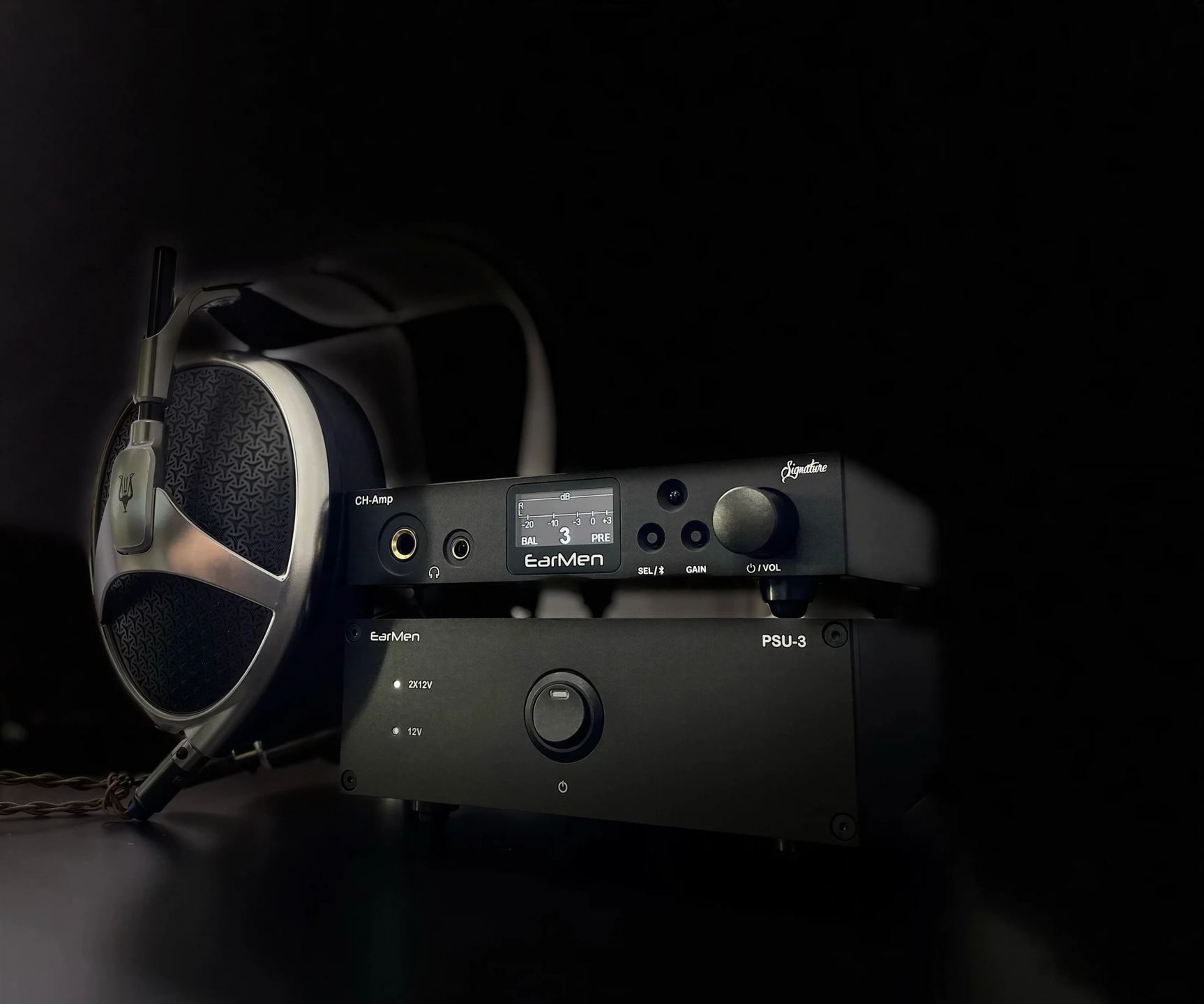
Bringing together a DAC, a balanced headphone amplifier and a preamplifier in a 15 cm square enclosure, with the power supply housed in a separate case: this is the challenge taken on by the Signature version of the CH-Amp. The original model only amplified, supported by a Tradutto DAC and a separate network player. Here, the digital source is built in, including Bluetooth input, while retaining the small OLED VU meter display on the front panel.
An ESS9038 DAC powered by a separate power supply
Digital conversion is handled by an ESS Sabre ES9038 chip, featuring the brand’s HyperStream II modulator and time-domain jitter eliminator. Via the USB-C input, the CH-Amp Signature reads PCM files up to 32-bit/768 kHz and DSD up to DSD512. On paper, this DAC achieves a dynamic range of nearly 140 dB; in the enclosure, the balanced 4.4 mm output delivers 123.5 dB, its best value.
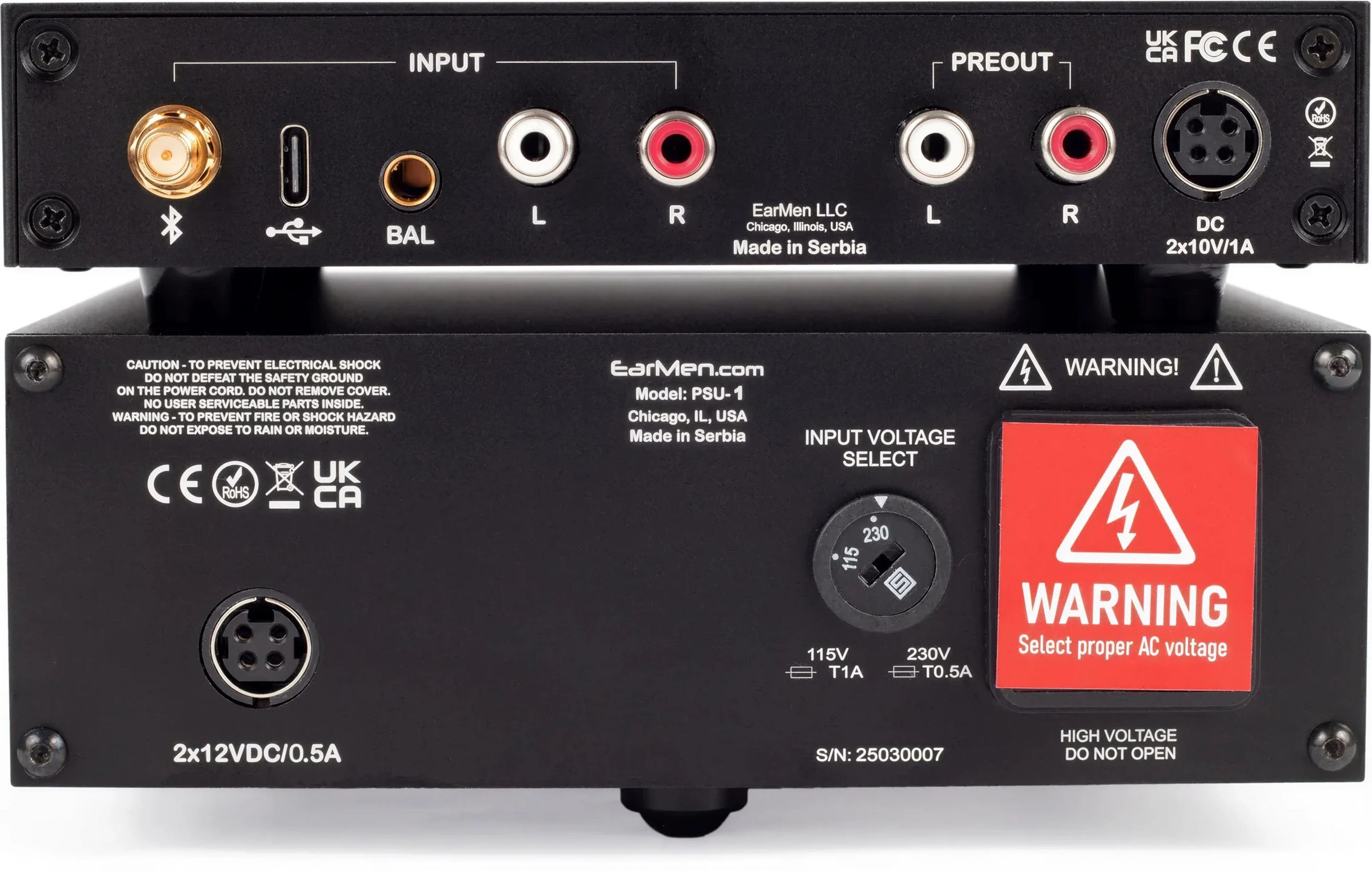
The power supply does not share the chassis. It occupies a second enclosure, connected via DC, with a 115 or 230 V voltage selector to set before making any connections. This type of linear power supply avoids the high-frequency noise of switching power supplies, at the cost of greater weight and size: the power supply enclosure alone weighs nearly 1.6 kg, compared with 550 g for the main enclosure, each measuring 15 cm square.
Two headphone outputs, two power levels
The two headphone outputs are located on the front panel: an unbalanced 6.35 mm jack and a balanced 4.4 mm jack. Switching to balanced operation doubles voltage and power. Unbalanced, the CH-Amp Signature delivers 6 Vrms and 1.1 W into 32 ohms; with the balanced 4.4 mm output, it delivers 9.5 Vrms and 2.8 W into the same load. Harmonic distortion remains below 0.005% regardless of the input, dropping to 0.001% on the unbalanced output with line input.
This power reserve is suitable for both sensitive IEMs and demanding planar headphones. The balanced 4.4 mm output also provides a higher signal-to-noise ratio, up to 123.5 dB, compared with 115 dB unbalanced.
Three gain settings, including an IEM mode
The gain button cycles through three settings: low, high and an IEM mode. The latter switches to a low-noise circuit dedicated to sensitive IEMs, whose high sensitivity makes even the slightest hiss noticeable on an overly powerful amplifier. Low gain is sufficient for easy-to-drive headphones, while high gain is for power-hungry models. Adjustment is made from the front panel or the remote control.
Headphone amplifier, then preamplifier when headphones are unplugged
At the rear, a pair of RCA connectors serves as both line output and preamp output. Switching is automatic: with headphones connected, the headphone output operates and the display shows the gain; when headphones are removed, the display switches to “Pre” and the rear output takes over to feed active speakers or a power amplifier. This output follows the volume knob, allowing the level of a speaker system to be controlled from the CH-Amp Signature. To protect downstream equipment, the volume drops to zero as soon as the headphones are unplugged.
Inputs: USB-C, Bluetooth and two analogue inputs
Four inputs share the rear panel. USB-C receives the main digital source, a computer or compatible source. The high-resolution Bluetooth input, with its supplied antenna, enables a wireless connection; the pairing button starts the search once this input has been selected. Two analogue inputs remain: a balanced 4.4 mm input and an unbalanced RCA input, for connecting a line-level source. The selection button cycles through the sources, and the CH-Amp Signature remembers the last one used: when switched on again, it returns to it.
OLED display, control knob and rechargeable remote control
The front-panel OLED display shows the channel, gain and volume, with a VU meter. At first startup, the logo appears before this information. The right-hand control knob combines functions: short press to switch on, long press to switch off, rotation for volume on a scale from 0 to 30, short press to mute, with the level then returning to its previous value. Two adjacent buttons manage source and gain, and an infrared receiver responds to the remote control.
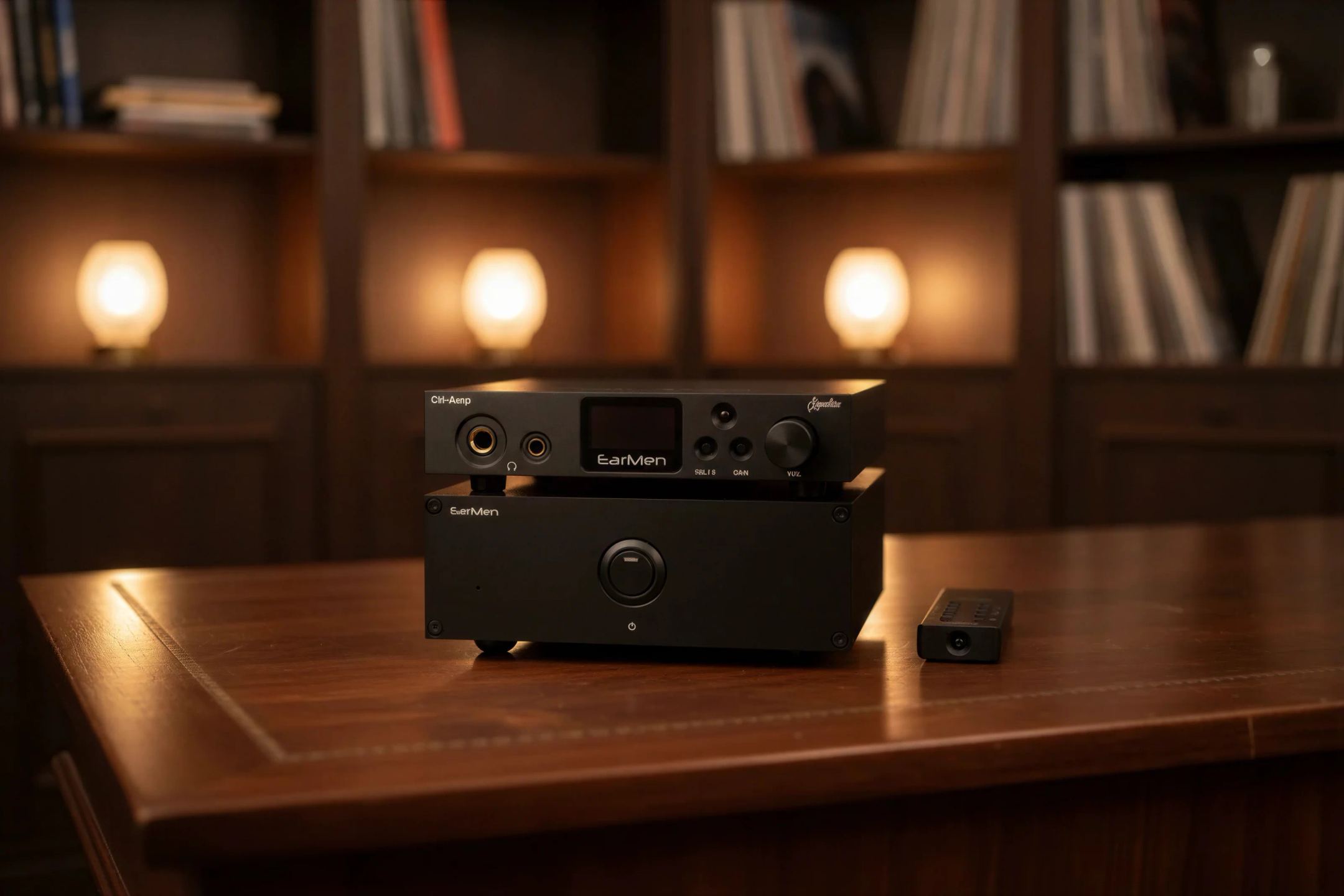
This remote control is machined from a solid block of aluminium and incorporates a rechargeable battery, with no batteries to replace. It controls power, mute, source selection, volume, Bluetooth pairing and gain. An LED indicates its status: green when active, solid red while charging, flashing red when the battery is empty.
Documentation
Technical Specifications
Design
- Desktop DAC, headphone amplifier and preamplifier
- Fully balanced architecture
- Machined aluminum chassis
- OLED display with VU meter
- Preamplifier function: active line output when headphones are unplugged
- Dedicated external linear power supply, in a separate enclosure
Digital Conversion
- ESS Sabre ES9038 converter, HyperStream II architecture
- Supported formats
- PCM up to 32 bits / 768 kHz
- DSD up to DSD512
Connectivity
- Inputs
- 1 USB-C audio input
- 1 high-resolution Bluetooth input, antenna included
- 1 balanced 4.4 mm jack analog input
- 1 unbalanced RCA analog input
- Outputs
- 1 unbalanced 6.35 mm jack headphone output
- 1 balanced 4.4 mm jack headphone output
- 1 unbalanced RCA pre-out and line output
Unbalanced 6.35 mm Headphone Output
- Output level: 6 Vrms
- Power: 1.1 W into 32 ohms
- THD+N: 0.001% to 0.003% depending on the input
- Frequency response: ±0.004 dB
- Signal-to-noise ratio: 115 dB
Balanced 4.4 mm Headphone Output
- Output level: 9.5 Vrms
- Power: 2.8 W into 32 ohms
- THD+N: 0.003% to 0.0045% depending on the input
- Frequency response: ±0.003 dB
- Signal-to-noise ratio: up to 123.5 dB
Unbalanced RCA Pre-out
- Output level: 3.4 Vrms
- THD+N: 0.002% to 0.003% depending on the input
- Frequency response: ±0.005 dB
- Signal-to-noise ratio: 115 dB
Controls
- Volume knob serving as power on / off switch, volume from 0 to 30
- Mute with a short press on the knob
- Source selection button
- Three-position gain selector
- Low gain
- High gain
- IEM mode with low-noise circuit for sensitive in-ear monitors
- Infrared receiver for remote control
Power Supply
- Dedicated external linear power supply, in a separate enclosure
- 115 or 230 V mains voltage selector
- DC connection to the device
Dimensions and Weight
- Device
- Dimensions (w x h x d): 15 x 3 x 15 cm
- Weight: 550 g
- Power supply
- Dimensions (w x h x d): 15 x 6 x 15 cm
- Weight: 1.59 kg
Included Accessories
- External linear power supply
- Rechargeable machined aluminum remote control
- User manual
Frequently asked questions
How does the CH-Amp Signature differ from the original CH-Amp?
The first-generation CH-Amp was a headphone amplifier only, to be paired with a separate DAC and network player. The Signature version integrates the DAC, adds Bluetooth input and preamp functionality, and retains the external linear power supply. The entire system fits into a single chassis, whereas several components previously had to be stacked.
Do I need to adjust anything on the power supply before connecting it?
Yes. The voltage selector on the back of the power supply unit must be set to 115 or 230 V depending on the mains supply, before making any connection. This unit also has its own on/off switch and output indicator, separate from the knob on the main enclosure.
Can a turntable be connected to the RCA input?
The RCA input operates at line level: it expects an already amplified source. A turntable therefore requires a phono preamp, either built into the turntable or added between the two. Without it, the level would be too low and RIAA correction would be absent.
Can the preamp directly power speakers?
Not passive speakers: the rear output is a line-level preamp output, not a power amplifier. It drives active speakers, which have their own amplification built in, or a power amplifier placed downstream. The volume of these speakers is then adjusted using the knob.
Can the Bluetooth input be used for listening with wireless headphones?
No. The CH-Amp Signature’s Bluetooth is an input: it receives sound from a phone or computer to play it through wired headphones or connected speakers. It does not transmit to Bluetooth headphones.
What is the maximum resolution via the USB input?
The USB-C input accepts PCM up to 32-bit and 768 kHz, and DSD up to DSD512. The analog inputs pass the signal through as is, while the Bluetooth connection remains dependent on the wireless connection, which has more limited bandwidth than a wired connection.
Should you choose the 6.35 mm output or the balanced 4.4 mm output?
The balanced 4.4 mm output delivers more voltage and power, with a higher signal-to-noise ratio: it makes sense for demanding headphones or those fitted with a balanced cable. The unbalanced 6.35 mm output remains the most common format and is sufficient for most headphones. The choice mainly depends on the cable plug and how difficult the headphones are to drive.
- Eco-contribution included in the sale price.


