

Line Magnetic LM-216IA plus
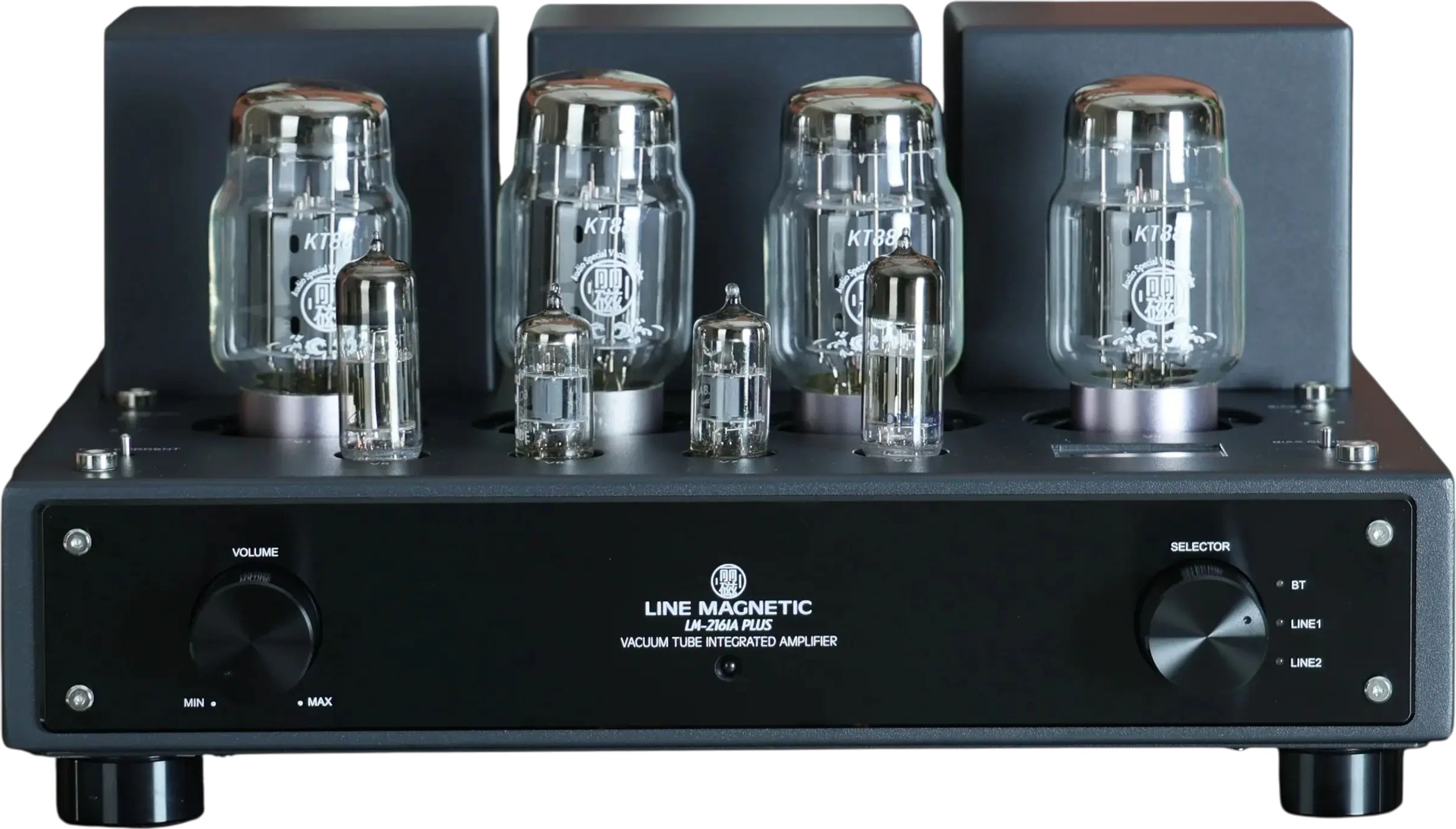
Line Magnetic LM-216IA plus, a redesigned KT88 push-pull
An integrated tube amplifier that built its reputation on four KT88 tubes in push-pull: that is the starting point. This plus version retains the principle while redesigning its input stages. New preamplification and driver tubes, output increased to 45 watts per channel, input sensitivity raised to 340 mV. The class AB design and all-in-one format remain, while the power reserve increases.
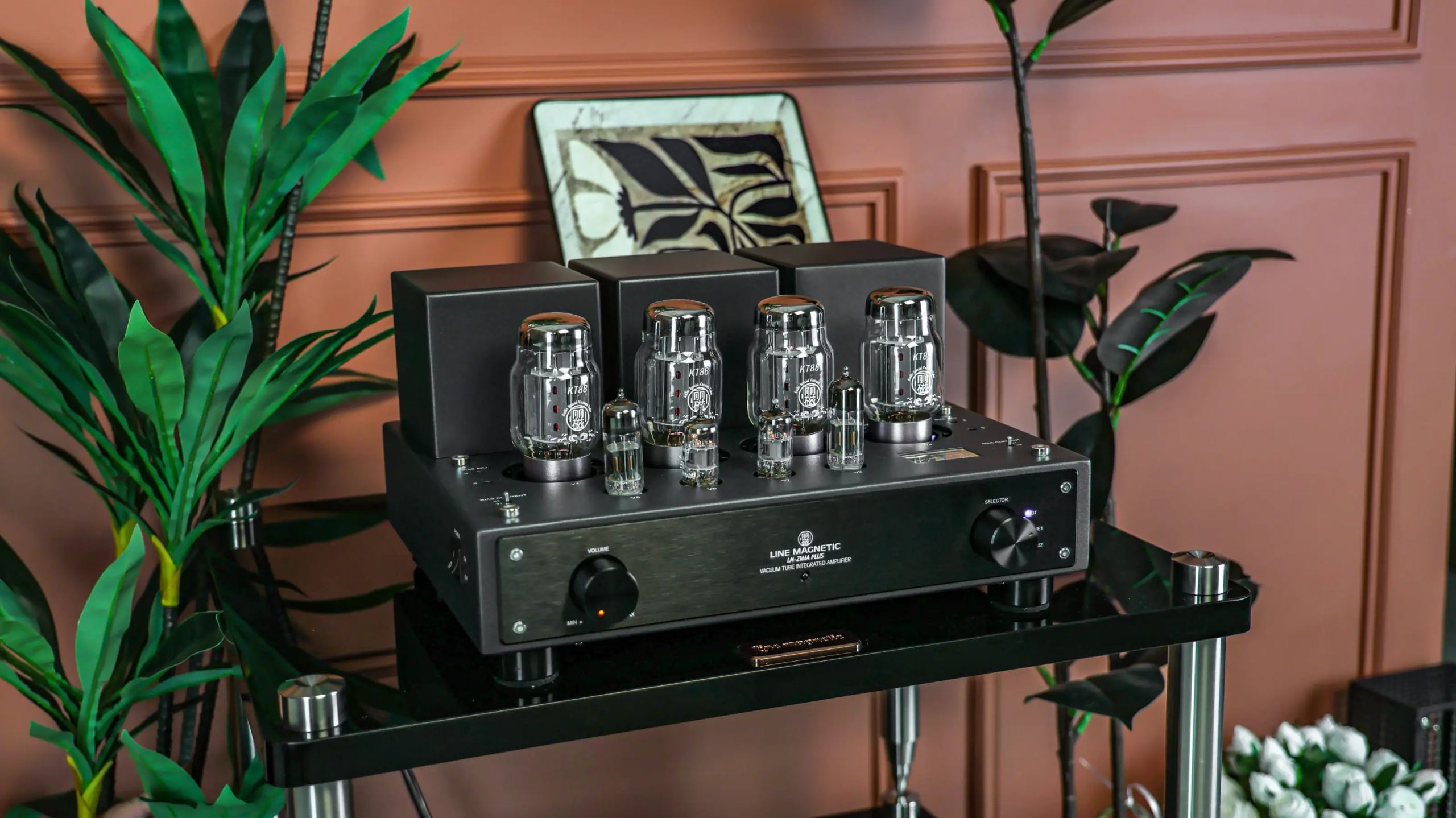
Four KT88 tubes in class AB push-pull
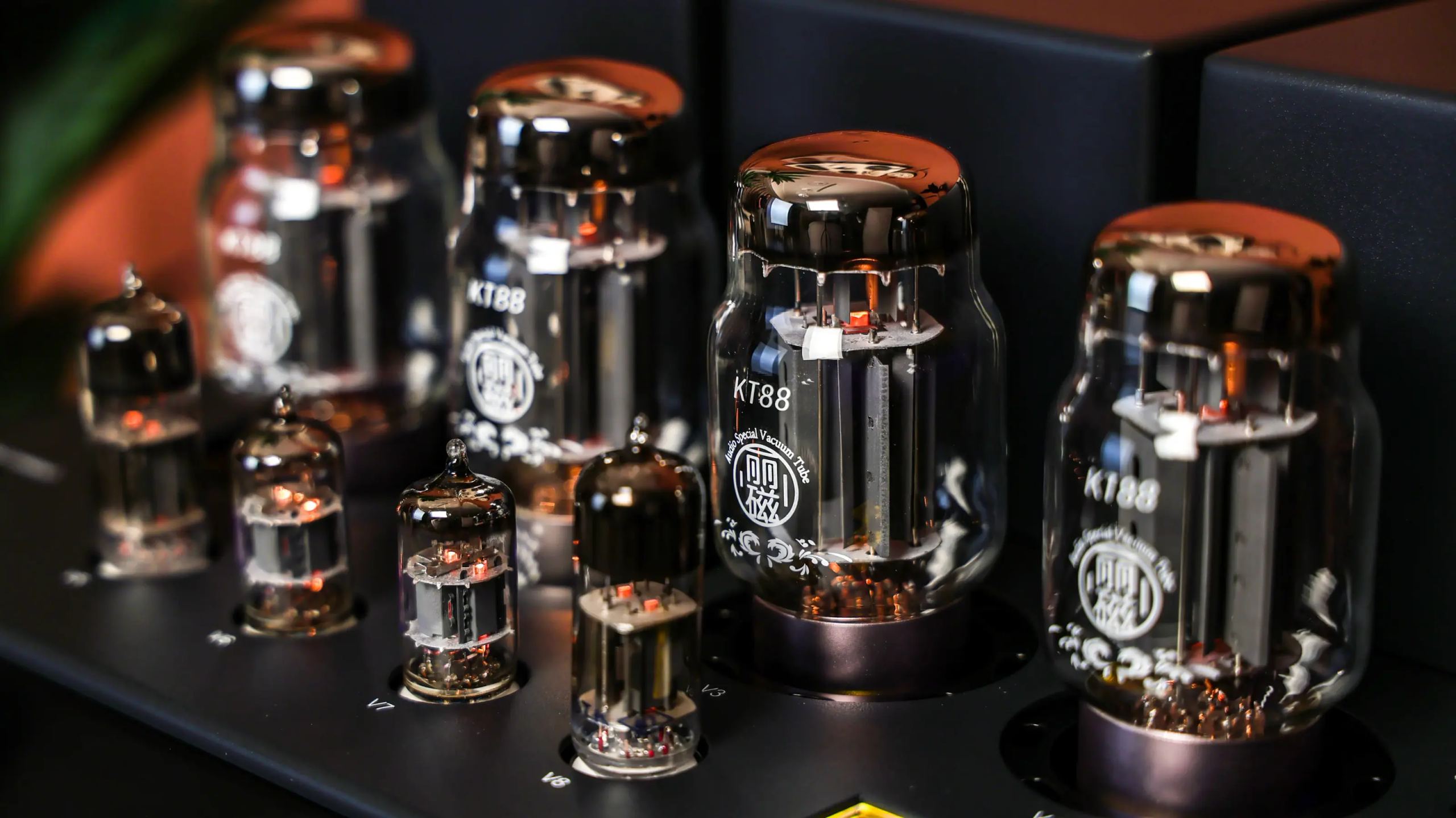
The power section relies on a quartet of KT88 tubes, two per channel, configured in push-pull. The principle: in each channel, two tubes operate in phase opposition, one handling the positive half-cycle of the signal, the other the negative half-cycle. This symmetry cancels part of the distortion and doubles the available power compared with a single-tube design. The KT88 is a power tube known for its bass control and ability to deliver current, which helps drive somewhat demanding speakers.
Class AB operation explains the claimed 45 watts per channel. On paper, this figure may seem modest compared with transistor amplifiers, but a tube watt behaves differently as it approaches saturation, with more gradual clipping. Still, 45 watts require speakers with decent sensitivity to perform at their best, a point I return to below.
The triode or ultra-linear selector
A front-panel switch moves the KT88 tubes from one operating mode to the other. In ultra-linear mode, the amplifier delivers all its power and grip, making it suitable for highly dynamic music and speakers that need drive. In triode mode, power decreases but the midrange gains smoothness and finesse, a setting that Line Magnetic associates with vocals, strings, and acoustic ensembles.
Switching from one to the other changes the sound character without touching the rest of the system. It is a simple way to tailor the amplifier to a record or the mood of the moment, rather than a gimmick.
Redesigned input tubes
This is where the plus version differs from the original amplifier. The small signal is no longer handled by the same tubes: two 12AU7 and two 6H6π tubes provide voltage amplification and drive the power tubes. This new combination can push the KT88 tubes harder, hence the 45 watts per channel.
It also changes what the amplifier requires from the source. Input sensitivity rises to 340 mV, meaning the voltage a player or preamplifier must provide to bring the amplifier to its rated output. The value remains standard for modern sources: a network player, a DAC, or a turntable through a phono preamp can reach it without difficulty.
Point-to-point wiring and manual biasing
Construction follows Line Magnetic’s in-house method: point-to-point wiring, also called free-air wiring, where components are connected by hand without a printed circuit board. It takes longer to produce, is easier to repair, and avoids etched traces between stages. The volume potentiometer is a motorized ALPS unit, the coupling capacitors are Realcap models, and the tubes sit on steatite sockets, a heat-resistant ceramic. The transformers are hand-wound EI types. The unit weighs nearly 20 kilograms in a compact 37.6 cm-wide format, with most of the weight coming from the transformers and chassis.
The power tube bias is adjusted manually. A backlit VU meter on the front panel and adjustments on top of the chassis are used to set the idle current of each KT88, tube by tube. The operation is simple once the logic is understood, but it requires checking from time to time and readjustment whenever tubes are replaced. This is the trade-off of a design without automatic biasing: a little more attention in exchange for direct access to the adjustment. At switch-on, a delay of around thirty seconds allows the tubes to warm up before the signal passes through, protecting the electronics.
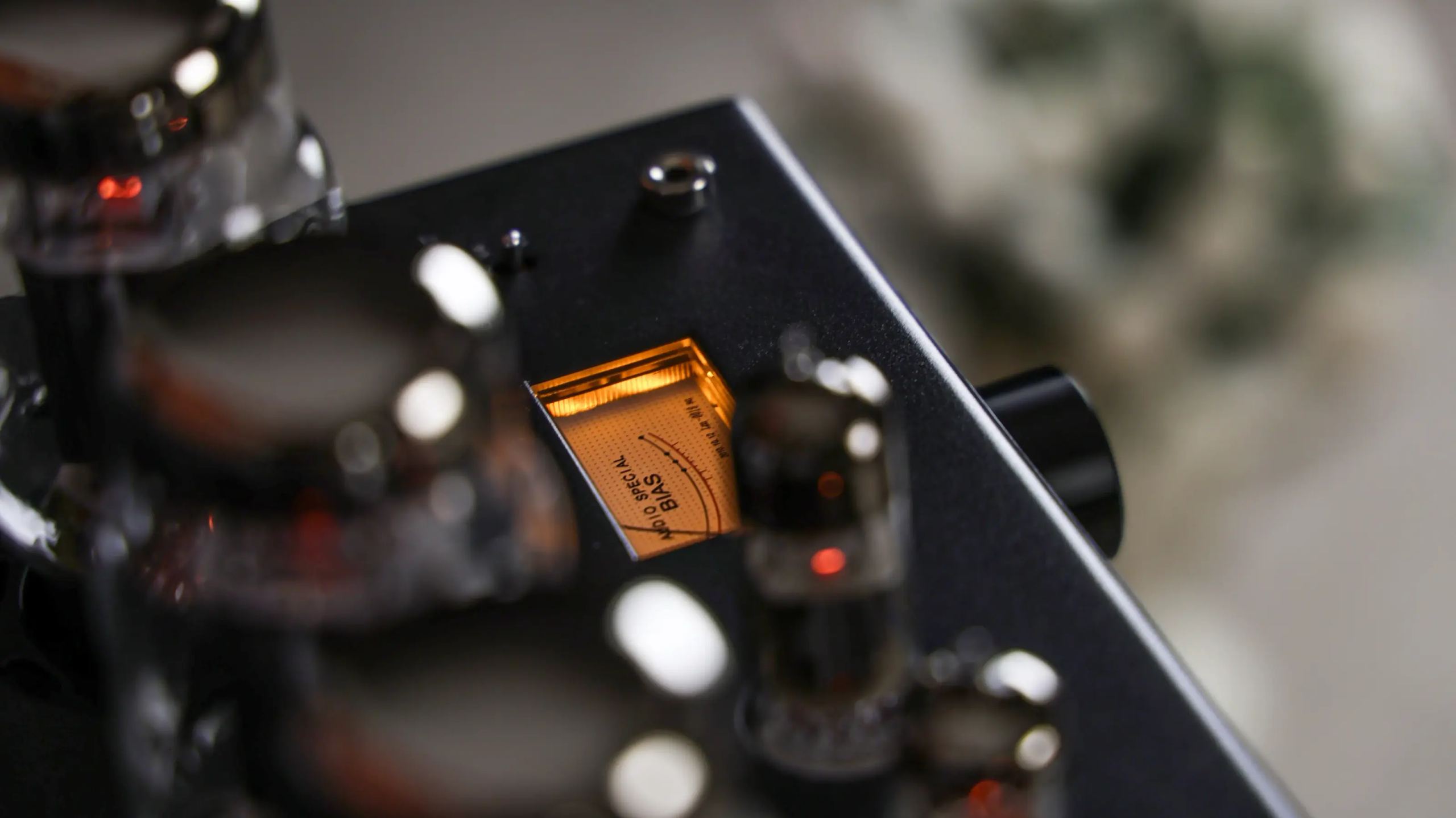
Analog sources and speaker choice
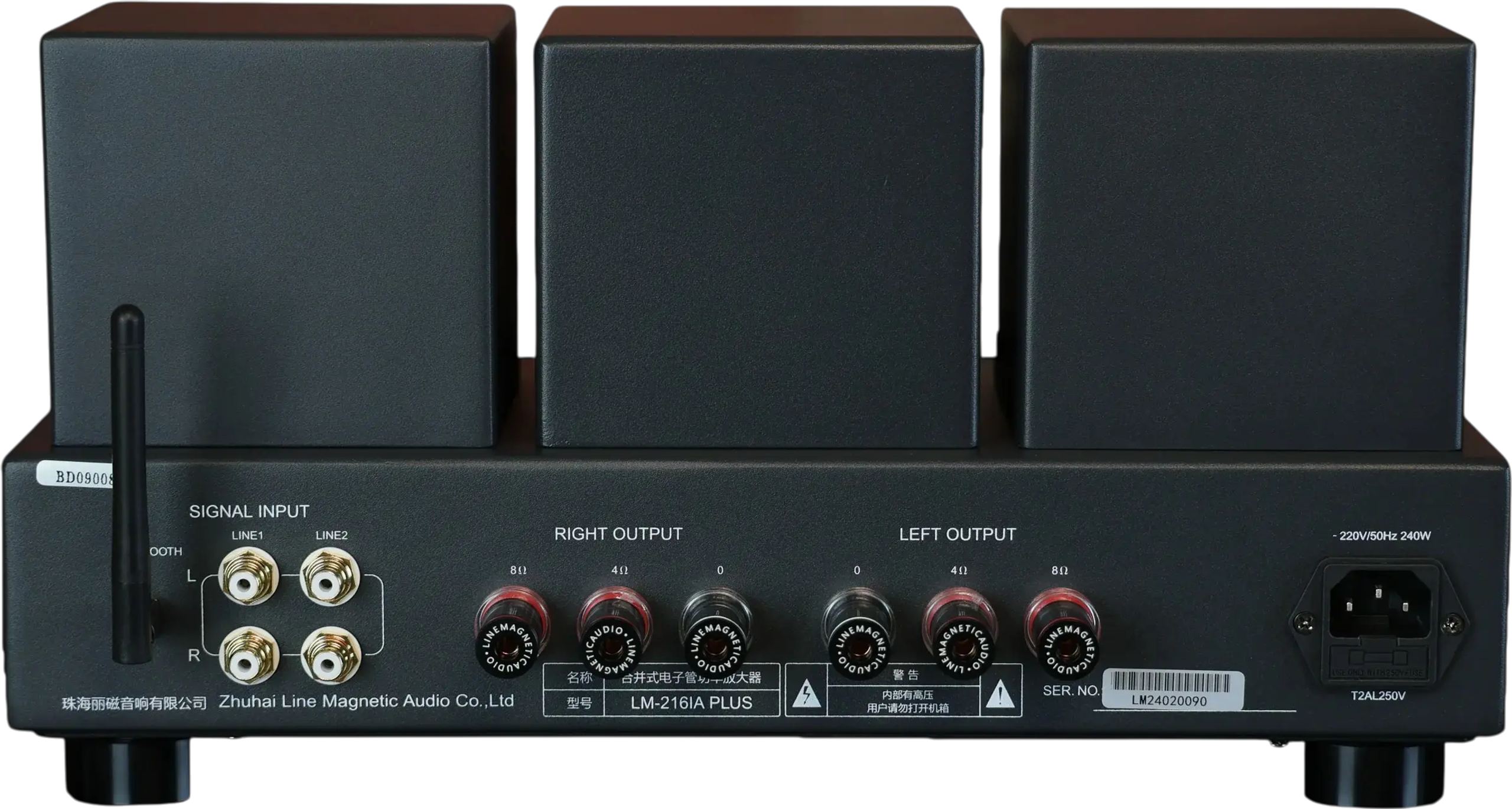
Connectivity focuses on essentials. Four RCA line inputs accommodate analog sources: a CD player, a DAC, a network player, or a phono preamp for a turntable. There is no built-in digital converter, phono input, or wireless reception: digital sources and a turntable with a moving-magnet cartridge therefore require a dedicated component upstream. Volume can be controlled from the front panel or with the supplied aluminum remote control, while source selection is performed on the unit.
For speakers, the binding posts offer 4 and 8 Ω connections: connect the speaker to the output matching its impedance. With 45 tube watts, high-sensitivity speakers get the best from the amplifier, especially in a medium-sized or large room. The unit draws 240 watts from the mains and generates heat during operation, like any tube amplifier: it is best to leave space around it and avoid enclosing it in a closed cabinet.
Technical specifications
Tube configuration
- Preamplifier tubes: 12AU7 x 2, 6H6π x 2
- Power tubes: KT88 x 4
Audio performance
- Output power: 45 W + 45 W (Class AB push-pull)
- Frequency response: 10 Hz – 50 kHz (-1.5 dB)
- Total harmonic distortion: 1% (1 kHz)
- Signal-to-noise ratio: 87 dB
Input and output characteristics
- Input sensitivity: 340 mV
- Input impedance: 100 kΩ
- Output impedance: 4 Ω, 8 Ω
Power supply
- Power consumption: 240 W
Dimensions and weight
- Dimensions (W x D x H): 376 x 345 x 191.5 mm
- Net weight: 19.6 kg
Frequently asked questions
How do I connect a turntable or a digital source?
All inputs are analog line-level inputs. A turntable goes through a phono preamp, built into the turntable or external, before reaching an RCA input. A digital source (computer, player, set-top box) goes through a converter, and streaming through a network player: in both cases, it is this component that delivers the line-level signal to the amplifier.
How often should the tube bias be adjusted?
Checking after a few minutes of warm-up, then every two to three months, is sufficient for normal use. Readjustment is always required after changing the power tubes, or if the sound quality deteriorates. The front-panel VU meter makes the operation easy to read, tube by tube.
How long do tubes last?
KT88 power tubes generally last a few thousand listening hours, depending on use and volume level. Small-signal tubes last much longer. KT88 tubes should be replaced as a matched set, followed by a new bias adjustment—an operation within the reach of a careful user.
What speaker sensitivity should you aim for with 45 tube watts?
Speakers with a sensitivity of around 89 to 92 dB give the 45 watts comfortable headroom, including for dynamic peaks and in a large room. Below that, the amplifier remains usable at a reasonable volume, but the headroom quickly diminishes when listening loudly.
Does the LM-216IA plus have a headphone output?
No, it is a speaker amplifier, with no headphone output. Headphone listening requires a separate headphone amplifier connected to the system.
Does the remote control operate all functions?
It controls the volume and muting. Source selection and switching between triode and ultra-linear modes are done directly on the device.
- Eco-contribution included in the sale price.


