iFi Audio iCAN PHANTOM 1.5


Overview
A headphone collection often ends up calling for several devices: a quiet amplifier for in-ear monitors, a powerful model for demanding planar headphones, then a separate energizer for electrostatics. This version 1.5 of iFi Audio’s flagship model brings all three together in a single chassis. It also offers a choice between a solid-state stage and a tube stage, building on the original iCAN Phantom with refinements to the gain, in-ear attenuation, and finish.
From in-ears to planar headphones, one amplifier
The available power sets the tone. Through the balanced outputs, the amplifier delivers more than 15,000 mW peak and more than 6,250 mW continuous (RMS) into 16 Ω, and more than 5,760 mW through the unbalanced outputs. These figures matter most for low-sensitivity planar headphones, which demand a lot of current. High-impedance dynamic headphones chiefly need voltage: more than 27 V into 600 Ω in balanced mode and 14 V in unbalanced mode, enough to preserve the dynamic peaks of an orchestral recording.
The same device must remain silent with in-ears that reach high levels with the slightest milliwatt, and that is where the gain control and IEMatch come in. Gain has three settings (0, +12, and +24 dB). At unity gain (0 dB), the amplifier adds no voltage gain and keeps background noise to a minimum. iFi recommends starting at this setting and increasing it only if the volume, set around the 12 o’clock position, is insufficient. IEMatch, its proprietary attenuation circuit, offers two levels: up to 12 dB of reduction on the unbalanced outputs and 24 dB on the balanced outputs. The volume knob can then operate within a comfortable range instead of being confined to the first few degrees of its travel. With a signal-to-noise ratio above 145 dB(A) in balanced mode and 130 dB(A) in unbalanced mode, the background remains quiet even with very sensitive earphones.
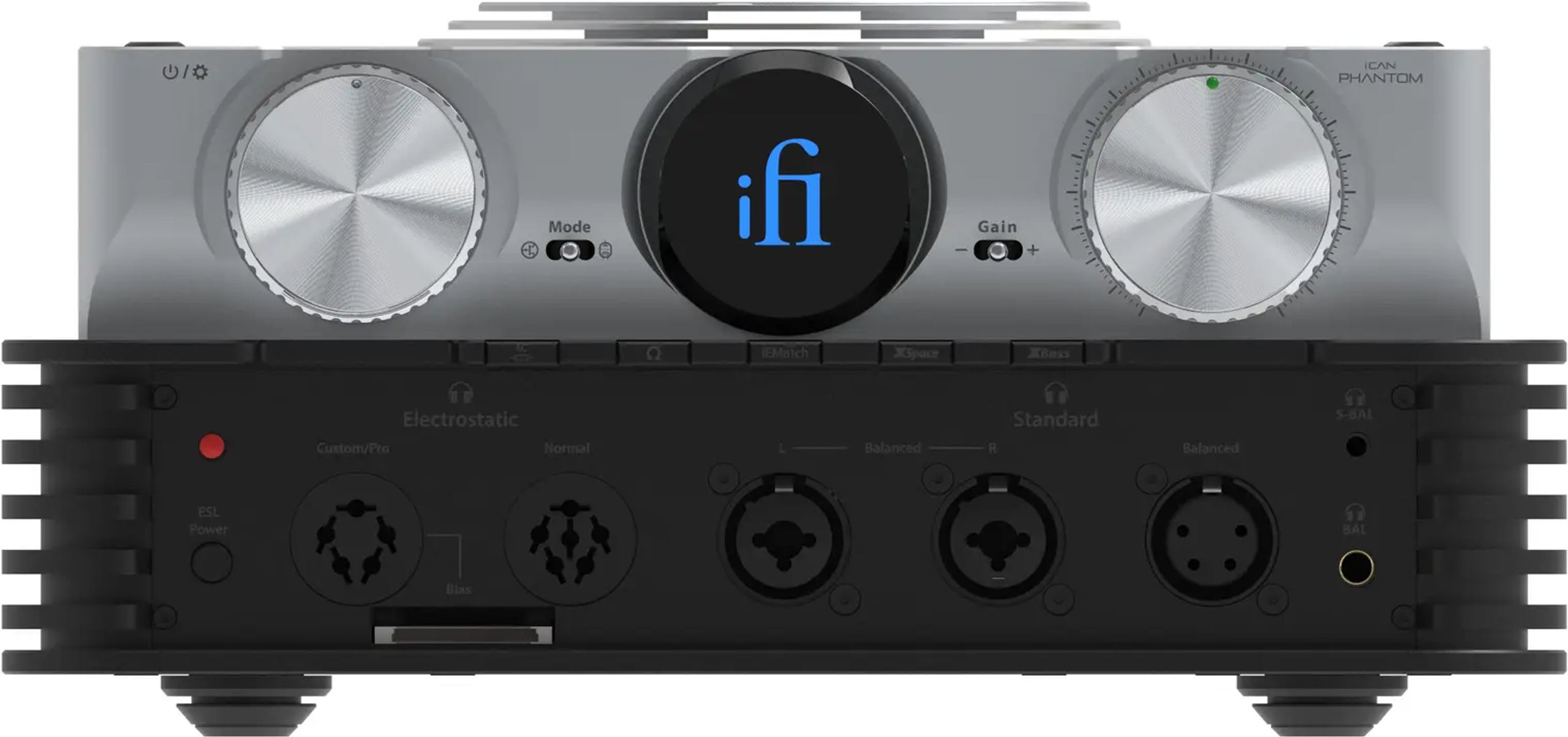
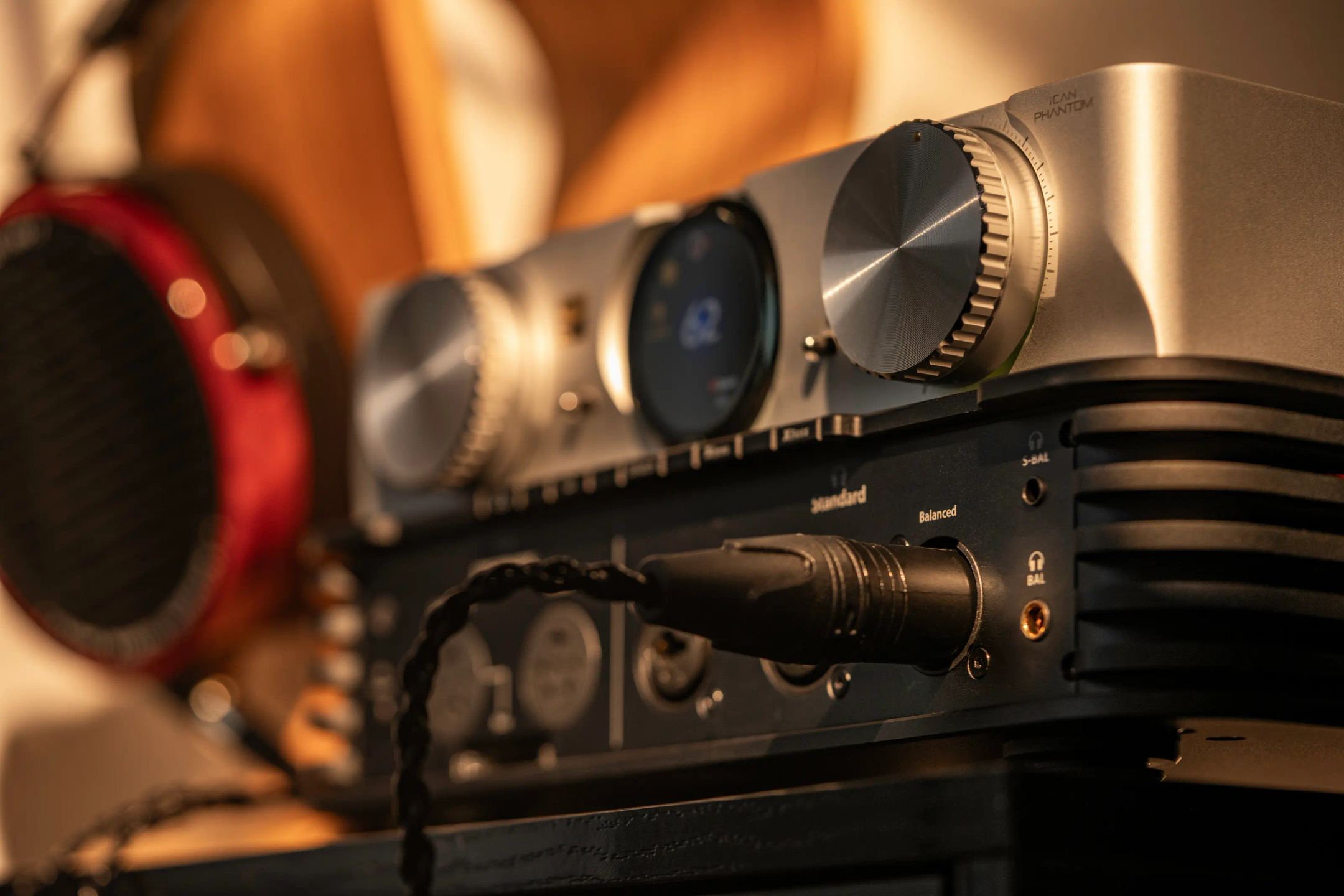
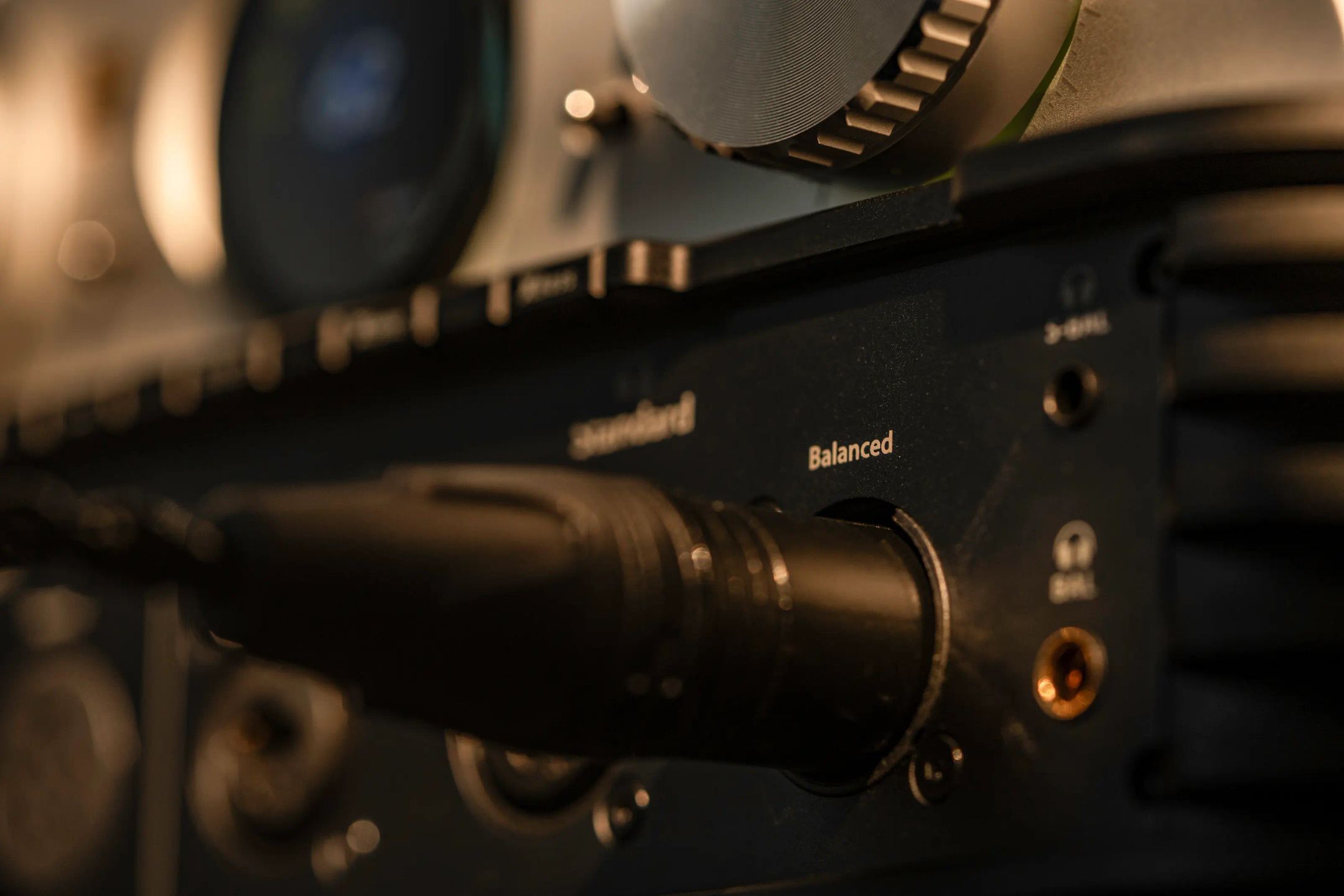
The front panel accommodates almost every connector format. Balanced headphones can use a 4.4 mm Pentaconn, a 4-pin XLR, or a pair of 3-pin XLRs. Two 6.35 mm jacks, one in phase and the other out of phase, together form a balanced connection with the appropriate cable, or can drive two unbalanced headphones at the same time. The 3.5 mm socket accepts both unbalanced TRS plugs and balanced TRRS plugs. Two dedicated electrostatic sockets complete the selection.
Solid-state, tubes, or Tube+: three characters to choose from
The signal passes through one of two separate input stages, both operating in class A: their components conduct continuously, without switching between the two halves of the signal. The first is a discrete junction field-effect transistor (JFET) circuit. The second is entirely tube-based, with a pair of General Electric 5670 NOS tubes—unused old-stock tubes that are hand-selected, computer-matched, and given a rejuvenation treatment before installation. In tube mode, the JFET circuit is removed from the signal path: the two stages are never layered together.
The tube stage offers two modes. Tube+ mode reduces negative feedback to a minimum—that is, the portion of the output signal fed back to the input to correct circuit errors. The tubes’ natural harmonics become more prominent, with a predominance of even-order harmonics that softens the presentation. The measurements reflect this trade-off: total harmonic distortion plus noise rises to 0.012% in balanced mode and 0.2% in unbalanced mode, compared with 0.0015% in solid-state mode and 0.002% in tube mode on the balanced outputs.
You can switch between modes while listening, following a brief switching pause. To preserve their lifespan, the tubes turn off after about ten minutes in solid-state mode. When you return to tube mode, they need around thirty seconds to warm up, during which the music continues through the solid-state stage. A front-panel indicator changes color according to the active mode.
An electrostatic section configured with calibrated cards
Electrostatic headphones do not work like dynamic headphones. Their extremely thin diaphragm is charged by a DC bias voltage of several hundred volts and moves between two grids that receive a signal carried at very high voltage. These requirements explain why an energizer is usually sold separately. Here, iESL technology is integrated into the chassis and has its own power button.
The Pro/Custom output, with a 5-pin socket, accepts six bias voltages: 500, 540, 580, 600, 620, and 640 V. The value is selected by inserting an SD-format card, individually calibrated and marked with compatible models. Without a card, the output remains inactive, and this physical selection eliminates the risk of a setting error in a menu. The six cards fit inside the magnetic rear cover, which can also cover the front panel when the device is used as a preamplifier. A second Normal output, with a 6-pin socket, supplies 230 V for older-generation electrostatic headphones.
Two settings complete the section. Impedance, adjustable from 16 to 96 Ω, sets the load the amplifier sees at the input of the step-up transformers. A lower value increases the sound level but places greater demands on the amplifier, and iFi recommends the higher values in most cases. Depending on this setting, the signal delivered to the headphones ranges from 320 to 640 V RMS. AC Termination changes the impedance at the bias point shared by the two channels, and its effect is felt mainly in XSpace spatialization.
The design of this section helps explain its quiet operation. The custom-made step-up transformers combine grain-oriented steel, suited to high levels, and permalloy, which is more linear at low levels, in their cores. The bias voltage is stored in a bank of film capacitors, recharged by brief pulses from a circuit that remains off more than 99.999% of the time. No power supply runs continuously and risks modulating the diaphragm with its noise.
A balanced, hybrid circuit from end to end
iFi uses its PureWave PRO circuit in this model, which it calls True Differential Balanced. Each channel is handled by two identical circuits, one for the in-phase signal and the other for the out-of-phase signal. This structure reduces noise and crosstalk (leakage from one channel into the other).
The signal path combines three types of components. The input stage uses JFETs or tubes, the second stage uses bipolar transistors, and the class A bipolar power stage is buffered by MOSFETs. The latter switches to class AB when low-impedance headphones are driven at very high levels. The entire circuit is DC-coupled, with no coupling capacitor in the signal path, and its frequency response extends from 0.5 Hz to 500 kHz at −3 dB.
Volume is controlled by a custom motorized potentiometer made by ALPS in Japan. Its six tracks comprise four that adjust the balanced signal and two that monitor the position of the control. The motor allows volume adjustment using the supplied infrared remote or the app, without resorting to digital volume control. Inputs are selected by miniature relays with gold-plated silver contacts, filled with inert gas, and the chassis rests on dual-layer damped feet.
What has changed from the original iCAN Phantom
The original iCAN Phantom’s circuit remains unchanged. The refinements concern headphone matching, operating noise, and everyday use. Gain changes from 0, 9, and 18 dB to 0, 12, and 24 dB, widening the gap between settings and providing more headroom for demanding planar and electrostatic headphones. IEMatch attenuation is increased, reaching 24 dB in balanced mode. Grounding, shielding, and some components have been revised to reduce noise further and stabilize operation.
As for the finish, the controls now rotate more smoothly with a damped feel, and the smoked-glass panel has an anti-fingerprint coating. The screen interface has been redesigned, and VU meters, disabled by default, track the level in summed mono, stereo, or dual mono. Updated control software makes the display and remote more responsive, and the iFi Nexis app now shows the status of the tubes.
A preamplifier for a hi-fi system
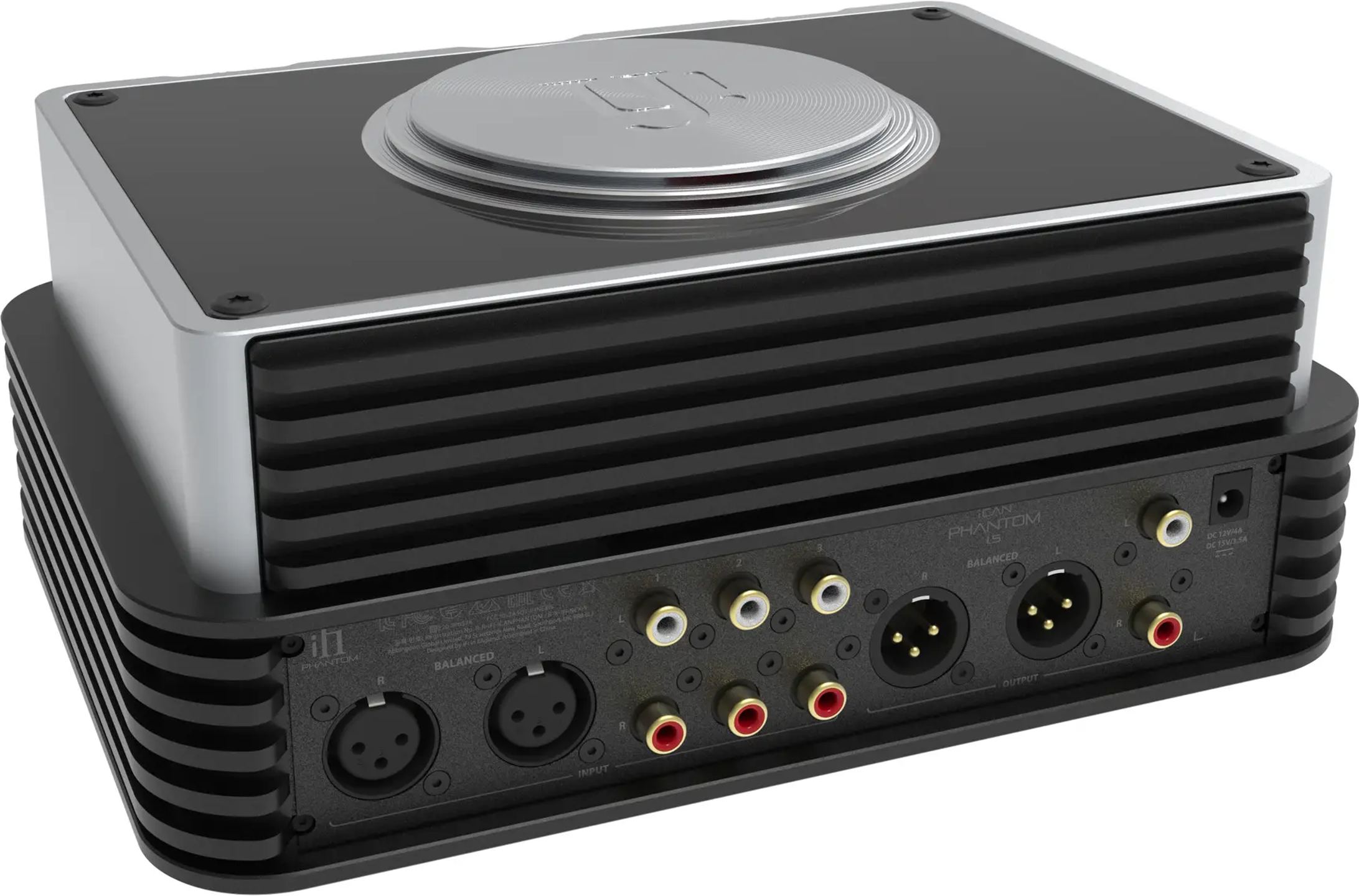
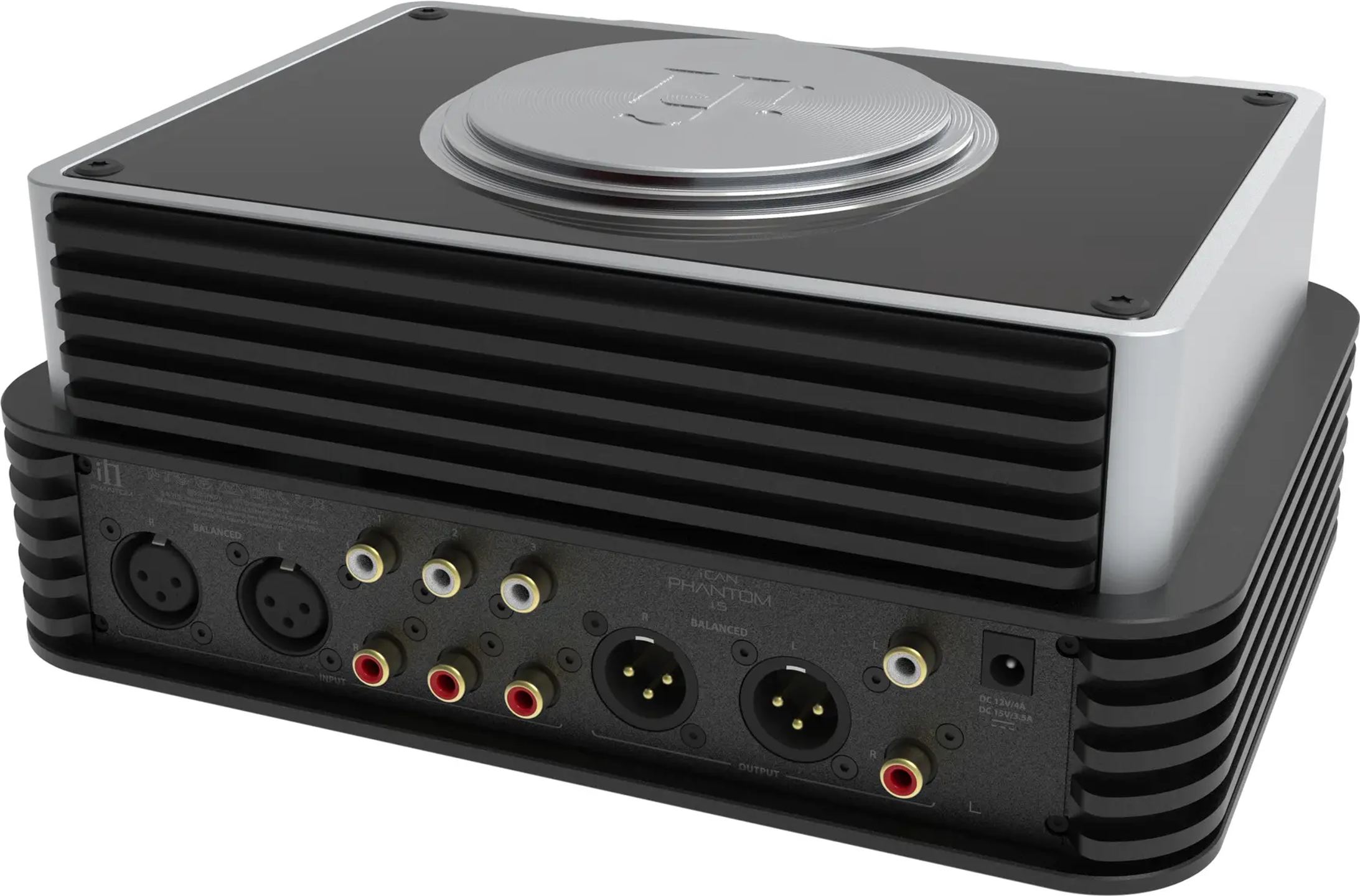
At the rear, three pairs of RCA inputs and one pair of XLR inputs accommodate up to four analog sources. Two outputs, XLR and RCA, let the amplifier sit at the front of a speaker system, ahead of a power amplifier or a pair of active speakers, with the motorized volume control serving as a remotely operated preamplifier.
The analog XBass Pro and XSpace Pro circuits work in both applications. XBass Pro compensates for a lack of bass, with up to 12 dB of boost centered on 10, 20, or 40 Hz, depending on how far the deficiency extends. XSpace Pro has two separate matrices that switch automatically according to the output in use. With headphones, it moves the soundstage outside the head to resemble listening through speakers, without adding reverberation. On the line outputs, its 30°, 60°, and 90° settings widen the soundstage beyond the speakers’ actual spacing. When disabled, the passive components of these circuits are removed from the signal path.
A two-level chassis with remote control
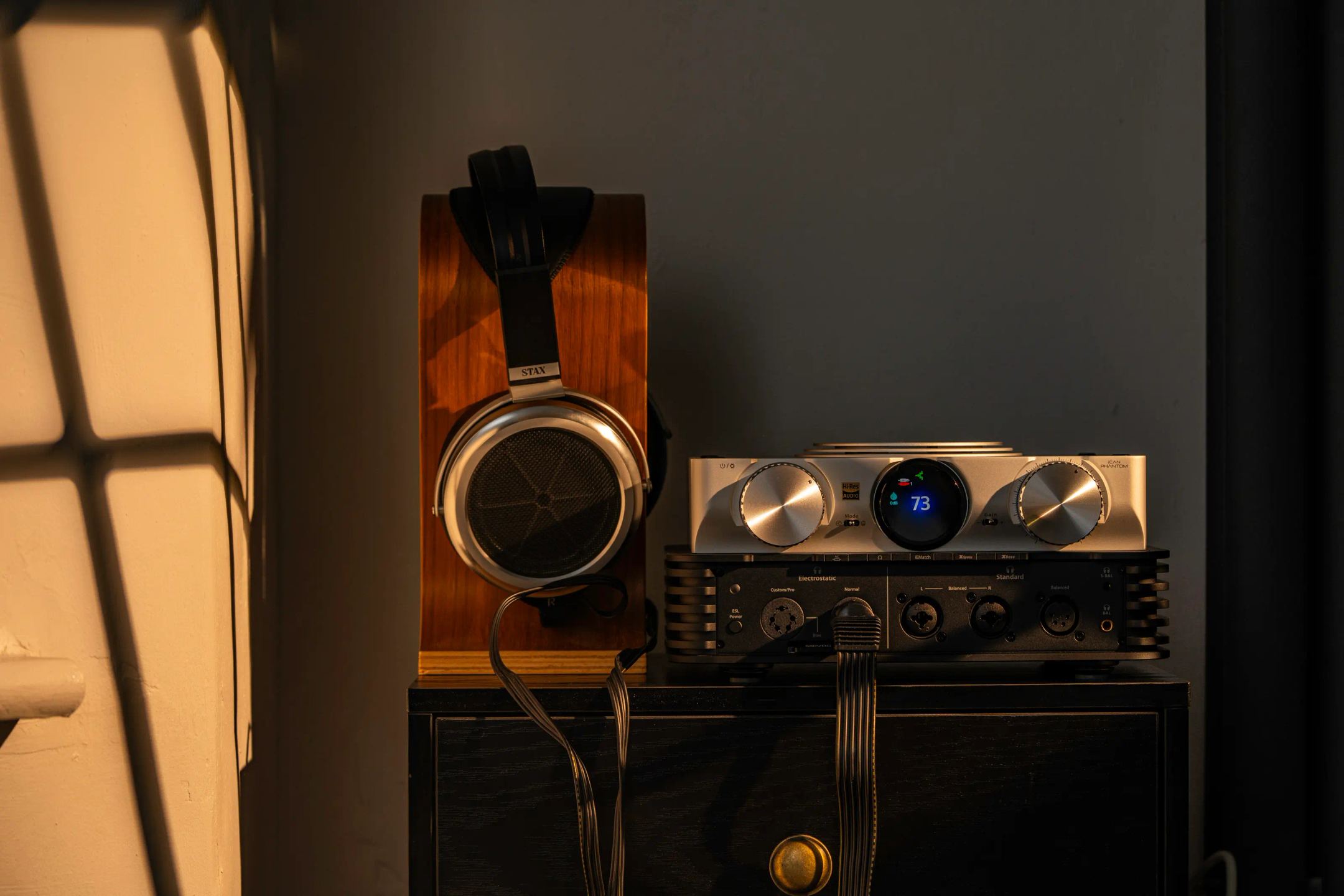
The device looks like two stacked units, but it is a single two-level aluminum enclosure. The lower level houses the connections, with headphone sockets at the front and source inputs at the rear. The upper level holds the controls and color screen, beneath smoked glass that reveals the circuitry. At 256 × 120 × 185 mm and 4.2 kg, it takes up a defined amount of desk space and stays stable when cables are handled. Because it warms up during operation, it needs a hard, well-ventilated surface.
The iFi Nexis app turns a smartphone into an extended remote control. It provides access to all settings and remote software updates, over the local network or via the Internet. The external iPower Elite 15 V power supply is included. Power consumption stays below 27 W at idle and reaches a maximum of 75 W, while automatic shutdown can be set for 30 minutes, 1 hour, or 3 hours without a signal.
Frequently asked questions
Do I need a digital converter upstream?
Yes. The iCAN PHANTOM 1.5 is an entirely analog amplifier, with no USB or digital input. It connects after a digital-to-analog converter (DAC), a network player with analog outputs, a CD player, or a phono preamplifier, through its RCA or XLR inputs. A balanced source connected via XLR makes the most of its end-to-end balanced circuit.
Which bias card should I choose for electrostatic headphones?
Each card lists the compatible models, and the voltage specified by the headphone manufacturer is the deciding factor. The bias known as Pro, the most common on current models with a 5-pin plug, is 580 V. Headphones with other connectors can be connected to the Pro socket using an adapter. The voltage takes time to fall after a higher setting: to compare several values, iFi recommends starting with the lowest and increasing gradually, never exceeding the headphones’ rated value.
How can I monitor the tubes’ condition and replace them?
The menu displays the cumulative time spent in tube mode, and the iFi Nexis app shows their status. Thanks to the GE 5670 tubes’ rejuvenation treatment and their automatic standby in solid-state mode, iFi expects several years of use. A 5670-to-6922 / 6DJ8 adapter is included for replacement, which should be done with a matched pair. The counter can then be reset from the menu.
Why so much power if my headphones are easy to drive?
The power reserve is mainly for dynamic peaks, which rise well above the average listening level. An amplifier with headroom does not run out of steam on those peaks. With sensitive headphones, simply stay at 0 dB gain and activate IEMatch with in-ears. Caution is still needed with XBass Pro at high gain: the amplifier has enough power to damage headphones if driven too hard.
Can I use headphones and speakers at the same time?
The rear XLR and RCA outputs do not turn off when headphones are plugged in. Nevertheless, iFi recommends using the device for one purpose at a time, either for headphones or as a preamplifier, rather than in a mixed setup. On the XLR output, the connected device must not connect pin 3 to ground.
What is the warranty in France?
iFi Audio warrants the iCAN PHANTOM 1.5 for two years, parts and labor, in the European Union, from the date of purchase from an authorized dealer.
Technical specifications
Architecture and amplification
- Type: reference-class Class A headphone amplifier
- Preamplifier architecture: dual symmetrical circuit
- Amplification modes: solid-state, tube, Tube+
- Selectable gain: 0 dB, +12 dB, +24 dB
- Output power at 16 Ω:
- Balanced output: > 15000 mW max., > 6250 mW RMS
- Unbalanced output: > 5760 mW max., > 4500 mW RMS
- Output voltage at 600 Ω:
- Balanced output: > 27 V
- Unbalanced output: > 14 V
Audio performance
- Frequency response: 0.5 Hz to 500 kHz (−3 dB)
- Signal-to-noise ratio: > 145 dB(A) balanced, > 130 dB(A) unbalanced
- Total harmonic distortion + noise (THD+N):
- Solid-state mode: ≤ 0.0015% balanced, ≤ 0.007% unbalanced
- Tube mode: ≤ 0.002% balanced, ≤ 0.006% unbalanced
- Tube+ mode: ≤ 0.012% balanced, ≤ 0.2% unbalanced
Outputs for electrostatic headphones
- ESL Custom / Pro output: 500 to 640 V RMS
- ESL Normal output: 230 V RMS
- Interchangeable bias architecture
- Bias adjustment using calibrated SD cards
- AC Termination and impedance settings
Features and controls
- XBass Pro: 3 levels
- XSpace Pro: 3 levels
- VU meters, color OLED display
- iFi Nexis app, remote control from a smartphone
- Over-the-air updates (OTA)
Power supply
- DC input: 12 V / 4 A or 15 V / 3 A
- Power supply AC input: 85 to 265 V, 50 / 60 Hz
- Power consumption: < 27 W at idle, 75 W max.
Dimensions and weight
- Dimensions (W × H × D): 256 × 120 × 185 mm
- Net weight: 4.2 kg
Included accessories
- 1 × iFi iCAN Phantom 1.5
- 1 × RCA cable
- 1 × iPower Elite 15 V power supply
- 1 × infrared remote control
- 1 × user manual
- Eco-contribution of €2.57 included in the sale price.
- Manufacturer reference: IFI0059