IOTAVX B:ound

Overview
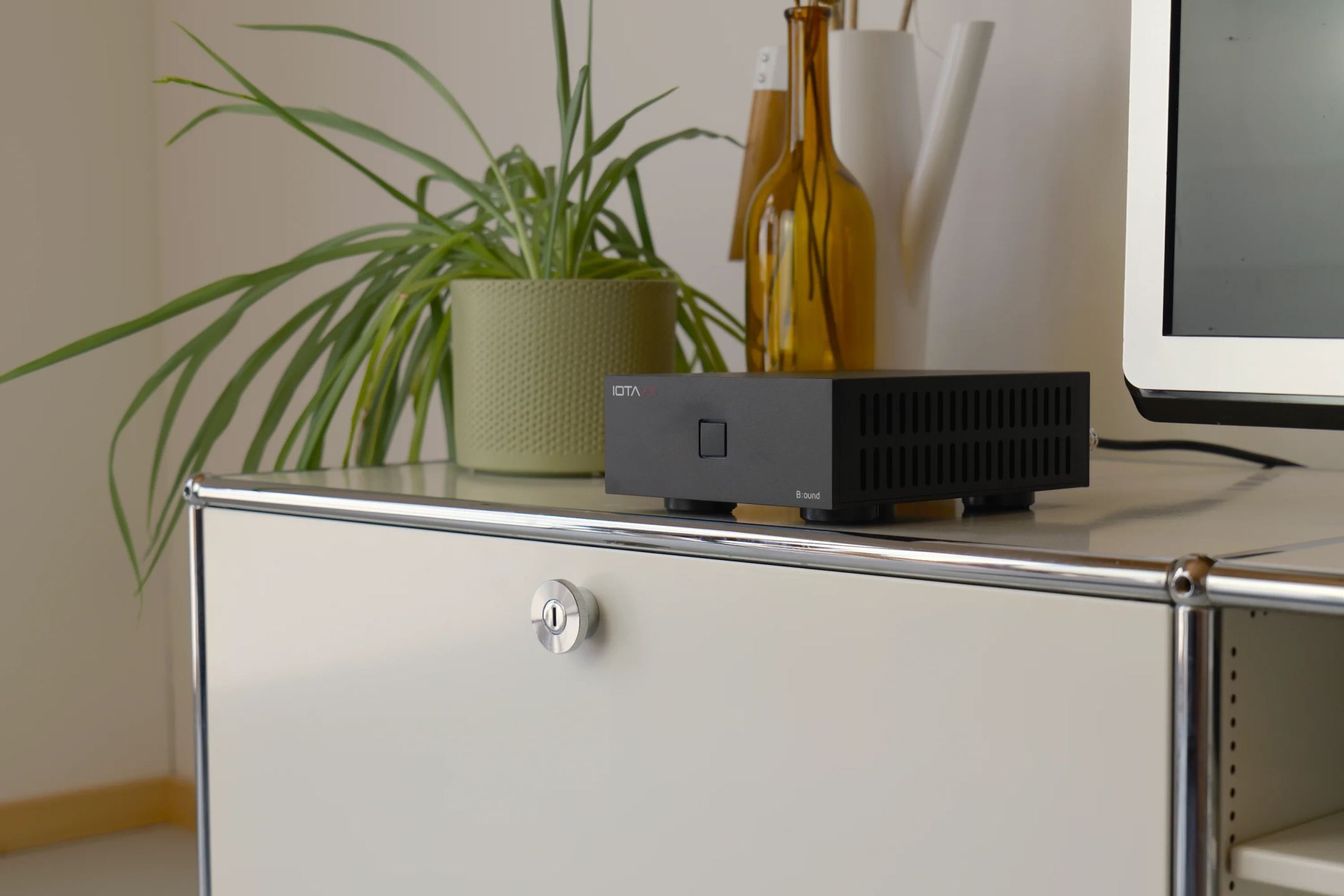
Sixteen centimeters wide, seven and a half high and 2.4 kg: that is the size of a small desktop converter for a 2 × 200 W amplifier. IOTAVX houses a linear Class B output stage inside, a rare choice in this format, where Class D dominates. Placed after a preamplifier, a network player with adjustable volume or the preamp outputs of a home theater amplifier, it powers a pair of speakers without cluttering the cabinet.
Linear Class B in a 16 cm-wide chassis
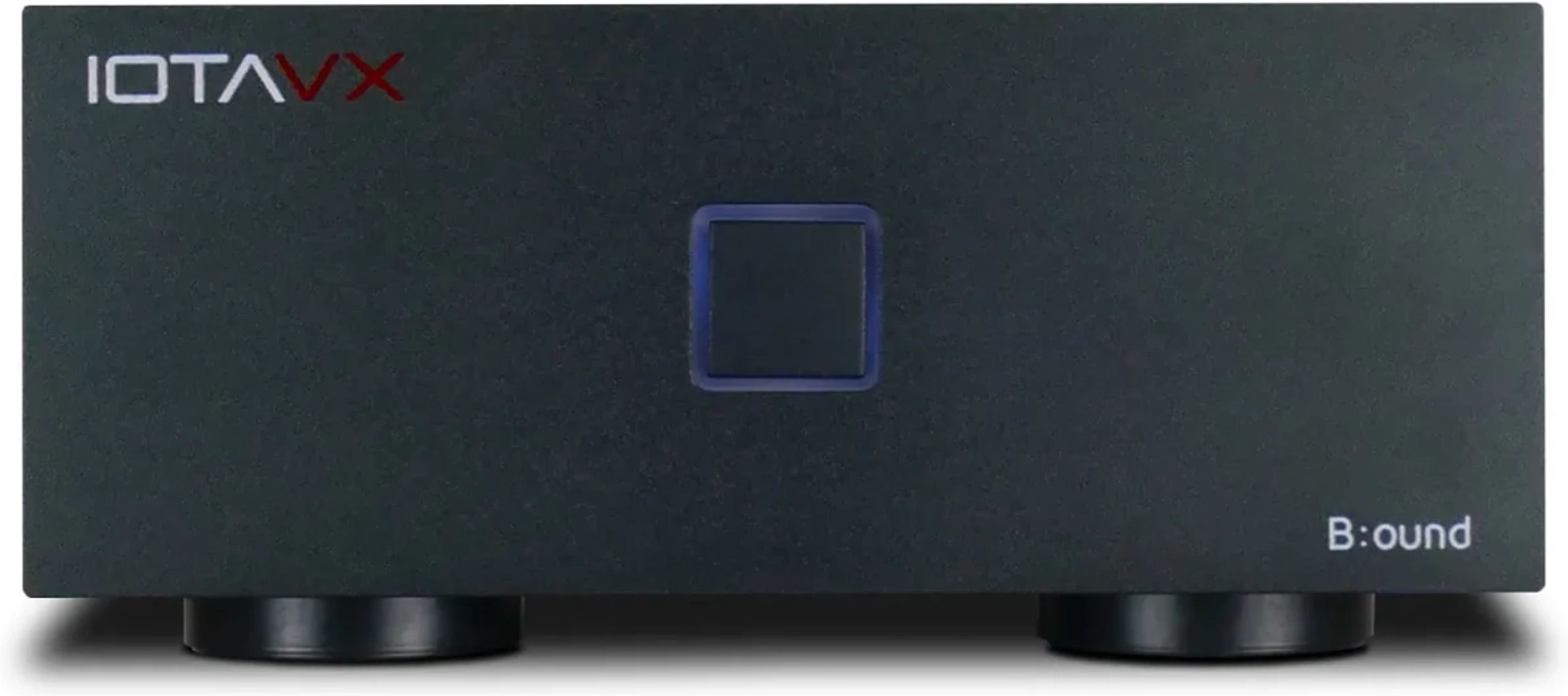
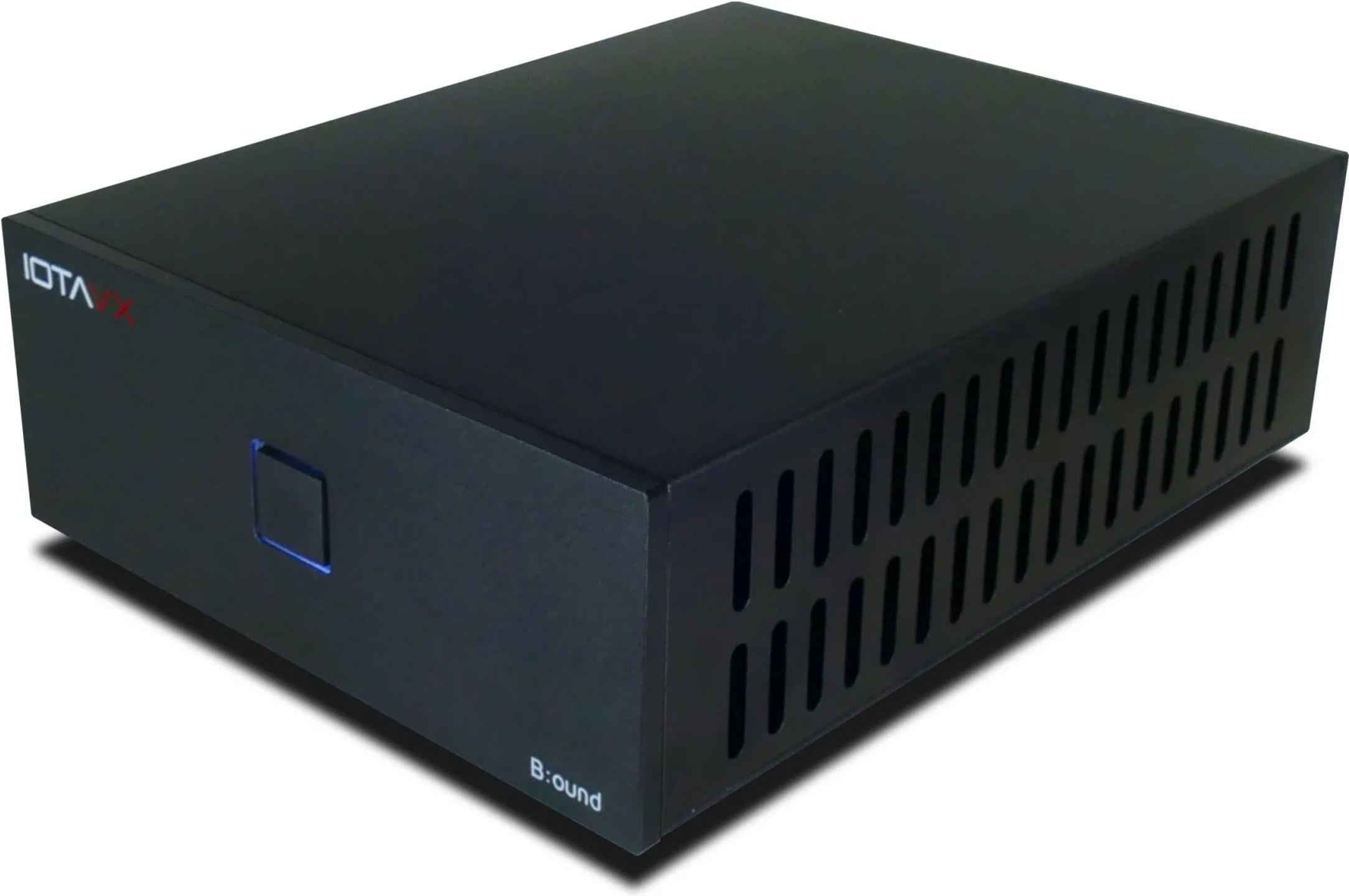
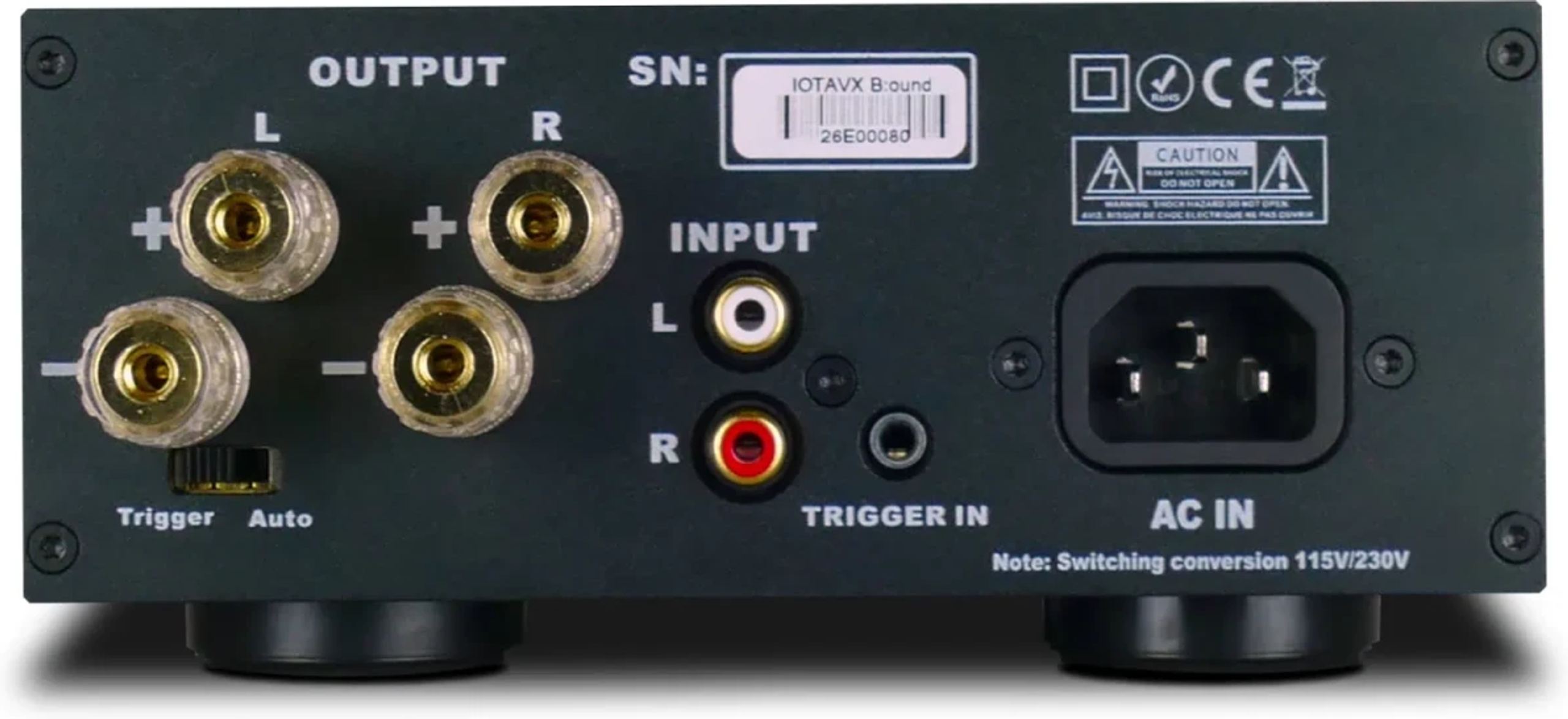
The chassis measures 164 mm wide, 75 mm high and 212 mm deep, or 238 mm including the terminals and feet. The front panel consists of a POWER button surrounded by an indicator light, red in standby and white during operation. Everything else is at the rear: a pair of RCA inputs, screw terminals for the two speakers, a trigger socket, the power-on mode selector and an IEC mains inlet. The unit fits on a bookshelf, next to a computer or in a TV cabinet.
At this size, most power amplifiers operate in Class D: their transistors switch at a very high frequency, and a filter reconstructs the audio signal at the output. IOTAVX has chosen linear Class B, where the output stage reproduces the waveform without chopping it up, with each half of the signal (the positive and negative half-cycles) handled by its own branch of transistors. Efficiency is better than in Class A, and the device consumes almost nothing at idle, since the transistors remain virtually inactive when there is no signal. The difficulty lies at the zero crossing, when one branch hands over to the other: if poorly controlled, this transition produces what is known as crossover distortion. To avoid this, most transistor amplifiers operate in Class AB, with a higher idle current that keeps both branches slightly conductive. On the B:ound, total harmonic distortion plus noise does not exceed 0.0002% at 100 W and 1 kHz, a very low figure measured at high power, whereas crossover distortion mainly affects low listening levels.
Power that doubles as impedance drops
Into 8 Ω, the B:ound delivers 2 × 100 W RMS. Into 4 Ω, power rises to 2 × 200 W. This exact doubling indicates a power supply capable of delivering the additional current required by a lower-impedance speaker, and the maximum power consumption of 505 W supports this. This reserve is sufficient to drive bookshelf or floorstanding speakers with typical sensitivity, around 86 to 90 dB, in an average-sized living room, including 4 Ω models that give small amplifiers trouble.
The frequency response extends from 10 Hz to 40 kHz within ±1 dB, beyond the audible range at both ends. The 700 kHz bandwidth and 40 V/µs slew rate (the maximum speed at which the output voltage can change) describe the speed of the output stage. To reproduce a 20 kHz signal at 100 W into 8 Ω, or approximately 40 V peak, an amplifier must change its voltage by roughly 5 V per microsecond: the B:ound has around eight times that headroom, enough to follow the shortest transients without rounding them off. The signal-to-noise ratio reaches 96 dB A-weighted, a level that leaves only a faint hiss with speakers of typical sensitivity. Very high-efficiency speakers, above 95 dB, remain those that most reveal an amplifier’s background noise.
Three power-on modes
The selector on the back determines how the amplifier switches on. In the Auto position, it exits standby as soon as a signal reaches its RCA inputs and returns to standby after 20 minutes without a signal, without any manual intervention. In the Trigger position, with a cable connected to the trigger output of a preamplifier, a home theater amplifier or another IOTAVX device, it switches on and off at the same time as that device. Left on Trigger with no cable connected, it is operated manually using the front-panel button, like a conventional amplifier. In standby, power consumption remains below 0.5 W.
A microcontroller monitors operation. When the temperature rises during listening, the white indicator starts flashing, signaling that the volume needs to be lowered or ventilation improved. If the temperature continues to rise to the critical threshold, the amplifier switches itself off for protection.
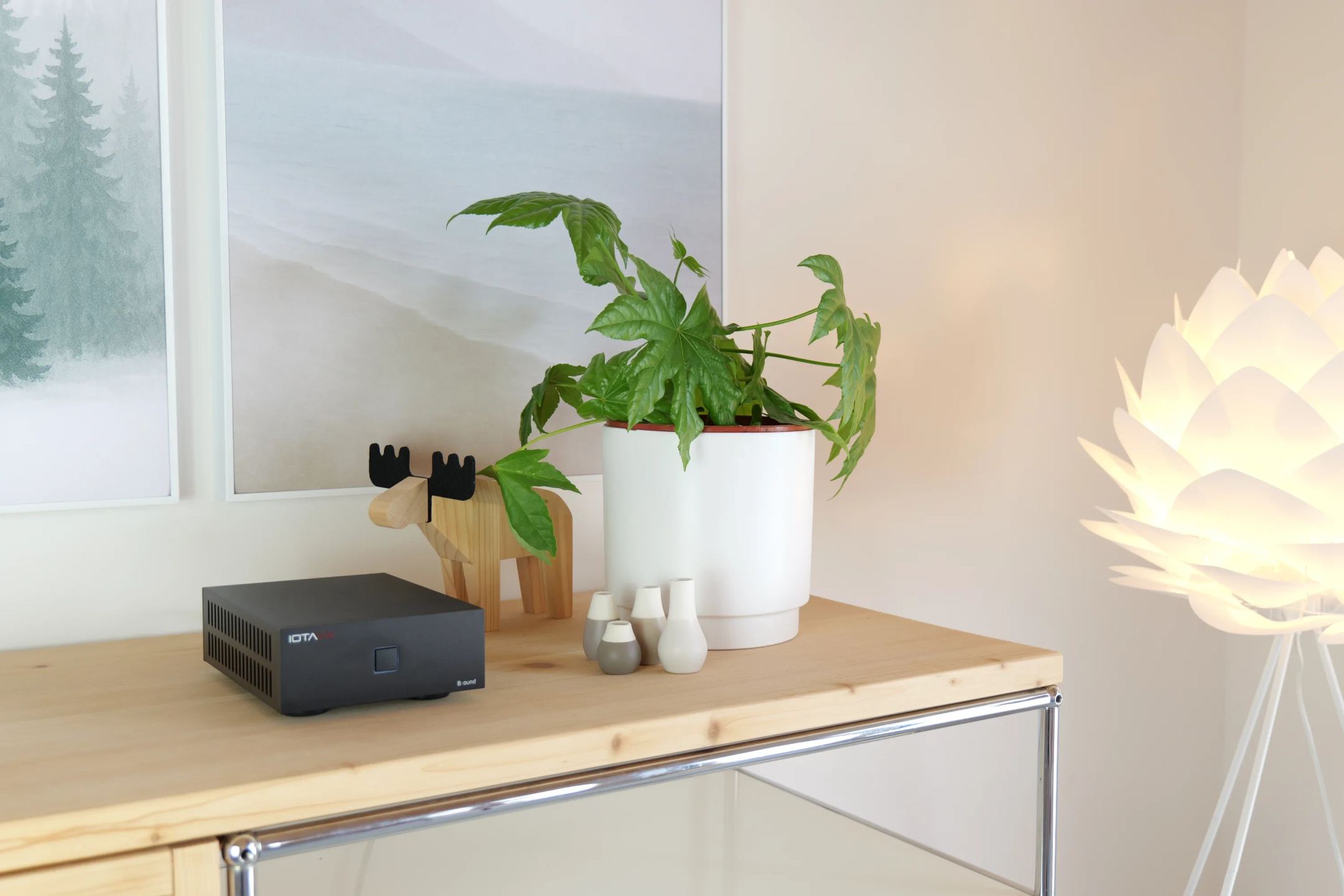
Where to place the B:ound in a system
The B:ound has neither a volume control nor a source selector: it amplifies the signal as it receives it and must therefore follow a device that controls the level. With a preamplifier, it forms a very compact separates system. With a network player or a converter featuring a variable-level output, you get a complete streaming system in two chassis, with volume controlled from the source’s app or remote control. On a desk, it fits between a computer connected to a converter with adjustable volume and a pair of compact speakers.
In a home theater setup, connected to the preamp outputs of an AV amplifier, the B:ound handles the front left and right speakers, those that work hardest with both music and films. The home theater amplifier then dedicates its power supply to the remaining channels: center, surround and height. An integrated amplifier equipped with a preamp output can also entrust it with a pair of speakers. The inputs are exclusively unbalanced RCA, with no balanced XLR input.
A switching power supply that needs air
The compact format is made possible by the power supply. Instead of the large toroidal transformer found in most linear amplifiers, IOTAVX uses a switching power supply, which is lighter and much less bulky for comparable power. It operates at 115 V or 230 V, at 50 or 60 Hz, and connects via a standard IEC mains cable, replaceable with any other cable of this format.
Two times 200 W in such a small enclosure generate heat at high listening levels. The vents must remain unobstructed, the device must be kept away from radiators and other heat sources, including other amplifiers, and it must not be installed in an enclosed cabinet or rack without ventilation.
Documentation
Technical specifications
Amplification and connectivity
- Type: stereo power amplifier
- Amplification class: class B
- Number of channels: 2
- RMS output power:
- 2 × 200 W into 4 Ω
- 2 × 100 W into 8 Ω
- Inputs: RCA
Audio performance
- Signal-to-noise ratio (SNR): 96 dBA
- Total harmonic distortion + noise (THD+N): ≤ 0.0002% at 100 W / 1 kHz
- Frequency response: 10 Hz – 40 kHz (± 1 dB)
- Stated bandwidth: 700 kHz
- Slew rate: 40 V/µs
Control and protection
- Automatic power-on upon detection of an audio signal
- Trigger for synchronized activation with other devices
- Automatic standby mode
- Thermal protection with light-emitting diode (LED) warning
- Automatic shutdown at critical temperature
- Supervisory microcontroller
Power supply and consumption
- Switch-mode power supply
- Supply voltage: 115 V or 230 V AC, 50/60 Hz
- Maximum power consumption: 505 W
- Standby power consumption: < 0.5 W
Dimensions and weight
- Dimensions (W × H × D): 164 × 75 × 212 mm
- Depth including binding posts and feet: 238 mm
- Weight: 2.4 kg
Frequently Asked Questions
Can you connect a turntable or CD player directly to the B:ound?
No. A CD player outputs a fixed level, and without volume control the amplifier would reproduce it at full power. A turntable also requires a phono preamplifier to amplify the cartridge’s very weak signal and apply RIAA equalization. In both cases, you need to insert a preamplifier, or an integrated amplifier with a preamp output.
What is the front panel button used for in automatic or trigger mode?
In these two modes, power turns on and off automatically, and the POWER button is used to mute and then unmute the sound. A white indicator light flashing just after a press indicates that mute is active. The button only acts as a power switch when the selector is set to Trigger with no trigger cable connected.
Does the B:ound get hot when it’s not playing?
Very little. In class B, the quiescent current is minimal, so the device stays almost cold when idle and when listening at low levels. Heat increases with the power required, hence the importance of ventilation during sustained listening at high volumes. This is a clear difference from class A, which generates heat constantly, and from class AB, which maintains a higher quiescent current.
Can it be bridged in mono for more power?
No, the B:ound does not have a bridged mode: the only switch on the rear panel controls power-on. It always operates in stereo, with two independent channels.
Can two B:ound units be used to bi-amp a pair of speakers?
Yes, if the speakers have two sets of binding posts per channel. Remove the jumpers connecting the two sets of binding posts, then assign one B:ound to each speaker, with one channel driving the bass and the other the treble. The preamplifier must have two pairs of outputs, or a Y-cable splitter. Two identical units have the same gain, which prevents any imbalance between the bass and treble.
Which speakers can it power?
Any passive speaker with a nominal impedance between 4 and 8 Ω, the two values to which its power ratings refer. With 2 × 100 W into 8 Ω and 2 × 200 W into 4 Ω, it easily drives bookshelf and floorstanding speakers with typical sensitivity. Very high-efficiency speakers require little power and are more sensitive to the amplifier’s background noise.
- Eco-contribution included in the sale price.
- GTIN / EAN: 5060530750283