Elipson Classic Sub 12
Overview
In a large living room, floorstanding speakers often start to lose steam around 40 Hz, and it is below this limit that you find the rumble of an explosion in a film, the lowest note of an organ or the sub-bass of an electronic production. The largest model in Elipson’s Classic Sub range entrusts this final octave to a 30 cm driver and 300 W of amplification, in a black cabinet weighing over 20 kg with an understated design and simple controls.
A 30 cm driver powered by 300 W of Class D amplification
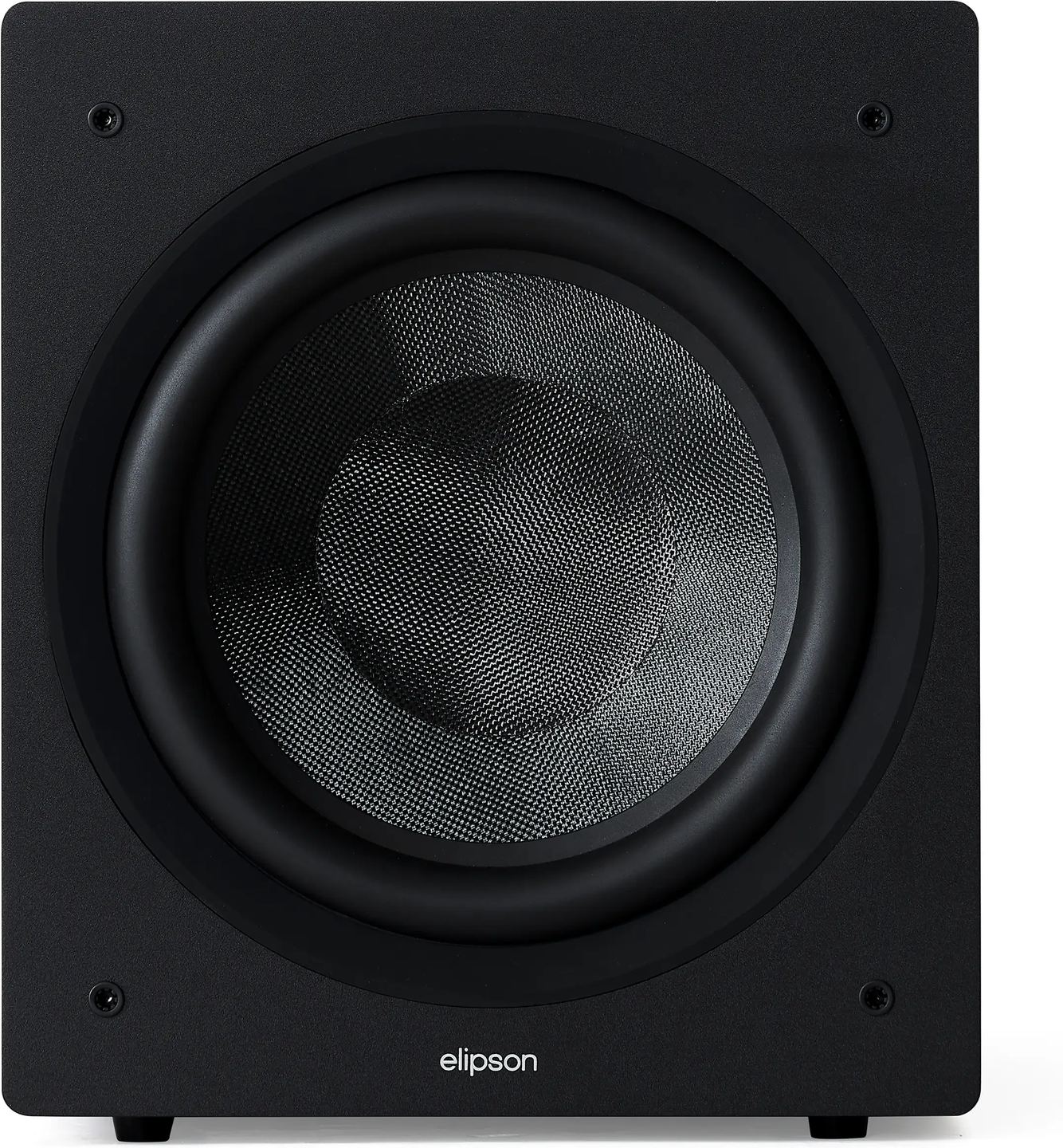
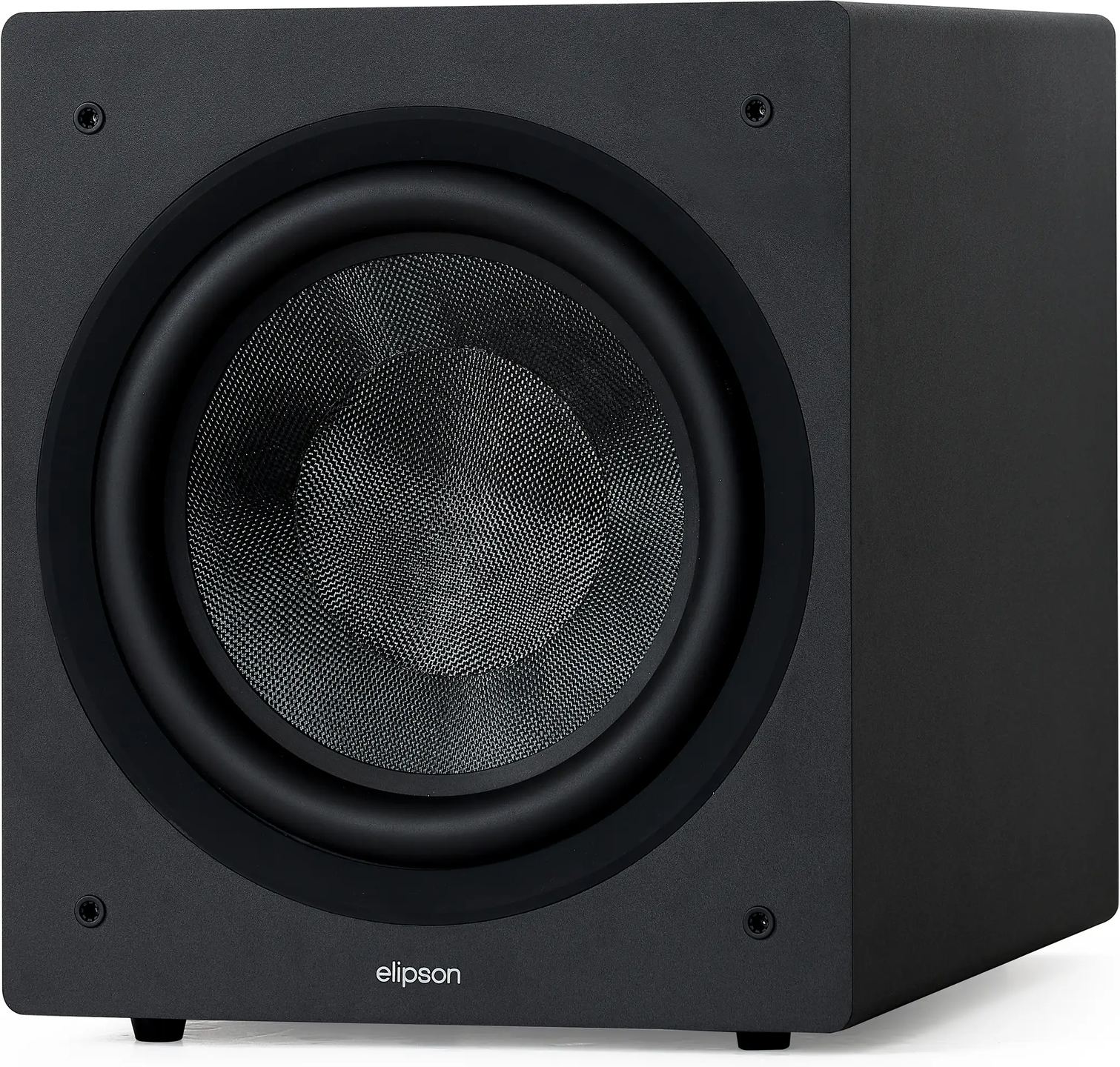
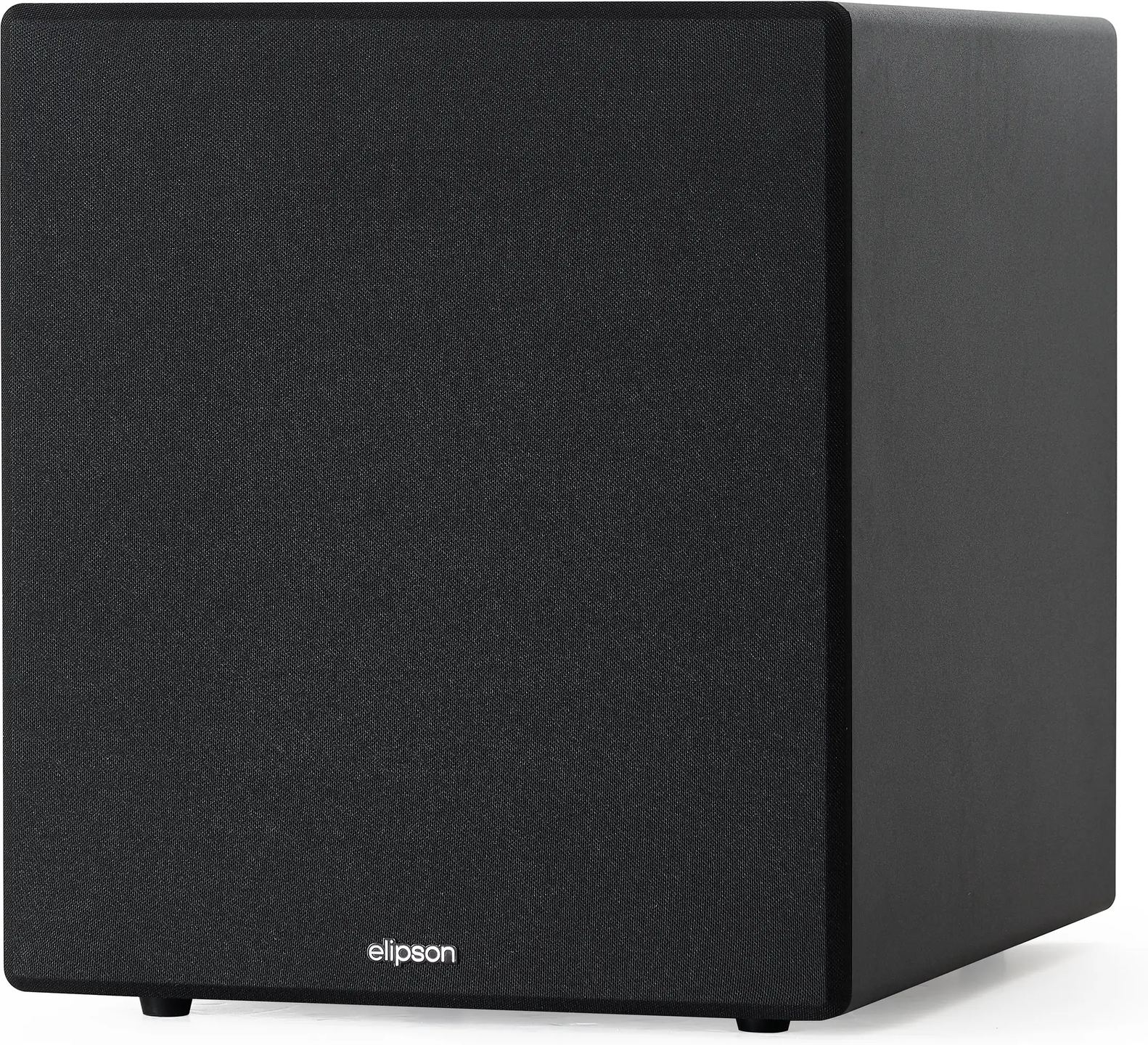
The 300 mm driver radiates forward, behind a removable grille, and uses a fiberglass cone, a composite that is both rigid and lightweight. This rigidity matters in a subwoofer: to reproduce 30 Hz at high levels, the cone travels several millimeters back and forth, and a material that is too flexible would deform during this movement, resulting in less defined bass and audible distortion. Here, the radiating surface moves as a single unit, like a piston.
The 300 W amplifier operates in Class D, a switching technology that converts almost all the energy consumed into useful power. It generates little heat, takes up little space in the cabinet and keeps power in reserve for soundtrack peaks.
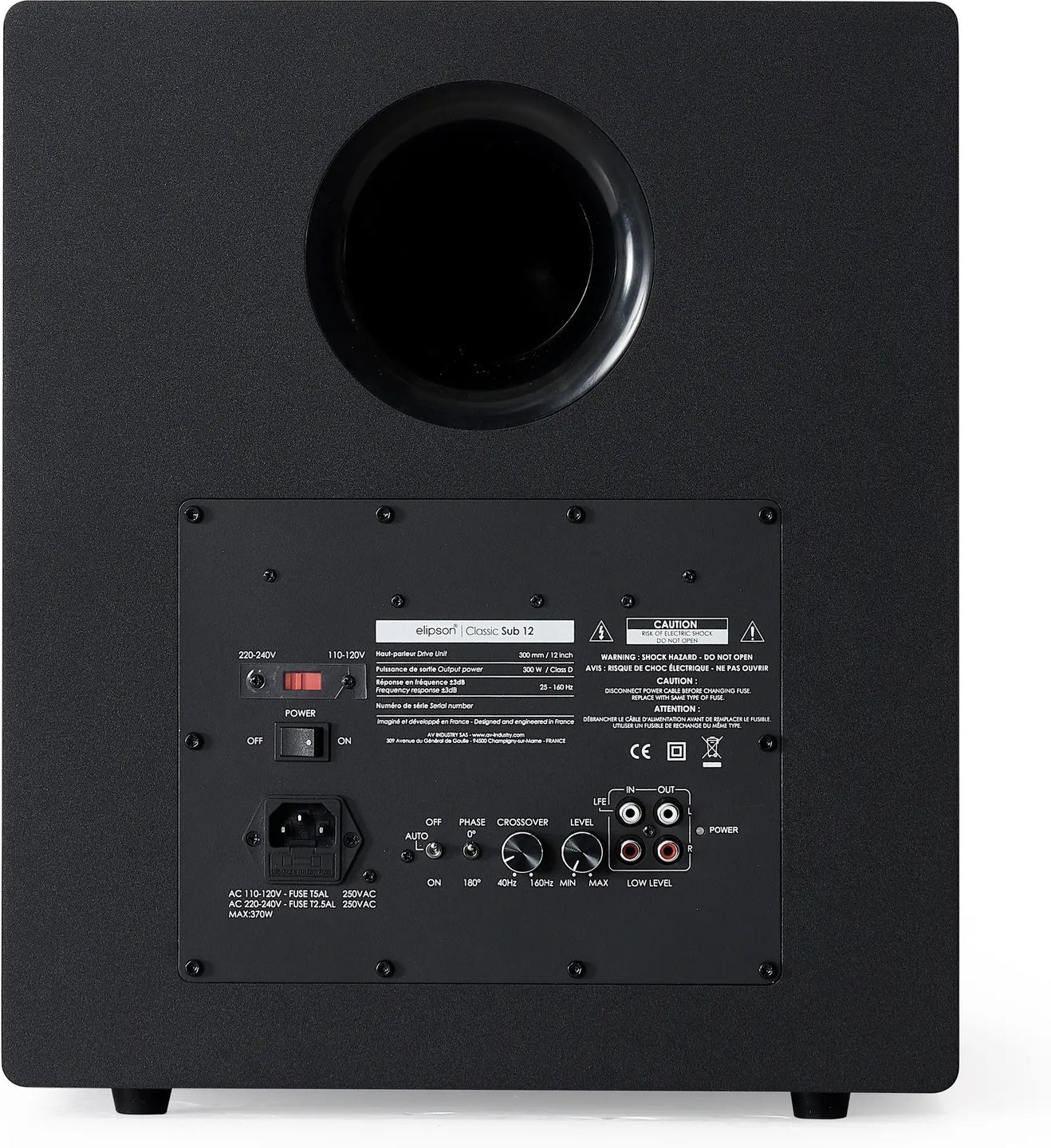
The cabinet uses a bass-reflex design: a port, a type of tuned duct, recovers the wave emitted by the rear of the cone and brings it back into phase to reinforce the bass around its tuning frequency. Internal braces stiffen the walls, which would otherwise vibrate under the air pressure and add their own resonances to the sound. The unit’s 20.4 kg weight, resting on feet that isolate it from the floor, gives an idea of the panels’ thickness. The finish is black, with no other options.
Reaching down to 25 Hz: digital boost and protection filter
The frequency response extends from 25 to 160 Hz at ±3 dB, placing the subwoofer in the region where you feel the pressure in the room more than you hear it. To achieve this with a reasonably sized cabinet, digital signal processing (DSP) boosts the region around 33 Hz by 6 dB. Human hearing loses considerable sensitivity at these frequencies, especially at moderate volume, and this boost maintains a perceptible foundation even during evening listening.
This gain has a physical cost worth knowing about: an extra 6 dB at a given frequency requires four times as much electrical power at that frequency. The 300 W are therefore called upon more heavily around 33 Hz than elsewhere, and at very high levels in a large room, this is the region where the reserve runs out first.
The subsonic filter completes the setup. Set to 23 Hz with a slope of 12 dB per octave, it gradually attenuates everything below this frequency. In a bass-reflex design, below the tuning frequency, the port no longer restrains the cone and its excursion increases very quickly. Yet these inaudible frequencies exist in certain soundtracks, in the undulations of a warped record or when the furniture is knocked: the filter removes them before they push the driver to its excursion limit.
Matching the subwoofer to your speakers and amplifier
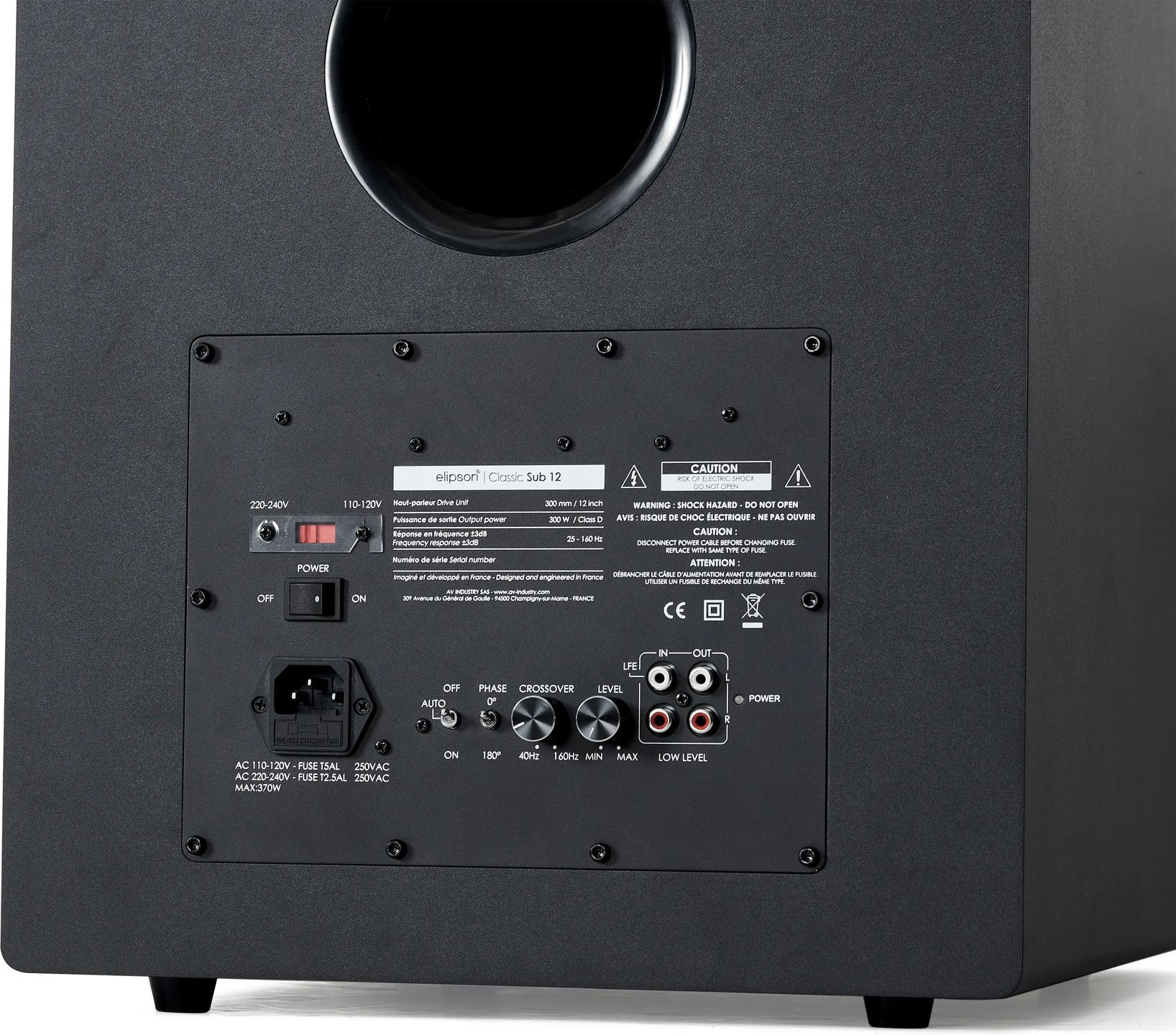
The crossover frequency is adjustable from 40 to 160 Hz. It sets the upper limit of what the subwoofer reproduces, and getting it right determines how well it blends with the main speakers. With floorstanding speakers that already reach low frequencies, a crossover set around 40 or 50 Hz leaves the subwoofer handling only the deepest bass. With more modest bookshelf speakers, a value of 80 Hz or above avoids a dip between the end of their response and the start of the subwoofer’s. The top of the range, at 160 Hz, is useful when a home theater amplifier handles bass management itself: the subwoofer’s crossover is set to maximum so that it does not overlap with the amplifier’s filtering.
The two-position phase selector (0° and 180°) reverses the cone’s movement. Depending on the distance between the subwoofer, the speakers and the listening position, the bass waves from the two sources can reinforce each other or partially cancel out at the crossover frequency; one of the two positions produces fuller bass, and that is the one to keep.
Connectivity is limited to low-level stereo line inputs and outputs. The subwoofer therefore connects to a preamp output or a subwoofer output on an integrated amplifier, a network amplifier or a home theater receiver. Automatic standby switches off the amplification when there is no signal and reactivates it as soon as the music or film resumes.
The largest model in the Classic Sub range
The Classic Sub range comprises three 8-, 10- and 12-inch subwoofers, all featuring fiberglass cones, Class D amplification and bass-reflex enclosures. Compared with the Classic Sub 10 (250 mm, 200 W, 29 Hz, 15.4 kg), the Classic Sub 12 gains 4 Hz of sub-bass extension and 100 W of power. These figures may seem modest, but in a large room, the additional cone area moves noticeably more air and remains comfortable at levels where a 25 cm driver starts to strain.
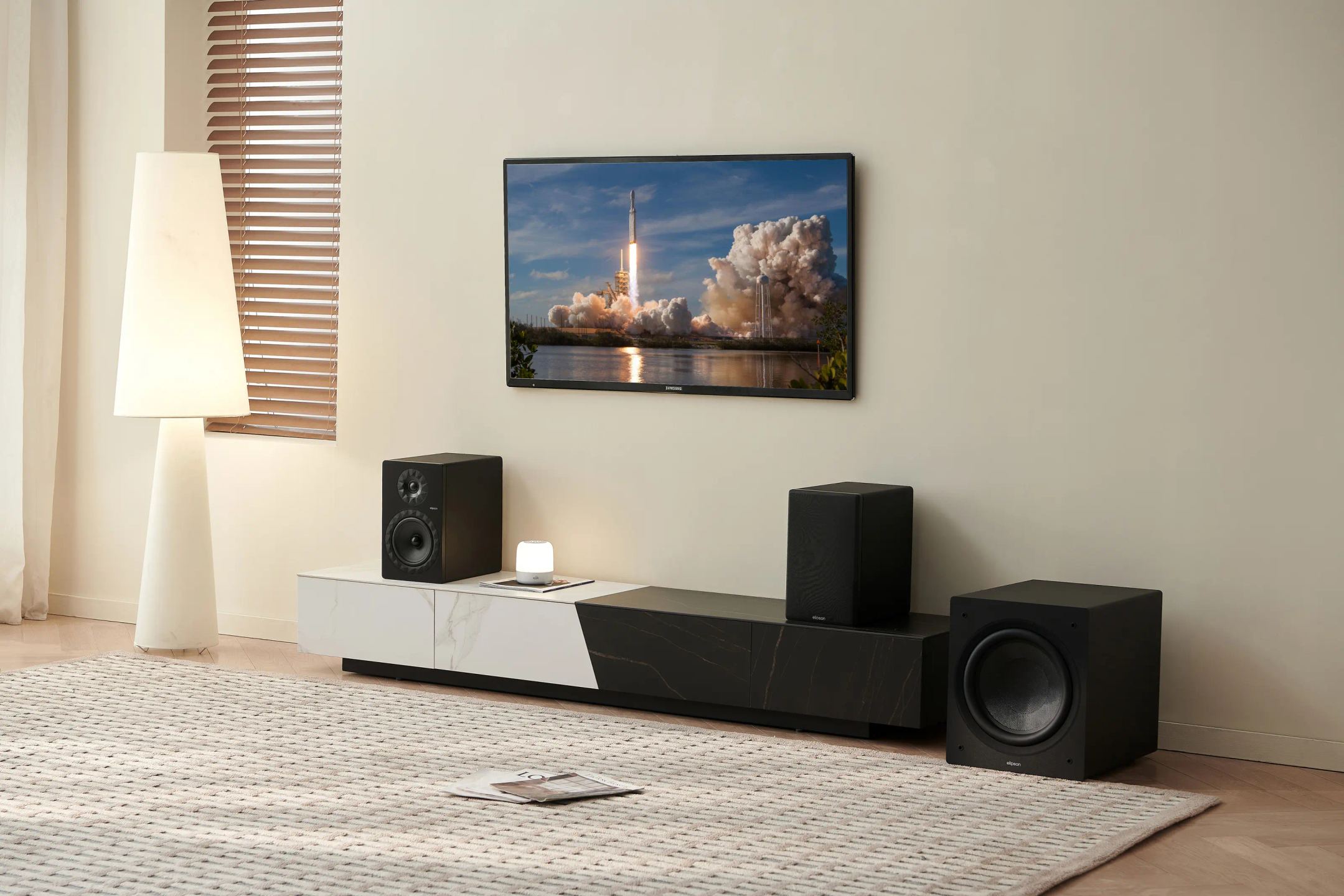
The dimensions follow suit: 356 mm wide, 422 mm high and 470 mm deep, increasing to 486 mm with the grille in place. The depth, close to half a meter, is the first figure to check before planning a spot alongside a sofa or next to a TV stand.
Documentation
French
Technical specifications
Design and amplification
- Type: active bass-reflex subwoofer
- Amplification: 300 W, Class D
- Driver: 300 mm diameter, fiberglass cone
Acoustic performance and settings
- Frequency response (± 3 dB): 25 to 160 Hz
- Subsonic filter: 23 Hz, 12 dB/octave slope
- Crossover frequency: variable from 40 to 160 Hz
- Bass boost: + 6 dB at 33 Hz
- Phase: 0° / 180°
- Standby: automatic
Connectivity
- Line inputs: left / right, low-level
- Line outputs: left / right, low-level
Dimensions and weight
- Dimensions (width × height × depth)
- Without grille: 356 × 422 × 470 mm
- With grille: 356 × 422 × 486 mm
- Net weight: 20.4 kg
- Gross weight: 23.6 kg
Frequently Asked Questions
Can the Classic Sub 12 be connected to a stereo amplifier without a subwoofer output?
The connection must use a line-level signal, as the subwoofer has no high-level inputs (those that connect to the speaker terminals). An amplifier without a preamp output or subwoofer output therefore cannot feed it directly. Most recent integrated amplifiers, connected amplifiers and network players with variable volume offer one of these outputs: this is what to check on the rear panel of your device.
How do I connect it to a home theater receiver?
There is no dedicated LFE input: connect the amplifier’s subwoofer output (often labelled “Subwoofer” or “LFE”) to one of the subwoofer’s line inputs using a single RCA cable. Then set the subwoofer’s crossover frequency to its maximum value, 160 Hz, and let the amplifier set the crossover point with the speakers, generally around 80 Hz, during its calibration procedure.
Where should the subwoofer be placed in the room?
Below about 80 Hz, the ear can no longer pinpoint where bass is coming from, which allows considerable flexibility in placement. A corner increases the perceived level but also accentuates certain room resonances, making the bass sound bloated and slow. A simple method is to temporarily place the subwoofer at your listening position, play a bass-heavy track, then move along the walls: the spot where the bass sounds most even is the right place for the subwoofer. Leave a few centimetres of clearance around the cabinet so the port can breathe freely.
What’s the difference compared to the Premium Sub 12 from the same brand?
Both share a 300 mm diameter and a fiberglass cone, but the Premium Sub 12 takes things up a notch in several areas: 500 W amplification, response extending down to 22 Hz, a separate LFE input, a front port fitted with a laminar-flow baffle that reduces air noise at high output levels, and a 27 kg cabinet. The Classic Sub 12 retains the essential controls in a lighter, more compact package.
Do two subwoofers perform better than one?
In a large room, two subwoofers placed in different locations distribute bass more evenly, because the dips and peaks caused by room resonances occur in different places for each one. The result is more consistent bass from one seat on the sofa to another, rather than simply an increase in level. Home theater amplifiers equipped with two subwoofer outputs make this type of setup easier, and their calibration takes both units into account.
Is the subwoofer suitable for an apartment?
Bass travels through floors and walls far more than other frequencies, and a 30 cm driver produces plenty of it. Adding an isolation support under the feet (a platform on soft material, damping pads) limits transmission to neighbouring homes. The boost at 33 Hz maintains presence at low volume, avoiding the need to turn up the level to regain bass weight in the evening.
Should you turn off the subwoofer after each listening session?
No, automatic standby takes care of that: amplification switches off when no signal reaches the subwoofer and switches back on automatically when the signal resumes. If the subwoofer remains connected to a device that emits a constant low-level background noise, signal detection may keep it awake; switching off the source or amplifier is then enough to trigger standby.
- Eco-contribution included in the sale price.
- Manufacturer reference: ELICLASUB12BK
- GTIN / EAN: 3700795194829