

Accuphase E-6000

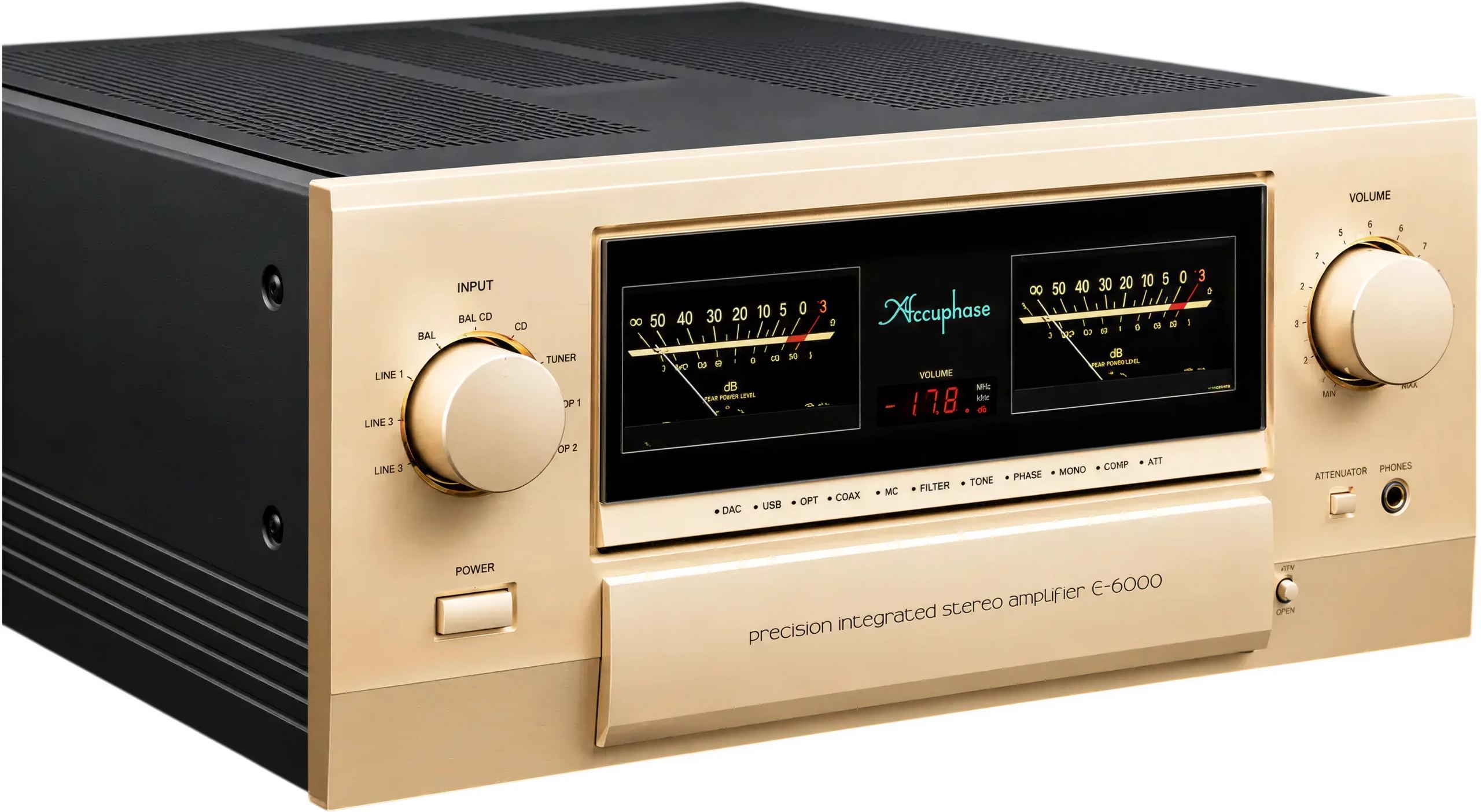
Accuphase E-6000, stereo integrated amplifier
Two hundred and sixty watts per channel into 8 ohms: no Accuphase integrated amplifier has ever claimed so much. The E-6000 replaces the E-5000 at the top of the Japanese brand’s Class AB range. It brings together circuits from the company’s separates in a single chassis: the balanced volume control from its preamplifiers and the output stage from the P-7500 stereo power amplifier. The whole unit weighs 38.6 kg, nearly five kilos more than its predecessor.
Volume control without a potentiometer
Most amplifiers adjust volume using a variable resistor, which attenuates the signal. Accuphase takes a different approach with its Balanced AAVA (Accuphase Analog Vari-gain Amplifier) system. The signal is first converted into current. The gain is then set electronically according to the knob position, before the signal is converted back into voltage. There is no variable resistor in the music signal path, and the level remains identical on both channels at every position. A custom-made, high-precision sensor reads the control position. Each channel uses two AAVA modules in a fully balanced configuration. The tone control circuit and the preamp’s output buffer stage are also balanced.
In the stage that converts current back into voltage, ANCC technology adds a small auxiliary amplifier. It measures the noise and distortion produced by the main circuit and cancels them out. The guaranteed signal-to-noise ratio rises from 111 dB on the E-5000 to 112 dB. The most meaningful improvement comes at actual listening levels: Accuphase claims 14% less noise in the volume range used day to day. The AAVA module is positioned at the front of the chassis, away from the power supply, on a gold-plated circuit board.
As for inputs, the E-6000 accepts five unbalanced sources via RCA and two balanced sources via XLR. The phase of the balanced inputs is adjustable.
Six pairs of transistors to keep the speaker under control
The power stage operates as an instrumentation amplifier: it receives the positive and negative halves of the signal simultaneously. The balanced configuration is therefore maintained from the input through to the output transistors. The circuit uses current feedback, a technique the brand has long employed for its speed and stability. The voltage amplification stage uses a bootstrapped cascode configuration.
The output features six pairs of bipolar transistors arranged in parallel push-pull, compared with five on the E-5000. Each transistor can handle 15 A. This is the same configuration as the P-7500 stereo power amplifier. Continuous power reaches 260 W per channel into 8 ohms and 350 W into 4 ohms, compared with 240 and 320 W for the previous model. Into 4 ohms, power increases without doubling, which is common in Class AB. Above all, the E-6000 has current in reserve for speakers whose impedance drops in the bass.
Speaker control worthy of a separate power amplifier
The guaranteed damping factor is 1,000, the same value as the P-7500. This figure describes the amplifier’s ability to brake a speaker cone after each impulse. The higher it is, the more controlled the bass and the less it lingers. Two techniques make it possible to reach this value. With Balanced Remote Sensing, the feedback samples the signal very close to the speaker terminals, on both the signal line and the ground line. The amplifier therefore corrects what actually reaches the speakers. Output impedance is reduced, as are harmonic distortion and intermodulation distortion.
Speaker protection relies on electronic MOSFET switches rather than mechanical relays. Their operating resistance does not exceed 0.84 milliohm, and they have no contacts that could oxidize over the years. The selected components have very low impedance, and the current paths are short with a large cross-section. Circuits continuously monitor output short circuits, abnormal temperatures and the presence of DC voltage at the terminals.
An enlarged power supply at the center of the chassis
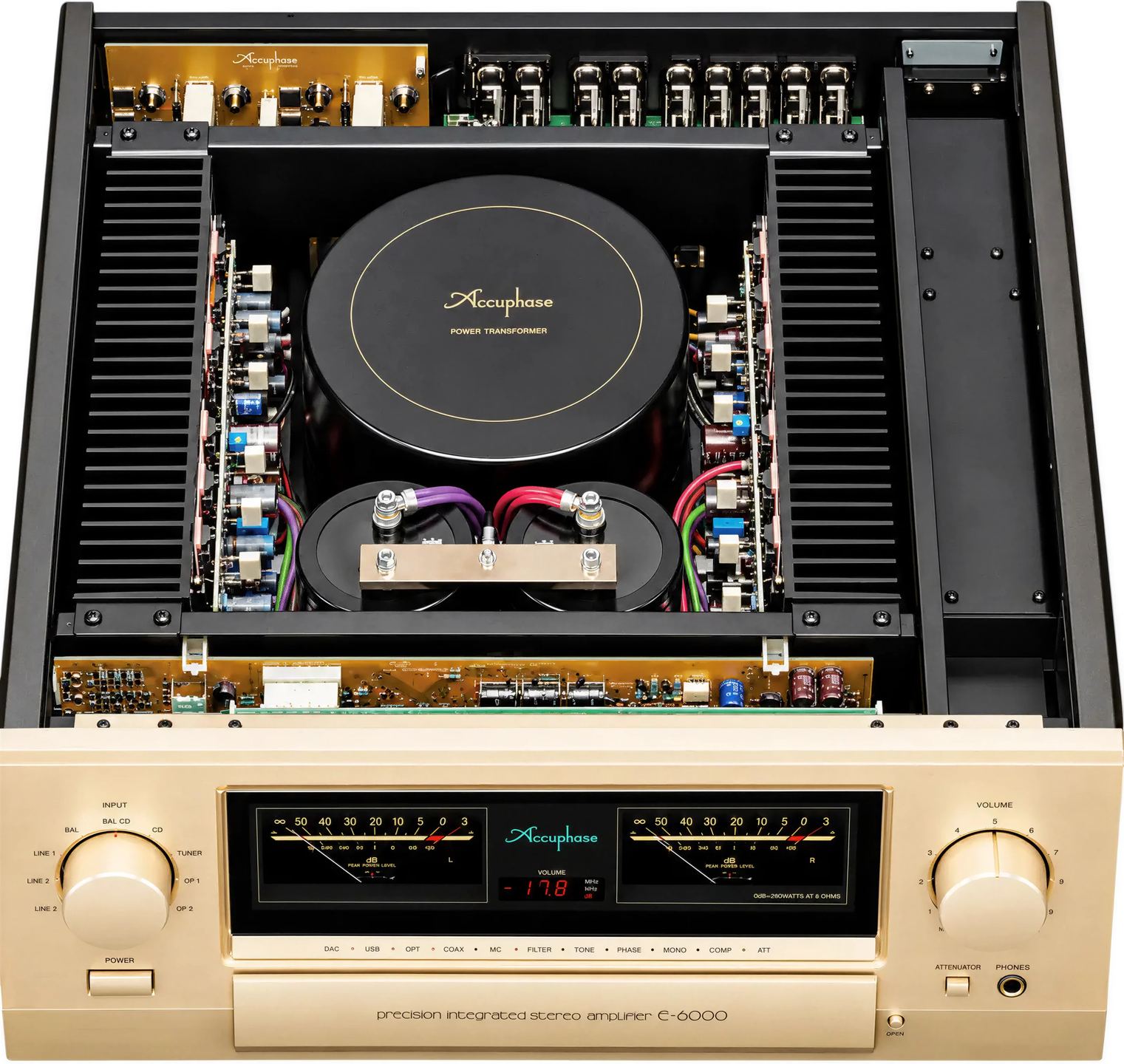
The custom-made toroidal transformer occupies the center of the unit. Its diameter has increased by 25 mm compared with the E-5000. It feeds two filter capacitors of 47,000 µF each, up from 40,000 µF previously. The energy reserve available during musical peaks increases by 17.5%. The left and right amplifier modules are positioned on either side of the power supply, separate from one another.
This extra power has implications for the furniture. In Class AB, the unit generates heat during operation. The heatsinks are longer, and the number and length of their fins have been recalculated. The chassis measures 221 mm high, compared with 211 mm on the E-5000, by 465 mm wide and 502 mm deep. A sturdy shelf is required, deep enough for the cables, with clear space above. It also takes two people to install it.
Needle meters and a gold front panel
The front panel retains the Accuphase style: a champagne finish, two large controls surrounded by gold-plated rings, and analog power meters. These meters have been redesigned, and their needles respond even at very low levels, including with the volume set below -60 dB. An amplifier this powerful is listened to at just a few watts most of the time, and it is precisely in this range that the needles remain active. The central display shows the volume level, and the sampling rate when the digital conversion board is installed. A headphone output is available on the front panel. The RC-260 remote control is supplied.
Two slots to upgrade the amplifier
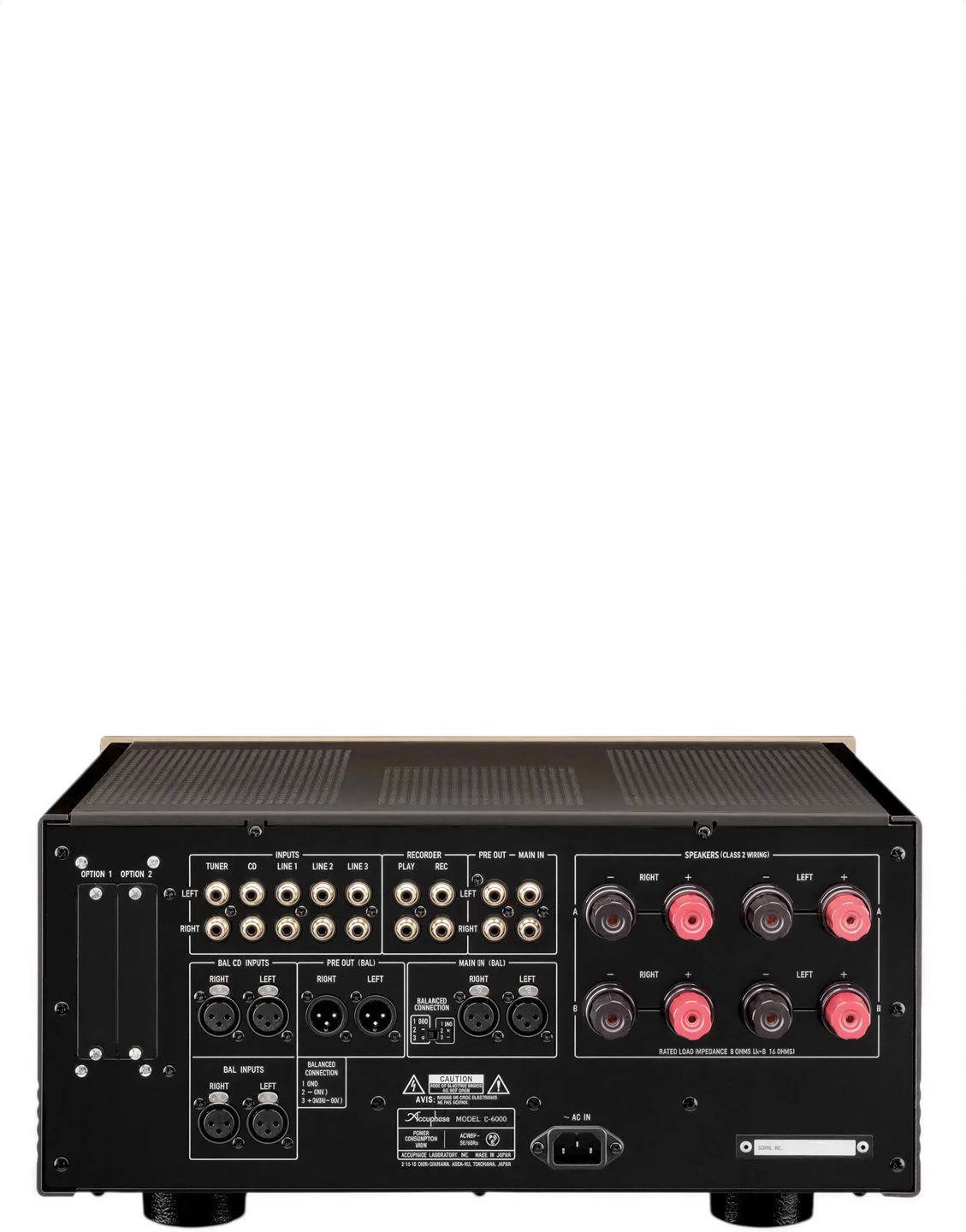
At the rear, two slots accommodate the brand’s optional boards. The DAC-60 board adds USB, optical and coaxial digital inputs. The input is selected from the front panel, and the display shows the frequency of the incoming signal. The AD-60 board adds a phono preamplifier for a turntable: the choice between a moving magnet (MM) and moving coil (MC) cartridge is made from the front panel, as is the MC load setting. Neither of these boards is supplied with the amplifier. Without them, the E-6000 remains an entirely analog integrated amplifier.
The preamp outputs (PRE OUT) and power amplifier inputs (MAIN IN) are available in RCA and XLR. The E-6000 can therefore serve as a standalone preamplifier, a standalone power amplifier, or be complemented by a second amplifier for bi-amping. Two sets of large terminals allow two pairs of speakers to be connected, or one pair of speakers to be bi-wired.
Technical specifications
Overview
- Model: Accuphase E-6000.
- Type: Class AB stereo integrated amplifier.
- Positioning: the most powerful integrated amplifier in the Accuphase range, successor to the E-5000.
Power and performance
- Average continuous power per channel:
- Into 8 Ω: 260 W, compared with 240 W for the E-5000.
- Into 4 Ω: 350 W, compared with 320 W for the E-5000.
- Guaranteed signal-to-noise ratio: 112 dB, compared with 111 dB for the E-5000.
Power supply
- Large, custom-made, high-efficiency toroidal transformer:
- Positioned at the center of the unit.
- Diameter increased by 25 mm compared with the E-5000.
- Filter capacitors: two capacitors of 47000 µF each, compared with 40000 µF each for the E-5000.
- Increase in energy storage capacity: 17.5%.
Volume control and preamplification
- Volume control via the Balanced AAVA system, Accuphase Analog Vari-gain Amplifier:
- Operation without a variable resistor in the signal path.
- Two AAVA modules per channel, arranged in a fully balanced configuration.
- Volume position read by a custom-designed high-precision sensor.
- Balanced tone control circuit and preamplifier output buffer stage.
- ANCC noise and distortion cancellation technology integrated into the AAVA current-to-voltage converter.
- Circuit mounted on a gold-plated printed circuit board.
Power stage
- Instrumentation amplifier architecture:
- Simultaneous reception of the positive and negative halves of the signal by the power stage.
- Signal kept balanced up to the power stage input.
- Bipolar transistor output stage:
- Six parallel push-pull pairs, compared with five for the E-5000.
- Current capacity of each transistor: 15 A.
- Power circuit with the same configuration as that of the P-7500 stereo power amplifier.
Speaker control and protection
- Guaranteed damping factor: 1000, as with the P-7500.
- A high factor improves control of speaker driver movement.
- Balanced remote sensing, Balanced Remote Sensing:
- Feedback signal taken near the speaker terminals, on both the signal line and the ground line.
- Reduction in output impedance, total harmonic distortion (THD) and intermodulation distortion.
- Speaker protection via metal-oxide-semiconductor field-effect transistor (MOSFET) switches, replacing mechanical relays:
- On-state resistance: 0.84 mΩ.
- Very low-impedance components, short current paths with large cross-sections.
Internal construction and heat dissipation
- Separate left and right amplifier modules, positioned on either side of the central power supply.
- Balanced AAVA module positioned at the front to limit interference.
- Longer heatsinks, with optimized fin count and length to improve heat dissipation.
Front panel and display
- Accuphase-style front panel, with gold-plated rings around the two large controls.
- New large analog power meters with needles:
- Response even at very low levels, including when the volume is below −60 dB.
- Central display showing the volume level.
Connectivity and optional boards
- Front-panel headphone output.
- Two sets of large speaker terminals.
- Two rear slots for optional boards:
- DAC-60, digital-to-analog conversion board: digital input selection from the front panel, sampling frequency shown on the central display when the board is installed.
- AD-60, phono board for vinyl records: moving coil (MC) / moving magnet (MM) cartridge type selection and MC load adjustment from the front panel.
- DAC-60 and AD-60 boards sold as options, not supplied with the unit.
Dimensions and weight
- Width: 465 mm.
- Height: 221 mm, compared with 211 mm for the E-5000.
- Depth: 502 mm.
- Weight: 38.6 kg, compared with 33.8 kg for the E-5000.
Frequently asked questions
Can the E-6000 be integrated into a home theater system?
Yes, via the MAIN IN inputs. The front left and right outputs of a processor or home theater amplifier then feed the power stage directly. Volume is controlled by the processor, bypassing the E-6000’s preamplifier. The same speakers are used for stereo music and movies, without compromising music listening.
What is the phase adjustment for balanced inputs used for?
There is no single wiring convention for XLR connectors. Depending on the manufacturer and era, the hot signal is on pin 2 or pin 3. With a device wired according to the other convention, the signal arrives inverted, which can disrupt the soundstage and bass impact. The selector restores the correct polarity without changing the cable.
How do I listen to vinyl records with the E-6000?
There are two options. The AD-60 board, installed in one of the rear slots, supports MM and MC cartridges and can be adjusted from the front panel. An external phono preamplifier can also be connected to a line input. The board frees up space on the equipment stand and avoids an extra cable. A separate preamp sometimes offers more load and gain settings for unusual MC cartridges.
Can two pairs of speakers be connected at the same time?
The two sets of speaker terminals allow this, with two pairs in different rooms or two pairs in the same room. If both pairs operate at the same time, the amplifier sees a lower load, since the impedances are combined in parallel. With two 8-ohm pairs, the load remains reasonable. With two 4-ohm pairs, it is best to use only one pair at a time.
How does it differ from Accuphase Class A integrated amplifiers?
The brand’s Class A integrated amplifiers continuously pass a high current through the output transistors. They operate in their most linear region, but their power is limited to a few tens of watts per channel and they generate a lot of heat. The E-6000 operates in Class AB: the quiescent current is lower and the available power is much higher. It is better suited to low-efficiency speakers, large rooms and high listening levels.
Are the preamp and power stage really separable?
Yes. PRE OUT and MAIN IN are available in unbalanced and balanced versions. An active subwoofer or a second power amplifier can be connected to the preamp outputs. The E-6000 can also be driven by an external preamplifier. This flexibility allows the system to evolve around the unit instead of replacing it.
- Eco-contribution included in the sale price.


