

Sendy Audio Egret
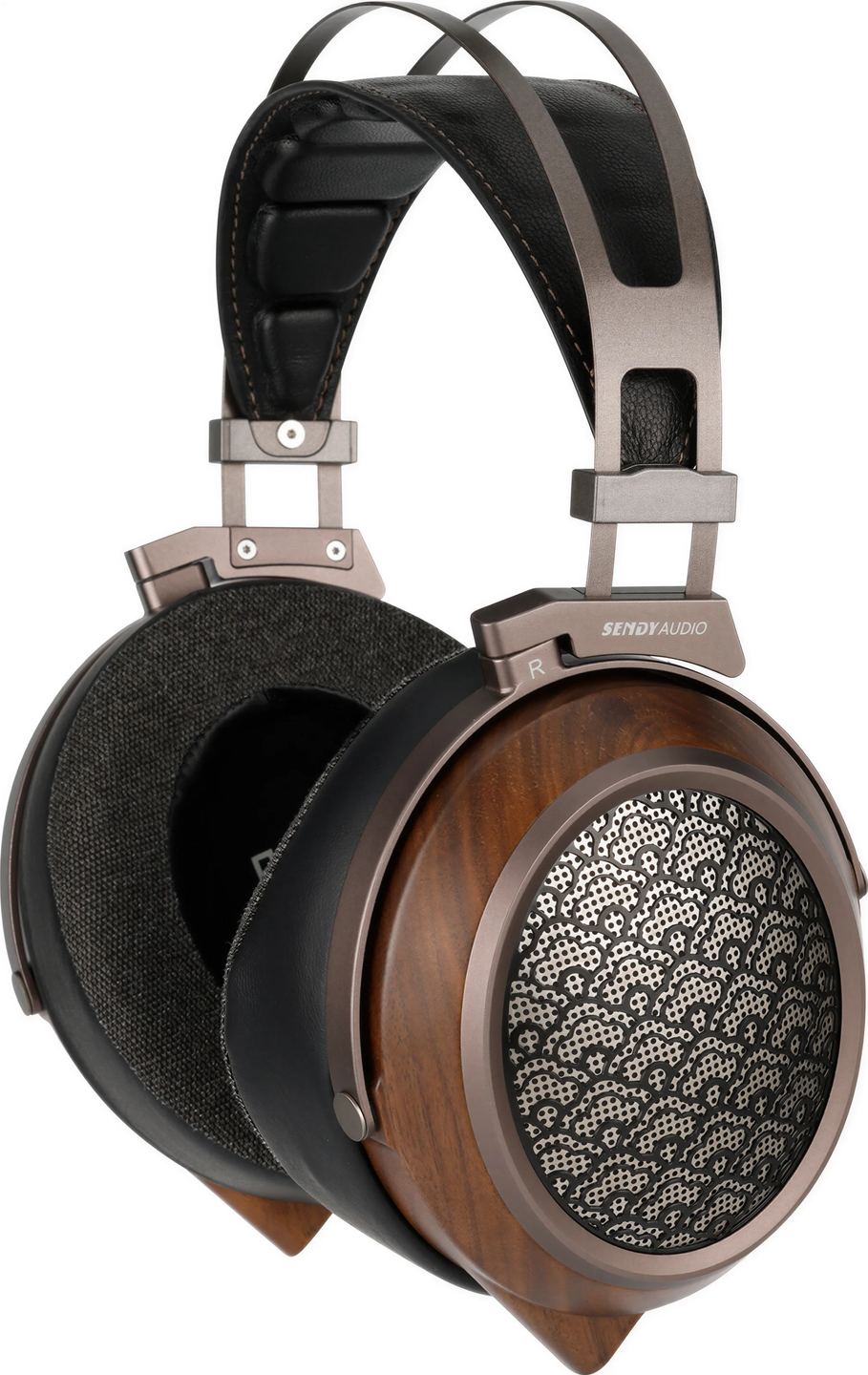
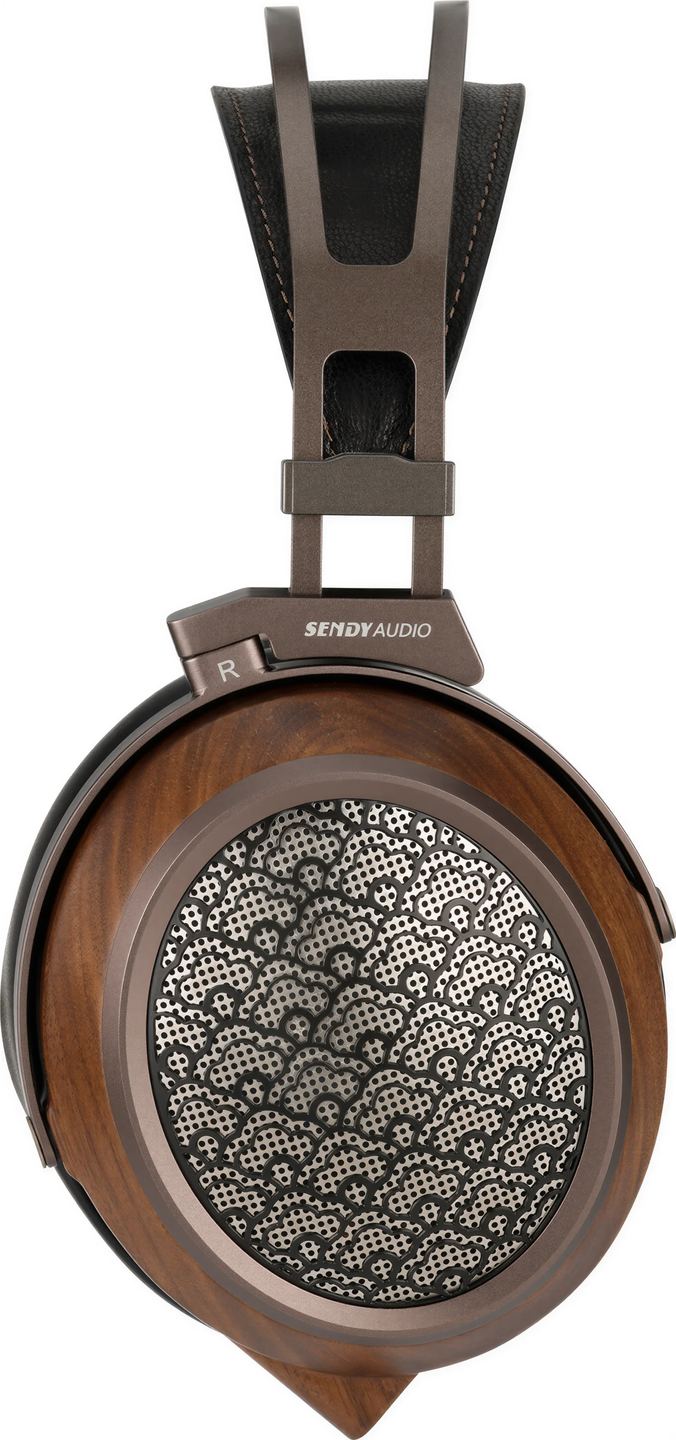

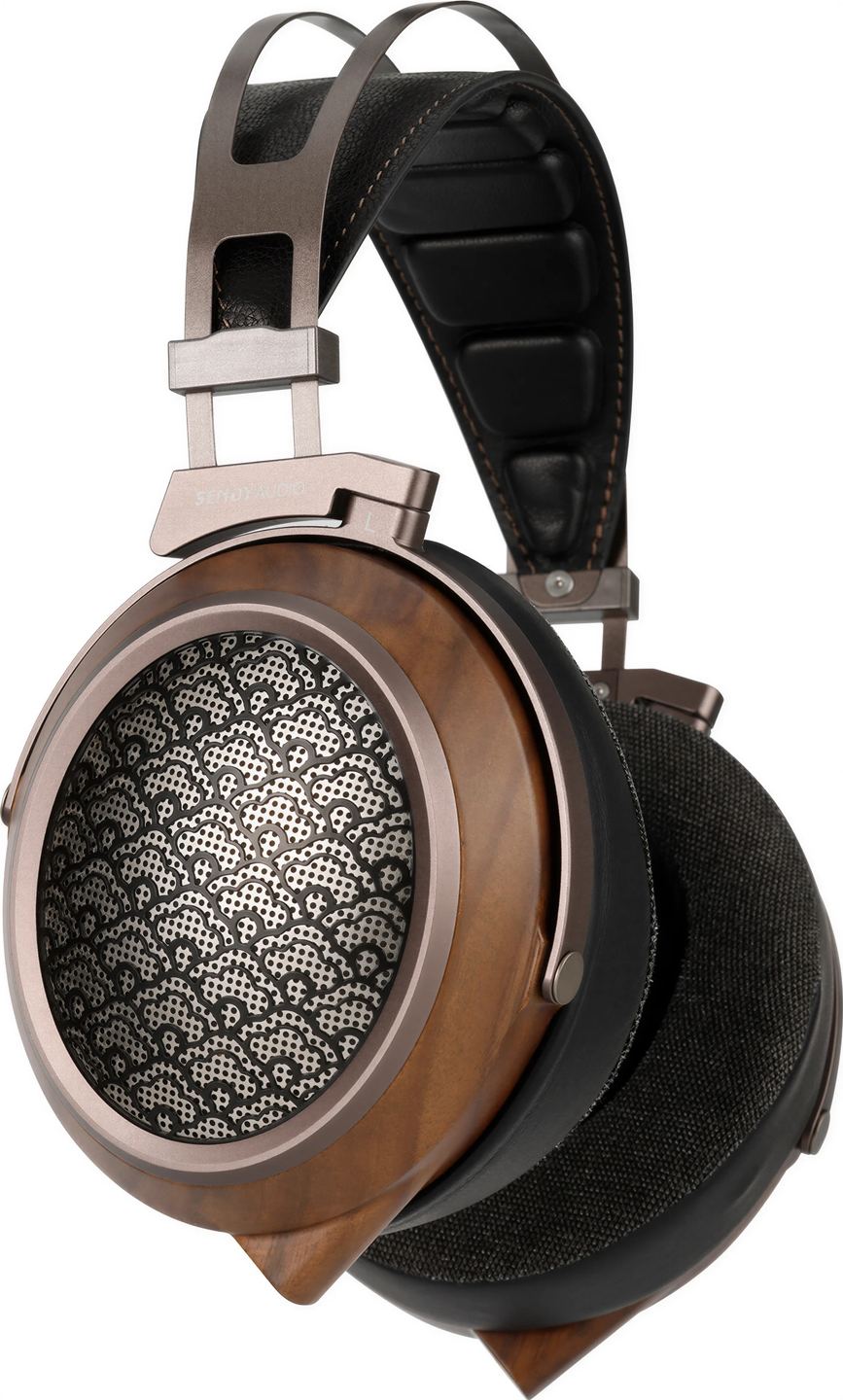
Sendy Audio Egret, open-back planar headphones in walnut
North American black walnut earcups, a metal grille inspired by the wings of an egret in flight and, behind it, a large oval planar driver: these open-back headphones from Sendy Audio combine handcrafted woodwork, the brand’s specialty, with a nanometer-thick composite diaphragm. Their braided balanced cable and two adapters make them suitable for use with a portable player or a home headphone amplifier.
A 98 x 84 mm planar diaphragm
In a planar magnetic driver, sound does not come from a cone driven at its center by a coil, but from a very thin diaphragm carrying a conductive circuit and positioned within a magnetic field. When the music signal passes through this circuit, the entire surface of the diaphragm moves uniformly. The Egret’s oval diaphragm measures 98 mm by 84 mm and amply covers the ear. Magnets are arranged on either side of the diaphragm, which moves within a symmetrical magnetic field and receives the same force in both directions of travel.
The diaphragm is a sandwich of composite materials whose magnetic layer is less than 800 nanometers thick, or less than one thousandth of a millimeter. Its aluminum circuit is neither glued nor printed: it is deposited by electron-beam evaporation, a process in which the metal, heated under vacuum, vaporizes and then condenses on the diaphragm as a very thin, uniform film. A diaphragm this light starts and stops faster in response to the signal, delivering crisp attacks and clearly resolved fine details, while the uniform deposition distributes the driving force across the entire surface and stabilizes the frequency response, specified as 20 Hz to 40 kHz.
Black walnut, aluminum and an egret-wing grille
The earcups are carved from North American black walnut, a hard, dense wood chosen as much for its acoustic behavior as for its dark grain. Each piece goes through a series of stages carried out largely by hand in Sendy’s workshops: wood selection, cutting, CNC machining, sanding, polishing, then several coats of varnish dried in the open air. As wood is a natural material, the grain and shade vary from one unit to another, and no Egret is quite identical to the one in the photos.
The yokes, earcup frames and other metal parts are machined from aircraft-grade aluminum, then anodized in anthracite gray with metallic highlights (a shade known as gunmetal) that complements the brown walnut; this is the only color available. The grille covering the rear of the earcups features an openwork design of outstretched wings and allows the diaphragm’s rear sound wave to pass through freely. This is the principle behind open-back headphones, which avoid the closed-enclosure effect and provide a more spacious soundstage, with a trade-off worth knowing: sound escapes outward and ambient noise comes in. The Egret is best suited to use at home in a quiet room, rather than on public transport or in a shared office.
Angled earpads and lambskin leather
The earpads vary in thickness from 20 to 35 mm from one edge to the other, an angle that follows the natural angle of the outer ear and distributes pressure all around it. Their edges are covered in lambskin leather, their skin-contact surface is made of more breathable velour, and the whole assembly rests on memory foam. They measure 102 x 116 mm on the outside with a 55 x 68 mm opening, and have clearly visible left and right markings inside. The adjustable headband is padded and covered in the same lambskin leather, and the earcups swivel to fit the shape and width of the face. The Egret weighs 443 g without its cable, a typical weight for planar headphones of this size built with wood and aluminum.
A three-metal balanced cable
The supplied cable, approximately 1.8 m long, has four conductors combining three metals: each contains 30 strands of 0.05 mm Furukawa OFC copper, 10 strands of silver-plated copper and 10 strands of enameled gold-plated copper. A graphene-reinforced PVC inner jacket provides both insulation and an initial layer of protection against electromagnetic interference, while a double braid of copper and silver-plated copper, covered by a PVC jacket, completes this shielding while improving the cable’s tensile strength. At the headphone end, it connects to two 3.5 mm mono jacks, one per earcup; at the source end, it terminates in a straight 4.4 mm balanced plug.
Two adapters are included. The first, a short cable around ten centimeters long, converts the 4.4 mm female connection to an unbalanced 3.5 mm plug, the format used for headphone outputs on most portable players and computers. The second converts this 3.5 mm plug to 6.35 mm for home amplifiers. The box also contains a leather carrying case and a hemp pouch.
What amplification does the Egret need?
With an impedance of 24 Ω and a sensitivity of 95 dB, the Egret is easier to drive than many planar headphones. A portable audio player or a small USB DAC connected to a smartphone is enough to reach a comfortable listening level, preferably through a balanced 4.4 mm output, which delivers more voltage than the 3.5 mm output. However, low-impedance planar headphones need current more than voltage, and this is where a desktop headphone amplifier provides extra headroom: bass becomes more controlled, and large changes in level come through without compression as the volume rises.
Technical specifications
Acoustic design
- Type: open-back over-ear headphones with planar magnetic drivers
- Drivers: oval shape, dimensions of 98 × 84 mm
- Diaphragm: nanoscale sandwich composite
- Magnetic cutoff layer less than 800 nm thick
- Aluminum circuits deposited by electron-beam evaporation
- Magnets: arranged on both sides of the diaphragm according to the Sendy exploded view, material not found
Audio performance
- Impedance: 24 Ω ± 15%
- Sensitivity: 95 dB ± 3 dB
- Frequency response: 20 Hz to 40 kHz
Materials and finishes
- North American black walnut earcups: sanded, polished, varnished in multiple coats, air-dried
- Metal grille with an egret-wing pattern
- Earcups, yokes and metal parts: CNC-machined aircraft-grade aluminum, gunmetal gray anodizing
- Headband: padded lambskin
- Earpads: angled, lambskin surround, velour face, inert foam, left / right markings
- Colors: walnut and gunmetal gray, a single color listed by Sendy as “black”
Adjustments and connectivity
- Adjustments: swiveling earcups, adjustable headband
- Headphone-side connectivity: two mono jack sockets, diameter not specified by Sendy
Included accessories
- Detachable cable with 4.4 mm balanced termination
- Triple composition: 30 strands of 0.05 mm Furukawa oxygen-free copper, 10 strands of 0.05 mm silver-plated copper, 10 strands of 0.05 mm enameled gold-plated copper
- Inner layer: graphene-reinforced PVC
- Outer layer: 8/7/0.06 mm copper braid, 8/7/0.06 mm silver-plated copper braid, PVC sheath
- Length: not found
- Adapter A: 4.4 mm balanced female to 3.5 mm unbalanced
- Adapter B: 3.5 mm to 6.35 mm
- Leather carrying case
- Hemp pouch
Dimensions and weight
- Earpad dimensions:
- External dimensions: 102 × 116 mm
- Opening: 55 × 68 mm
- Thickness: 20 to 35 mm
- Weight: 443 g
Frequently asked questions
Does the Egret have a microphone or Bluetooth connectivity?
No. These are wired headphones with no microphone, remote control, or built-in electronics. For wireless listening, you need a Bluetooth receiver with a headphone output.
Can the Egret be connected to a smartphone without a headphone jack?
Yes, with a small USB-C converter (dongle) that includes a headphone output. Models with a 4.4 mm output accept the original cable directly; for a 3.5 mm output, use the supplied adapter.
What is the difference between a balanced and an unbalanced connection?
With an unbalanced connection (3.5 or 6.35 mm jack), both channels share the same return wire. With a balanced connection (4.4 mm), each driver is connected via its two terminals to its own amplification stage, eliminating this shared return, improving left/right separation and generally doubling the available voltage on sources that support it. The supplied adapter switches the Egret back to unbalanced operation: it works normally, with less power available depending on the source.
Can I use a cable other than the one supplied?
Yes. The headphones’ two 3.5 mm mono jack sockets are a common format, and many commercially available cables fit them, both balanced and unbalanced. Just check that the plug housings fit into the recesses in the earcups.
Why doesn't the item I received look exactly like the photos?
The shells are carved from solid walnut, and each piece of wood has its own grain and shade. These variations are not defects: no two Egret are ever exactly alike.
How do I care for wooden housings?
A soft, dry cloth is all you need for the varnish. It is best to avoid household cleaners and solvents, keep the headphones out of direct sunlight and away from heat sources, and store them in their case between listening sessions to protect the wood from knocks and changes in humidity.
- Eco-contribution included in the sale price.
- Manufacturer reference: SENDY-EGRET
- GTIN / EAN: 6973869471011


