

T+A SDX 3100 HV
Specifications and features


T+A SDX 3100 HV, reference network player and preamplifier
To drive a power amplifier or a pair of active speakers, a single source is all you need here: the SDX 3100 HV plays music over the network, converts it into an analog signal and then adjusts its volume, all within a 26 kg aluminum chassis. Successor to the SDV 3100 HV in the HV series, the reference range from T+A, it gains analog inputs, fully analog tone controls and a slot for a phono module.
Two separate paths for PCM and DSD
PCM is the format used by CDs and virtually all files and online services: each sample is encoded using 16 to 32 bits, tens or hundreds of thousands of times per second. DSD, the SACD format, takes the opposite approach, with a single bit repeated several million times per second. The SDX 3100 HV does not route these two signals through the same circuit: each has its own digital section, conversion stage and analog output stage, a separation that T+A calls Path Separation Technology.
On the PCM side, four 32-bit Burr-Brown sigma-delta chips operate in a double-differential configuration, providing four converters per channel. Before conversion, a programmable signal processor oversamples the stream to 705.6 or 768 kHz using a choice of four filters. The two FIR filters, one long with a highly linear frequency response, the other short and better suited to transients, sit alongside Bézier interpolation combined with an IIR filter, with behavior close to that of an analog circuit, and pure Bézier interpolation. The latter, developed by T+A, reconstructs the curve between two samples without the pre-ringing and post-ringing of conventional oversampling. Two NOS modes disable all internal oversampling when computer software is already handling it.
DSD follows a direct path, without digital filtering or noise shaping, to the brand’s True 1-Bit converter, which accepts native streams up to DSD1024 (49.2 MHz). At the output, a third-order linear-phase analog Bessel filter can be set to 60 or 120 kHz: the wide setting gives the sound more space, while the 60 kHz setting better protects tweeters and narrow-bandwidth amplifiers from the high-frequency noise carried by DSD64. The clock combines two femtosecond quartz oscillators with multistage jitter cleanup (jitter being timing irregularities in the digital signal); when an external source’s clock is clean enough, the SDX 3100 HV switches to its internal oscillator and indicates this on the screen.
A fully balanced dual-mono preamplifier
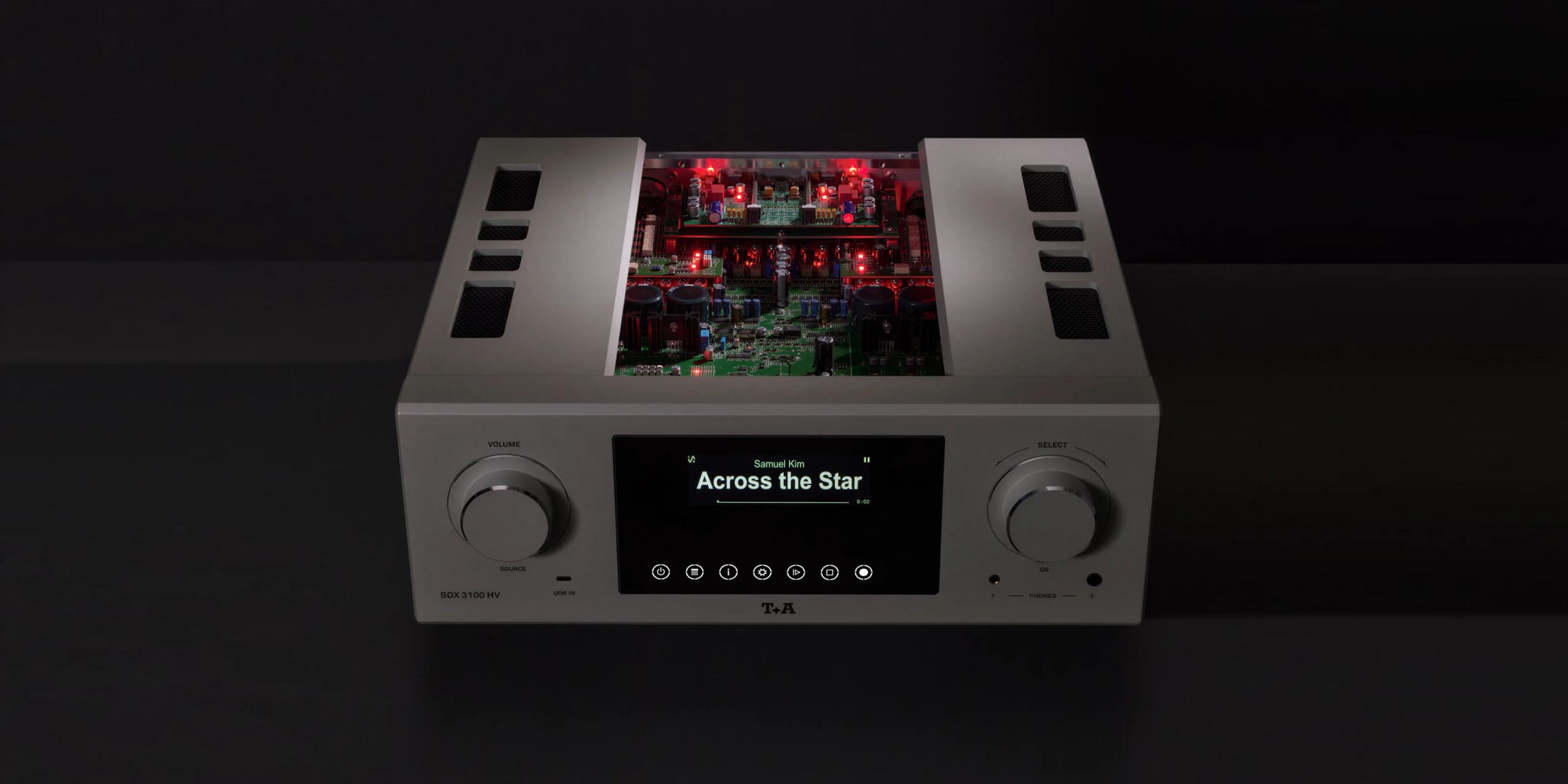
Each channel has its own circuit, from the first component to the output socket, delivering 110 dB channel separation, a weighted signal-to-noise ratio of 117 dB and distortion below 0.001% over a bandwidth of 0.5 Hz to 300 kHz. Volume adjusts in 1 dB steps, as does balance, and the unit can start at the last level used, at a capped level or at a predefined fixed value.
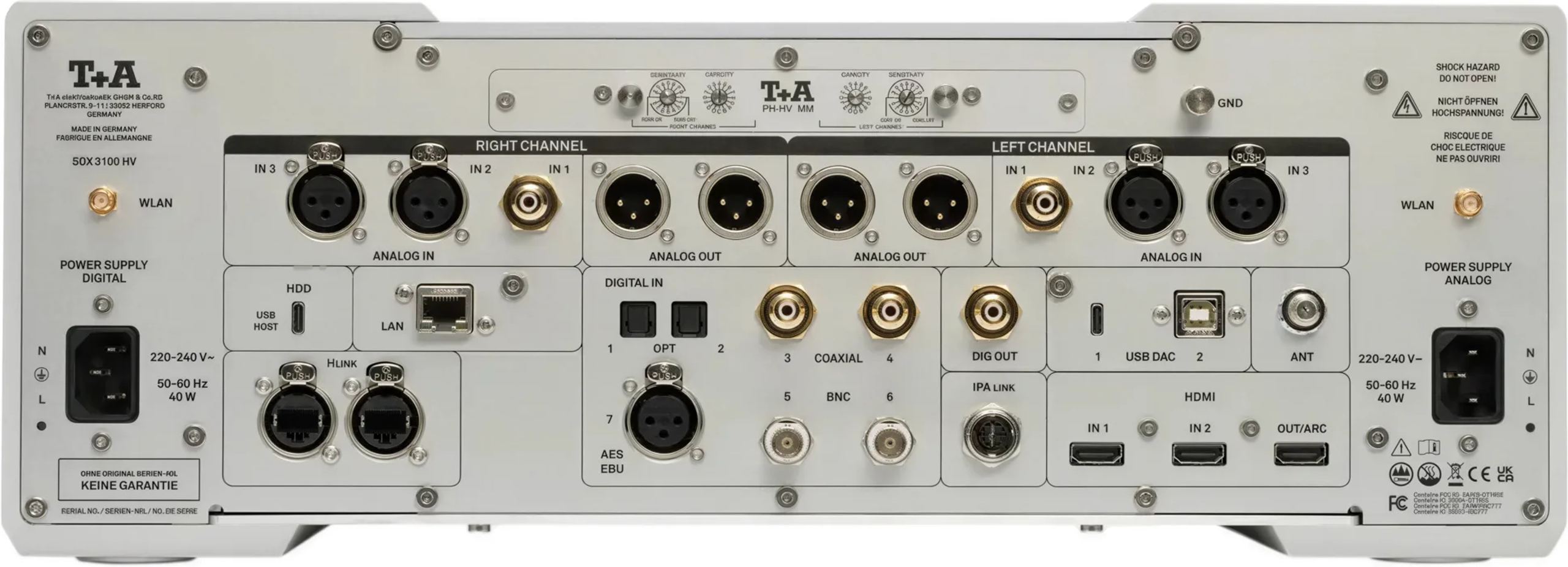
Where the SDV 3100 HV was limited to one analog input, the SDX 3100 HV offers two, one balanced XLR and the other RCA. They accept up to 18 V and 9 V RMS respectively, well above what a domestic source delivers, so no player is likely to overload the input. A “pass-through” mode bypasses volume control on either input: a home theater processor then controls the front left and right channels itself, benefiting from the same signal chain as stereo music.
There is a single XLR output with variable level (1.45 V nominal, up to 19.6 V) and an impedance of 50 Ω, suitable for long cable runs. The absence of an RCA output requires a power amplifier or active speakers with balanced inputs. With an HV-series amplifier connected via the supplied HLink cable, the remote control also mutes and restores its speaker outputs, and the amplifier adopts the name assigned to the player on the network.
Bass and treble adjustment without digital processing
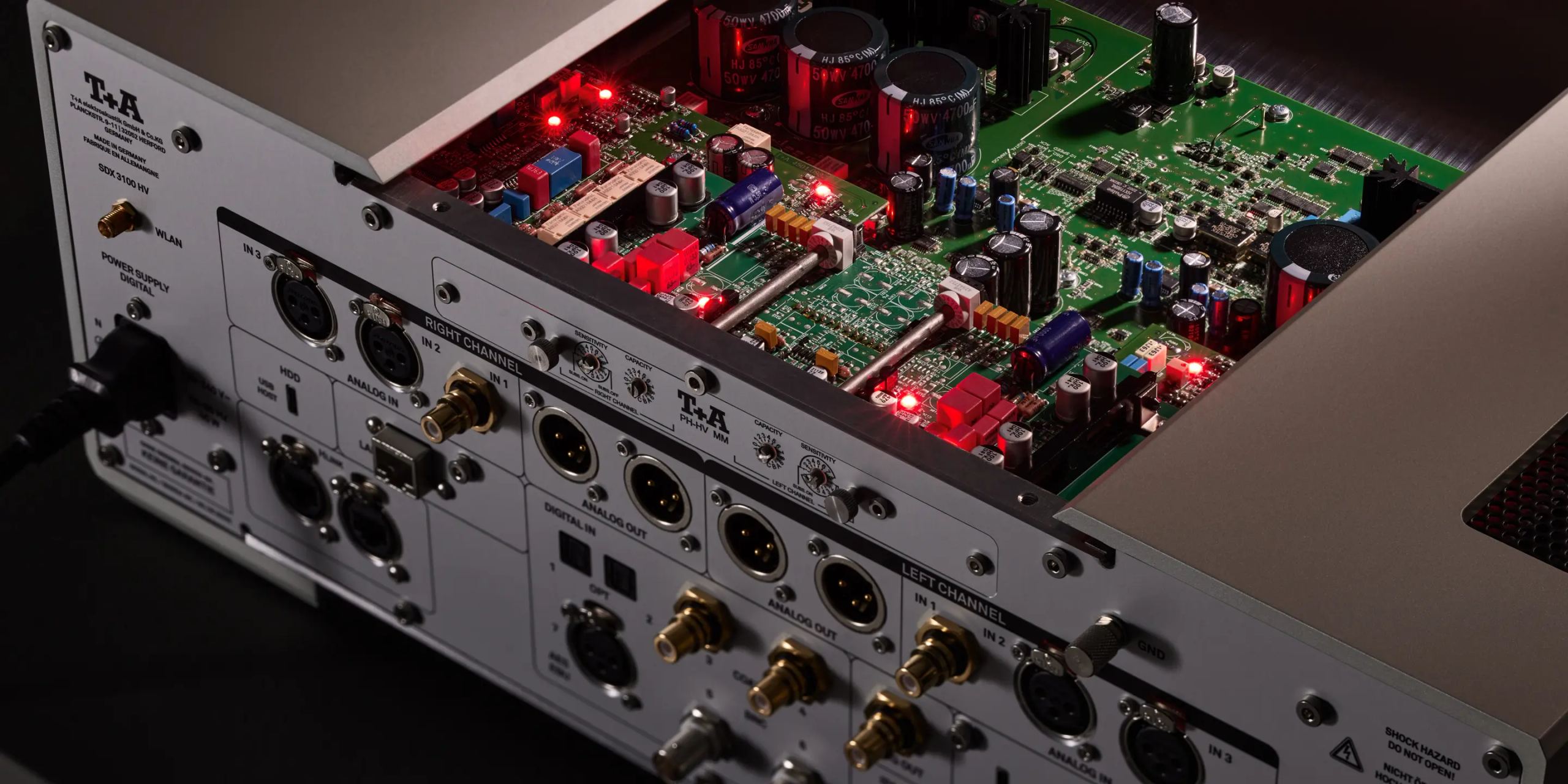
The VTC tone control module acts directly on the analog signal. A microprocessor controls the settings, but the circuits themselves remain analog, without conversion to digital and back. Bass and treble can be adjusted from -6 to +8 dB, and each also has an adjustable turnover frequency, meaning the point from which the adjustment takes effect. For bass, five positions range from 60 to 650 Hz: at 60 Hz only the lowest bass is affected, while at 650 Hz the adjustment extends into the lower midrange, adding body to voices. For treble, the five positions range from 1.5 to 10.5 kHz, from the vocal presence region to the air around instruments.
Settings can differ between the left and right channels, useful when one speaker is close to a corner of the room and the other is against a wall. Loudness compensation, adjustable from -25 to +10, boosts the frequency extremes that the ear perceives less readily at low volume. Any unused block is removed from the signal path by a relay with gold-plated contacts: with tone controls disabled, the music passes through none of these circuits. Tone adjustment is useful in an overly damped or reverberant room, or with old tapes that have lost some of their treble.
Network playback, radio and Bluetooth
The ASA G3 streaming platform, the third generation developed by T+A, provides access to Qobuz Connect, Tidal Connect, Spotify Connect, Deezer, Amazon Music HD and HIGHRESAUDIO, as well as AirPlay 2 and playback from Audirvana. Files on a NAS can be played via UPnP/DLNA, and those on a USB flash drive or hard drive via the front or rear USB port. Over the network, PCM reaches 384 kHz at 24 bits, and DSD plays natively from DSD64 to DSD256 in DSF and DFF formats. Connection is via Gigabit Ethernet or Wi-Fi 6 with 2 × 2 MIMO, using two antennas with magnetic bases. The T+A Music Navigator G3 app, for iOS and Android, controls everything and manages connections to music services.
Radio covers three reception modes: Internet radio and podcasts through the airable service (over 11,000 stations, with an automatically updated database), FM with RDS and DAB+, each source offering 99 presets. Bluetooth 5.4, with aptX HD, AAC or SBC, comes in handy for playing a track from a guest’s phone; transmission remains compressed by nature, and network playback retains the advantage for attentive listening.
Eleven digital inputs and a dedicated link for the SACD player
The SDX 3100 HV also serves as a converter for other sources. One AES/EBU, two coaxial RCA, two BNC and two optical inputs accept stereo signals from 32 to 192 kHz. The two asynchronous USB inputs for computers support PCM up to 768 kHz and DSD1024; beyond DSD256, a Windows PC equipped with the T+A driver or a recent Linux system is required, while a Mac is limited to DSD256 without a driver.
The two HDMI inputs receive stereo PCM up to 384 kHz and DSD64 from a Blu-ray or SACD player, and pass the picture to the television through the HDMI OUT/ARC port. This same port brings sound back from the television via the audio return channel, and CEC control lets the television’s remote adjust the volume, or even turn the player on and off along with it. A coaxial digital output sends the selected source to another device. Finally, the IPA Link socket connects the PDT 3100 HV CD/SACD transport from the same series and transmits its PCM and DSD signals in their original format.
A phono module that slots into the rear
The HV-series phono preamplifier is now available in a plug-in version, offered as an option and installable after purchase, in MM (moving magnet) or MC (moving coil) variants. Four rotary switches, two per channel, match it to the cartridge using a small screwdriver. Sensitivity has eight settings, from 1 to over 10 mV for MM and from 100 µV to over 1.2 mV for MC, each available with or without a subsonic filter to suppress very low-frequency noise (record warps, impacts). The MM module’s input capacitance covers 70 to 460 pF in sixteen steps, to be adjusted taking into account the tonearm cable’s capacitance, often between 50 and 200 pF. The MC module’s input resistance covers 55 to 1,000 Ω, also in sixteen steps.
A Class A headphone output with discrete components
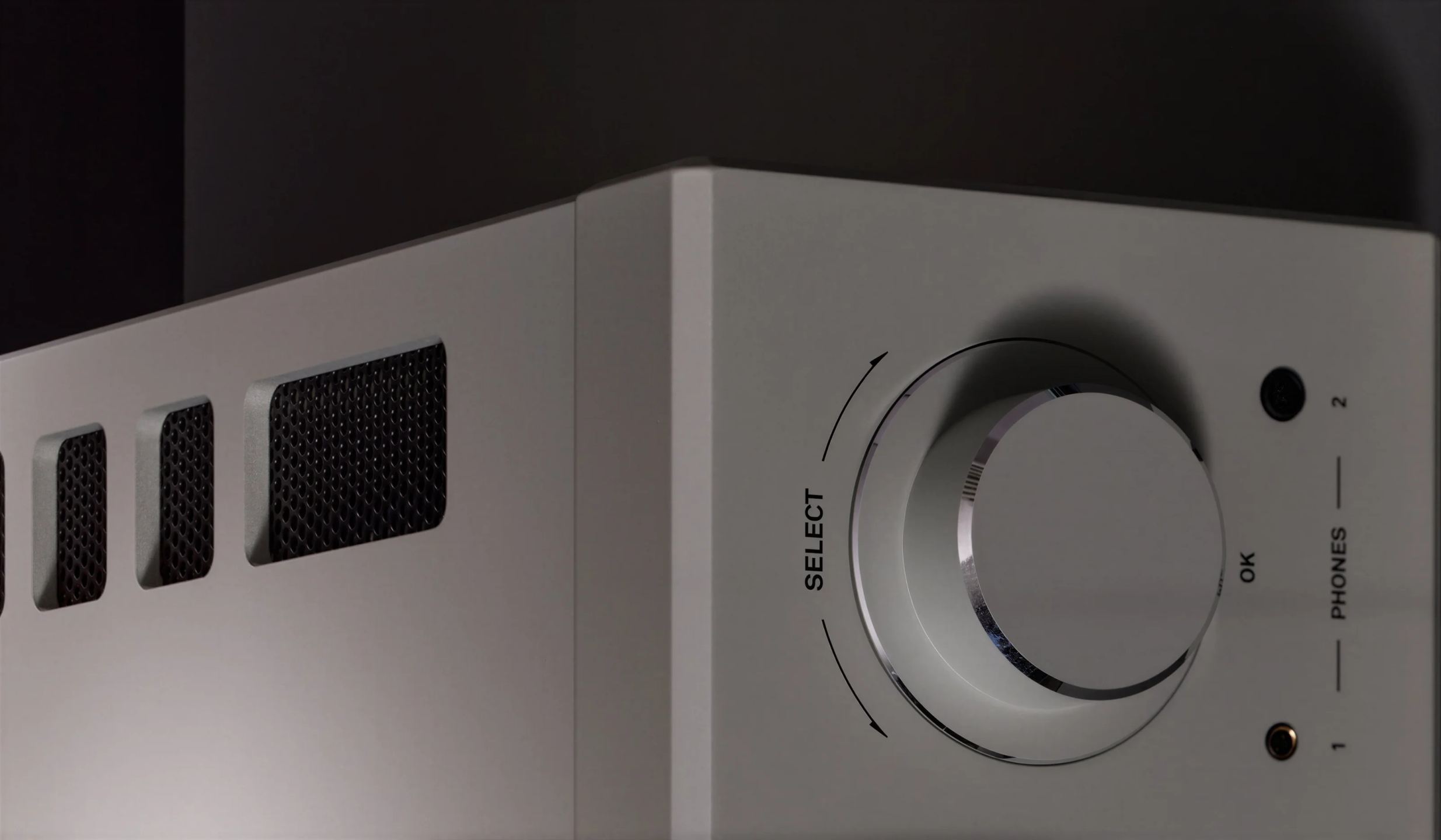
The front panel combines a 6.35 mm jack socket and a balanced 4.4 mm Pentaconn socket, powered by discrete-component output stages operating in Class A up to 200 mA. In Class A, the transistors conduct continuously and do not hand over as the signal crosses zero, eliminating crossover distortion. The 6 Ω output impedance suits the vast majority of hi-fi headphones; with a 16 Ω model whose impedance varies significantly with frequency, the tonal balance may shift slightly. Headphone volume is stored separately from the main volume, a volume limit can be set, and the XLR outputs are automatically muted as soon as headphones are connected, except in manual mode.
Two power supplies and a non-magnetic metal chassis
The digital and analog power supplies occupy two shielded compartments, on the left and right of the chassis, each with its own mains inlet: both supplied power cords must be connected. The digital section consumes a maximum of 40 W, and the analog section 55 W. In standby, consumption falls below 0.5 W, or below 2 W in comfort standby, the mode that allows wake-up via the app and television.
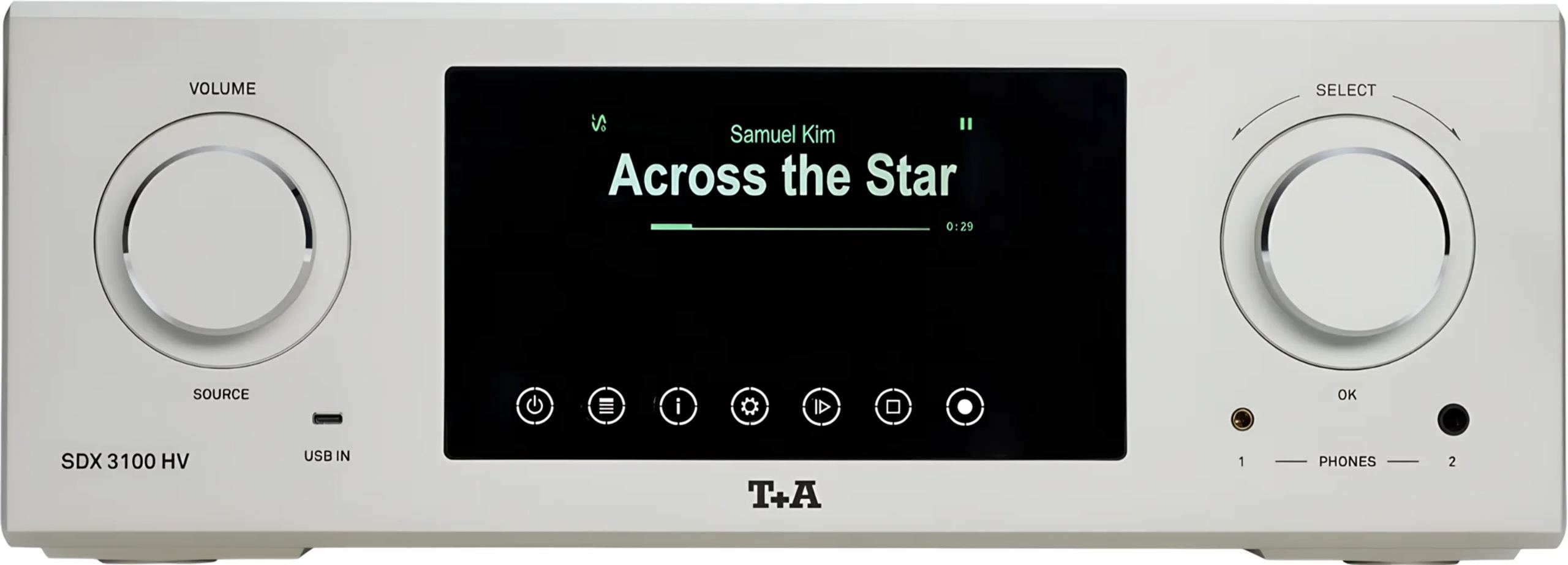
The enclosure uses only non-magnetic metals, which provide shielding against external interference without interacting with the signal. It measures 46 cm wide, 46 cm deep and 17 cm high, comes in a silver or titanium finish, and is made at T+A’s factory in Herford, Germany. Two large rotary knobs on the front control volume, sources and navigation, while the screen alternates between a large-character display, readable from a distance, and a detailed display showing resolution and bit rate. The F3100 infrared remote control provides access to all settings.
Documentation
Technical specifications
Preamplifier
- Frequency response: 0.5 Hz to 300 kHz (+0 / −3 dB).
- Signal-to-noise ratio: 108 dB unweighted, 117 dB weighted.
- Total harmonic distortion (THD): less than 0.001%.
- Intermodulation distortion: less than 0.001%.
- Channel separation: 110 dB.
Analog connections
- Unbalanced RCA inputs:
- Sensitivity: 250 mV to 9 V RMS.
- Impedance: 10 kΩ.
- Balanced XLR inputs:
- Sensitivity: 500 mV to 18 V RMS.
- Impedance: 20 kΩ.
- Balanced XLR outputs: nominal level of 1.45 V RMS.
- Maximum output level: 19.6 V RMS.
- Output impedance: 50 Ω.
Headphone amplification
- Connectors: 6.3 mm jack, 4.4 mm balanced Pentaconn.
- Output impedance: 6 Ω.
- Architecture: discrete-component power stages.
- Class A operation: up to 200 mA.
Digital connections
- Digital output: 1 coaxial output compatible with IEC 60958 and LPCM.
- AES/EBU input: 1 input, up to 192 kHz and 24 bits.
- S/PDIF inputs: 6 inputs, including 2 coaxial, 2 BNC, 2 TOSLINK optical.
- HDMI inputs: 2.
- HDMI ARC: 1 audio return channel connection on the HDMI output.
- USB device ports: 2 ports with asynchronous transfer.
- Supported formats: PCM up to 768 kHz, DSD up to DSD1024.
- DSD512 / DSD1024 compatibility: requires a compatible computer and software environment.
- USB 2.0 host ports: 2.
Digital-to-analog conversion
- High-end architecture.
- PCM architecture: quadruple differential conversion, with 4 converters per channel.
- Digital processing: 32-bit sigma-delta conversion.
- PCM conversion frequencies: 705.6 kHz, 768 kHz.
- DSD conversion: T+A True-1Bit technology with native bitstream.
- Maximum DSD resolution: DSD1024, approximately 49.2 MHz.
- PCM oversampling: programmable digital signal processor (DSP).
- Digital filters: 4 selectable algorithms, short FIR, long FIR, Bézier / IIR, Bézier.
- Analog filtering: third-order linear-phase Bessel filter.
- Analog cutoff frequencies: 60 kHz or 120 kHz, selectable.
- PCM frequency response:
- 44.1 kHz: 2 Hz to 20 kHz.
- 48 kHz: 2 Hz to 22 kHz.
- 96 kHz: 2 Hz to 40 kHz.
- 192 kHz: 2 Hz to 80 kHz.
- 384 kHz: 2 Hz to 100 kHz.
- 768 kHz: 2 Hz to 120 kHz.
- DSD frequency response:
- DSD64: 2 Hz to 44 kHz.
- DSD128: 2 Hz to 60 kHz.
- DSD256: 2 Hz to 80 kHz.
- DSD512: 2 Hz to 100 kHz.
- DSD1024: 2 Hz to 120 kHz.
- Total harmonic distortion: less than 0.001%.
- Weighted signal-to-noise ratio: 117 dB.
- Channel separation: 110 dB.
Network connectivity
- Wired Gigabit Ethernet: 10/100/1000 Base-T.
- Wi-Fi 6: IEEE 802.11a/b/g/n/ac/ax.
- Antenna configuration: 2 × 2 MIMO.
- 2.4 GHz band:
- Frequency range: 2.412 to 2.472 GHz.
- Bandwidth: 20 MHz.
- Number of channels: 13.
- Maximum antenna gain: 3.2 dBi.
- 5 GHz band:
- Frequency range: 5.180 to 5.825 GHz, depending on regional regulations.
- Number of channels: up to 24 advertised channels.
- Maximum antenna gain: 4.25 dBi.
- Maximum power at the antenna connection: 17 dBm.
- Network configuration: automatic.
Network audio playback and control
- Supported audio formats, including high-resolution: MP3, AAC, OGG Vorbis, FLAC, WAV, AIFF, ALAC, DFF, DSF.
- Network PCM playback: 32 to 384 kHz, at 16 or 24 bits.
- Maximum MP3 bitrate: 320 kbit/s, constant or variable bitrate.
- Network DSD playback: DSD64, DSD128, DSD256.
- Streaming services: Tidal Connect, Deezer, Qobuz Connect, Spotify Connect, HIGHRESAUDIO, Amazon Music HD.
- Apple compatibility: AirPlay 2.
- Software compatibility: Plays with Audirvana, Roon certification reportedly pending.
- Control app: T+A Music Navigator G3 for iOS and Android.
Radio reception and podcasts
- Internet radio and podcasts: airable service.
- Access to over 11000 stations.
- Automatic station database updates.
- FM receiver:
- Frequency range: 87.5 to 108 MHz.
- FM-HD: available only in the United States.
- Sensitivity: 1 µV.
- Signal-to-noise ratio: greater than 65 dBA.
- DAB / DAB+ reception:
- Band III: 168 to 260 MHz.
- Sensitivity: 2.0 µV.
- Signal-to-noise ratio: greater than 96 dBA.
- RDS / RDBS functions: station name (PS), program type (PTY), radio text (RT).
Bluetooth connectivity
- Bluetooth version: 5.4.
- Audio profile: A2DP.
- Remote control: AVRCP 1.4.
- Supported codecs: aptX HD, SBC, AAC, MP3.
- Frequency band: 2.402 to 2.480 GHz.
- Maximum equivalent isotropically radiated power (EIRP): less than 10 dBm.
Included accessories and options
- Remote control: F3100 infrared.
- Antennas: 2 Wi-Fi antennas, 1 FM antenna.
- Included cables: 2 power cords, 1 XLR cable, 1 RCA cable, 1 USB-C cable, 1 HLink cable.
- Documentation: user manual.
- Phono option: moving magnet (MM) or moving coil (MC) module.
Dimensions and weight
- Height: 17 cm.
- Width: 46 cm.
- Depth: 46 cm.
- Weight: 26 kg.
Frequently asked questions
Can the SDX 3100 HV be paired with an integrated amplifier?
It’s possible, provided the integrated amplifier has an XLR input. The cleanest solution is to use a “bypass” or home theater input, which bypasses the amplifier’s volume control. With a standard input, there are two successive volume controls: you then need to set the integrated amplifier’s volume to a reasonable level and control the listening volume from the SDX 3100 HV.
Is a TV's sound output in multichannel?
No, the SDX 3100 HV only processes stereo. The audio output of the TV or Blu-ray player must be set to stereo PCM. The connection to the TV uses the Audio Return Channel (ARC), not eARC.
Can the phono module be added later?
Yes, the module can be installed at any time. Choose the MM or MC version according to the cartridge, as only one module can occupy the slot. The factory settings are 4 to 6.5 mV and 170 pF for the MM module, and 330 to 460 µV and 100 Ω for the MC module. These are average values to be fine-tuned later according to the cartridge manufacturer’s specifications, applying the same settings to both channels.
Do I need an Ethernet cable, or is Wi-Fi enough?
Wi-Fi 6 with 2 × 2 MIMO easily handles high-resolution bitrates in a home with good coverage. An Ethernet cable remains preferable for DSD256 or PCM files at 352.8 and 384 kHz, or if the router is far away. Over Wi-Fi, the antennas provide their best range when placed on their magnetic base, clear of the unit, and the Ethernet cable must be unplugged to activate the wireless connection.
How do I change the conversion filter?
The converter menu opens with a long press of the dedicated button on the remote control or from the system menu on the front panel. It adapts to the current format: the four PCM filters and two NOS modes appear only during PCM playback, and the two DSD modes only during DSD playback. The easiest approach is to compare the filters on the same track, as the change can be heard within a few seconds.
Does the SDX 3100 HV work with Roon?
Roon Ready compatibility is undergoing certification. During Roon playback, everything is controlled from the Roon app, and the player’s screen displays ROON as the source. Audirvana and AirPlay 2 are operational.
How are updates performed?
Software updates take just a few minutes over the Internet connection, via the device’s information menu. When connected to the PDT 3100 HV transport via the HLink cable, the SDX 3100 HV also updates it. It is best to check for updates during initial setup.
What precautions should be taken during installation?
Allow 10 cm of clearance all around for ventilation, provide a rigid, level surface capable of supporting 26 kg, and have two people move it. When stacked with other equipment, the SDX 3100 HV must be placed at the top, with nothing resting on its cover. On a lacquered or wooden surface, it is best to check the effect of the feet on an inconspicuous area.
- Eco-contribution included in the sale price.


