

T+A M 200 silver
T+A M 200: 200 series mono power amplifier
This monoblock takes the electronics of the 200 series A 200 stereo amplifier from T+A and dedicates them to a single speaker, with more than 400 watts available into 4 ohms. A stereo system therefore requires two. The enclosure retains the series’ compact format, 32 cm wide and weighing 5 kg, and connects to the brand’s DAC 200 DAC/preamplifier or any preamplifier equipped with RCA or XLR outputs.
An entire amplifier for each speaker
In a stereo amplifier, the two channels share a chassis, a power supply and adjacent circuits. A small portion of the left-hand signal always ends up on the right: this is crosstalk. With one monoblock per speaker, this problem no longer exists, and each driver has access to its power supply’s entire energy reserve without sharing it during demanding passages. The M 200 delivers 210 W into 8 ohms and 420 W into 4 ohms. Power doubles exactly when impedance is halved, demonstrating a power supply capable of maintaining its voltage when the speaker demands more current. Speakers with low or highly variable impedance benefit the most.
The Purifi Eigentakt output stage adapted by T+A
The output stage operates in Class D. Its transistors do not conduct continuously; they switch at very high frequency, and the audio signal is then reconstructed by filtering. Losses are low and heat generation is modest, hence an idle power consumption of 25 W and no need for large heatsinks. Here, T+A relies on Eigentakt technology from Danish specialist Purifi, adapted to its own requirements with its designers’ approval. The frequency response extends from 1 Hz to 60 kHz within 3 dB. This margin beyond the audible range preserves transient waveforms and prevents the early phase shifts that degrade treble on more limited amplifiers. Harmonic distortion and intermodulation distortion both remain below 0.002%, and the signal-to-noise ratio reaches 113 dB.
An HV input stage inherited from the high end
Before the Class D stage, voltage amplification uses the HV topology from T+A’s most ambitious series. Conventional amplifiers correct their errors through heavy negative feedback, which feeds part of the output signal back to the input to compare it with the original signal. This lowers measured distortion but can introduce artifacts of its own. The HV circuit achieves linearity through its very design and dispenses with this heavy negative feedback. Total gain is 31.4 dB, or a factor of 37. Reaching rated power requires 1.13 V at the RCA input or 2.26 V at the XLR input, levels that a typical preamplifier supplies without difficulty.
A high-frequency sinusoidal switching power supply
The M 200 has neither a massive toroidal transformer nor a bank of large capacitors, which explains its 5 kg weight. Its switching power supply, developed by T+A, operates with a pure sinusoidal clock at twice the frequency of conventional switching power supplies. The interference that this type of power supply ordinarily generates in the audible band is pushed beyond the range of human hearing. The reservoir capacitors are recharged 100,000 times per second, and the voltage supplied to the output stages remains stable even under heavy load. Maximum power consumption reaches 500 W and falls below 0.5 W in standby.
A damping factor adjustable from the front panel
The damping factor expresses the amplifier’s ability to control the movement of the cone, and especially to stop it dead once the signal has passed. It corresponds to the ratio between the speaker’s impedance and the amplifier’s output impedance. With a factor above 800, the M 200 has an output impedance of approximately one hundredth of an ohm with an 8-ohm speaker and maintains very firm control over the bass. The DF LO button on the front panel lowers this factor to above 70. The bass becomes rounder, the sound warmer, and some speakers, originally tuned for less tightly controlling amplifiers, regain their balance. The right setting depends on the speakers and personal taste; a comparative listening session is enough to decide. When connected to a DAC 200, the M 200 changes settings with a long press of the F3 button on the preamplifier’s remote control.
Bi-wiring, bi-amping and connection to the 200 series
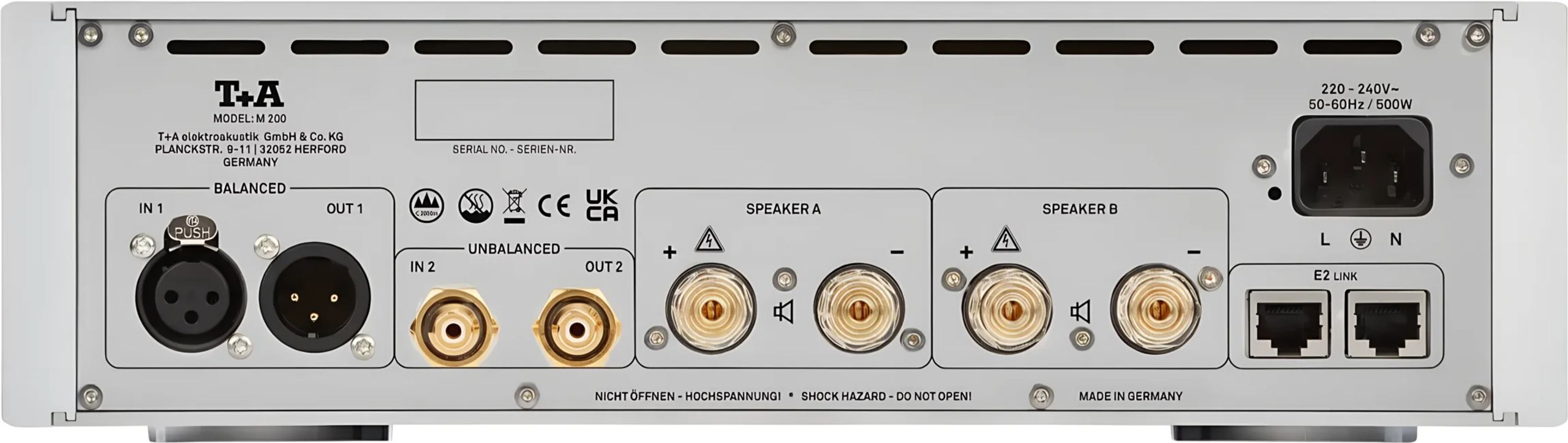
The rear panel offers a balanced XLR input and an unbalanced RCA input, to be used one or the other, never both together. The XLR connection, more resistant to interference picked up along the cable, is the recommended choice when the preamplifier provides it. Each input has a loop-through output in the same format, which passes the signal to a second amplifier for bi-amping. In this configuration, an M 200 powers the bass section of each speaker, while an A 200 or another M 200 handles the midrange and treble, once the jumpers have been removed from the speaker terminals.
Two speaker outputs, A and B, can be switched separately from the front panel. They allow bi-wiring of a speaker with dual terminals or powering of two speakers. A single speaker must have an impedance of at least 4 ohms, and two speakers at least 8 ohms each. With the DAC 200, the supplied E2-Link connection switches both monoblocks on and off along with the preamplifier, without delay, and the remote control cycles through outputs A, B, A+B or neither.
Protection that monitors temperature, load and clipping
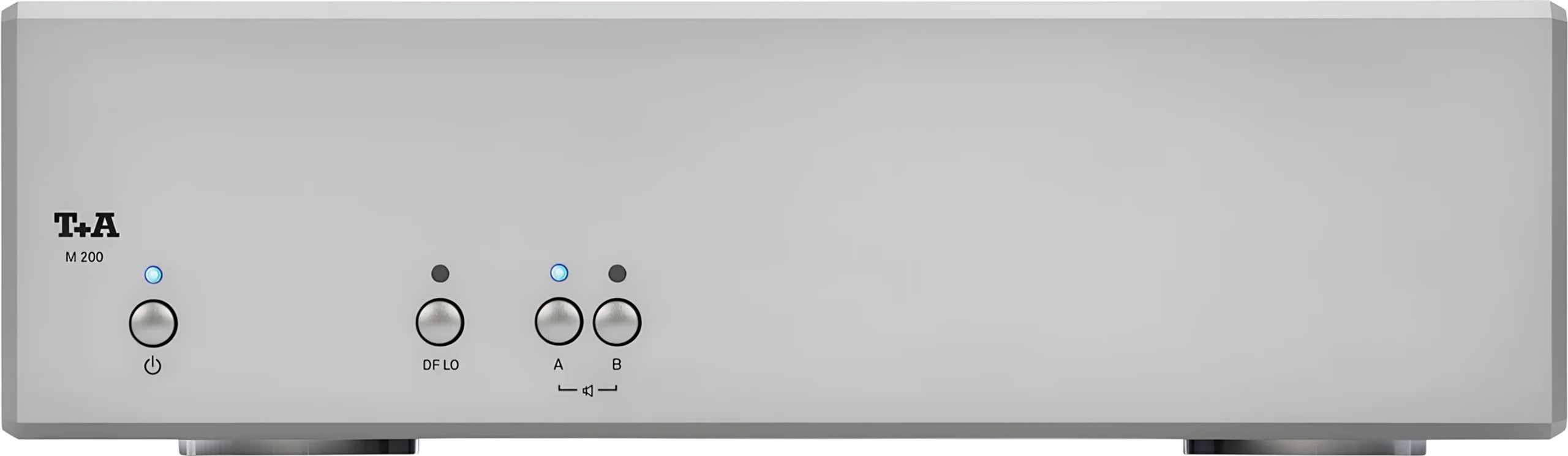
The Intelligent Safe Control system continuously monitors temperature, the load presented by the speaker and clipping. In the event of an overload, short circuit or saturation, it immediately disconnects the speaker outputs and the front-panel indicators flash in a color code indicating the cause. The amplifier recovers after around twenty seconds, or after cooling down in the event of overheating. The anodized aluminum front panel, in silver or black, follows the design of the A 200 and features just four illuminated buttons: power, DF LO, output A and output B.
Technical specifications
Power stage
- Rated power per channel
- Into 4 Ω: 420 W
- Into 8 Ω: 210 W
- Frequency response: 1 Hz to 60 kHz (+0 / −3 dB)
- Signal-to-noise ratio: 113 dB
- Distortion
- Total harmonic distortion (THD): less than 0.002%
- Intermodulation distortion: less than 0.002%
- Damping factor: greater than 800
- In DF LO mode: greater than 70
- Gain factor: × 37, or 31.4 dB
Audio inputs
- Unbalanced RCA line-level input
- Rated sensitivity: 1.13 V RMS
- Impedance: 5.8 kΩ
- Balanced XLR input
- Rated sensitivity: 2.26 V RMS
- Impedance: 20 kΩ
Power supply
- Supply voltage: 220 to 240 V
- Mains frequency: 50 to 60 Hz
- Power consumption
- Maximum: 500 W
- Idle, unit on with no signal: 25 W
- Standby: less than 0.5 W
Supplied accessories
- Mains power cord, E2-Link cable
Available finishes
- Silver anodized aluminium: reference 43
- Black anodized aluminium: reference 42
Dimensions and weight
- Dimensions (H × W × D): 10 × 32 × 34 cm
- Weight: 5 kg
Frequently asked questions
Can the M 200 work with a preamplifier from another brand?
Yes, any preamplifier with RCA or XLR outputs is suitable. The M 200 has no volume control, so it must receive a variable-level signal from a preamplifier, an integrated amplifier with preamp outputs, or a network player with built-in volume control. E2-Link control functions (synchronized power-on, remote switching of the damping factor and outputs) remain exclusive to the DAC 200.
Does the M 200 turn on and off by itself?
When not using an E2-Link connection, an automatic power-on function switches on the amplifier as soon as a music signal reaches its inputs. After about thirty minutes without a signal, it returns to standby, and the DF LO indicator flashes during the last five minutes to give advance notice. The function is enabled or disabled by pressing and holding the DF LO button (green indicator for enabled, red for disabled). With a DAC 200 connected via E2-Link, it is unnecessary and must remain disabled.
Can the two M 200 units be placed near the speakers, far from the preamplifier?
Yes. The speaker cables become very short, and the length shifts to the line-level interconnect, where a balanced XLR connection handles long distances better. The DAC 200 has two E2-Link sockets, allowing each M 200 to be connected directly rather than daisy-chaining the two monoblocks.
What's the difference compared to the A 200 stereo amplifier?
Both devices share the Eigentakt output stage, HV input stage, high-frequency sinusoidal power supply, enclosure and appearance. The A 200 distributes these technologies across two channels in a single chassis, while the M 200 dedicates them to a single channel, with higher power and no crosstalk between channels. The A 200 can also be paired with two M 200 units in a bi-amping configuration, with the M 200 units handling the bass.
What happens with speakers rated below 4 ohms?
With a 4-ohm speaker, or two 8-ohm speakers connected in parallel, high currents cause the output stages to heat up during prolonged listening at high volume. The protection circuit then shuts off the speaker outputs, or even the entire unit if it overheats significantly, until it cools down.
How do I connect speaker cables?
The screw terminals accept bare wire or spade connectors and must be tightened by hand only, without pliers. On units intended for the European Union, red and black plugs block the centre of the terminals and prevent the use of banana plugs. The conductor cross-section must be at least 1.5 mm².
Does the orientation of the mains plug matter?
To obtain the best signal-to-noise ratio, the live wire of the wall socket must connect to the contact marked with a dot on the M 200’s mains inlet. A phase tester can be used to identify it. All connections between devices must be made before plugging in the mains power cord.
What installation precautions should be taken?
Class D generates little heat, but at least 10 cm of clearance must be left around the unit, and its ventilation openings must not be covered. In a stack of components, the M 200 goes on top, with nothing placed on its cover. The ambient operating temperature ranges from 10 to 35 °C.
- Eco-contribution included in the sale price.


