

Onkyo Muse Y50 80th
Onkyo Muse Y50 80th, the network amplifier celebrating Onkyo’s 80th anniversary
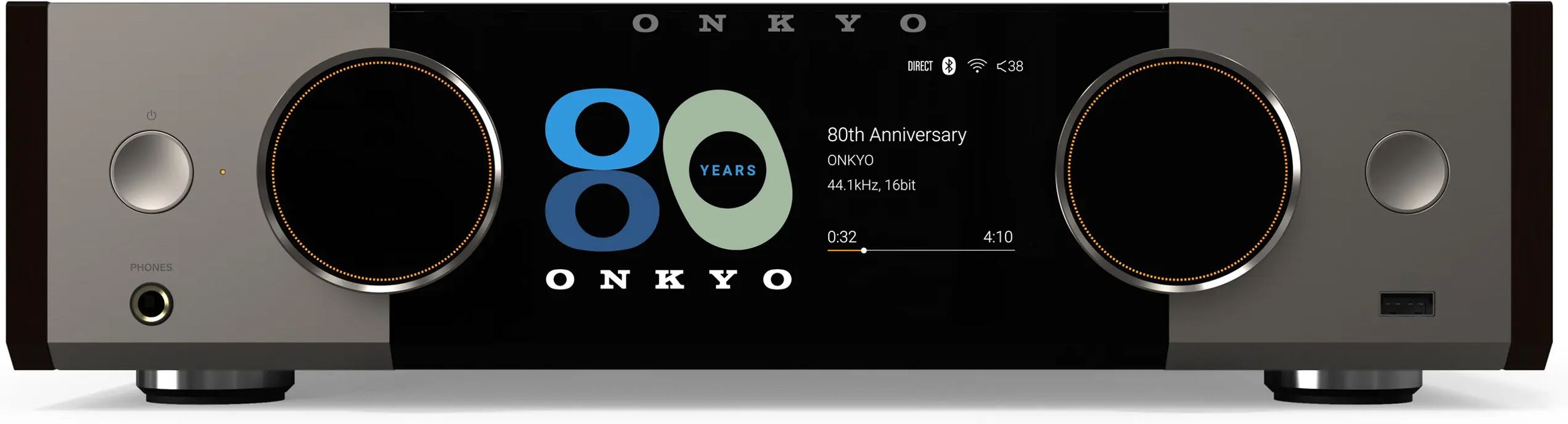
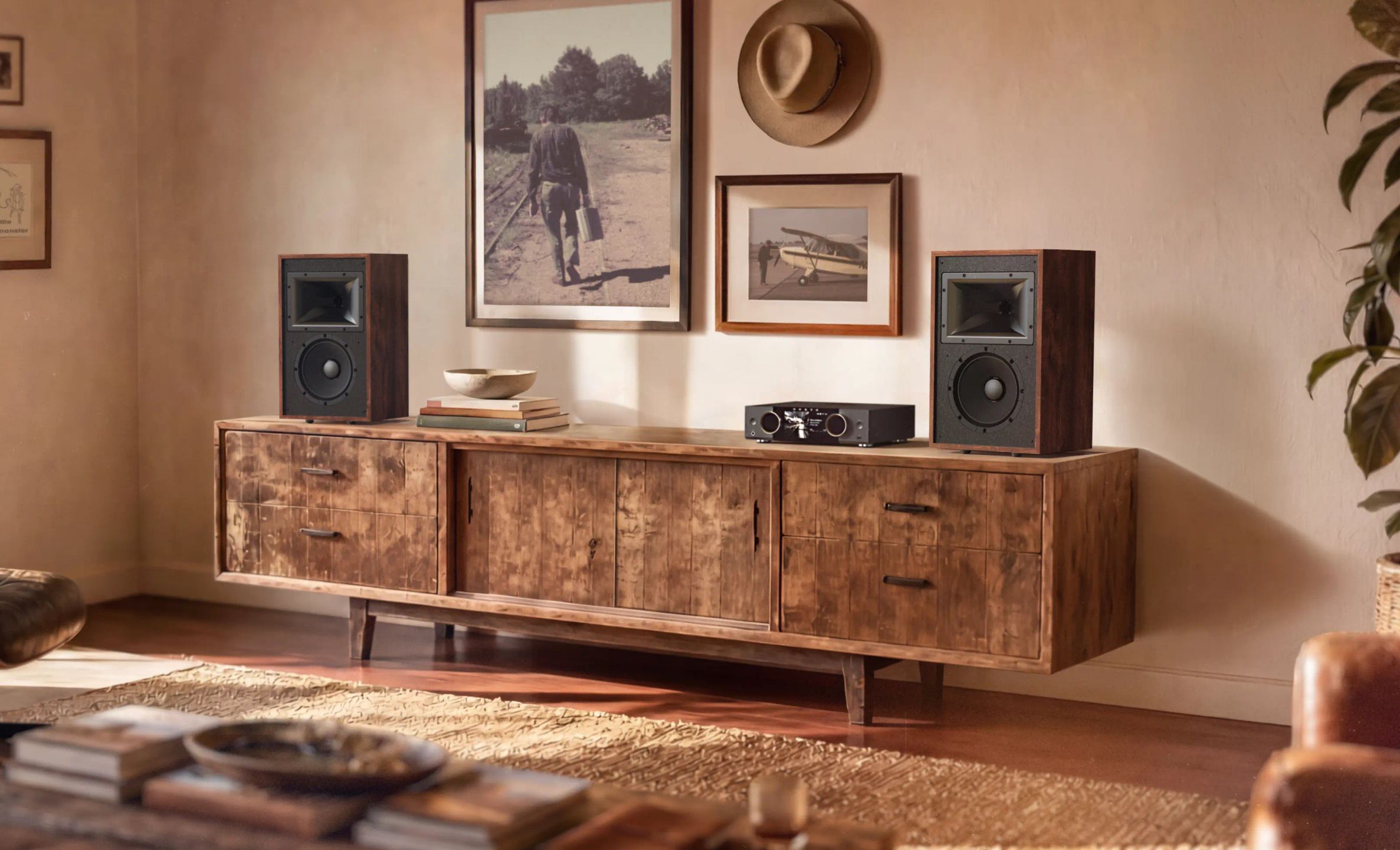
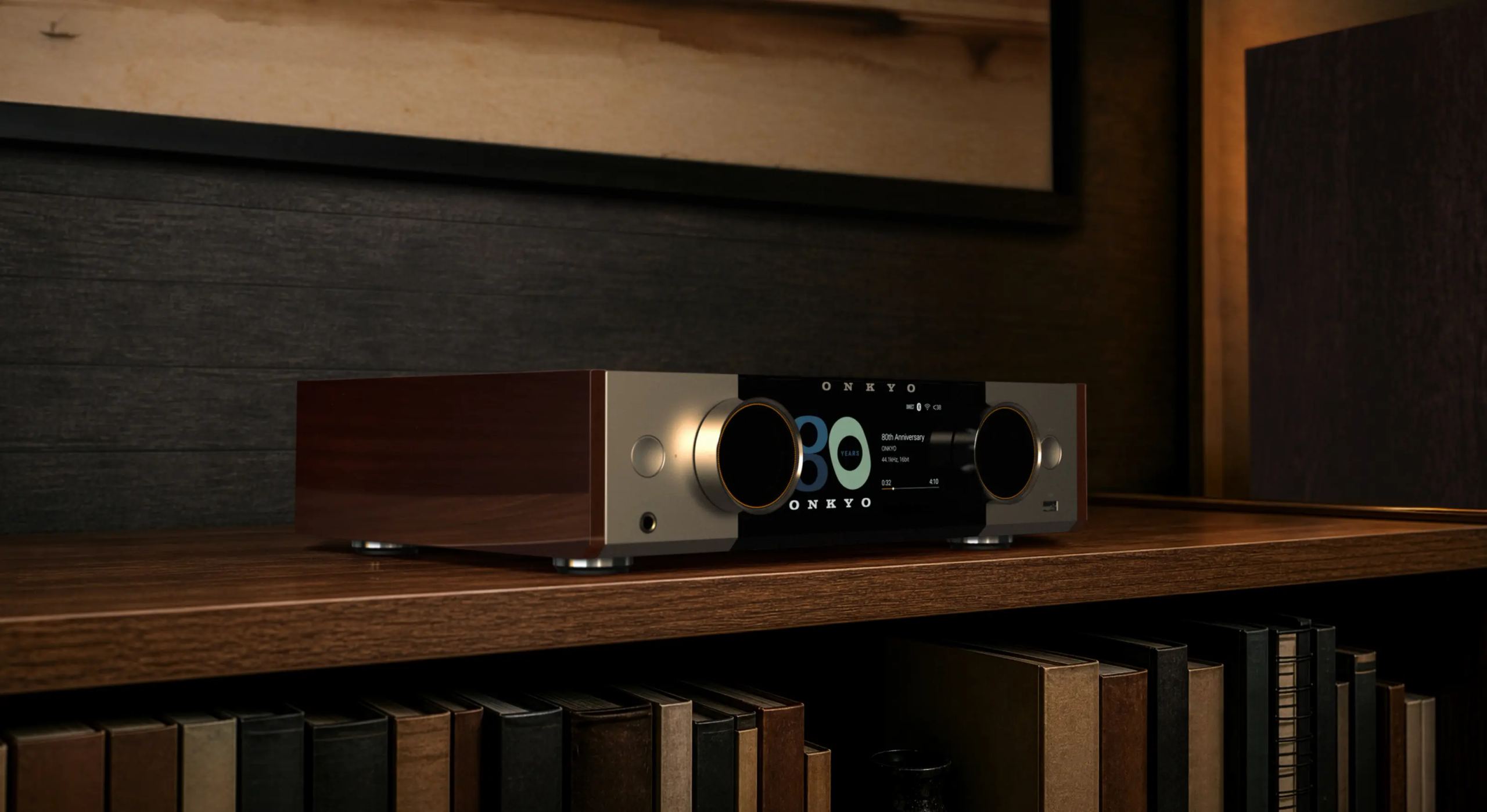
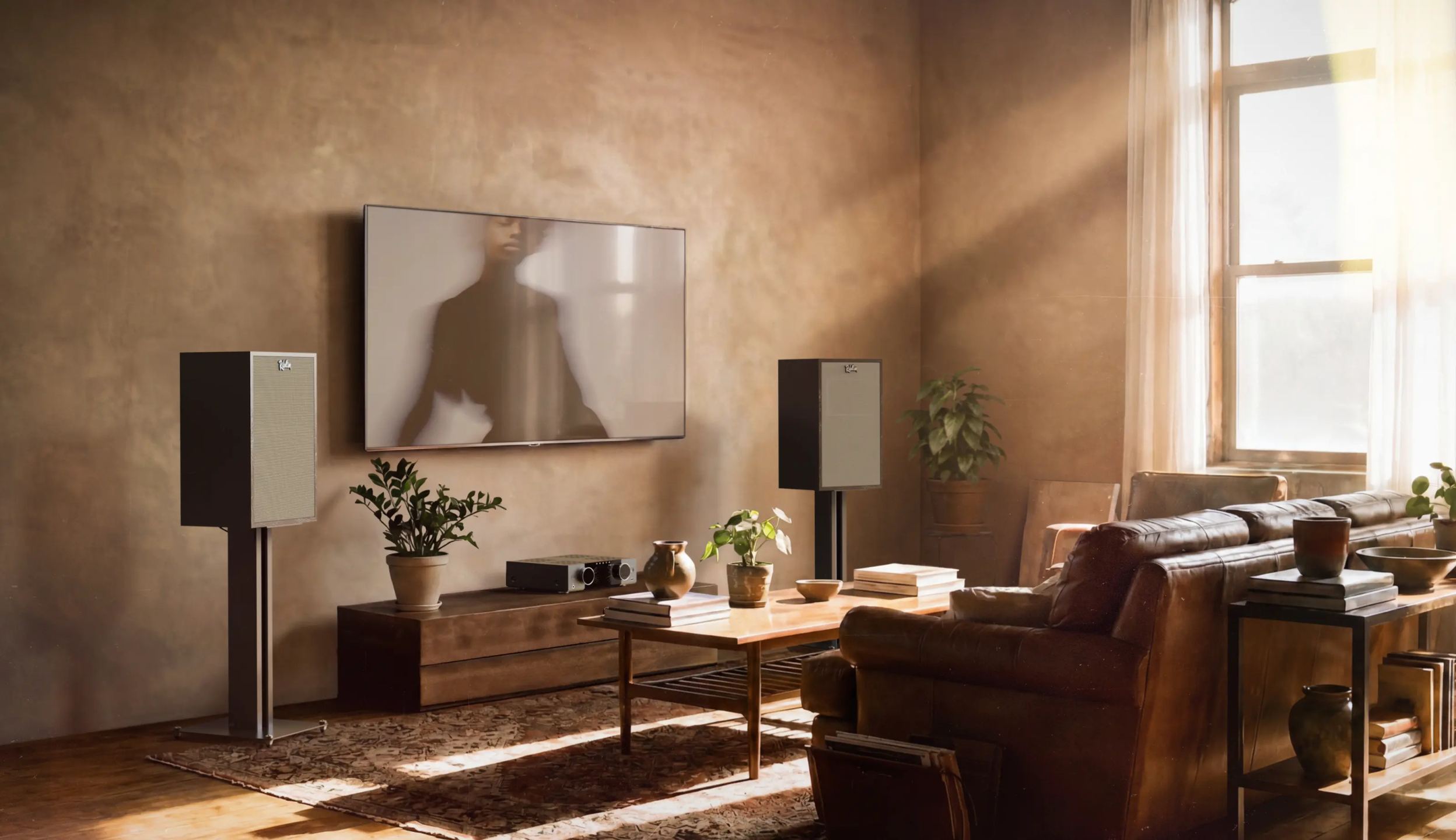
Founded in Osaka in 1946, Onkyo celebrates its eightieth anniversary by bringing design cues from its 1990s Integra amplifiers to a modern stereo amplifier. It streams music online, connects to a TV and accommodates a turntable. Its walnut side panels and gold front panel recall the Japanese hi-fi equipment of that era. Add a pair of speakers and you have a complete system, controlled from your phone, the remote control or the two front-panel knobs.
A front panel inspired by the Integra models of the 1990s
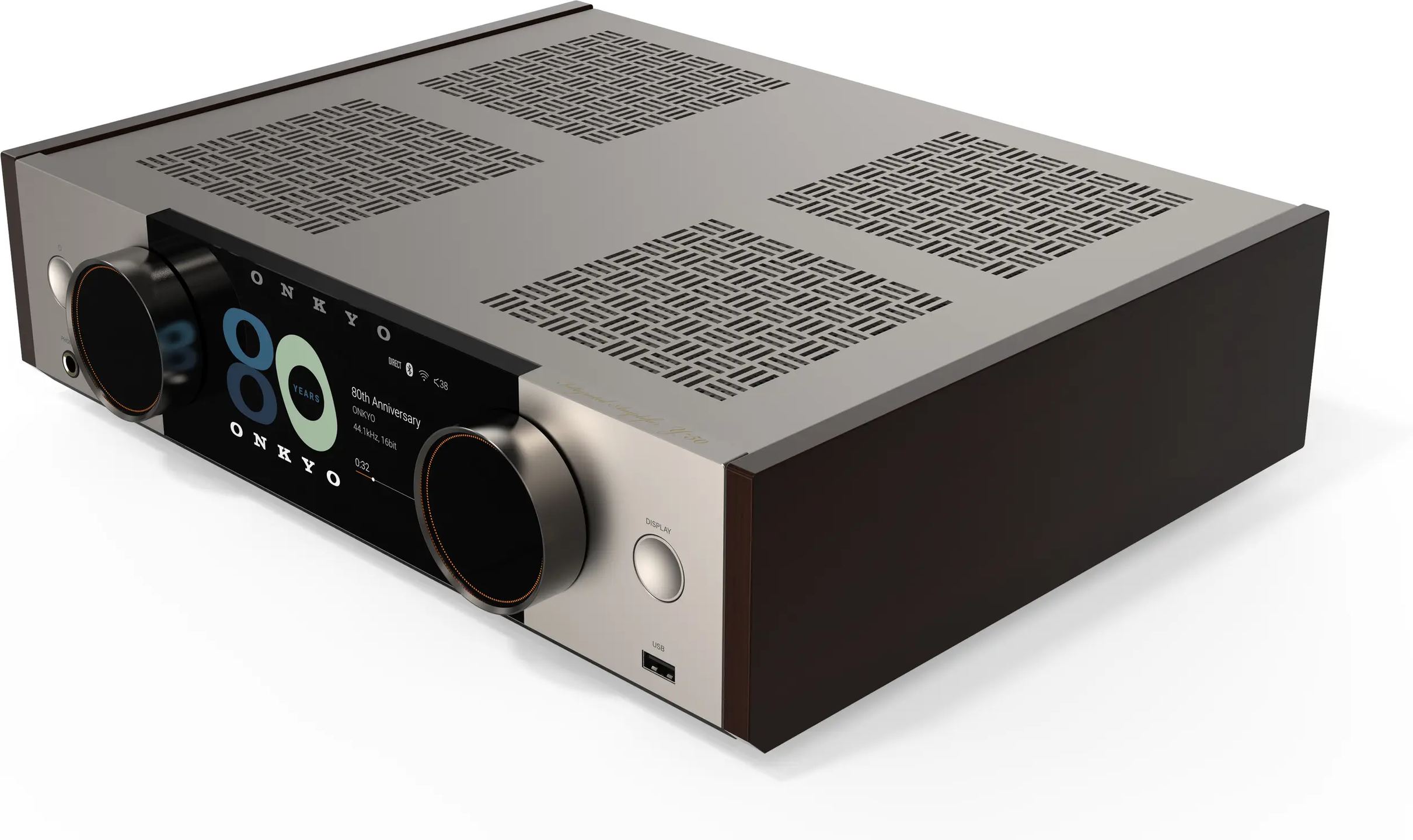
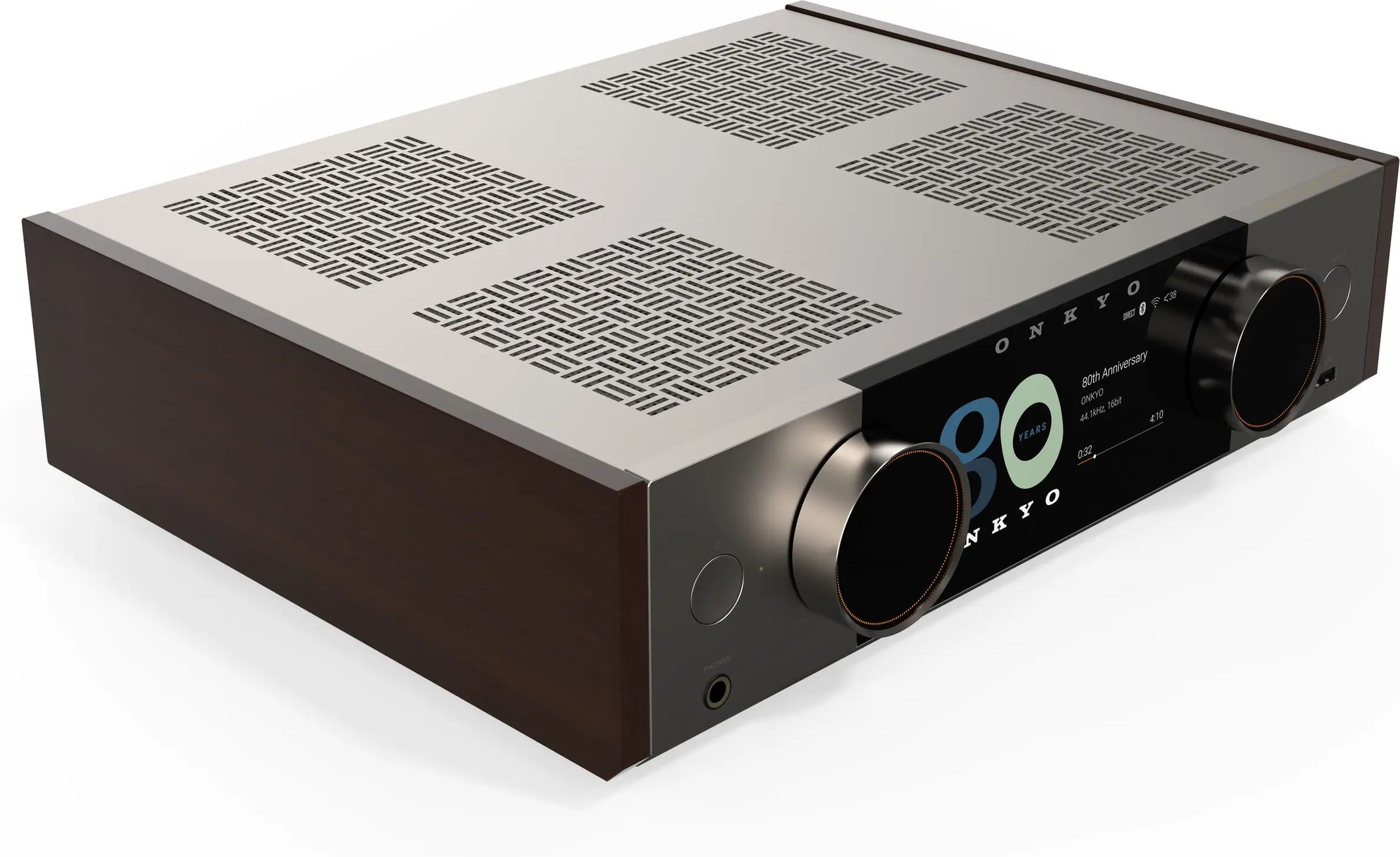
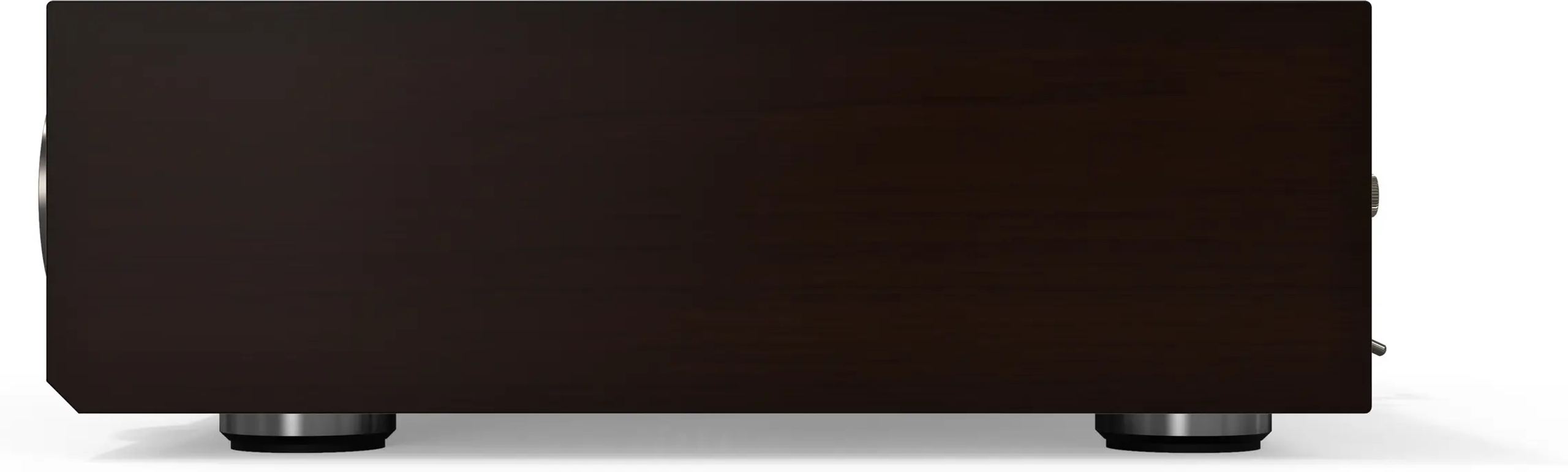
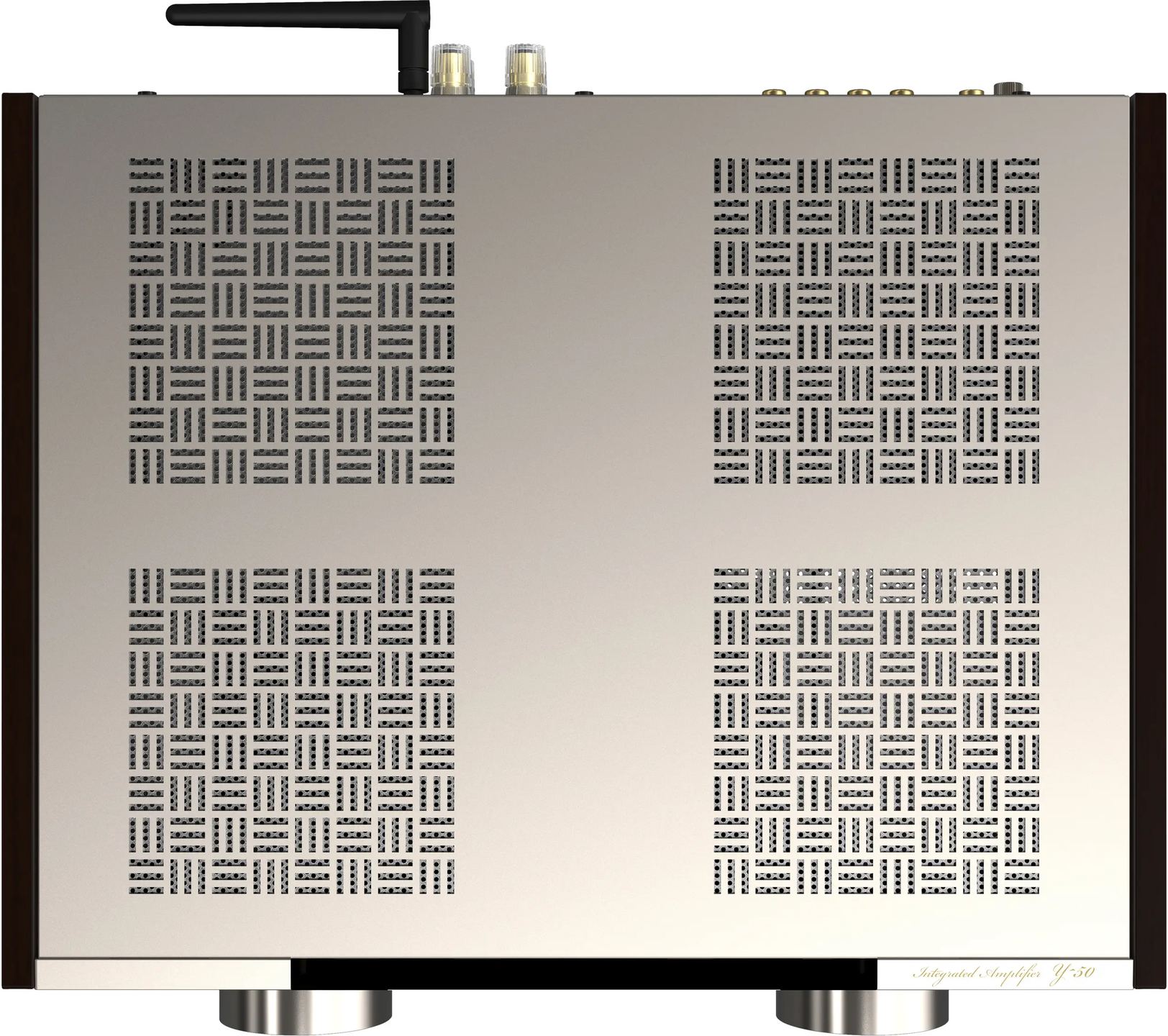
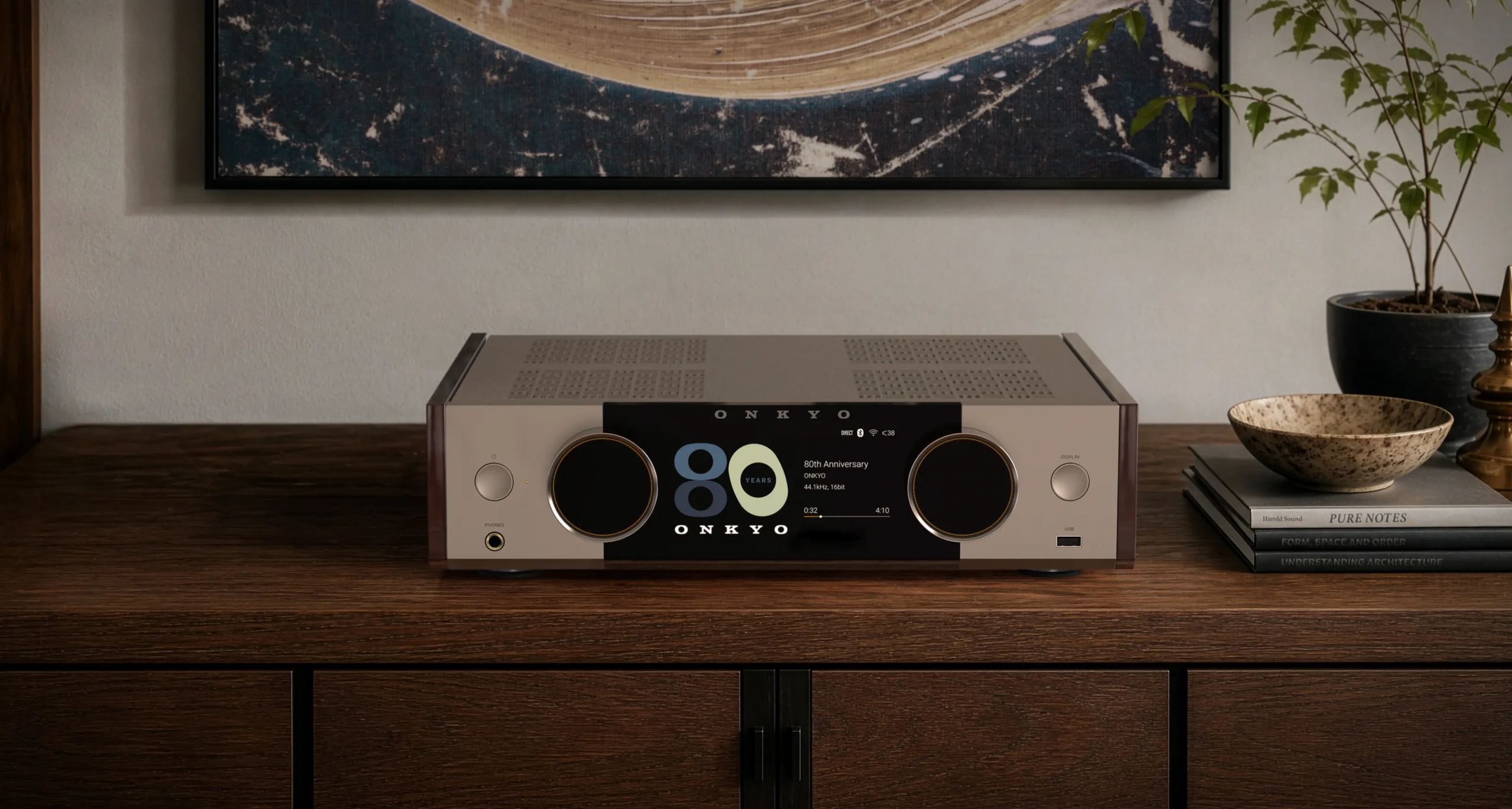
In the early 1990s, the Integra M-588 power amplifier featured solid walnut side panels and large illuminated VU meters. The Muse Y50 80th adopts the same look with genuine walnut panels in a burgundy shade and a rigid aluminum front panel in a Champagne Gold finish, which resists vibrations transmitted by the speakers. The top cover is perforated in the San Kuzushi pattern, a traditional Japanese geometric design used here for ventilation. The walnut panels are held in place by magnets: install the amplifier, connect the cables, then attach them to either side. With its panels fitted, the amplifier measures 37.6 cm wide, 10 cm high and 33.7 cm deep and weighs 4.9 kg, allowing it to fit on a TV stand or a standard hi-fi shelf. An amber light ring surrounds the source selection and volume knobs, echoing the lighting of older Integra models, and the dimmer turns it off for listening in the dark.
125 watts per channel in Class D, without a fan
Amplification is based on a fully digital Axign Class D circuit, with MOSFET output transistors. Class D switches the signal at a very high frequency rather than reproducing it continuously. It is highly efficient and generates little heat, so the amplifier needs no fan: no fan noise intrudes on the music during quiet passages, and the circuit monitors its own temperature. Background noise remains very low, with a signal-to-noise ratio of 106 dB from a digital source and 100 dB at the line input.
The 125 W per channel into 8 Ω is measured across the entire audible range (20 Hz to 20 kHz), with both channels driven and 0.08% distortion. This is the figure to use when comparing two amplifiers. The 250 W into 4 Ω is measured at a single frequency (1 kHz), with 0.7% distortion allowed. Above all, it indicates that a 4 Ω speaker, which demands more current, will not put the amplifier under strain. It supports speakers from 4 to 16 Ω, both bookshelf and floorstanding models.
Streaming, TV and console on a single amplifier
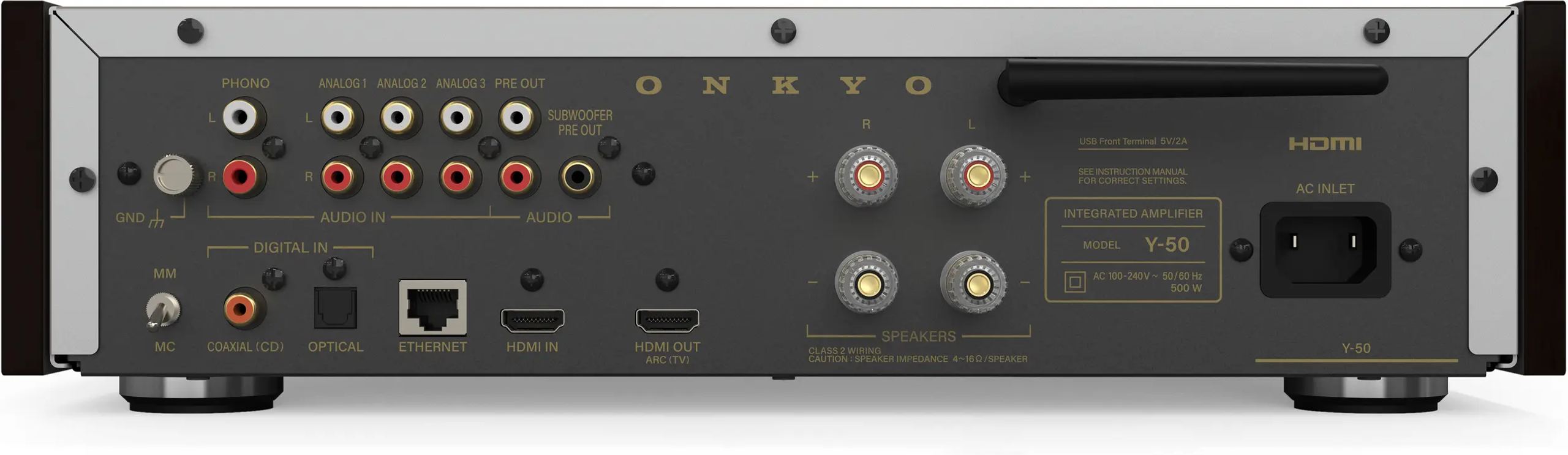
Spotify Connect, TIDAL Connect and Qobuz Connect all work in the same way. Select the amplifier in the service’s app, and the amplifier retrieves the music directly from the Internet without going through your phone, which remains free to use. AirPlay 2 and Google Cast take over for other iPhone and Android apps. The amplifier also plays music stored on a local network server, such as a NAS (a hard drive connected to your router). The front USB-A port plays files from a flash drive or hard drive at up to 192 kHz / 24-bit. Dual-band Wi-Fi works with the supplied antenna, and an Ethernet port provides a wired connection. Bluetooth 5.1 comes in handy when a guest wants to play a track, but it is limited to the SBC and AAC codecs (wireless audio compression formats) and falls short of the built-in services.
For TV use, the HDMI ARC output receives TV sound over a single cable, and HDMI CEC control lets you adjust the amplifier’s volume with the TV remote. The HDMI input accepts a console or player and passes the picture to the screen at up to 4K at 120 frames per second or 8K at 60 frames per second, with HDR10+ and Dolby Vision. It supports recent gaming features: VRR matches the screen’s refresh rate to the console’s output, and ALLM switches the TV to low-latency mode. As there is only one HDMI input, other video sources connect to the TV and their sound returns via ARC. Three analog RCA inputs and two digital inputs, coaxial and optical (up to 96 kHz / 24-bit), accommodate a CD player, a tuner or a TV without HDMI ARC. Processing remains in 2.1 stereo: a subwoofer output adds bass to films, and a preamp output lets you connect a separate power amplifier later.
A phono input for MM and MC cartridges
The turntable connects directly to the amplifier, which includes a phono preamp. It accepts the two main cartridge types (the component that reads the groove), with a selector on the back to switch between them. The moving magnet (MM) cartridge, the most common type, delivers a fairly strong signal, expected here to be around 4 mV. The moving coil (MC) cartridge, common on higher-end turntables, delivers a signal ten times weaker, which the input accepts at 0.4 mV into 110 Ω. Since it requires more amplification, background noise is more noticeable: the signal-to-noise ratio is 60 dB in MC mode compared with 76 dB in MM mode. With a very low-output MC cartridge, a step-up transformer placed before the input helps keep the background quiet. A ground terminal accepts the turntable’s ground wire to prevent hum.
Room calibration and sound settings
Onkyo Room EQ, the calibration system developed for the Muse series, measures the room’s acoustics and adjusts playback accordingly. This is useful when the speakers are close to a wall or in a corner, where bass tends to become boomy. Bass, treble (±10 dB) and balance can be adjusted manually. Vocal Enhancer boosts or reduces voices by 6 dB, in 0.5 dB steps, making dialogue clearer when watching a film or the TV news. Direct mode, conversely, turns off all this processing so the signal follows the shortest path. With a subwoofer, the crossover frequency can be adjusted from 20 to 200 Hz in 5 Hz steps. Double Bass mode sends bass to both the speakers and the subwoofer for greater weight.
The color screen and its needle VU meters
The 13.9 cm (5.46-inch) LCD screen offers four display options. The standard screen shows the source and volume, another shows the album artwork with track information, and two styles of needle VU meters echo the dials of the Integra M-588. Its brightness can be set to three levels. Each of the four MY INPUT buttons stores a source along with its settings: one for the turntable, one for Qobuz and one for the TV, for example, with a single press recalling everything. The amplifier is controlled using the Onkyo Controller app or the RC-994S remote control. It automatically enters standby after 20 minutes without a signal.
Specifications
Overview
- Type: network stereo integrated amplifier (built-in streamer)
- Series: Muse, limited edition celebrating Onkyo’s 80th anniversary (brand founded in 1946)
- Manufacturer reference: Y-50(G)
- Inspiration: Integra M-588 amplifier from the early 1990s
- Amplification: 2 channels, 2.1 preamplification
Design and finish
- Rigid aluminum front panel, Champagne Gold finish
- Real walnut side panels, Bordeaux finish (Bordeaux Walnut)
- The side panels attach magnetically, to be fitted once the unit is installed
- Vented top cover, Japanese San Kuzushi pattern
- Selector and volume knobs surrounded by an amber light ring, which can be switched off using the dimmer
- 5.46-inch (13.9 cm) color LCD screen
- No fan, so no airflow noise; temperature is controlled by the circuit
Amplification
- Axign Class D amplifier, MOSFET transistor output, fully digital circuit
- Power: 2 × 125 W into 8 Ω (20 Hz-20 kHz, 0.08% THD, 2 channels driven)
- Power: 2 × 250 W into 4 Ω (1 kHz, 0.7% THD, 2 channels driven)
- THD+N distortion: 0.08% (20 Hz-20 kHz, at half power)
- Frequency response: 20 Hz-30 kHz (+1 dB / −3 dB, Direct mode)
- Supported speaker impedance: 4 to 16 Ω
- Signal-to-noise ratio:
- 100 dB at line input (2 V)
- 106 dB with digital source
- 76 dB with MM phono
- 60 dB with MC phono
Phono section
- Phono input supporting MM (moving magnet) and MC (moving coil) cartridges, with an MM/MC selector on the rear
- Sensitivity and impedance: 4 mV / 47 kΩ for MM, 0.4 mV / 110 Ω for MC
- Maximum input voltage: 50 mV for MM, 4 mV for MC
- Ground terminal (GND) for the turntable
Inputs
- 3 analog RCA inputs (line)
- 1 MM/MC phono input
- 1 coaxial digital input
- 1 optical digital input
- Coaxial and optical inputs support PCM up to 96 kHz / 24-bit
- 1 HDMI input
- 1 front-panel USB-A port, for playing music from a flash drive or disk
- 1 Ethernet RJ45 port
Outputs
- 1 HDMI ARC output (to the TV)
- 1 left/right RCA preamp output (1 V / 470 Ω), for connecting a power amplifier
- 1 subwoofer output (subwoofer pre out)
- 1 front-panel 6.35 mm headphone jack output
- Premium speaker binding posts
HDMI
- HDMI input: 4K/120p and 8K/60p passthrough
- HDR10+ and Dolby Vision compatible
- Gaming and video features: VRR, QFT, ALLM, QMS, SBTM, DSC
- HDCP 2.3 protection
- HDMI ARC output: TV sound is received through a single cable
- HDMI CEC control
Headphones
- Power: 80 mW + 80 mW (32 Ω, 1 kHz)
- Supported headphone impedance: 13 to 600 Ω
- Frequency response: 20 Hz-40 kHz
Streaming and network
- Spotify Connect, TIDAL Connect, Qobuz Connect
- Apple AirPlay 2
- Google Cast (Chromecast built-in)
- Playback from a music server on the local network
- Wi-Fi 802.11 a/b/g/n/ac, 2.4 GHz and 5 GHz bands
- Ethernet 10BASE-T / 100BASE-TX
- Control app: Onkyo Controller
Bluetooth
- Version 5.1, reception
- Codecs: SBC, AAC
- Range of approximately 15 m without obstructions
Supported formats (USB and network server)
- FLAC, WAV, AIFF, Apple Lossless: up to 192 kHz / 24-bit
- AAC: up to 96 kHz
- MP3, WMA: up to 48 kHz / 320 kbit/s
- LPCM: 44.1 / 48 kHz at 16-bit (network server)
- Supported USB flash drive or disk formats: NTFS, FAT16, FAT32, exFAT
Sound settings
- Onkyo Room EQ: calibration that measures the room and adapts the sound to its acoustics
- Bass and treble: ±10 dB (at 100 Hz and 10 kHz)
- Left/right balance
- Vocal Enhancer: boosts or reduces vocals (−6 to +6 dB, in 0.5 dB steps)
- Direct mode: bypasses all processing for the shortest signal path
- Subwoofer management:
- crossover frequency adjustable from 20 to 200 Hz, in 5 Hz steps
- adjustable level for each channel
- Double Bass mode: bass is sent to both the speakers and the subwoofer
Display and ease of use
- 4 display options:
- standard screen (source and volume)
- album artwork and track information
- two styles of needle VU meters
- Screen brightness adjustable across 3 levels
- MY INPUT: 4 buttons each store a source and its settings
- Automatic standby after 20 minutes without a signal
- RC-994S remote control
Power supply and consumption
- Power supply: 100-240 V, 50/60 Hz
- Power consumption: 115 W (European version)
- Network standby (wired or Wi-Fi): 1.8 W
- Standby with HDMI CEC active: 0.7 W
Dimensions and weight
- Dimensions with walnut panels (W × H × D): 376 × 100 × 337 mm
- Weight: 4.9 kg
- Box: 465 × 225 × 405 mm, 7.6 kg
Box contents
- Muse Y-50 80th Anniversary amplifier
- 2 Bordeaux walnut side panels, with magnetic attachment
- RC-994S remote control and 2 AAA batteries
- Wireless antenna (essential for Wi-Fi and Bluetooth)
- Power cord
- Installation guide and safety instructions
Frequently asked questions
What is the difference between the Muse Y50 80th and the Muse Y40?
The Muse series, unveiled by Onkyo at CES 2026, includes two network amplifiers. The Y40 is the more modest model, rated at 150 W per channel into 4 Ω compared with 250 W for the Y50. The Muse Y50 80th is the anniversary version of the Y50, produced as a limited edition, with Bordeaux walnut panels, a Champagne Gold front panel and a top cover featuring a San Kuzushi pattern.
Is Wi-Fi enough, or do I need a network cable?
Wi-Fi 5 (802.11ac), on the 2.4 GHz and 5 GHz bands, is sufficient for high-resolution streams, provided you install the supplied antenna, which also serves Bluetooth. The Ethernet connection (100 Mbit/s) remains the most stable when the router is far away or many devices share the Wi-Fi.
Which headphones can be connected to the front-panel output?
The 6.35 mm jack accepts headphones from 13 to 600 Ω and delivers 80 mW per channel into 32 Ω, from 20 Hz to 40 kHz. For earphones with a 3.5 mm jack, a simple adapter is all you need. High-impedance headphones (300 or 600 Ω) require more voltage, so the maximum volume will be lower than with a 32 Ω model.
What file formats can the amplifier play from a USB drive or a network server?
It plays FLAC, WAV, AIFF and Apple Lossless up to 192 kHz / 24 bits, AAC up to 96 kHz, as well as MP3 and WMA up to 320 kbit/s. USB flash drives and disks must be formatted in NTFS, FAT16, FAT32 or exFAT.
What’s in the box?
The box contains the amplifier, the two magnetically attached Bordeaux walnut side panels, the RC-994S remote control with two AAA batteries, the wireless antenna, the power cord, the installation guide and the safety instructions.
- Eco-contribution included in the sale price.
- Manufacturer reference: Y50GUM
- GTIN / EAN: 4573211156348


